law firm clients

Why the ‘So What?’ test is so important to the success of your business development efforts

When I was younger, my mother would often say to me: “Because it’s important to you Richard, doesn’t make it important to me“.

My mother had worked with lawyers earlier in her career, and I thought this piece of advice just profound (as you typically do with tidbits your mum says when growing up!). Until one day I was working with a partner who said exactly the same thing to me when I mentioned I had been waiting to see him all day!

So what’s the point I’m trying to make here?

Well, as with most things in life, when we think about what our clients need/want we think of this from the prospective of what we can provide them, rather what their true needs/wants are. To try and minimise this, I often ask my clients: “So What?“.

Asking “So What?” can sound abrasive. But, what it does is help to clarify the message, the reason, the rational we are sending to our clients about why they need our services/products and why they need them now.

And so I thought I would run through a high-level overview of the “So What?” test.

What is the “So What?” Test?

Being required to answer the “So What?” question is a means of evaluating the relevance and impact of your proposal/messaging to clients or prospective clients.

Answering this simple question demands clarity, purpose, and a focus on client outcomes – and helps move the narrative away from the product/service you are trying to sell.

If you are unable to answer this simple question convincingly, then your proposal almost certainly lacks relevance to the client and will not resonate with them.

Benefits of getting the right answer(s) to the “So What?” Test

Aligns your offer with the what the customer values

  • Asking the “So What?” question forces you to examine whether your solutions genuinely solve the customer’s problem(s). This alignment ensures you focus on outcomes that genuinely matter to your client.

Sharpens your messaging

  • In proposals and presentations, cluttered messaging dilutes impact. The “So What?” question helps eliminate unnecessary fluff and refines your message to its core purpose. Clear, concise messaging drives client engagement.

Helps build credibility

  • Proactively applying the “So What?” question puts you in the shoes of your client. You are able to anticipate their questions and build a solid case for your services/products. Demonstrating this level of critical thinking goes along way to establishing trust and credibility – it’s not about you, it’s about them!

Ultimately it saves you time!

  • Actively applying the “So What?” question acts as a filter to identify opportunities that are worth pursuing. If you can’t articulate why an initiative matters, it might not be worth the investment of time and resources pursuing that opportunity!

Bringing it all together…

The “So What?” test isn’t just a question – it’s a discipline. Asking the question allows you the opportunity to refine your message – to sharpen your focus, align your efforts, and ensure you’re solving the right problem, for the right person, with the right tools.

Incorporating the “So What?” test into your business development efforts will result in your business development activities becoming more impactful; your messaging more persuasive; and your win/loss ratio becoming more transformative!

As always, get in touch if you need help with your business development strategy and activities.

Richard & GSJ

📩 richard@gsjconsulting.com.au

High-Value Retainers

I put a post up last week on LinkedIn, off the back of a very interesting blog by Jordan Furlong on his Substack feed: ‘The legal world in 10 years (if we’re really lucky)‘, that got some social media traction so I thought I would re-share here.

At the heart of my LinkedIn post was a comment Jordan makes on – what he calls – High-Value Retainers and the effect Gen AI will have on these fee arrangements. To quote:

High-Value Retainers
Thanks to Gen AI’s consumption of many traditional tasks, lawyers have moved up the value ladder, going beyond “bet-the-company” and “run-the-company” work to start offering “grow-the-company” work (or “advance-the-individual”). These are engagements in which lawyers ask: “How can I improve your situation? What are your near-term and long-term goals? How can I help you anticipate problems and prevent them before they happen? How can I bring you more stability and peace of mind? How can I be your advocate and counsellor in whatever you need?”

While I think Jordan’s point is an excellent one, mine was this: “Do you think this could work in 10 years time?

Because if you think it could: Why are you waiting 10 years for AI to develop in order to have this conversation – have this conversation with your clients now!

In that, it’s not a 10+ years from now discussion. It’s not a 10+ years from now problem. It’s a HERE AND NOW problem and a here and now discussion.

rws_01

Kick off 2022 by providing real value to your customers using the 3Es!

Happy New Year to you all, and welcome to the new calendar year that is 2022.

During the holiday period here in Australia (published 13 December 2021) I was fortunate enough to read a really insightful article in MIT Sloan Management Review by Andreas B. Eisingerich, Deborah J. MacInnis, and Martin Fleischmann titled ‘Moving Beyond Trust: Making Customers Trust, Love, and Respect a Brand

which set-out how service providers, like law firms, could provide real value to their customers using the 3Es:

  • enable
  • entice,
  • enrich

Where:

  • Enable = help your customers solve problems in ways that are economically feasible, reliable, efficient and convenient
  • Entice = making your customers feel good
  • Enrich = build self-affirming identities.

And the benefits of using this method?

Evidencing the research outcomes of this methodology, the article sets out 6 benefits you should see:

  1. Higher Revenue
  2. Lower Costs
  3. Higher Barriers to Entry
  4. More Paths to Grow[th]
  5. Stronger Talent Pool (within your firm as lawyers want to do this type of work for this type of client), and
  6. Greater Retention Rates in your firm.

All of which – should – result in higher profit.

Well worth a look, take a read – and certainly food for thought!

As always, the above represent my own thoughts and would love to hear yours in the comments below.

rws_01

(ps – I would recommend you add a 4th ‘E’ to this list – Empathy’ 🙃)

Photo credit to Jon Tyson

Will law firms introduce ‘Anchor Days’ in 2022?

You’d have to have been hiding under a rock for past two years not to have seen an article or two on the benefits/pitfalls of remote working. But, as we move into the next phase of this pandemic/endemic, one in which we must start to learn to live with COVID, law firm management now need to be asking:

What does the future of the office look like for our firm?

Truth is, there’s no simple answer to this question. On the one hand, we have those who advocate that “distance breeds distrust” and “out of sight, out of mind”. On the other hand, we have a lot of people saying we’re not going back to the old ways – and if you make us, we will part of the Great Resignation.

One answer to this issue might be in what the Australian Financial Review recently termed ‘Anchor Days’.

As per the AFR article, ‘Anchor Days’ are days on which a group of employees (in the same team) agree to go into the office on the same day each week with the aim of enhancing collaboration and ensuring a more lively office culture.

While I like the concept of Anchor Days, I think I should also point out that, from my reading, it comes with a couple of major misconceptions:

  • we all work in the same physical location (geographically in the same State/Cities, but also on the same floor of a building!).
  • that collaboration is more likely to happen in physical presence, when what we actually find is that collaboration more likely occurs with inclusion, and inclusion is more aligned with trust. QED, if you want more collaboration within your team, then trusting that your team can get it’s shit done here remotely/agile and not dictating collaboration top down, is a big step in the right direction.

My final comment: if Anchor Days become a thing, what day(s) would you chose?

rws_01

‘How much are you charging your client for that value add?’

It’s a question I often ask law firm partners:

How much are you charging for that value add?

And nearly always the response I get is the same:- *shocked face look*.

Why, well because in my experience lawyers are willing to give something of real value away for free to a client in the hope that same client will then given them their legal work.

But it rarely works like that.

And, more importantly, it shouldn’t work like that in today’s world (if it ever really did).

Don’t get me wrong, there will always be a cost of doing business component to our profession. CPDs/CLEs for in-house counsel would, in my opinion, sit in this category (but not all L&D activity) [tip: if you do this, open a ‘value account’ for your client and put a nominal value, say A$200 per 1 hour session per attendee, again this to try and show the client (in $$$ terms) the value you are providing here].

Rarely though do lawyers give thought to the ramifications of when they offer their clients something of real value, that really differentiates their firm, and then they give the IP away for free in the hope of getting the “more profitable” legal work.

Case in point is the following comment attributed to DHL Supply Chain Americas GC Mark Smolik in an article in yesterday’s The American Lawyer by Gina Passarella Cipriani [‘GCs Are Offering Work on a Silver Platter—and Law Firms Aren’t Taking It’]

“On the matter side, DHL Supply Chain Americas GC Mark Smolik gave an example of what he wishes law firms would do—and it’s something none of his firms ever has. He suggested a firm might want to look at, say, all of the employment cases emanating out of his California warehouses. Maybe they find that 50 percent of the cases are coming from one warehouse, and one person is the culprit. The GC can then take that information to its business units and work out a solution. It makes the GC look good and it makes the law firm look good to provide that kind of actionable intelligence. Other GCs echoed similar requests during Legalweek’s Business of Law Forum.”

Getting down to the bare bones of my point though:- Mark doesn’t suggest this be done for free. And, in my opinion, done right, there is every chance Mark will pay for this value add.

But that’s just my take – as always, would be interested in your thoughts, views, feedback.

rws_01


Survey: The 5 Biggest Challenges Facing Australian Law Firms in 2019

Screen Shot 2019-01-01 at 9.29.51 pm

Happy New Year and Welcome to 2019!

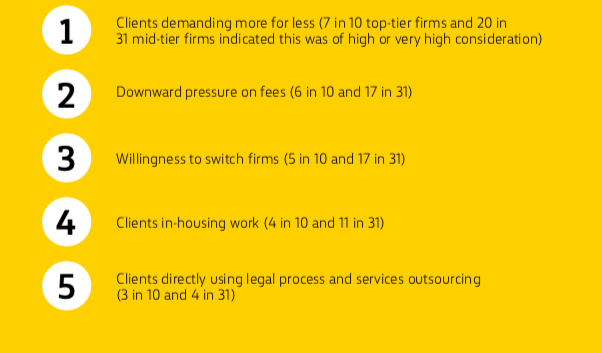
The recent (December 2018) Commonwealth Bank ‘Professional Services’ report highlights five challenges law firms in Australia are likely to experience further pressure on in 2019, which are:

  1. ‘Clients demanding more for less’
  2. ‘Downward pressure on fees’
  3. ‘Willingness to switch firms’
  4. ‘Clients in-housing work’
  5. ‘Clients directly using legal process and services outsourcing ‘

Each of these has it merits, while none is particularly new. So let’s take a quick look at each and assess them on their merit.

The call for ‘more for less’

It’s true, the call for ‘more for less’ continues. But I believe we may be misinterpreting the call a little here between what in-house really want (see Ann Klee, VP of Global Operations — Environment, Health & Safety, at General Electric Company – ‘less for less’) and what law firms believe they should be providing – a Rolls Royce service for a Toyota price tag.

My take: Neither client nor law firm are currently getting what they want and the net result is that nobody is happy with the relationship. Law firms need to get a better understanding of what is being asked of them. Scoping work properly – by experts – and then the subsequent professional project management of that is where the greatest return can come from here.

‘Downward pressure on fees’

Admission time!!:-

“I have never really understood the ‘downward pressure on fees’ argument”

Why?

Because, in order to be putting downward pressure on fees, surely you need to know upfront what that fee is – right?

However, if what you are saying is that this is actually a downward pressure on hourly rates argument, then I get where you are coming from.

But this is not the same thing as a downward pressure on fees argument, because there is little doubt in my mind that clients are willing to pay a premium on fees when the value of those fees have been fully explained and justified.

My take: despite the rhetoric, law firms still have a long way to go in understanding what in-house General Counsel are actually saying when they say “no surprises” on fee issues. And here’s a working reason why:- because while the GC can talk to legal issues the company faces, it’s the CFO who is responsible for explaining costs; and in more Australian companies than not, the GC reports to the CFO. A lesson in that for most private practice firms here.

A ‘Willingness to switch firms’

I often laugh when I see this one, because, really, ask yourself this: if most of your partners and lawyers are willing to switch to another firm, why shouldn’t your clients?

My take: if you want client stickiness, why not start with re-engaging with your own staff and get loyalty in your firm brand (something that hasn’t really happened since 2008 in Oz). Because while attrition will never be zero, if you can get your own staff on board as brand advocates you may find it a lot easier to convince your clients to hang-around.

‘Client in-housing work’

Without a doubt the biggest change in my working life has been the increase in in-house practitioners. A career in-house is now a very viable option for someone leaving university, something that was never even thought of in my day!

My take: the biggest competitors most law firms are not other law firms. It’s not even the #Big4. Don’t get me wrong, these are competitors, but nothing compared to the CFO of your major client working out its cheaper to hire a new lawyer in-house than pay your fees (see here for more on my views on your in-house competitors).

‘Clients directly using legal process and services outsourcing’

Not 100% sure what is meant by ‘outsourcing’ here. If this includes ‘on-shoring’, then I agree it’s a real threat.

My take: law firms in Australia will face a number of challenges over the next 12 to 24 months. Outsourcing, on-shoring will be among them, but I’m not sure I give them the same weight as the Commonwealth Bank Report does.

Some of the other issues I believe law firms here need to be aware of include further consolidation of the market (it remains too big for such a small market), staff retention issues, profit squeezes, technology and process improvements (and how, through change management champions, these are being handled within law firms because currently we are failing badly).

And finally, some 750 words into this post, we can mention the “innovation” word 🙂 .

Anyhow, guess you get the gist of where I am going with these so best of luck for 2019!

As always, would be interested in your views.

rws_01

Why asking someone to work 2,000 billable hours a year will kill their spirit

Business Development image

According to a post by Casey Sullivan of Bloomberg, earlier this week US law firm Crowell & Moring announced that it would increase its billable hour requirement for associates, from 1,900 hours per year to 2,000 per year. This new target will take effect 1 September 2016, but on the plus side 50 pro bono hours will count as billable.

15 Years ago I would have cried out “all kudos to you”. Back then my yearly billable target for an English ‘Magic Circle’ firm was 1,400 hours and I flogged my guts out to achieve that. So if you can effectively put 50% of billables on top of what I was doing (and trust me when I say I wasn’t going home at least one day a week), then you’re a better person than I (or so I would have said then).

But if you really need validation of what asking someone to work 2,000 billable hours a year means, then I would like to recommend you read “The Truth about the Billable Hour” by no less an institution than Yale University. In that publication, Yale caution aspiring lawyers that if you are being asked to “bill” 2201 hour, you need to be “at work” (includes travel time and lunch, etc.) 3058.

Taking that further, from an Australian law perspective, if you are being asked to bill 2,000 hours a year then you need to bill 8.3 hours a day (assuming a 48 week year and you never get sick; which, if you are being asked to do this, you most likely will be). That means you are very likely going to need to be “in the office” around 12 hours a day – and that assumes no write-off by your partner or leakage.

But here’s the question: “What difference does this make?

I ask this because I wholly agree with the following comment my friend Kirsten Hodgson made when I posted a link to this article on LinkedIn:

“why would you reward the number of hours someone spends working? Surely it would be better to focus on how to deliver value smarter and more quickly. This doesn’t incentivize innovation or any type of process improvement.”

Exactly right, you’re measuring all the wrong things!

Leaving aside the Balance Scorecard argument, asking someone to do 2,000 billable hours a year doesn’t take into account:

  • client satisfaction
  • realisation (it’s a utilisation metric)
  • working smarter
  • innovation

or many other metrics.

And for those who may point out the benefits of this including 50 hours pro bono I say this: the Australian Pro Bono Centre National Pro Bono ‘Aspirational Target’ (ie, where we would like to get to), is 35 hours per lawyer per year.

But probably more importantly than all of this is this:

–  if you ask someone to do this, then you really leave them very little time to do anything else.

This really should be a concern, on the business front because you leave almost no time whatsoever to train them in the business of law – ie, you kill any entrepreneurial spirit they may have. And, crucially, the only metric that really counts to them is that all important 2,000 billable hours (keep in mind that like I was, they’re very young). Which for a profession that has the mental health issues we do, is not good.

For all of these reasons, I’m hoping no other law firm follows this. But sadly I think they will.

Oh, and if you are a law firm client reading this post you might just want to look up whether your local jurisdiction has a “Lemon Law” rule that applies to provision of a service.

RWS_01

AFAs accounted for less than 10% of all matters in the US last year

This month saw publication of the End-of-Year 2015 edition of the Enterprise Legal Management Trends Report by LexisNexis and CounselLink.

Based on data derived from outside counsel invoices – accounting for US$21 billion in legal spend in the USA – processed through the CounselLink platform, to my mind what makes this Report different to others is this: it provides insights others might miss because while talk can be cheap, the numbers rarely lie.

i2

[click on image to enlarge]

From an Australian perspective, a couple of surprising statistics come out of this year’s Report.

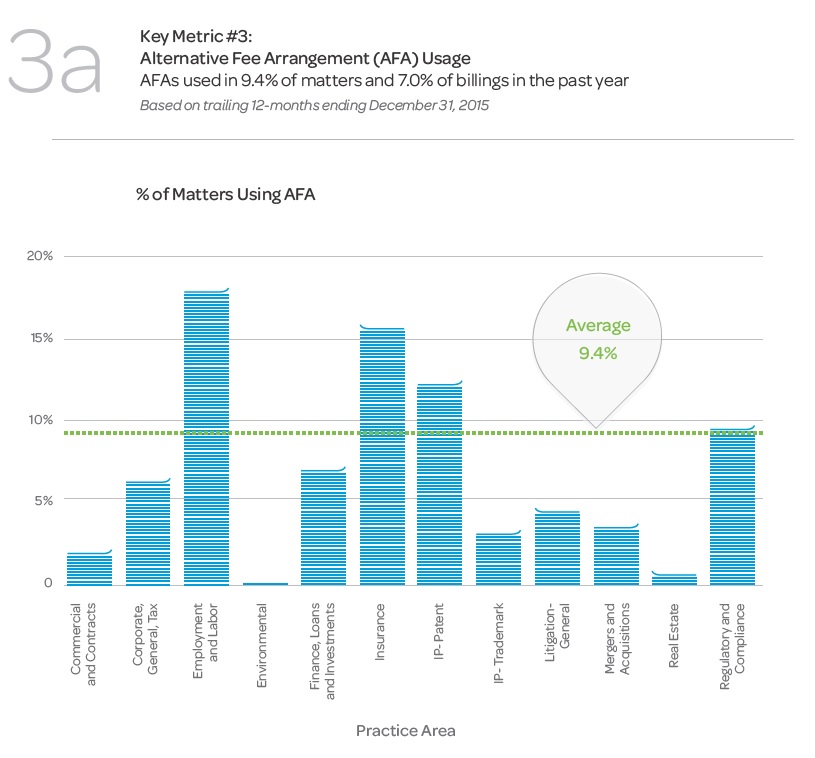
  • the use of AFAs, to govern the service payment of matters, only accounted for 9.4% of matters processed through the CounselLink platform. Given all the chatter and whining you hear from law firms, I would have expected this rate to be much, much higher.
  • Employment and Labor (at 17.3%) is a fairly significant practice area leader in the number of matters (but not revenue – see below) using AFAs, but Real Estate accounting for something less than 2% of its practice area matters using AFAs seems out of whack.
  • Nearly 10% of Regulatory and Compliance matters are done under AFA arrangements. At first this seemed a little strange (given the grey hair nature of the advice being sought), but then I thought a large number of compliance programs could be sold using retainers, fixed fees and other AFAs.

i3

[click on image to enlarge]

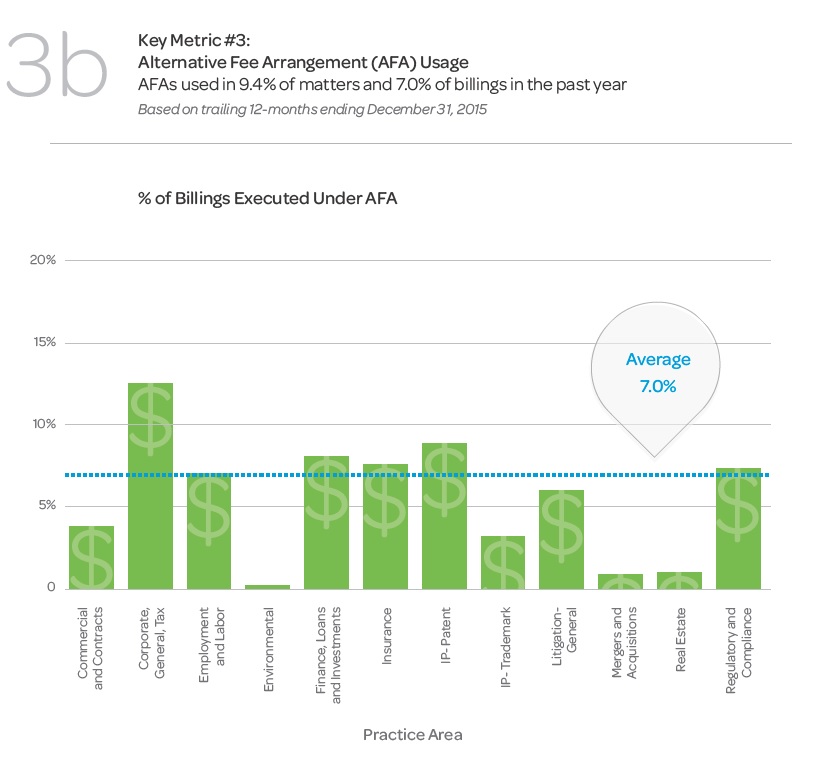
Moving on to percentage of “billings” executed under AFAs and things start to get really interesting.

  • at 12.4%, by far the biggest practice area using AFAs by billings is Corporate, General and Tax (excluding Mergers and Acquisitions, which is a separate line entry). Not sure I would have guessed that.
  • Finance, Loans and Investments ranked third highest practice area using AFAs by billings last year. Again, don’t think I would have picked that.
  • by billings, only 7% of Employment and Labor practice area matters are executed under AFAs. So, 17.3% of Employment and Labor matters were conducted under AFAs, but only 7% of billings. Might just be me, but that seems strange and I’d want to dig deeper into why that might be the case if my practice was showing these numbers. Then again, may just be the Pareto Theory in practice!
  • At roughly 2% of practice area billings, who says Real Estate has become a commoditized practice area? Because these numbers aren’t showing it.

Interesting numbers showing through this Report. Lots of chatter around the rise in M&A activity/revenue and the fact that “New Law” isn’t being hired to do big ticket work, but the use of AFAs and rationalization of legal panels (which I may well blog on later this week) were my two big takeouts.

RWS_01

Altman Weil Flash Survey: Has the era of data driven pricing arrived?

Last week saw the publication of Altman Weil’s 2016 Law Firms in Transition Survey. Now in its eighth year, this survey continues to be a good indicator of the market forces law firms are facing and in recent years it has been a good indicator of the fee pressure clients are putting on firms.

So, how have firms been tracking when it comes to pricing pressure issues?

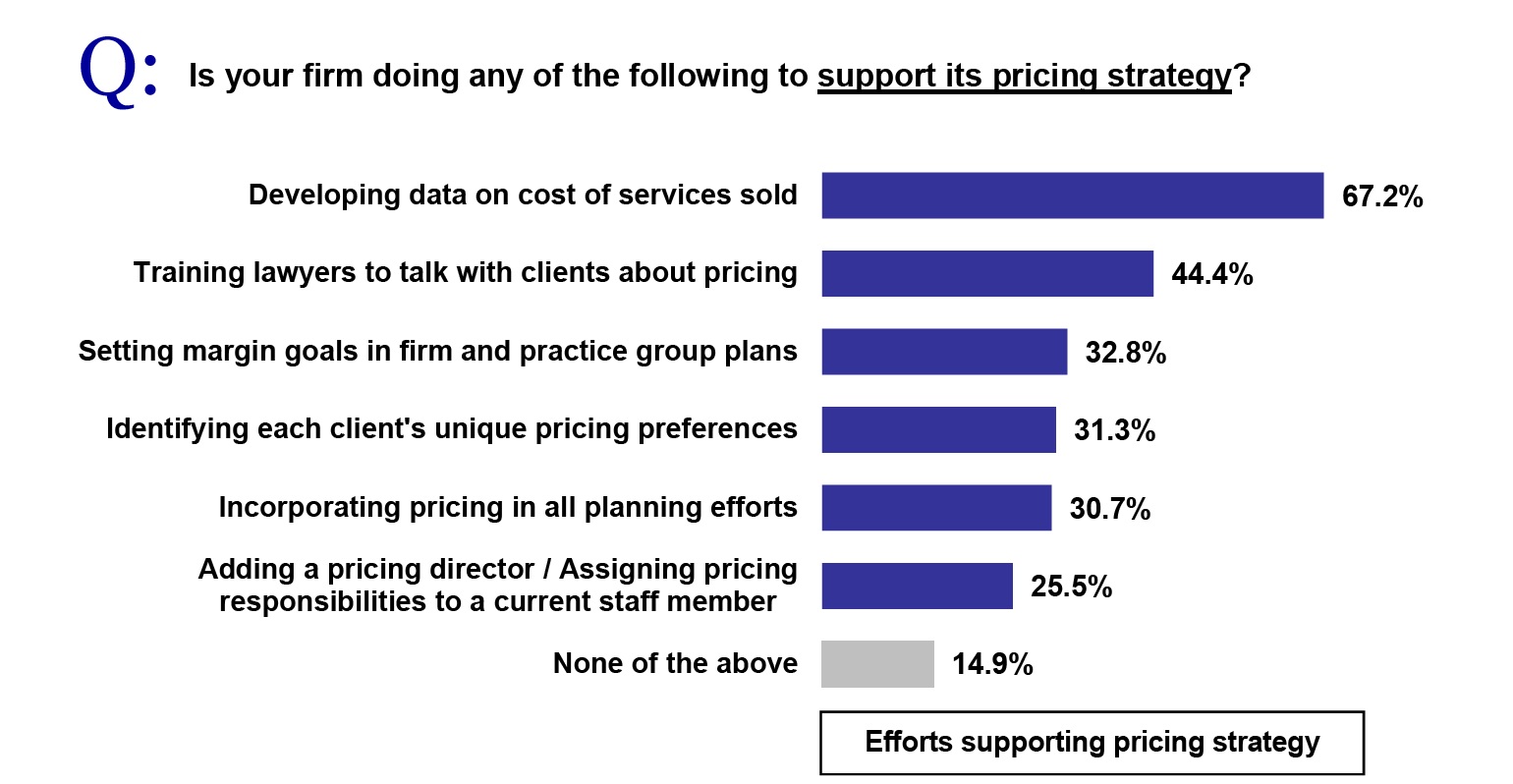
At first blush – well. When asked: “Is your firm doing any of the following to support its pricing strategy?“, “Developing data on cost of service sold” and “Training lawyers to talk with clients about pricing” rank head and shoulders (in first and second spot) above everything else.

AM 1

[click on image to enlarge]

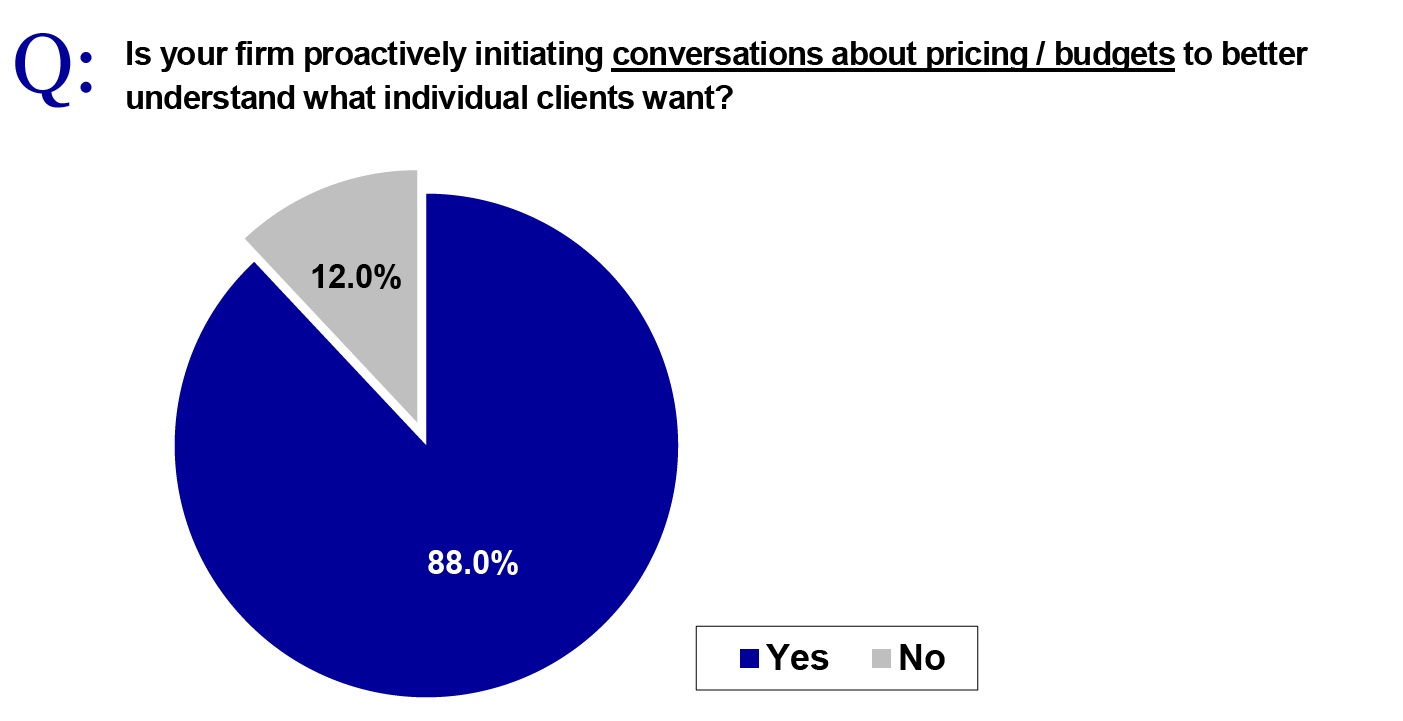
Clearly moving in the right direction then, reinforced by the overwhelmingly positive response to: “Is your firm proactively initiating conversations about pricing / budgets to better understand what individual clients want?

AM 2


[click on image to enlarge]

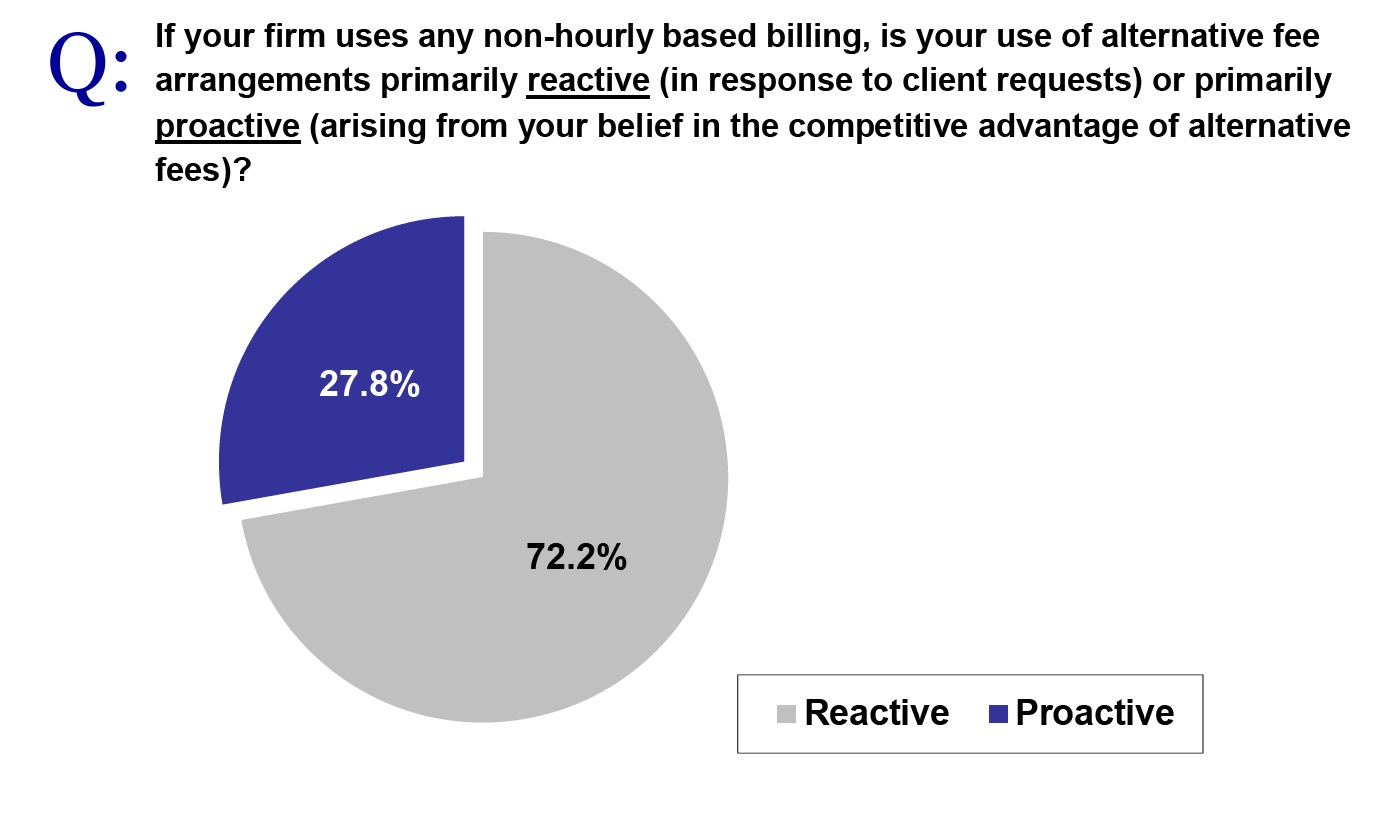
until we get to this shocker…

AM 3


[click on image to enlarge]

So, almost half (44%) of law firms are now training lawyers to have the pricing conversation with their clients, a whopping 88% of firms are proactively initiating that conversation – and yet three-quarters (72.2%) of firms only make use of non-hourly based billing methods in response to a client request.

Am I the only one who finds that incredible?

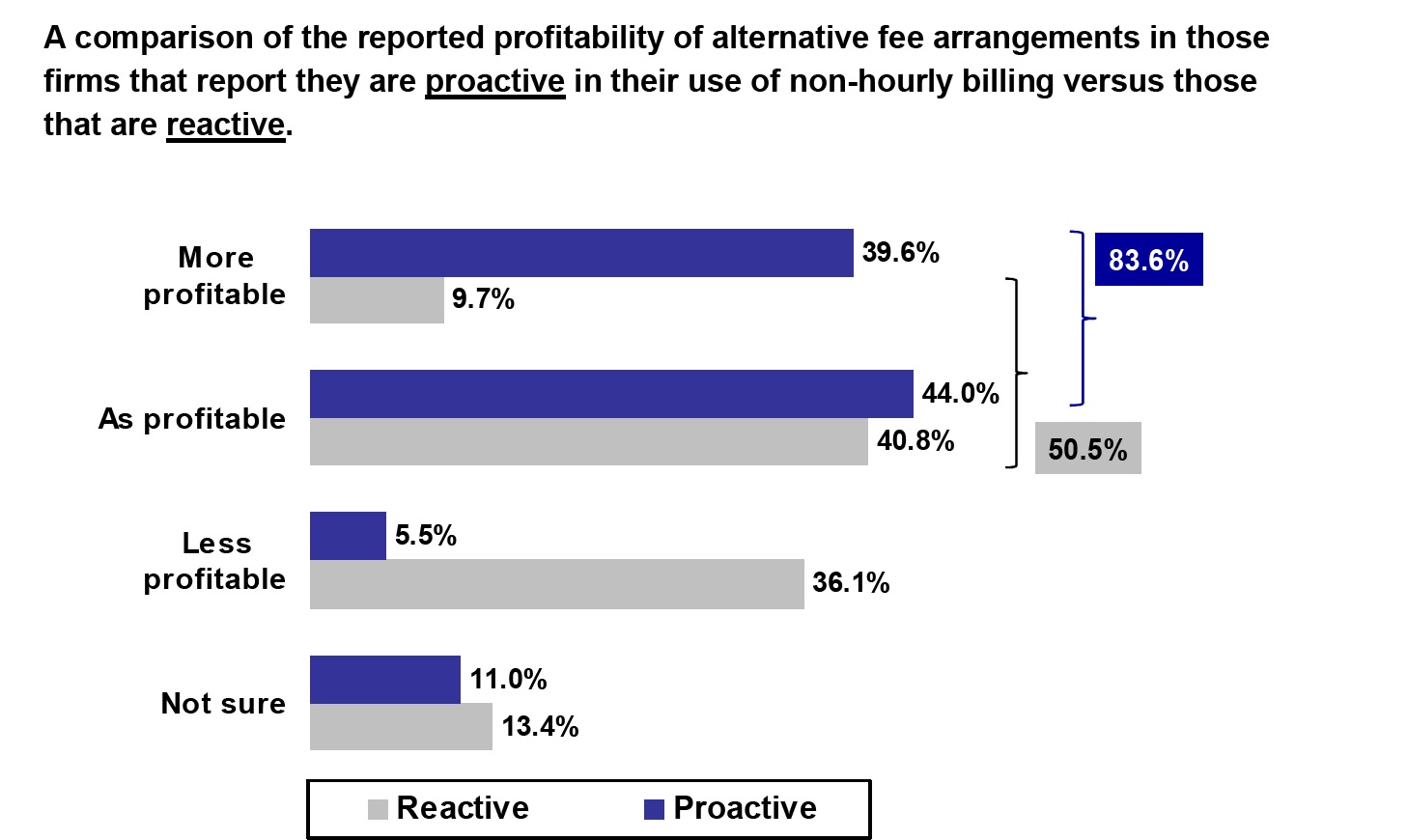
But really, why does it even matter?

Well, here’s your answer:

AM 4


[click on image to enlarge]

There’s a clear lesson here for anyone that’s willing to listen to it: if you want your firm to be more profitable, be on the front foot when it comes to opportunities to provide alternative fee arrangements.

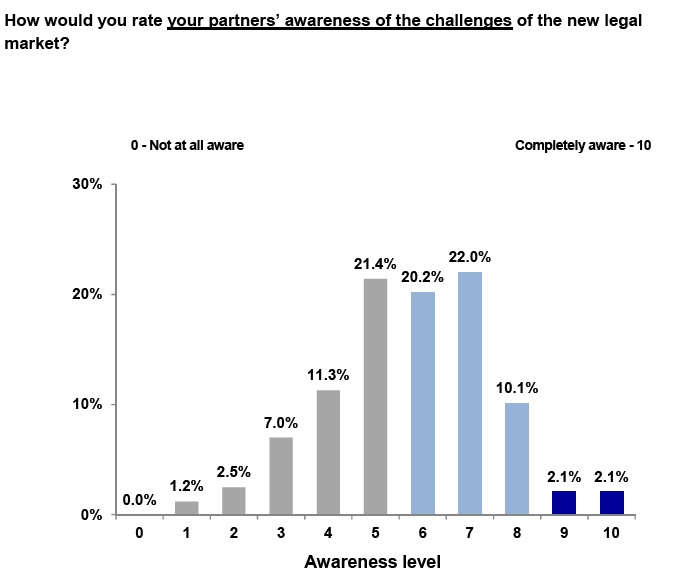
If you haven’t already, I’d like to recommend you download and read the full survey, if for no other reason than it contains this gem…:


AM 5

[click on image to enlarge]

Which, if you believe, suggests that around half of all law firm partners are not even aware of the challenges their firms face!

RWS_01

The law firm disconnect in two images

This week saw the publication of LexisNexis’s Bellwether Report 2016. titled:- ‘The Riddle of Perception‘.

Based on structured interviews with 122 independent lawyers and 108 clients (all UK-based I believe), this year’s Report provides valuable insight into the thinking of lawyers and law firms and, incredibly, how far removed that thinking still appears to be from the views of their clients.

None so is this more starkly brought home to me than in two separate images in the Report in response to questions put forward around the issue of fixed fees.

The first (which is actually the second in the Report) can be found on page 22:-

Image 1

[click on image to enlarge]

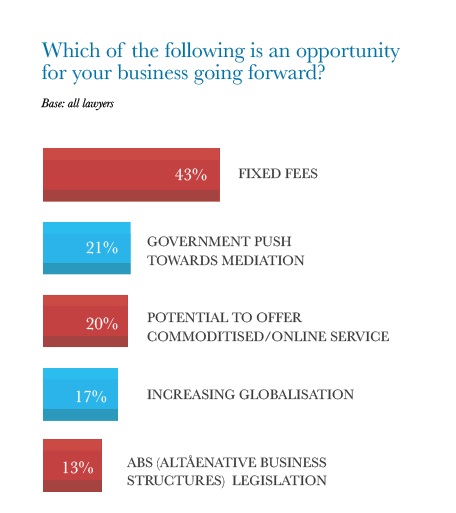
where, in response to “Which of the following is an opportunity for your business going forward?” – 43% answered: fixed fees.

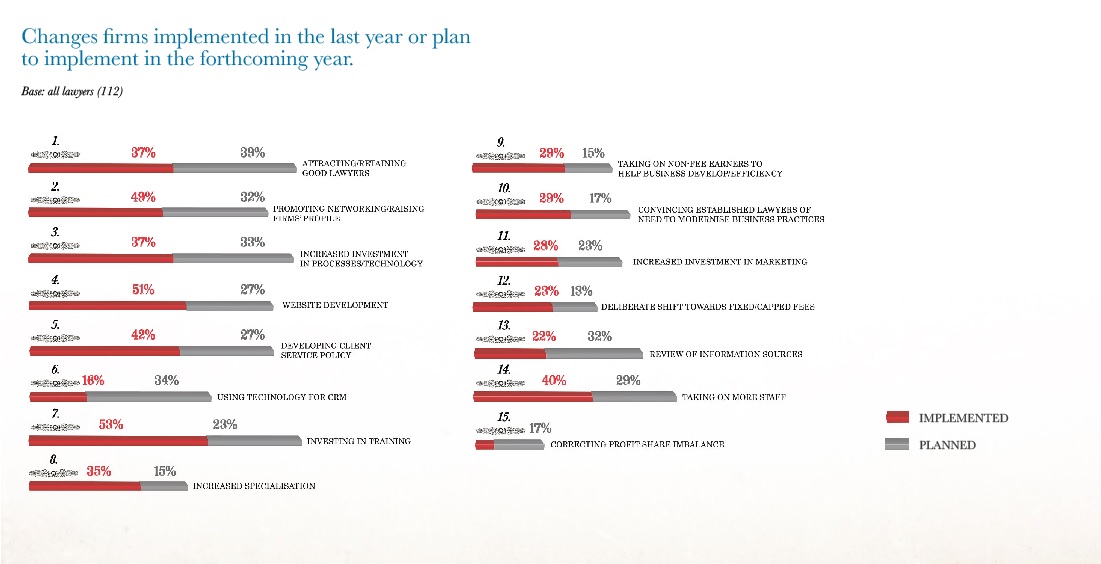
The second is found earlier in the Report on page 18, where when asked what “Changes forms implemented in the last year or plan to implement in the forthcoming year?” – a “deliberate shift towards fixed/capped fees” raked 12th. with only 13% saying there was anything planned around this for the forthcoming year.

Image 2

[click on image to enlarge]

Now call me crazy, but that seems to be as close as you can get to madness.

Read the Report though, it really is very good.

RWS_01