
General business development issues

Currency woes strike again!

dreamstime_m_34802664

It’s that time of the year again when law firms in the UK (at least those with LLP status) publish their annual accounts and, once again, it would appear that currency exchange fluctuations have played a significant part in the profit and loss (P&L) sheets of most with international operations (‘Currency woes hit growth‘ – subscription required).

As I pointed out back in March 2013, and then again in August 2014, the Australian operations of international law firms were not going to be sitting pretty when it came to reporting full year earnings in GBP or US$. At the time the experts were predicting mid 80 cents on the US$, and things can only be said to have taken a turn for the worse since then.

Failing a dramatic turnaround in commodity prices, it doesn’t take a genius to work out this will remain the same unless – or until – the Australian arm of international firms can muscle in on the [hopefully much more attractive US$] rates their offshore partners set up for them on advisory or transactional matters (see my post ‘Can a falling A$ make selling Australian legal services easier overseas?‘).

Alternatively, if you are an international firm with operations in Australia you could do what I have seen a number of firms doing during this reporting season and talk up you Australian earnings in “local currency contributions“. Because all things being equal, these firms have worked hard over the past 12 – 18 months to get their strategy on track and have most likely seen real growth in local currency contribution terms.
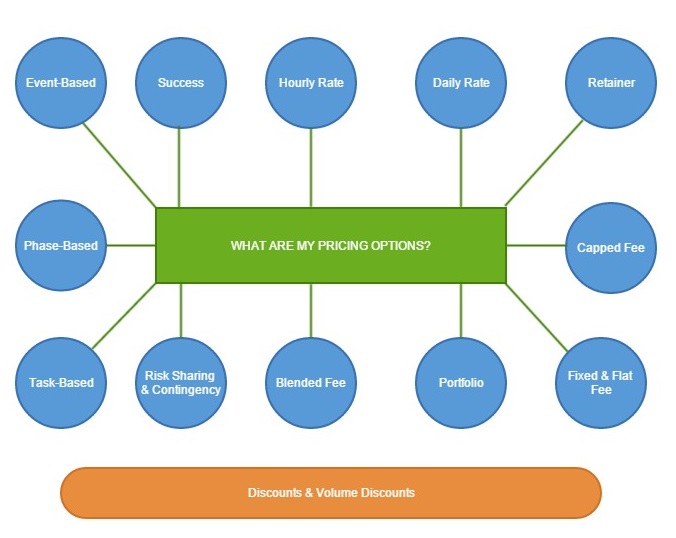
What are my pricing options?

what are my pricing options

You hear a lot these days about ‘pricing‘. This might be as it relates to Alternative Fee Arrangements (AFAs) or Value-based pricing (VBP).

Indeed, all the noise around this issue can get daunting at times.

So for today’s post I thought I would share a graphic that I have created from the many RFTs (tenders), RFQs (quotes), RFPs (proposals) that I have been involved in over the years and which I have named: “What are my pricing options?“.

Also, I’ll let you in on a little secret:- there’s isn’t such as thing as an “Alternative Fee Arrangement” – only pricing options or fee arrangement. Likewise, if properly explained and clearly transparent, all pricing options are value-based.

There’s one caveat I have though: any pricing option that includes a ‘discount’ or ‘volume discount’ component isn’t a pricing option – as you’re not getting your asking price!

I hope your find the graphic useful and if this is a subject you are interested in learning more about I would suggest you start with the Association of Corporate Counsel’s (ACC) Value-based fee primer.

To succeed in the future, law firms need to specialise

dreamstime_m_34802664

Over the course of the past week I have seen two news items that include comments by prominent industry experts advocating that for law firms to success in the future they will need to specialize.

The first item was a short [1 minute 40] video interview of David Lat (editor of Above the Law) titled More ‘Shakeout’ Coming for Big Law, Says Above the Law Editor in which (the recently married – congratulations David) Lat touches on the issue that for firms to survive going forward, they will need to get much better at the specialization game.

The second item, from the same day (11 September), was an article (‘How future-ready is your law firm?‘) on the Australasian Lawyer website that included comments by Keynote speech presenter Jordan Furlong of Edge International and Tim Williams of Ignition Consulting Group at last week’s ALPMA (Australasian Legal Practice Management Association) Annual Conference on the Gold Coast (at which I was not a participant).

In essence the article promulgates the experts opinion that the “future of law firms will be specialisation, rather than expansion” and that “In reality, clients have changed from wanting to be loyal to a full service firm to shopping around for the best firm suited to a particular project.

Both the article and Lat’s interview video raise an interesting issue and I have to say that while I largely agree with William’s view that:

“Buyers [today] are seeking best in class solutions to their problems. They no longer need to fall back on a generalist firm that they can count on for everything in their hometown.”

it has yet to be fully explained to me why some, but certainly not all, full service firms cannot also claim that they provide “best in class solutions to their clients’ problems”.

The 4 Cs you need to attain “trusted advisor” status

4 Cs of Trust

Following the breakthrough work of David Maister in 2000, gaining The Trusted Advisor status has become the Holy Grail of all private practising lawyers. Not many, however, fully understand what this entails. While many may be able to name one or two elements what follows constitutes the 4 Cs you will need to demonstrate in order to attain “trusted advisor” status with clients and your work colleagues:

 C1 = Credibility: delivering what you promised, when you promised it
 C2 = Competence: having the right expertise and the right track record for the job – and being able to evidence this (as well as being able to say you DON’T have the right expertise to do the job!).
 C1 = Compatibility: being able to work collegiately (as part of a team)
 C2 = Consistency: delivering over a period of time

NB: this post was inspired by a recent post by Rachael Wheatley on PM Forum South West: “The Trusted Advisor is Dead. Long Live The Trusted Advisor

Successful lawyers don’t sell, they educate

Business Development image

Don’t sell, educate

One of the first pieces of advice I was given when I entered this profession was not to be selling, but to always be educating.

Over the lifetime of my career I’ve found this small bit of advice to be invaluable. Yes, both the audience [from clients to partners] and the content [the law to coaching] of the ‘educating’ has changed over time – which is only natural given the many varying roles I have had in this profession, but by and large the principle has remained.

Given the above, I find it strange that a growing number of consultants have jumped on the bandwagon that “lawyers don’t sell time, they sell value“, when the reality is they sell neither – what they do sell is expertise.

Which is to say: successful lawyers educate their clients on the potential outcomes of a particular activity or inactivity.

In other words, in “A+B = C”, your lawyer should be educating you on what ‘C’ is before you do ‘A+B’ or else advising you how you can get out of the problems that being in ‘C’ is causing you.

As always, ultimately it will be up to you, as the client, to determine whether or not you wish to proceed with your lawyer’s advice; but, in any event, that lawyer is neither selling you ‘time’ nor ‘value’.

Yes, the currency in which the lawyer is getting paid may be determined [at least in part] by time and/or perceived value, but this is not the same as saying the product being sold is time or value.

So, the next time a legal industry consultant tells you not to sell time but rather to be selling value, I would like to suggest that you respond:

“I don’t sell, I educate.”

‘Technology Can Help Lawyers Add Value’

Business Development image

If you haven’t seen it, SeyfarthLean Consulting LLC  – a wholly subidary of US law firm Seyfarth Shaw LLP – Seytlines Changing the Practice of Law blog for the 18th August by Kenneth Grady was on the issue of ‘Lawyers Need an App for That‘.

Overall a really good read, but in my opinion the gem takeout of this post comes under the final paragraph headed “Technology Can Help Lawyers Add Value” and reads:

“As technology noses into the delivery of legal services, lawyers must become more focused on where they add value. Understanding the core human thing, the social experience, is a defining difference. By using technology creatively, such as an app to speed communication on matters in ways that enable continuous improvement, lawyers can facilitate client problem solving and higher quality communication. This type of differentiation will separate lawyers from minute-counters.”

If you forget everything else this week, remember this.

“… we are being asked to do less with less”, Ann Klee of GE

Business Development image

Work in the legal profession for more than 5 minutes and you’ll hear someone say that clients today are asking the law firm to do “more for less“. It is probably one of the fastest terms to become a cliché in the English language.

So imagine my delight, when watching a video of a presentation given by Ann Klee, VP of Global Operations — Environment, Health & Safety, at General Electric Company at the recent Big Law Business Summit, in describing how (in part) GE managed to reduce its outside legal spend by $60 million in a year, she says that the bottom line is that the role of a lawyer today is about managing more risk, it’s not about just being asked to do more for less, it’s being asked to do less with less (see 16 minutes and 15 seconds into video).

This absolutely spot on.

Law firms today need to:

  • partner with the business to empower their clients,
  • always be looking to deliver on outcomes, not to be following procedure for procedure’s sake (or, worse, following procedure to blow out legal fees),
  • through the use of legal project management, agile or some other mechanism that works for you: identify and eliminate any workflows that are adding no value to the deal/advice.

In short: we need to be doing ‘less for less‘, but we need to be doing it in such a way that is “faster, better, and smarter” for our clients.

At the end of the day, clients like GE are already doing this – so law firms today can either get on board with solving their clients’ problems from their clients’ perspective, at a standard of accountability that their clients are being held to; or they face the very real prospect of becoming irrelevant.

Fannie Mae’s GC says “Call Me When I’m Not Sending You Work”

Business Development image

Part 1 of an outstanding interview with Fannie Mae’s General Counsel Brian Brooks was published to Bloomberg’s Big Law Business website on Friday.

Although full of insightful comments and suggestions for private practitioners, my favourite is this:

“[Then] there are lawyers who are really sources of market information and intelligence, who are always letting you know what’s going on in your industry, even when you yourself may not have a need for them that day. Those are the people who really become the trusted advisors.

I know that phrase “trusted advisor” gets overused. Maybe it becomes trite, but it really means something. What it means is that, even when I’m not in a position to send any work your way, you’re still going to pick up the phone and let me know what’s going on in my industry.”

Brian puts the dynamics of the client-lawyer relationship pretty simply really.

He also has something to say on ‘depth versus breadth’ that’s well worth a read, so wonder on over and take a read.  In the meantime, I’ll look forward to Part 2.

Loyalty programs revisited

Business Development image

Back in March of this year I blogged that loyalty programs were likely an under-utilised means by which Australian law firms could differentiate themselves in a highly competitive legal market. I was, then, particularly happy to see that recently Australian Government Business (www.business.gov.au) blogged  on a similar issue – ‘Customer loyalty or reward programs‘ – which looked at, among other things:

  • What customer loyalty programs are.
  • The benefits and risks of a customer loyalty program.
  • Tips when implementing a customer loyalty program.
  • Legal and compliance issues for customer loyalty programs.

A lot of which is directly relevant to law firms looking to implement a customer loyalty program.

Why you should think of implementing a customer loyalty program in your firm

As far as law firms are concerned, the perennial question has been:

How do we make sure that our customers [clients] understand the benefits of being exclusive to our brand?

Here, while we have known for a long time now that the ‘customer experience‘ has been the bedrock of customer loyalty, it has only been in recent times that we have been able to show that loyalty programs can, and do, add to this overall customer experience.

But customer experience isn’t the only reason why law firms need to think carefully about implementing a loyalty program. Other benefits include:

  • gaining a better understanding of the customer buying behaviour – which practice groups are they using, when, how often, why? Are they using more than one partner in a practice group or the same partner?
  • increase you brand recognition within your existing customer base – putting in place a formal loyalty program should go some way to helping you promote you law firm internally within your client’s business; if for no other reason than water-cooler chat.
  • increase your word of mouth referrals.
  • provides an added incentive for clients to give you work rather than a like skilled and experienced firm (i.e., all things being equal).
  • can be used to help recognise referrers to the firm – if you include referrers in the program, all things being equal they will more likely refer clients to your firm than a competitor.
  • it can help you implement formal and informal customer listening and feedback programs (as part of the program offering).
  • it will help members of your firm get to know who your key customers are and what they do.
  • it should provide your firm with a platform to cross pollenate into other service areas without looking like a hard sell.

You could also find that putting a customer loyalty program in place leads to greater use of your much underutilised CRM systems!

All that said, a word of caution for those who are intending to implement a customer loyalty program in their firm:

  • customer loyalty marketing must start with the law firm demonstrating loyalty to the client. Much like the trust it is built on, you cannot expect loyalty from your client if you are unwilling to offer the same type of loyalty to your client,
  • the foundation of a customer loyalty program is a promise. If for any reason whatsoever you are unable to fulfil on that promise, then you shouldn’t implement the program, and
  • always keep in mind that while the lawyer inevitably gets the credit when things go well, it is the brand that gets the blame when things go wrong – so make sure that at the heart of you customer loyalty program is always a dialogue between you and your client.

Get it right though and a well implemented and executed customer loyalty program could be just he thing your firm need in order to differentiate itself from the market.

Is a law firm in your pocket the next big thing?

Business Development image

A 54-page report out last month [July 2015] by UBS analysts in London, New York, Hong Kong and Japan, working with consultants at KPMG, titled “Is a bank in your pocket the next big thing?” (extracts of which have been published in today’s Sydney Morning Herald), that surveyed 67 bank management teams in 18 countries, predicts that as much as 11 per cent of Australia’s bank branches are threatened by closure over the next three years as a result of the proliferation of mobile banking.

According to numbers cited in the article, on the latest data available from the Australian Prudential Regulatory Authority (the relevant governing body), an 11 per cent closure of local bank branches would amount to circa 603 branches closing.

Thinking “this is banks, what have they got to do with law?“; or “law is different“?

If so, take a second to process this: we are no longer talking disruption of an industry here, we are now talking about transformational, fundamental technological change in society.

As the UBS report says:

“Going forward, emerging technology and innovation will further enhance mobile banking functionalities that aim to develop deep customer relationships and superior mobile banking experiences, such as communication enrichment, a comprehensive ‘mobile wallet’, and content monetisation, (for example) revenues related to music and e-book downloads.”

… not seeing it?

How about this quote from Commonwealth Bank of Australia (CBA) chief executive Ian Narev at a lunchtime function in July:

“These days, you have to understand in real time what your customers are doing and react in real time,” Mr Narev said. “And that aspect in the use of technology to drive customer engagement will be our number one priority.”

For any doubters out there, the final nail in the coffin for me was this:

“The report also showed how the mobile channel is catching up to the internet channel, with mobile expected to be used by more customers than internet web pages in three years.”

So, how are your customers buying your legal services? And how confident are you that they will still be doing the same in three years from now?

Because you never know, your law firm could very well be the next app in your client’s pocket…