legal

2018 was a great year for AusLaw firms*!

As we close out the year that was 2018, the graph below – from the recent (December 2018) Commonwealth Bank ‘Professional Services’ report – would appear to support the fact that 2018 has been a financially beneficial one for all those involved in private practice in Australia:
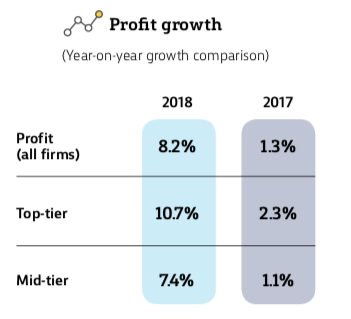
Screen Shot 2018-12-30 at 8.37.01 pm

The question I have though is this: is this a true correction?

And what I’m really asking here is this:

  1. have the underlying structural changes that we all know need to be made been put in place?
  2. if so, are we starting to see the benefits of these, or does this chart represent a false dawn?

And as we entered 2019 I’m going to leave those two questions out there, as I think many of us know what the real answers are here.

As always, would be interested in your views.

rws_01

* or was it?

My comments on today’s Lawyers Weekly article: ‘Observations on NewLaw in Australia in 2018’

Today (28 December 2018), Lawyers Weekly in Australia published an article by Lachlan McKnight, CEO of LegalVision in which Lachlan comments on his ‘Observations on NewLaw in Australia in 2018‘.  At the outset I should state that I don’t know Lachlan, and this post is no way directed at him, but is just a numbered-point muse on the interesting observations he makes in his article.

  1. ‘NewLaw’ (which is as meaningless a term as ‘Mid-tier’) is now an ‘industry’ – now that’s interesting.
  2. Agree with Lachlan’s comment in #1.
  3. While I agree with Lachlan’s comments in #2, I also believe the attitude here is changing within the more ProgressiveLaw firms. ProgressiveLaw firms realise that with greater risk (which fixed fees actually are), there should be a premium (much as there is with any insurance premium). EvolutionaryLaw firms go one step further and start to have a conversation about ‘value’ pricing.
  4. Three is an interesting comment: aren’t LegalVision in part owned by G&T  – as an aside (re #3 above), didn’t Danny Gilbert recently state that he thinks that clients don’t want move away from the #BillableHour?. Nevertheless, I agree with a lot of what Lachlan says in #3 but would probably set the bar at $75 million (we still only have a population of 25 million and IBISWorld still only puts the WHOLE legal industry revenue in Australia at $20bn [NB: the top 30 law firms in Australia make over $50m a year – in an industry this small!]).
  5. I would totally disagree with Lachlan’s comments in 4 and in my opinion you only need to look at the stuff MinterEllison and KWM are doing (with whom I have no association) to see this point – to me – is misplaced. In fact I would go 180 and say many BigLaw firms are going through their Arthur Andersen/Accenture moment (the original ‘child eat parent’?).
  6. The biggest challenge NewLaw (and Mid-tier law if such a thing exists) has to #5 isn’t OldLaw, it’s the #Big4.
  7. Number 6 is a point I have tried raising several times this year – scale. Law (Old and New) see ‘scale’ as being bodies (in part because of time-based billing). If it ever was it not longer is and any law firm, new or old, that get’s the right answer to scale will have a point of difference and in such a competitive market this is crucial. The reality is that potentially the biggest winners here should be the so-called Mid-tier (who have a lot of the grey haired industry knowledge without, currently, the scale – but I fear they have missed the boat because of lack of investment).
  8. For #7, see my comment in #3 re G&T.

As always, would be interested in your views.

rws_01

Why most law firms don’t need to hire a Head of Pricing

Following a conversation I had recently with John Chisholm, I had reason to revisit Patrick Johansen’s website patrickonpricing.com and re-read both his Continuum of Fee Arrangements™ and his Roll Call of pricing professionals.

Let’s get controversial. Re-reading Patrick’s stuff it occurred to me that there are an awful lot of law firms have hired pricing experts (Patrick has over 300, but it wouldn’t surprise me if that number were closer to 500) on -most likely- really good money who, get this: don’t really need them.

Why do I say that?

Looking again at Patrick’s Continuum of Fee Arrangements, Patrick has sixteen different pricing options available for law firms to offer clients:

  1. Hourly – the ‘go to’ pricing option for law firms. But are hourly rates pricing or billing?
  2. Volume – nope, not a pricing mechanism. It’s a discount. Not even an alternative fee arrangement (AFA).
  3. Blended – isn’t that an hourly rate?
  4. Retainer (Periodic) – okay, now we are talking. Law firms may need some help from a pricing expert on this one. But wait up, how much of a law firm’s revenue is done on a retainer mechanism? Less than 5% would be my guess. Justify the cost of pricing expert on the books (as opposed to freelancing), unlikely.
  5. Capped – OMG don’t get me started on capped fees. Known as the “heads I lose, tails I lose” pricing mechanism for law firms. I understand why clients love capped fees, they cannot lose. But any pricing expert on a law firm’s books who recommends capped fees as an option deserves to be sacked immediately.
  6. Task – okay, but isn’t this really just a fixed fee?
  7. Flat (Transaction) – okay, but again: isn’t this really just a fixed fee?
  8. Phase – sounds like a fancy name for task to me!
  9. Fixed – Nirvana. Now we need a pricing expert.
  10. Contingency – implies it needs to be contingent on something.
  11. Portfolio – my view is that this is one of the most misunderstood and under-used of the various pricing options. I’m not sure there are many pricing experts in commercial law firms who do this well.
  12. Hybrid – yeah right. Are we talking cars now?
  13. Holdback – this isn’t pricing. This is a reward mechanism. I could do all the pricing calculations in the world, but if the legal team provide a rubbish service then the client will withhold a part of the fee.
  14. Risk Collar – is hourly billing with an up and downside calculation mechanism.
  15. Success/Bonus – again, performance related.
  16. Value – right, and how many law firms are really doing this? Few and far between. Hell, most law firms don’t even understand the ‘value’ they provide (see ‘discounts’ and google number one AFA offered by law firms). No, nice to say; but a very long way from getting it.

So looking at this list I ask myself: “How much science is involved in pricing legal services?”. And the answer I come up with is: “Not a lot”.

Taking all this on board, I get why law firms hire ‘pricing experts’ out of accounting teams. And maybe that’s where the real opportunity is being missed.

But trust me, for all but two or three of the above pricing options, you don’t need a pricing expert – you need an accountant. So don’t waste your money hiring one.

rws_01

How much do you love your client?

I read an article last week in which Jeffrey Cashdan, a partner at King & Spalding, who represents Coca-Cola, is quoted as saying he had banned all [Coca-Cola] competitor drinks from his home.

Think about that for a second…

…banned all competitor drinks from his home!

That’s a hell of a range. And a hell of a commitment, especially if you have children under the age of 20 running around!

So I started to think:- how many of the products in my home belong to my clients?

And I was pleasantly surprised by the answer – a fair few.

But I was also surprised how many competitor brands were in the house.

So I got to thinking, if we expect loyalty from our clients (whether that’s expertise or brand), how many of us out there are willing to go as far as Jeffrey Cashdan, who would appear to walk the walk when he says:

“I’m all-in for my client,”

rws_01

Some thoughts on ‘value’

Business Development image

One of the biggest challenges we face in any professional services organisation is both an understanding of, and an ability to communicate, the value of the service we provide.

To some, “value”…

“…is the difference between a prospective customer’s evaluation of the benefits and costs of one product when compared with others. Value may also be expressed as a straightforward relationship between perceived benefits and perceived costs: Value = Benefits / Cost.”

To others, “value”…

“…is like beauty; it’s in the eye of the beholder (the payer)…it’s not measured by internal costs or profit levels.”

To my mind though, one of the nicest pieces written about the challenges humans face in understanding the value they provide comes from the Japanese artist Mariya Suzuki, who wrote recently:

“I wasn’t very aware of the value of my work until a short while ago. If you asked me about it I would just have said “it’s just a drawing” but now I realise that to get to make that drawing I have invested many years and practice. It wasn’t until people told me not to give everything away for free.

Today, in my starting career as an illustrator, I try to value my work much more.”

Trying to “value my work much more” – getting a better understanding of the overall value my product or service brings to the equation – seems like a good starting point to me.