pricing

Progressive pricing – the “essence of fairness”

Business Development image

Value is shared with customers rather than extracted from them

Following on from my ‘Will We See Hourly Rate Load Pricing In The Legal Industry?‘ post of last week, during the course of this week I had the chance to read a January 2019 Whitepaper by Jean-Manuel Izaret and Just Schurmann ‘Why Progressive Pricing Is Becoming a Competitive Necessity‘ published by Boston Consulting Group and the Henderson Institute.

For those who have not read it, Izaret and Schurmann’s Whitepaper provides some really thought-provoking insights, including:

  • Progressive pricing scales prices up or down on the basis of the value an individual customer derives.
  • the levels of pricing under progressive pricing are value-based, not means-based
  • Progressive pricing seems to violate the rules of traditional economics, which assume that customers buying the same product or service will pay the same price.
  • Progress pricing enables providers to offer each customer a fair, personalized product and price point.

In essence, progressive pricing enables service providers, such as law firms, to calibrate the value they provide at an individual customer level.

But, importantly to Izaret and Schurmann (see #4 of their ‘four most important differences between progressive and traditional pricing approaches‘):

Progressive pricing is a fairer way to determine prices, because customers pay a price proportional to the value they receive, rather than paying the same fixed price others pay.

For any supporters of value-based pricing, the above quote is pure gold.

But, the caveat in next line of Izaret and Schurmann’s piece is probably more crucial:

But the firm must make the case for this perceived fairness

QED, it is the duty of the firm to communicate the value the customer is getting, not the customer!

As a growing advocate of value-based pricing in professional services, one of the greatest take-outs for me was this line:

Making progressive pricing a profitable day-to-day reality can happen only if firms change how they create, define, and measure value so that they can share it fairly.

All I can say to that is “amen” – because it isn’t going to come out of utilisation and realisation rates, no matter how hard you look!

It is such a great piece I’m going to leave you with the following three quotes from this paper:

  1. Companies must first step back and re-imagine the concept of value in their market. How can a business combine its own capabilities with the close personal knowledge of its customers to create something that fundamentally changes a customer’s life?
  2. Can you define value, measure it, and get everyone to agree on what value is?
  3. Most firms are accustomed to expressing prices in units of product or some other basic metric such as hours. If they can instead calibrate prices in terms of unit of value, then the price per unit of value can remain constant and the amount a customer pays can scale in proportion to the value demanded. That is the essence of fairness.

Great read. If it is not on your list – add it* (*then get back to me and let me know if you agree)!


rws_01

Will We See Hourly Rate Load Pricing In The Legal Industry?

Business Development image

Rational choice theory hypothesises that individuals use rational calculations to make rational choices to achieve outcomes that are aligned with their own personal objectives.

One of the biggest (of many) problems I have had with the hourly rate in the legal industry – dating back to my start in the early 1990s – is that it assumes every hour in the day is equal. But, as anyone who has worked in private practice law will tell you, this simply isn’t true.

What do I mean?

Well, to say that the value of the work that we do at 6am, is the same as the value of the work that we do at 12am, is the same of the value of the work that we do at 9pm, is the same as the value of the work that we do at 12pm is simply false in my opinion.

And, critically, this doesn’t take into account an important factor; namely to anyone who has worked in private practice for any length of time, saying that an hour of work (from a personal cost perspective) at 10% utilisation is the same as an hour of work at 130% utilisation is simply insulting.

So what’s the answer?

Well, if hourly billing is your thing, has the time come to consider load weighting?

How would load weighting work?

Well, if you’re a morning person, what if you told your customer that your time between 6am and 10am was going to be at a higher premium than your time between 6pm and 10pm?

Conversely; if you are an evening person, what if you told your customer that your time between 6pm and 10pm was going to be at a higher premium than your time between 6am and 10am?

Or, alternatively, if you haven’t seen your family for several days because of a busy workload, you tell your customer that your 40th working hour that week was (emotionally, because it will rarely be economically) worth than your first or tenth hour (as opposed to the scaling discount most firms apply)?

As an industry we need to move away from the one set billable hour value; but to do that we first need to accept that not all billable hours are equal and to start talking to our customers about charging a premium for those hours in the day/week/month/year that are worth more – to both us and them – than others!

rws_01

‘Bears and Alligators’

Business Development image

Happy New Year to all.

I trust everyone had a relaxing and enjoyable holiday period. I certainly did, and took the opportunity to catch-up on some podcasts I had missed towards to the end of 2019. One of those was Episode 47 of Mark Stiving’s weekly Impact Pricing.

In this episode Mark has a free-ranging talk with Kevin Christian on all things pricing related under the appropriately named ‘Two Pricing Experts Talk Pricing(published 9 December 2019) and, while the whole podcast is great, things get particularly interesting  around the 19 minute mark when Kevin asks Mark:

“If a bear gets in a fight with an alligator, who wins?”

Now I can hear you saying: “What has this got to do with law firm business development and pricing issues?”, but – pun intended – ‘bear’ with me.

Because, as is music to the ears of every lawyer, Kevin explains,

‘it depends’ –

on where the fight is taking place.

If the fight is taking place on land then the bear is more likely to win; but if the fight is taking place in water then the alligator is more likely to win.

Que?

Here goes – bears and alligators are analogies to the ‘value’ discussion such that, as Kevin states, if you are:

  • Talking about the ‘Value of your Solution’: then you are in the seller/vendor territory and the seller/vendor is going to be leading and benefiting from the conversation;

whereas:

  • If you are only talking about the ‘Price of your Solution‘, without talking about the value, then you are in the buyer’s territory.

Takeout – what does this mean?

In a world when we deal with procurement and other agents who are not looking at the value of the service we provide, but are constantly looking at the cost of that service; then, as law firms, it becomes imperative that we explain the value being provided and have ourselves a land battle with the alligators.

rws_01

It doesn’t pay to be a loyal customer

Business Development image

The Chanticleer column in this weekend’s Australian Financial Review is titled ‘It doesn’t pay to be a loyal customer’. The article is a post-Hayne, post several reductions in interest rates, look at bank mortgage rates and analysis undertaken by Matthew Wilson at Evans & Partners that suggests:

“In Australia, the banks enjoy a profit benefit of about $3 billion a year from exploiting the difference in mortgage rates between existing and new customers”.

I’m not going to comment on whether or not that statement is correct/true (although a hunch would suggest it is), but it did make me think that in the professional services (read ‘legal’) sector it absolutely holds true that it doesn’t pay to be a loyal customer/client.

What do I mean by this?

Well when pricing services to new customers/clients – especially in tender situations, law firms are far more willing to:

  • Buy the work to cement the relationship
  • Offer volume discounts
  • Deeply discount on rack-rates
  • Agree to discounted fixed fee arrangements
  • Agree to risk-sharing arrangements

Indeed, more often than not the average billing rate (ABR) and the average realisation rate of a long-term customer/client will be higher than a new client, while lock-up days will be lower.

As Chanticleer says, it really doesn’t pay to be a loyal customer these days!

As always though, interested in your thoughts/views/feedback.

rws_01

Report: Eight of the biggest challenges law firms associate with rates and pricing

Business Development image

After a great holiday enjoying the Northern Hemisphere summer – and thereby avoiding some of the cold winter of Sydney – I returned last week to a read about law firm rates and pricing that really caught my attention, the ‘LawVision & Peer Monitor Pricing Survey: The Growing Prominence of Pricing within Law Firms‘.

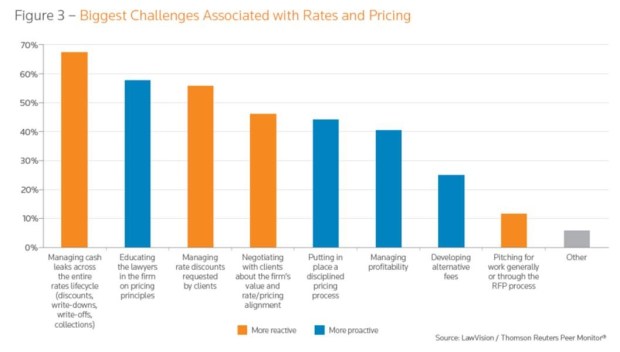
Predominately North American based, it’s nonetheless an interesting read – with some contentious stuff (see the ‘LawVision Maturity Curve’ for example) – for anyone even remotely interested in following the current trends and traits affecting law firm pricing issues. But what particularly grabbed my attention in this Report was the ‘8 biggest challenges law firms associate with rates and pricing’ (Figure 3):

pricing.jpg
And what really, really fascinated me about this list is how few of them actually have anything to do with either rates (if that’s the way you want to do things) or pricing.

As you can see from the list, in desending order they are:

  1. Managing cash leaks across the entire rates lifecycle (discounts, write­downs, write­offs, collections)my comment: neither a rates issue  nor a pricing issue, but a behavioural issue
  2. Educating the lawyers in the firm on pricing principlesmy comment: neither a rates issue  nor a pricing issue, but a training issue
  3. Managing rate discounts requested by clientsmy comment: neither a rates issue  nor a pricing issue, but a behavioural issue (and are we seriously still having this conversation!)
  4. Negotiating with clients about the firm’s value and rate/pricing alignment
  5. Putting in place a disciplined pricing processmy comment: neither a rates issue  nor a pricing issue, but a training issue
  6. Managing profitability – my comment: neither a rates issue  nor a pricing issue, but an accounting issue
  7. Developing alternative fees
  8. Pitching for work generally or through the RFP process – my comment: can someone please let me know what this has to do with either rates or pricing!

Which leaves us with:

  • Negotiating with clients about the firm’s value and rate/pricing alignment, and
  • Developing alternative fees

Both of which, depending where in the buying cycle these conversations are taking place with your customer, could actually have something to do with a rates and pricing discussion.

But seriously, Challenges 4 & 7 of 8, and we wonder why law firms struggle with the concept of pricing and the disconnect between firm and customer.

And if we are really being honest and true to our clients, then even inward looking the #1 issue should not be ‘Managing cash leaks across the entire rates lifecycle (discounts, write¬downs, write-offs, collections)‘ but should rather be: ‘How are we rewarding and incentivising in our staff?‘ – because if the answer to that is ‘utilisation‘, then everything above is relatively meaningless.

As always though, interested in your thoughts/views/feedback.

rws_01

Game: ‘Questions to ask your deal team about why your customer is happy to pay your fee?’

Business Development image

Came across the bones of a really interesting game you can play with your deal team at your next after action deal debrief/lessons learnt meeting.
Handout a piece of paper to each of your deal team members and ask them to rank, in order of priority, the top 5 reasons – from the following list – why the customer is happy to pay your fees in full (no discounts/write-offs, etc allowed):
  1. Demonstrated an understanding of the customer’s business/industry throughout the deal
  2. Demonstrated an understanding of relevant law
  3. Responsiveness to customer’s requests – phone/email/meetings
  4. Built good rapport and a trusting relationship during the deal (was in the trenches with the customer)
  5. Used expertise to help save the customer money (either on the deal or fees)
  6. Used Legal Project Management techniques to stay within the deal scope and didn’t allow scope creep without first taking to the customers
  7. Used technology, AI, Legal Process Outsourcing and value adds to make the customer’s life easier during the deal
  8. Offered the customer a great discount
  9. Hourly rate was attractive to the customer
  10. Any other reason(s)

Remember, they can only pick 5. And they need to be in order of priority.

I would love to hear feedback on which five were the most popular chosen.

rws_01

What is the biggest pricing problem law firms are facing today?

This week’s episode of the Impact Pricing podcast (episode 20 – ‘Mastering SaaS Pricing: How to Price and Package Your Service’) sees host Mark Stiving talking with Kyle Poyar, Vice President for Market Strategy at OpenView. By their own admission, Mark and Kyle geek-out over SaaS pricing theory and its KPIs, so this podcast is not for everyone.

What is interesting, however, is the response Kylie gives to a question Mark asks at the 23 minute 37 second mark.

Mark’s question:

What do you see as the biggest pricing problem that subscription companies are having today?

Kylie’s response:

…structurally speaking, companies are not spending enough time on pricing, they don’t take a scientific or rigorous enough approach to optimising their pricing and testing it and collecting data on it. And we have gotten smart about just about everything in technology and if you look at the level of sophistication of the operations of a technology company it’s like just so different from where we were a few years ago. But pricing hasn’t really changed and I’ve just started to hear of companies that are trying to bring on pricing talent and make their first dedicated pricing hire and have that happen earlier in their lifecycle; but then those companies are having trouble figuring out what’s the right profile to hire for, who is going to do a good job in this role, and then finding that talent and so I think like, structurally, their biggest challenge is just lack of great pricing skills…

In my opinion, that sums up pretty well the pricing problem that we have in law firms:- we’re in such a rush to show everyone how serious we are about the pricing issue/problem facing the industry (as in, alternatives to the billable hour, project management, process improvement etc), that we have hired Heads of Pricing by the boat loads, but a niggling issue remains – industry report after industry report that has sought feedback from clients indicates (some might even say, shows) that we haven’t gotten all that much more sophisticated or even better about how we price. If that’s the case, we have to ask: is there just a lack of great pricing skills in the industry?

As always, interested in your thoughts/views/feedback.

rws_01

NB: please ignore all comments Kylie makes about volume discounts prior to his comments above, as regular readers will know I don’t hold with those views!

“A lawyer’s time is the only commodity that we have to sell”

Earlier today I listened to a podcast on respected legal technologist expert/journalist/speaker Ari Kaplan’s Reinventing Professionals from May 2, 2019 in which he spoke with Josh Taylor, an attorney and the lead content strategist at Smokeball, a practice management software platform that started out life here in Australia and now appears to be mainly located in Chicago (although retains a presence in Sydney and Melbourne).

The first seven minutes (out of nine) I was entertained and thought were good.  But two minutes and twelve seconds from the end Ari throws out his last question (my transcript follows so sorry for any errors) to Josh:

Where do you see the use of technology in solo practices and small firms headed?

And Josh responds:

One thing that we struggle with so much, and I have saved it to the end here Ari instead of mentioning it as a pain-point upfront, the main part of the small law practice that we see people failing at day after day is accurately tracking their time and either on the the extreme cheating a client by over estimating, which is very rare, more likely and more often we see small law firms cheating themselves by under valuing every minute they have; when I go around speaking to bar associations around the country I always say “you know a lawyer’s time is the only commodity that we have to sell, we don’t make a thousand widgets in a minute that we can then sell for the same price, we have minutes in a day that is the only thing that we can sell out to our clients” because we cannot double bill people so to value and track time accurately I think is where legal tech is going to start leading the way…

Leaving aside the whole time-based billing versus value-based billing discussion, even if you only believe in time-based billing (cost-plus or however that looks) and never want to entertain the notion of any kind of alternative pricing method, to say:

a lawyer’s time is the only commodity that we have to sell

is so far removed from reality it’s not funny.

What a lawyer’s ‘commodity’ is, is the knowledge they have acquired, the experience they acquired to be able to apply that knowledge to the situation their client is facing, and the insight to do this in a valuable and respectable way.

Regardless of how you bill – as a lawyer that is the only commodity you have to sell.

rws_01

An OmniFocus subscription – a great example of ‘charm pricing’?

Not familiar with the term ‘charm pricing’? – neither was I until I started taking the issue of pricing seriously, but at it’s core is something we (tender and pitch professionals) see daily,  the psychological effect of reducing the the left digit(s) by one so that “0” and “00” becomes “9” and “99” – i.e. $150.00 becomes either $149 or $149.99.

Why is it important?

Check out these two subscription options…

Screen Shot 2019-05-20 at 8.47.23 pm

…and let me know which you would have gone with.

rws_01


Would you use an unlicensed or unqualified legal advisor?

Last Friday’s (April 26) The Soul of Enterprise Free Rider Friday podcast (Millionaires, Marxists, and Minimum Wage) with Ron Baker and Ed Kless, included a ‘stack’ (their term not mine) by Ed on the news that “Kim Kardashian Is Right: Lawyers Shouldn’t Have to Attend Law School”. As someone who knows absolutely nothing about the Kardashian family (nor wishes to), not much in that – apart from the comment that Ed and Ron go on to make in respect of Episode #225 of their series of podcasts in relation to “occupational licensure”.

In short Ron and Ed talk about the fact that there are some jobs around the world where you need a ‘licence to practice’ – examples: a barber (hat tip to Ron’s Dad there), an accountant, and even a lawyer.

On the back of the Kim Kardashian issue, Ed and Ron then go on to ask this question:

If you know someone isn’t qualified (e.g., don’t have a law degree) or isn’t licensed (e.g. have a practising certificate), should you still be able/allowed to ask them for professional advice – provided that you sign a waiver/agreement/whatever stating that you know that persons isn’t qualified or licensed to provide the requested advice?

Never, no way, stupid idea.

And I would agree with you.

But wait, we’re all adults here and should be allowed to determine our own future and make our own decisions.

Exhibit A: this is an excerpt from the British Government’s website (April 2017) in relation to obtaining legal advice in Thailand:-

“There is no restriction on any Thai national , with or without a law degree [bolded and underlined for emphasis by me], to offer you legal advice.”

Now Thailand is a civil law jurisdiction with a codified law, but still…

…leaving aside the whole issue of how stupid you may or may not need to be take legal advice from a non-licensed, non-qualifed expert (bought a pre-pack will lately?) – here’s a precedent.

There are “lawyers” who advise “on the law” who are not educationally qualified (as opposed to possibly life) or institutionally licensed.

Interesting as that all is though, that’s Thailand – hardly the US, UK or Australia.

Well hang on a second…

Listening to Ed and Ron’s podcasts there are States in the US where you can now obtain ‘legal’ advice from someone who isn’t qualified or licensed, provided that you sign a waiver saying that you knew this to be the case.

And, in my view the following comment from legalfutures.com – reporting on The UK Legal Services Consumer Research Report 2019 yesterday:-

A smaller majority (58%) would be prepared to use freelance solicitors, due to arrive this November with other Solicitors Regulation Authority rule changes, if they could save money on fees.

means they are not a long way behind.

As always though, interested in your thoughts/views/feedback.

rws_01

* if I have misrepresented or misunderstood my take-outs from Ed and Ron’s podcast, then I apologise to them.