The most recent – 2026 – Citi Hilderbrandt Client Advisory Survey Report published earlier this month contains some interesting commentary on how US law firms faired in 2025. None more so than the finding that:
a growing number of firms estimating that more than half their revenue will come from pre-negotiated discounts. (page 23)
Pre-negotiated discounts
The Report does not explicitly define “pre-negotiated discounts”; however it refers to alternative fee arrangements (AFAs) as including fixed, capped or blended rates. It is, therefore, reasonable to interpret “pre-negotiated discounts” as encompassing agreed reductions to standard charge-out rates, volume-based discounts and other upfront pricing concessions.
Viewed positively, this trend signals a shift away from reactive, end-of-matter discounting towards earlier and more deliberate pricing discussions. In principle, this should create a stronger foundation for meaningful conversations about value-based pricing, particularly where clients are seeking price certainty, predictability and risk sharing. From that perspective, pre-negotiated pricing is not inherently problematic — and may in fact represent a necessary transitional step.
The more concerning implication, however, is that for many firms these discussions appear to be anchored primarily in discounting, rather than in value definition. Where pricing conversations begin and end with rate reductions, firms risk reinforcing a price-taker mindset rather than asserting their role as price-setters. Left unchallenged, this dynamic contributes to margin erosion, commoditisation of legal services and an imbalance in client-firm relationships that becomes increasingly difficult to unwind.
AFAs as a pricing option
Despite persistent commentary throughout 2025 that artificial intelligence (ai) will fundamentally disrupt — or even eliminate — the billable hour, the data in this Report suggests otherwise. The proportion of revenue derived from AFAs has remained effectively flat, increasing only marginally from 23.5% in 2024 to a projected 23.6% in 2025.
Setting aside the fact that many commonly cited AFAs are, in reality, variations of the billable hour by another name, and acknowledging that it may still be too early to fully assess AI’s structural impact on pricing legal services, one conclusion is unavoidable: the billable hour remains very much alive.
The way forward
With 74% of firms expecting a growing proportion of revenue to come from AFAs by 2027, the issue is not whether pricing models will continue to evolve, but how deliberately firms choose to engage with that evolution; and whether AFAs are used as strategic tools or simply as discounted billing mechanisms.
In sum
Taken together, the findings in this Report further highlight a profession at an inflection point. While the billable hour continues to dominate, the steady rise of pre-negotiated discounts and the anticipated growth in AFAs suggest mounting client pressure for greater certainty, transparency and perceived value.
The critical question for law firms now is not whether they should offer alternative pricing arrangements, that horse has bolted, but whether they are prepared to move beyond discount-led negotiations and engage in genuine upfront value-based pricing conversations.
Firms that continue to compete primarily on price risk entrenching themselves as price-takers in an increasingly sophisticated procurement environment. Those that invest in articulating value, pricing outcomes and structuring risk intelligently will be far better positioned to protect margins and strengthen client relationships in the years ahead.
The decision on the way forward now rests with the firms themselves.
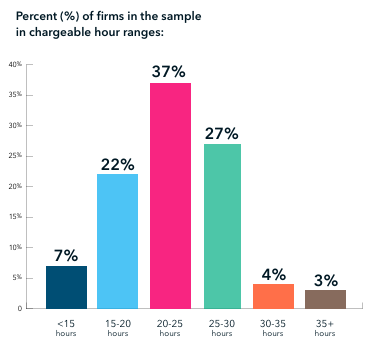
A recent report, “Strategic Sector Insights for the Legal Profession 2025: Mid-Sized Firms”, published by The Law Society and MHA, reveals a striking trend:
👉 More than 50% of mid-sized law firms report that their lawyers bill less than 25 hours per week on average. 👉 Less than 3% of lawyers at these firms bill anywhere close to the full 40-hour workweek.
While it’s unrealistic to expect lawyers to bill every hour they work, these numbers highlight why alternative pricing models are a key priority for firm leaders in 2025.
⚖️ What does the future of legal pricing look like? If you’re exploring value-based pricing, subscription models, or hybrid fee structures, let’s talk!
📩 DM me to discuss innovative pricing strategies for law firms.
I put a post up last week on LinkedIn, off the back of a very interesting blog by Jordan Furlong on his Substack feed: ‘The legal world in 10 years (if we’re really lucky)‘, that got some social media traction so I thought I would re-share here.
At the heart of my LinkedIn post was a comment Jordan makes on – what he calls – High-Value Retainers and the effect Gen AI will have on these fee arrangements. To quote:
High-Value Retainers Thanks to Gen AI’s consumption of many traditional tasks, lawyers have moved up the value ladder, going beyond “bet-the-company” and “run-the-company” work to start offering “grow-the-company” work (or “advance-the-individual”). These are engagements in which lawyers ask: “How can I improve your situation? What are your near-term and long-term goals? How can I help you anticipate problems and prevent them before they happen? How can I bring you more stability and peace of mind? How can I be your advocate and counsellor in whatever you need?”
While I think Jordan’s point is an excellent one, mine was this: “Do you think this could work in 10 years time?“
Because if you think it could: Why are you waiting 10 years for AI to develop in order to have this conversation – have this conversation with your clients now!
In that, it’s not a 10+ years from now discussion. It’s not a 10+ years from now problem. It’s a HERE AND NOW problem and a here and now discussion.
In the 1980s it took Concord a little under 3 hours to fly New York to London.
Today [2023], 40 years later, the quickest you can travel that exact same route (New York City – London) is a little over 5 hours.
…And this is why you should always bill by the hour – it ensures your clients get the best possible experience (after all, why would you want to fly Concord!) and it incentives innovation!
If you don’t have time to read Andrew Malocussions article, and I suggest you do because it’s actually very interesting, the long and short of it is that the reason why big (read global) law firms are losing millions in revenue (opportunity) is because…
… their pricing teams are too small.
All I have to say is, “seriously”!
Do yourself a favour, go back in time 5 years and work out for yourself whether or not the fact that law firm pricing teams are too small is the real reason they may or may not be losing millions of dollars in revenue.
For my part, this type of thinking doesn’t pass the pub test!
Feel free to reach out to me if you want to talk through any pricing strategy related issues/questions.
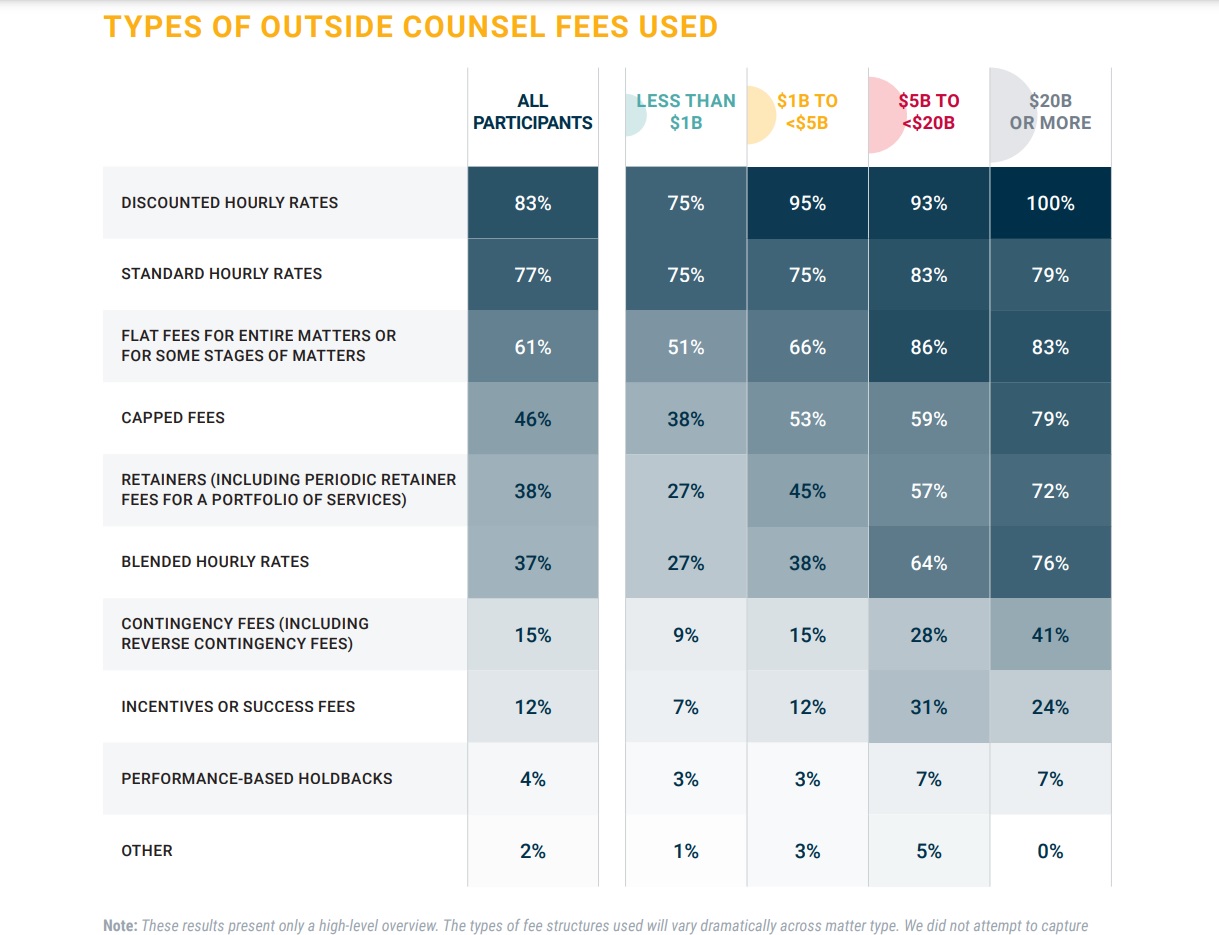
If you are wondering what types of Alternative Fees Arrangements (AFAs) in-house General Counsel are asking their private practice suppliers to provide them with – or, to flip the coin, what AFAs private practice lawyers are charging their in-house GCs, then wonder no longer. The latest market report from the Association of Corporate Counsel (ACC) sets this out in a nice clear table:
Some take-aways:
The #1 AFA fee request of outside counsel is Discounted Hourly Rates. No less than 100% of companies with revenue over $20BN or more use Discounted Hourly Rates with their private practice lawyers! When, oh when, will we learn that Discounted Hourly Rates are NOT a fee structure? On this point, I have been arguing for years (literally, the linked post was from 2018!) that there is no point having a pricing function in your law firm if all you are going to offer clients is discounted hourly rates! Seriously, save yourselves the money.
Say what you want, the #BillableHour is far, far from over if it is the preferred billing method of over three-quarters (77%) of all in-house GCs participants in the survey!
Capped fees are dumb! They are a lose-lose: both for the law firm who if they come under the cap can only charge what is on the clock and if they go over the cap have to wear the additional cost; but also for the in-house team who will get under served as soon as it becomes clear the cap cannot be met (and probably never was going to be). So why are they so prevalent? I can only assume capped fees are driven by the CFO wanting “cost certainty”.
Given the continued popularity of hourly rates, Blended Hourly Rates are nowhere near as popular (at 37%) as you would think. On transactional matters in particular, you would think this rate of use would be a lot higher.
The use of Success Fees is woeful. Is this a reflection of the amount of M&A and privatization work actually being done (where you would expect it to be prevalent, or is it an actual fact that in-house counsel don’t like/understand the benefits of this arrangement? Or could it be, every deal is getting done so why take the uplift risk?)?
An understanding of Performance Based Holdbacks has a long, long way to go.
Importantly though, despite talking about implementing AFAs for over two decades, we are still a long way off actually using them in practice.
Again, take a look at my linked article above where I talk to Patrick Johansen’s Continuum of Fee Arrangements™, where Patrick sets out 16 different types of fee arrangements that can be used:
Hourly
Volume
Blended
Retainer
Capped
Task
Flat
Phase
Fixed
Contingency
Portfolio
Hybrid
Holdback
Risk Collar
Success/Bonus
Value
And ask yourself, how many of these are being actively used in this latest report from the ACC?
Notably missing from the list above? Value Based Billing!
Yes, despite what you may read and hear elsewhere, in practice we are long, long way away from understanding and implementing the appropriate (a term I learned from Toby Brown) use of relevant fee arrangement for the task at hand.
In-house or private practice, if you’re struggling to get to grips with this issue, feel free to reach out to me for a chat.
Leaving aside the whole issue of whether or nor the billable hour is the best way to charge clients, do you think it is fair to charge different client different rates for the same work?
This article by Jordan Rothman on abovethelaw.com would suggest the answer to that question is – ‘yes’.
And I actually don’t disagree with Jordan’s outcome, but do disagree with his thinking of why.
After all, at least here in Australia, we very rarely have the same panel rate for all legal panels we are appointed to so; despite, or rather, the fact that we will be doing similar work under the various panel appointments.
QED – IMO – it’s fair to charge different clients different rates for the same work we do (and, HINT, it all comes out in the wash when you look at the Average Realised Rate – but I will leave that for another post).
But, and here is the critical difference I have with Jordan’s post, different clients will equate a different value to the work being done by you – and so it is more than fair to charge one client more or less than another client perceived on the value of the service they are getting.
For example, and I accept this is somewhat crude, somebody who has never been divorced before and whom your firm ‘looks after’ in a very emotional period of their life is way more likely to value the service your firm provides than someone going through their fifth divorce – so charge them more!
If you want to have a chat about how you can maximise your value opportunities, feel free to reach out.
“As of April 03, 2023, the subscription fee for Microsoft 365 Family will change from AUD 129 to AUD 139 to address changing market conditions.”
Microsoft email notification 19 March 2023
Okay, not a huge increase. But:
absolutely no explanation or detail as to what those “changing market conditions” are.
no explanation about the additional value being provided.
no detail about any additional costs being incurred.
no information provided around whether the scope of services provided will change.
Other than to say: “if you don’t like this increase, here is a link to unsubscribe”, absolutely nothing.
My take:
a really badly drafted email to loyal subscribers (I think my family have subscribed to Microsoft 365 Family for around 10 years).
a missed opportunity to set out all the great features that Microsoft 365 Family provides – and there really are a lot -and why paying AUD 10 per year more will be worth it at the end of the day (after all, this is less than AUD 1 per month).
TIP
If, like me, you got this email can I suggest you file this away as an example of how NOT to communicate a price increase to your clients/customers.
And if you need help talking through how you might be able to do a much better job than Microsoft have in communicating price increases to your loyal clients, feel free to reach out:








 RWS_01's B[D]log