Tesla, Elon Musk’s EV carmaker, published its Q3 results earlier today (Australia time). Profits plunged 44 per cent. But, from my perspective this was the interesting part: “after it cuts prices to boost sales“.
Let’s unpack that for a second: Tesla “slashed prices by around 25 per cent in the United States during the last year” – “putting the priority on sales rather than profit“.
As it happens, this is also a common trait of professional services firms: prioritizing getting the deal done over making an actual profit – including agreeing to heavy “volume discounts”.
As the Tesla results show though, any price discount you give comes directly from profit – not sales revenue.
So the price discount you offer your clients is essentially compounded on your bottom line – 10% is not 10%, it’s more like 30%.
Or in the case of Tesla: a 25% price discount has resulted in a 44% plunge in profit.
Something to think about when you are next thinking about what pricing options you have available to you.
And please, don’t follow this advice:
“I view it as a way to defend market share at the expense of margin” .
Kevin Roberts, director of industry insights and analytics at CarGurus, an online auto sales site
In professional services firms, market share should never Trump (pun intended) profit.
As usual, if you need any help with any of this, feel free to reach out.
If you don’t have time to read Andrew Malocussions article, and I suggest you do because it’s actually very interesting, the long and short of it is that the reason why big (read global) law firms are losing millions in revenue (opportunity) is because…
… their pricing teams are too small.
All I have to say is, “seriously”!
Do yourself a favour, go back in time 5 years and work out for yourself whether or not the fact that law firm pricing teams are too small is the real reason they may or may not be losing millions of dollars in revenue.
For my part, this type of thinking doesn’t pass the pub test!
Feel free to reach out to me if you want to talk through any pricing strategy related issues/questions.
I have read a lot recently about how AI and ChatGPT in particular is going to kill the billable hour. That may well end up happening. What I do suspect though is that it is unlikely to happen soon. And if the billable hour is to be killed off, technology – such as AI and ChatGPT – may well play a part, but it will be the cultural/behavioural change that’s needed that will be the final nail in this coffin.
Don’t believe me?
Here is a quote (of kinds) by Aarash Darroodi, Fender’s General Counsel, at the recent Legal Marketing Association’s annual gathering in Hollywood, Florida:
…the mere fact that he’s being billed by the hour isn’t a problem — but that the billable hour’s implementation can be.
In other words, Darroodi doesn’t mind that his law firm(s) charge him (his company) by the hour, but he does mind if you take him for a fool.
And until this mindset changes, you’re not going to see the death of the billable hour anytime soon.
Darroodi’s comments on the RFP process – should clients do an “open day” before tendering?
While Darroodi’s comments on the billable hour were interesting, his comments on the approach law firms should take to the RFP process were even more insightful. To quote from the article:
[Darroodi] described receiving template-based RFP responses from law firms — an approach he called “fundamentally a mistake.”
Instead, he would like to see a law firm respond to an RFP with an offer to come look at the company’s operations in-depth, gaining a better picture of his organization before a proposal is prepared.
“First of all, it shows initiative on your part. It shows the fact that you care,” he said. “And plus, it shows us that you’re going to submit something that’s directly related to our existing organization.”
Now I’m more than sure that not all GCs will take this approach. And before everyone in Australia says this would likely breach procurement protocols (after the RFP has been issued), I know.
But, wouldn’t it be interesting – and just a little more relevant, if clients did an “open day” before they issued the RFP? Particularly in cases where the tender is by invitation only?
In my view it would certainly make sense and would undoubtably result in more directly relevant and related (and probably eminently more readable) tender responses.
Not only is it highly insightful – so “thanks for posting it Jeremy”, but it contains this nugget – again from Darroodi – on his views about client events (and if you are anEvents Manager in a law firm, stop reading now 🤣):
“I don’t want to spend time with my lawyers,” Darroodi said to laughter, comparing the idea to hanging out with his dentist.
Ouch!
In the meantime, if you need help with your pricing or RFP responses, feel free to reach out to me.
Leaving aside the whole issue of whether or nor the billable hour is the best way to charge clients, do you think it is fair to charge different client different rates for the same work?
This article by Jordan Rothman on abovethelaw.com would suggest the answer to that question is – ‘yes’.
And I actually don’t disagree with Jordan’s outcome, but do disagree with his thinking of why.
After all, at least here in Australia, we very rarely have the same panel rate for all legal panels we are appointed to so; despite, or rather, the fact that we will be doing similar work under the various panel appointments.
QED – IMO – it’s fair to charge different clients different rates for the same work we do (and, HINT, it all comes out in the wash when you look at the Average Realised Rate – but I will leave that for another post).
But, and here is the critical difference I have with Jordan’s post, different clients will equate a different value to the work being done by you – and so it is more than fair to charge one client more or less than another client perceived on the value of the service they are getting.
For example, and I accept this is somewhat crude, somebody who has never been divorced before and whom your firm ‘looks after’ in a very emotional period of their life is way more likely to value the service your firm provides than someone going through their fifth divorce – so charge them more!
If you want to have a chat about how you can maximise your value opportunities, feel free to reach out.
“As of April 03, 2023, the subscription fee for Microsoft 365 Family will change from AUD 129 to AUD 139 to address changing market conditions.”
Microsoft email notification 19 March 2023
Okay, not a huge increase. But:
absolutely no explanation or detail as to what those “changing market conditions” are.
no explanation about the additional value being provided.
no detail about any additional costs being incurred.
no information provided around whether the scope of services provided will change.
Other than to say: “if you don’t like this increase, here is a link to unsubscribe”, absolutely nothing.
My take:
a really badly drafted email to loyal subscribers (I think my family have subscribed to Microsoft 365 Family for around 10 years).
a missed opportunity to set out all the great features that Microsoft 365 Family provides – and there really are a lot -and why paying AUD 10 per year more will be worth it at the end of the day (after all, this is less than AUD 1 per month).
TIP
If, like me, you got this email can I suggest you file this away as an example of how NOT to communicate a price increase to your clients/customers.
And if you need help talking through how you might be able to do a much better job than Microsoft have in communicating price increases to your loyal clients, feel free to reach out:
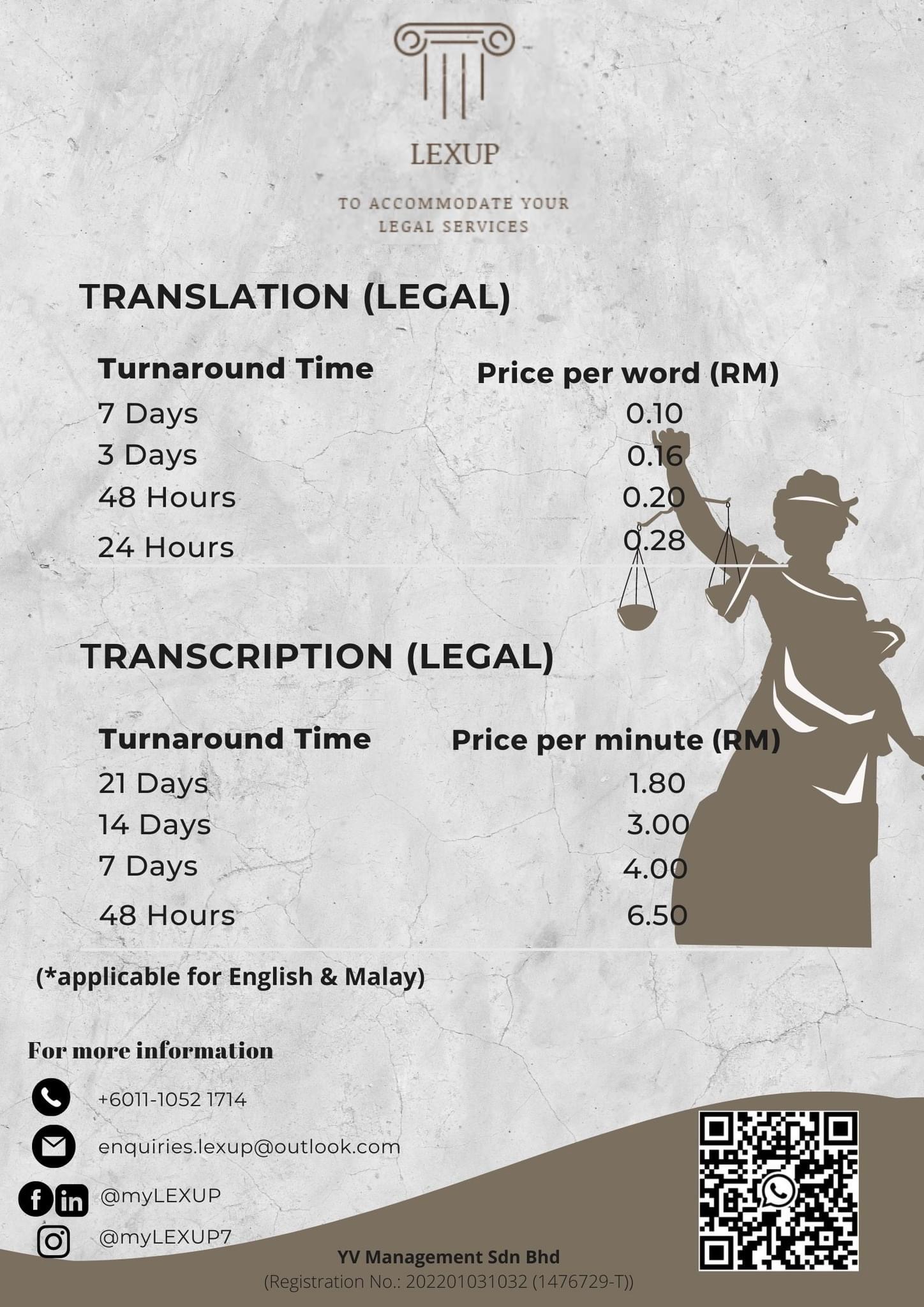
Not exactly sure where I came across this pricing menu by a translation service provider in Malaysia – Lexup – so apologies if I am not giving you the credit you deserve because this really grabbed my attention.
A translation service focussed on the legal profession that not only charges by the minute (let alone 6 minute units), but whose rates vary depending on how urgent your need is.
Alternatively, if you’re not happy with the hourly billing model, then let’s go old school (Charles Dickens era) and pay by the word. Again though, the quicker you want your work back, the more it will cost you!
Peak-load pricing. I have no idea why law firms have not adopted this years ago!
As usual comments are my own – but I’m sure there is someone out there who can tell me the optimum price to time!
If you missed it, the recently published ‘The Legal Spend Landscape for 2022‘ by Apperio sets out the ‘Top 5 Measures Of Value‘ in the eyes of the survey respondents – aka, your clients!
In order, these included:
Outcome of legal matters – 66%
Hourly cost per lawyer – 60%
Spend forecast vs Actual spend – 46%
Risk exposure – 43%
Overall spend by law firm, matter type or business unit – 40%
Interestingly, in the same Report, the Top 3 answers to what the ‘Most Effective Techniques For Controlling Legal Costs‘ were:
Structuring more legal work under AFAs – 74%
Utilising specialist software for monitoring and maintaining cost – 63%
Centralising all legal spend through the legal department – 49%
And I very much suspect that the last of these – “Centralising all legal spend through the legal department” – is going to be a post in the near future, either here or on my other blog.
As usual, comments are my own and I welcome feedback.
Happy New Year to you all, and welcome to the new calendar year that is 2022.
During the holiday period here in Australia (published 13 December 2021) I was fortunate enough to read a really insightful article in MIT Sloan Management Review by Andreas B. Eisingerich, Deborah J. MacInnis, and Martin Fleischmann titled ‘Moving Beyond Trust: Making Customers Trust, Love, and Respect a Brand’
which set-out how service providers, like law firms, could provide real value to their customers using the 3Es:
enable
entice,
enrich
Where:
Enable = help your customers solve problems in ways that are economically feasible, reliable, efficient and convenient
Entice = making your customers feel good
Enrich = build self-affirming identities.
And the benefits of using this method?
Evidencing the research outcomes of this methodology, the article sets out 6 benefits you should see:
Higher Revenue
Lower Costs
Higher Barriers to Entry
More Paths to Grow[th]
Stronger Talent Pool (within your firm as lawyers want to do this type of work for this type of client), and
Greater Retention Rates in your firm.
All of which – should – result in higher profit.
Well worth a look, take a read – and certainly food for thought!
As always, the above represent my own thoughts and would love to hear yours in the comments below.
You’d have to have been hiding under a rock for past two years not to have seen an article or two on the benefits/pitfalls of remote working. But, as we move into the next phase of this pandemic/endemic, one in which we must start to learn to live with COVID, law firm management now need to be asking:
‘What does the future of the office look like for our firm?’
Truth is, there’s no simple answer to this question. On the one hand, we have those who advocate that “distance breeds distrust” and “out of sight, out of mind”. On the other hand, we have a lot of people saying we’re not going back to the old ways – and if you make us, we will part of the Great Resignation.
One answer to this issue might be in what the Australian Financial Review recently termed ‘Anchor Days’.
As per the AFR article, ‘Anchor Days’ are days on which a group of employees (in the same team) agree to go into the office on the same day each week with the aim of enhancing collaboration and ensuring a more lively office culture.
While I like the concept of Anchor Days, I think I should also point out that, from my reading, it comes with a couple of major misconceptions:
we all work in the same physical location (geographically in the same State/Cities, but also on the same floor of a building!).
that collaboration is more likely to happen in physical presence, when what we actually find is that collaboration more likely occurs with inclusion, and inclusion is more aligned with trust. QED, if you want more collaboration within your team, then trusting that your team can get it’s shit done here remotely/agile and not dictating collaboration top down, is a big step in the right direction.
My final comment: if Anchor Days become a thing, what day(s) would you chose?
Last week saw the publication of the 14th edition of CommBank’s Legal Market Pulse report for 2021. What I recall starting out as a quarterly, then half-yearly, report, now looks to be permanently set as an annual publication (feel free to do a search of my previous posts on the CommBank report to see some of the history behind this).
Anyhow, the overriding message of this year’s Report is that the pandemic had little affect on overall profit growth at most Australian law firms (probably as a result of dramatically reduced costs). And with year-on-year median 12.1% growth in profit, on first look it appears that the profession is going great guns. Which, as someone who advises to the profession, is great news!
But where do law firms think growth will come from over the next 3 years?
How Australian law firms are looking to grow over the next 3 years?
Looking at page 11 of the Report, Australian law firms will primarily look at the following 11 ways to grow their firm’s revenue over the next 3 years:







 RWS_01's B[D]log