legal services

Are international law firm offices worth the trouble?

dreamstime_m_34802664

I’ve read four news items in the last 24 hours that, frankly, would make any law firm managing partner ponder on whether there was any value in opening an international office or two.

1.  PWC’s 2015 Annual law firms’ survey

The first item I read was PWC’s 2015 Annual law firms’ survey – specifically the ‘Global operating and financial performance‘ section, which included the following doom & gloom news:

  • The UK continues to subsidise international offices and exchange rates have further accentuated the imbalance this year. UK profit per all partners is ahead of international by 74.4% (2014: 65.8%) in the Top 10 and 88.5% (2014: 66.8%) in Top 11-50 firms. Fewer chargeable hours and consequently higher fee earner staff cost ratio in international offices is the key differentiator.

  • International chargeable hours for the 1-5 years pqe grade are significantly behind UK offices (between 3% and 33% across the bandings) with the exception of Top 10 firms in the USA (no difference) and Top 11-25 firms in the Middle East (1% in excess of UK performance).

  • Top 11-50 firms continue to expand internationally, with mixed results as the range in performance widens. Average global net profit margins now range from 23.0% to 44.0%.

There’s more, but I think you get the picture:- international law firm partners are effectively being subsidized by their UK partners.

2.   Merged Firms Contend With Weak Aussie Dollar

The second item was by The Asian Lawyer over on the americanlawyer.com who published an article yesterday on an issue that I’ve blogged on no less than four times since 2013 – ‘Merged Firms Contend With Weak Aussie Dollar‘.

The article mentions the entry into the Australian legal market of Herbert Smith (Freehills), Ashurst (Blake Dawson), K&L Gates (Middletons) and King & Wood (Mallesons) and contends that each largely saw the weakening of the Australian Dollar prior to merging and were still happy to proceed with the merger.

It’s definitely an interesting read, if not a little flawed. For a start, K&L Gates are on record as saying that the fall in the Australian currency has hurt them.

If you add to that the HSF tie-up was probably more a “Freehills” driven deal than “Herbert Smith”, and add that currency fluctuations would probably have been the last thing discussed in the Swiss Verein tie-up of KWM, then you’re only left with Ashurst – and rumblings in the UK industry press would seem to suggest that they are not overly happy with the results from their Australian operations at the moment.

All in all then, despite the upbeat message in the article, not a particularly good advertisement for international operations in my opinion.

3.  China set to invest £105 billion in UK over next 10 years

The third article I read was in the China Daily no less, which stated that ‘China set to invest £105 billion in UK over next 10 years‘.

This item, based on research done by think tank the Centre for Economic and Business Research and international law firm Pinsent Masons, is on the back of a trip to the UK by President Xi Jinping.

It nevertheless provides some insight into why Pinsent Masons felt the need to open an office in Australia, even after its merger talks with Australia firm Maddocks fell through. It also makes one think that there’s a world of opportunity out there if you have the right international strategy.

  4.  Cross-border M&A surges

The last was an item I read this morning over on the Australasian Lawyer website – ‘Cross-border M&A surges‘.

This article highlights the findings of a new study by international law firm Baker & McKenzie and again touches on a topic that I’ve blogged about in the past, namely that:

“Australia is a significant destination for inbound cross-border M&A and that’s a trend that has continued in recent years and in the past 12 months, there has been a number of significant cross border M&A transactions into Australia,” Baker & McKenzie Sydney partner David Holland told Australasian Lawyer.

While the last two items undoubtedly give you cause for why a law firm would have international operations, I’m nonetheless cautioned by another my recent posts: “A bridge too far” : When international law firm mergers turn sour, which also featured a certain K&L Gates.
BTI’s The Mad Clientist: New Business for the Taking: Corporate Counsel Shift Work Back to Law Firms

dreamstime_m_34802664

In private practice and looking for a good news story to read this weekend? Then BTI Consulting Group’s The Mad Clientist may well just have it.

According to his latest blog post,

“After 4 years of feverishly bringing work in-house [following the GFC] corporate counsel are reversing course.”

Is that cries of joy I hear ring out?!? If so, the news only gets better. Because not only are in-house counsel shifting work back to law firms, but the type of work they are sending out is the sweet spot big ticket matters. Indeed, according to BTI’s study of 322 corporate counsel, “Chief Legal Officers expect a tripling of bet-the-company litigation, increases in class actions, and substantially more securities litigation.”

But before you go clambering over your other partners to get on the phone to your in-house counsel contacts, keep in mind that (1) the study was done in the USA, and (2) BTI is of the opinion that:

“The big winners will present themselves to clients as strategists and discuss risks and exposures before the matters ever start. The bigger winners will discuss prevention, potential settlement postures and learn about the business risks posed by the new matters.”

Putting that aside for a second though, we can but hope that the tide is turning here and that the pendulum has once again swung back in favour of private practice. But in order to be best placed to take advantage of this development, you need to be working through your client plans (including engagement and communication actions) now so that you can be ready to take full advantage of whatever 2016 throws at you!

Until then, “have a great weekend!”

A ‘Failure To Deselect’?

A Failure To Deselect

Read a fantastic rant by Barrie Seppings – Director of Creative Strategy at wordsearch, the world’s leading marketing network for architecture, property and real estate – on the Firebrand Ideas Ignition Blog yesterday titled “Copywriters: What the %$@#* are you saying?“.

Barrie’s post get my approval merely for quoting Don Watson, Paul Keating’s former speechwriter, brilliant book Death Sentence – and if you have ever written a tender and not read Don’s book, please do!

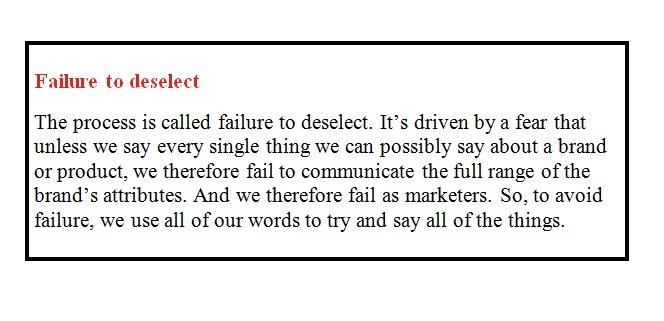
Anyhow in his post Barrie makes mention to something I had not heard of before and which he terms a ‘Failure to deselect‘, being:

“… a fear that unless we say every single thing we can possibly say about a brand or product, we therefore fail to communicate the full range of the brand’s attributes. And we therefore fail as marketers. So, to avoid failure, we use all of our words to try and say all of the things.”

Now, swap out ‘brand or product‘ and ‘marketer‘ and replace it with ‘law or regulation‘ and ‘lawyer‘ and does this sound familiar to you?

It certainly did to me. And in this time of ‘doing more for less‘ in law, it got me to thinking: are we actually suffering from a ‘failure to deselect’?

Is an iTunes store for professional services the next big thing?

dreamstime_m_34802664

Today the Australian Financial Review has published a very interesting article (‘iTunes store for professional services‘) that states:

“Global professional services giants will invest hundreds of millions of dollars over the next 18 months to build iTunes-style repositories of software-supported services that can be distributed to clients through a digital shopfront anywhere in the world.”

going on to state that: “[KPMG] is throwing $US200 million to $US300 million ($425 million) at populating this repository with “disruptive technology assets”“.

All sounds a bit far fetched doesn’t it?

Or does it?

We already know that a number of leading law firms in Australia have developed client facing apps since Gilbert + Tobin’s Telco Navigator app was awarded ‘Services to the industry’ in the professional services category at the 2014 Communications Alliance and CommsDay (ACOMMS) Awards.

Most recently this has included the very informative K&L Gates Hub platform, which is described as being:

“a digital destination for timely insight on critical issues at the intersection of business and law.”

So while law firms may not be throwing $US200 million to $US300 million at this development, there’s little doubt that iTunes (as well as Google Chrome App) may well play a significant role in the way law firms distribute their thought leadership in the future.

And while there is absolutely nothing wrong with this, it made me recall another quote I read this morning to the effect that in the future it may well be the case that your firm’s differentiating factor could be as simple as having the human touch.

Which would you prefer: to be well known, or well paid?

Untitled

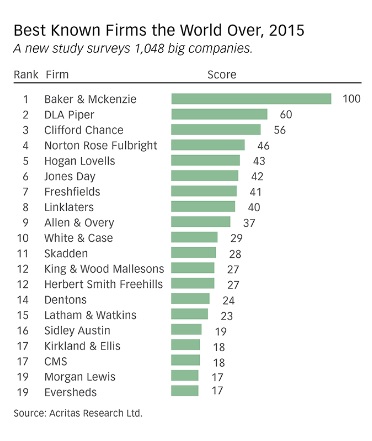
This week saw the publication of Acritas’ report of the ‘Best Known Firms the World Over, 2015‘.

For regular readers of this blog, my views of reports of this kind should be pretty well known by now (hint: I don’t hold them in much stock).

However, this year’s Acritas report goes a step further:- not for who is in the report, but for who isn’t.

And who might they be?

Well, in Slaughter & May and Quinn Emmanuel, only two of the most profitable law firms in the world.

Which rather goes to show that either:

  • (a) “detailed telephone interviews of 1,059 heads of legal departments, their deputies or chief operating officers at 1,048 companies at randomly selected companies with gross revenues of at least $1 billion” means that neither of these firms is that well known, and/or
  • (b) there’s very little correlation between being well known and being well paid.

Given the choice though of coming top of a league of well known law firms or top of a table of most profitable law firms (profits per equity partner), I know which I’d choose.

3 ways you can grow your book of business today

Business Development image

It’s very much been a story of doom and gloom in the Australian legal marketplace of late. Demand is down. The Aussie Dollar has fallen through the floor and seems to keep going. It’s nightmare and has been for some time.

As someone who advises law firms on business growth strategies, all this doom and gloom can be down right depressing. If, that is, you let it.

As for me, I prefer to talk things up and I enjoy looking around for the opportunities rather than dwelling too long on the negative. With that in mind, here are three ways and places you could be growing your book of business today:

  1.  Thailand

tweet 1

Rohini Kappasath (handle @TalkingAsia on twitter) recently tweeted that there are 180 Australian companies – large and small SMEs – operating in Thailand who are looking for growth and guidance.

When I questioned Rohini where these numbers came from, he told me (vid DM) they were provided by DFAT (Department of Foreign Affairs and Trade).

Think about that for a second: 180 Australian companies operating in Thailand who are looking for growth and guidance. I wonder how many of these companies are currently represented by Australian law firms? Having lived in Thailand for 12 years myself, I’d hazard a guess not too many.

Massive opportunity going begging here.

  2.  Malaysia

Headline in yesterday’s The Star Online:

“Domestic F&B players strive to expand into Australia”

with a lead paragraph that reads:

“The domestic food  and  beverage (F&B) sector is striving to expand into the high-value Australian market as reflected from the participation of 18 Malaysian exhibitors at the Fine Food Australia 2015.”

18 Malaysian exhibitors at the Fine Food Australia 2015 with,

“Ninety-five business meetings with over 80 potential business partners were arranged by Matrade for the Malaysian companies during the event”

and not a single law firm in sight (from what I can see).

Massive opportunity going begging here.

3. Inbound M&A

Headline from yesterday’s Australian:

“Foreign takeovers tipped to surge”

with the following graph:

inbound M&A

Other than, “massive opportunity going begging here”, not really sure I need to add anything to that!

So if you practice law in Australia and you are wondering what you can do about your ever dwindling revenue stream, all I can say is the work is out there: you just need to go looking for it.

* did you notice how I didn’t need to mention China once in this post… …quite clever that really.

Currency woes strike again!

dreamstime_m_34802664

It’s that time of the year again when law firms in the UK (at least those with LLP status) publish their annual accounts and, once again, it would appear that currency exchange fluctuations have played a significant part in the profit and loss (P&L) sheets of most with international operations (‘Currency woes hit growth‘ – subscription required).

As I pointed out back in March 2013, and then again in August 2014, the Australian operations of international law firms were not going to be sitting pretty when it came to reporting full year earnings in GBP or US$. At the time the experts were predicting mid 80 cents on the US$, and things can only be said to have taken a turn for the worse since then.

Failing a dramatic turnaround in commodity prices, it doesn’t take a genius to work out this will remain the same unless – or until – the Australian arm of international firms can muscle in on the [hopefully much more attractive US$] rates their offshore partners set up for them on advisory or transactional matters (see my post ‘Can a falling A$ make selling Australian legal services easier overseas?‘).

Alternatively, if you are an international firm with operations in Australia you could do what I have seen a number of firms doing during this reporting season and talk up you Australian earnings in “local currency contributions“. Because all things being equal, these firms have worked hard over the past 12 – 18 months to get their strategy on track and have most likely seen real growth in local currency contribution terms.

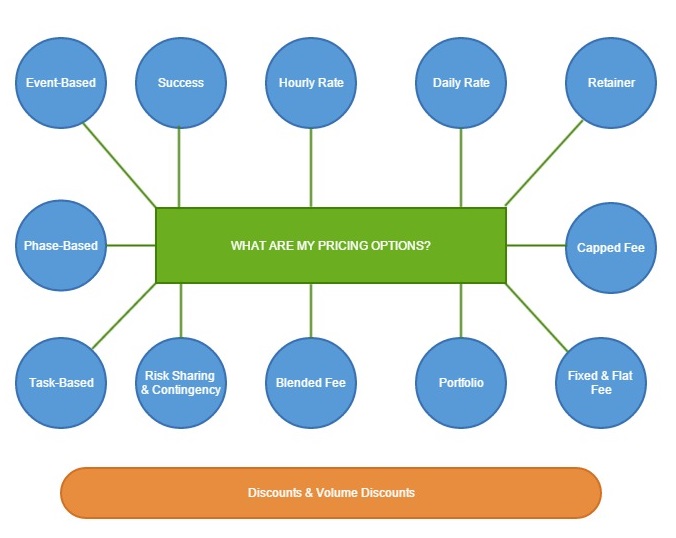
What are my pricing options?

what are my pricing options

You hear a lot these days about ‘pricing‘. This might be as it relates to Alternative Fee Arrangements (AFAs) or Value-based pricing (VBP).

Indeed, all the noise around this issue can get daunting at times.

So for today’s post I thought I would share a graphic that I have created from the many RFTs (tenders), RFQs (quotes), RFPs (proposals) that I have been involved in over the years and which I have named: “What are my pricing options?“.

Also, I’ll let you in on a little secret:- there’s isn’t such as thing as an “Alternative Fee Arrangement” – only pricing options or fee arrangement. Likewise, if properly explained and clearly transparent, all pricing options are value-based.

There’s one caveat I have though: any pricing option that includes a ‘discount’ or ‘volume discount’ component isn’t a pricing option – as you’re not getting your asking price!

I hope your find the graphic useful and if this is a subject you are interested in learning more about I would suggest you start with the Association of Corporate Counsel’s (ACC) Value-based fee primer.

To succeed in the future, law firms need to specialise

dreamstime_m_34802664

Over the course of the past week I have seen two news items that include comments by prominent industry experts advocating that for law firms to success in the future they will need to specialize.

The first item was a short [1 minute 40] video interview of David Lat (editor of Above the Law) titled More ‘Shakeout’ Coming for Big Law, Says Above the Law Editor in which (the recently married – congratulations David) Lat touches on the issue that for firms to survive going forward, they will need to get much better at the specialization game.

The second item, from the same day (11 September), was an article (‘How future-ready is your law firm?‘) on the Australasian Lawyer website that included comments by Keynote speech presenter Jordan Furlong of Edge International and Tim Williams of Ignition Consulting Group at last week’s ALPMA (Australasian Legal Practice Management Association) Annual Conference on the Gold Coast (at which I was not a participant).

In essence the article promulgates the experts opinion that the “future of law firms will be specialisation, rather than expansion” and that “In reality, clients have changed from wanting to be loyal to a full service firm to shopping around for the best firm suited to a particular project.”

Both the article and Lat’s interview video raise an interesting issue and I have to say that while I largely agree with William’s view that:

“Buyers [today] are seeking best in class solutions to their problems. They no longer need to fall back on a generalist firm that they can count on for everything in their hometown.”

it has yet to be fully explained to me why some, but certainly not all, full service firms cannot also claim that they provide “best in class solutions to their clients’ problems”.

The 4 Cs you need to attain “trusted advisor” status

4 Cs of Trust

Following the breakthrough work of David Maister in 2000, gaining The Trusted Advisor status has become the Holy Grail of all private practising lawyers. Not many, however, fully understand what this entails. While many may be able to name one or two elements what follows constitutes the 4 Cs you will need to demonstrate in order to attain “trusted advisor” status with clients and your work colleagues:

 C1 = Credibility: delivering what you promised, when you promised it
 C2 = Competence: having the right expertise and the right track record for the job – and being able to evidence this (as well as being able to say you DON’T have the right expertise to do the job!).
 C1 = Compatibility: being able to work collegiately (as part of a team)
 C2 = Consistency: delivering over a period of time

—

NB: this post was inspired by a recent post by Rachael Wheatley on PM Forum South West: “The Trusted Advisor is Dead. Long Live The Trusted Advisor“