Law firm

Exiting the ‘Valley of Despair’: Tips on rebuilding a book of business

Valley of despair

source: Emily Carr:- ‘Practical Change Management for IT Projects

The ‘Valley of Despair‘ is a term used in IT process improvement projects to describe the period of time where productivity decreases immediately after the implementation of a new process. In essence it describes that period of time during which you shift away from what you know and are comfortable with to what is new and unknown (but which will ultimately, hopefully, results in better processes).

Although a term commonly associated with process improvement, to me this has also become a good way to best describe a growing trend in the modern lawyer’s life; namely that particularly difficult period during which a disruptive element impacts on their book of business. Examples would include:

  • economic: with the GFC most securitization lawyers lost their practices overnight.
  • panel: when your firm loses a panel appointment with your practice’s biggest client as a result of the client rationalizing the number of its panel firms.
  • relationship: the key contact at your biggest client moves to a company your firm has no relationship with; or, worse, is promoted to a role where they no longer have influence over who gets the legal instructions.

There are many others, but you get the gist: your performance hits a wall called ‘change‘.

In my experience, partners who face this scenario come face-to-face with Elizabeth Kuber-Ross’ “Five Stages of Grief“:-

Denial —> Anger —> Bargaining —> Depression —> Acceptance

To overcome the Valley of Despair you need a sixth element: a desire to move forward.

  • Step 1: Accept your fate

The first step in any recovery program is accepting you have an issue. Too often law firm partners stick their heads in the sand and refuse to accept that anything is wrong until the Managing Partner is knocking on their door asking them what their plans are for the future (wink, wink: it’s not with us!). By then, you are well and truly in to the ‘bargaining’ and ‘depression’ phases. If you want to rebuild your book of business you need to be much further ahead of the game than that.

  • Step 2: Do an audit

Here’s the thing: things in life are rarely as bad as they first seem. So, as soon as you become aware of a change agent – such as those above – get out your pen and a piece of paper and write down a list of who you know, when was the last time you contacted them, what type of work could you be doing for them, are you already doing that type of work, etc.

In short, take stock of what you have and who you could be doing it for.

  • Step 3: Make a plan

Alan Lakein is reported to have said: “Failing to plan is planning to fail“. I’m not sure if he actually did, but it’s pretty accurate and if you want to rejuvenate your book of business then you will need a plan of how to go about this.

This plan should include the obvious, like:

  1. what type of work do I want to be doing?
  2. who do I want to do this work for?
  3. what do I know [commercially] about these businesses [tip: if the answer is “not a lot”, get a research assistant on to it ASAP]?
  4. who are the decision makers at these companies?
  5. how likely are they to give you / your firm the work [tip: rank the likelihood from 1 – 5 (very – unlikely)]?

Your plan also needs to include things you may not think of, such as:

  1. will my partners give me relief while I try and rebuild my book of business? If so, how long?
  2. what level of fees do I need to generate (cost +, times 3, times 5)?
  3. what rates will I need to charge to generate that level of fees? will the target client accept these rates? if I need to discount, will my partners accept me discounting to win work when their clients are paying full freight?
  4. who is currently doing the work for the target and what am I bringing to the table that would make the target move the work to me?
  5. how will my competition react to me invading their turf?
  • Step 4: Execute on the plan

I’ve heard it said that: “a plan without an action is a wish“. In the world of professional services, we see a lot of wishing!

So, as soon as you have your plan in place you need to get out from behind your desk and start to execute on it. Look at what

  • inbound and outbound related activities you need to do;
  • networking events are taking place and when;

then set yourself a 30-60-90 day action plan to work towards.

Most importantly, always be responsive and never, ever quit.  Building a book of business takes patience and repetition, you cannot adopt a “lottery mentality” as one shot actions nearly always lead to failure.

So if at first you don’t succeed, try again. That way, you’ll give yourself the very best chance of rebuilding your book of business and moving forward.


RWS_01

Report: Do high growth firms share common traits?

Business Development image

This month saw publication of the 2016 High Growth Study by Hinge Research Institute. Although not limited to law firms, law firms (along with “Healthcare & Other”) made up 12.9% of the 968 respondents who answered Hinge’s survey and, therefore, the Study’s findings help provide some insight into whether or not “High-Growth” firms share common traits.

First, “High-Growth” was defined as being a firm with:

“Over $1 million in revenue and had an average yearly growth rate of at least 20%”.

Not exceptional. Having said that, of the firms surveyed:-

  • 30% generated over 88% of new revenue growth and were 45% more profitable than their No-Growth counterparts

so most definitely desirable.

So, did these High-Growth firms share any traits? In short, “yes”; and these included:

  • Target Clients: High-Growth firms are 75% more likely to have a highly specialized practice – i.e., not all things to all people or full services firms
  • Client base: High-Growth firms are more likely to target the larger clients (over $10 million in revenue)
  • Research: High-Growth firms are 2X more likely to conduct research on their target client
  • Differentiation: differentiators favoured by High-Growth firms are twice as likely to be easier to prove and are more relevant to clients. Importantly, these don’t include “reputation” and “awards won” (favour of No-Growth firms) and do include “culture” and “people”
  • Marketing investment: High-Growth firms invest 23% less in traditional marketing than No-Growth firms. This is because what marketing High-Growth firms do is targeted and measured

While some of these may surprise, they reinforce that in order to grow in today’s market firms need to have a clear understanding of who they are, who they work for, who they would like to work for, and the value/benefits they provide. In short, they’re focused.

RWS_01

Medibank Idea Exchange

Business Development image

For my sins I am a member of Medibank Private Health Insurance. I understand it has something to do with having a young family and the Medicare rebate. Anyhow, regardless the reason I get a lot of emails from Medibank that have always gone to straight to my trash folder. That is, until this morning.

What makes this morning any different? Well, I received an email inviting me to join the Medibank Idea Exchange community. In part wondering why they were suggesting the singular rather than the plural, I thought I would take a look.

What did I find?

Well, while I have no intention of joining, what I found was an offer to join an ‘invite only’ community where I will be able to share my thoughts and ideas on a variety of different topics and issues and:

  • Contribute to discussions and surveys – so you can tell Medibank what you think and help shape future business decisions,
  • Talk with other members – so you can share experiences and handy tips,
  • Earn rewards for participating – that you can redeem on a great range of products and services.

and I thought to myself: “there might be something in this for law firms to learn from“.

RWS_01

Almost 20% of Australian law firms revenue is now coming from fixed fees

dreamstime_m_34802664

It has been a full six months since the last CommBank Legal Market Pulse (conducted by Beaton Research + Consulting) was published and from what I can tell from this latest publication, not very much has changed in that time.

While some members of the Australian legal publishing world have commented on the rising optimism (note this is “perception”, and this has gone from awful to not quite so awful), what grabbed my attention was a piece towards the end of the report (page 19) that states:

“Revenue is still predominantly derived from hourly rates. However, almost 20% of all firms revenue, irrespective of size, is now coming from fixed fees.”

I don’t have to hand data from 5 years ago that would allow me to do a comparison to see what this means in real terms, but given that IBISWorld puts the size of the Australian legal market at $23BN, that’s a lot of fixed fee generated revenue.

Somewhat surprisingly, there doesn’t appear to be a huge difference in the percentage of fixed fee revenue being derived at “top-tier” and “mid-tier” firms – with fixed fees accounting for 19.4% of revenue at top-tier firms and 19.2% among mid-tier firms.

The types of work for which fixed fees are being agreed/charged is also very similar – 88% for transactional matters at top-tier and 89% at mid-tier.

Notable, and surprisingly, is that top-tier firms would appear to be much more willing than mid-tier firms to offer fixed fees for litigation work – 50% to 33%.

But the test is always in the tasting (for wine lovers at least): so how good are Australian law firms at fixed fee pricing?

Well, not very if the data is to be believed. Asked for the margin on fixed fees relative to hourly rates, the responses were:

  • higher: 13% top-tier / 15% mid-tier;
  • lower: 0% top-tier (which seems a little hard to believe) / 56% mid-tier (which is probably being too honest)
  • about the same: 75% top-tier / 19% mid-tier; and
  • not sure: 13% top-tier / 11% mid-tier (which should be worrying some managing partners out there).

As well as finding out that Australian law firms are not very good at fixing fees, the report also tells us that over 67% of all law firm revenue still comes from standard hourly rates or discounted hourly rates. Here though, over 25% of revenue comes from “discounted” hourly rates – which begs the question: when do you start saying your discounted rates are your real rates?

Lastly, almost 3% of all law firm revenue now comes from retainer arrangements (2.6% for top-tier, 2.8% for mid-tier). Now that’s certainly something worth keeping an eye on!


Forget the Gadens merger, the big news today is Olswang’s announced ‘Revenue Share Scheme’

dreamstime_m_34802664

Pretty much all anyone involved in the Australian legal sector will read about in the industry news today will be the reported three way tie-up between Global behemoth Dentons, Australian law firm Gadens and Singaporean firm Rodyk & Davidson, which is still subject to a partner vote but you assume is pretty much a done deal.

Although this may have a profound effect on the Australian legal market in years to come, in much the same way as the K&L Gates / Middeltons merger has hardly set the sector alight, I somehow doubt this merger will too.

There is, however, another piece of news being reported this morning that could very well have a massive effect on the local market – and that is the news that Olswang has established a ‘Revenue Share Scheme’ that it hopes will incentivise staff (it is being reported the scheme is open to all employees at the firm, from partners through to business services staff) to refer clients to the firm through a referral bonuses scheme that will pay an employee who introduces a new client who subsequently spends more than £20,000 in the first year instructing the firm, 10 per cent of the instruction fees in the next year.

I worked under a scheme very similar to this is Asia just after the Asian Financial Crisis and I can vouch that provided you get your conflicts worked out (because trust me, this leads to a lot more potential conflict situations), then this type of scheme can be very incentivising.

While I doubt this type of scheme will be introduced widely here in Australia too soon – after all, why do we get paid salaries, I can see this becoming more prevalent and certainly having a more profound effect on market practice globally.

It’ll be left to the test of time however to see whether – in five years time – everyone is discussing their 10 per cent bonus or the Gadens-Dentons tie-up!

‘Drive for show, Putt for dough’

Business Development image

According to a post earlier this week on the LexisNexis Business of Law Blog:

“A new legal spending trends report finds big law billing rates grew notably – pushing a 6% increase in the gap between the top two tiers of law firms, by attorney headcount, from 38% to 44%.”

Indeed:

“Median partner rates at the “Largest 50” law firms – those with more than 750 lawyers – rose to $711 per hour, based on 12 months of data ending June 30, 2015. That number is up from the last report where median partner rates came in at $675 per hour for the 12 months ending December 31, 2014.”

As I have posted before, however, this [rising headline hourly rates] is absolutely meaningless if your realization rates are in decline – an issue this particular report appears to remain silent on.

I have never understood, beyond ego, why a partner would be more interested in their hourly rate than their average realized billable rate (ARBR). After all, the ARBR amount is the amount that clients are willing to pay you – money in the bank – and is a more accurate reflection of your true worth/value.

Eventually you have to ask yourself which you would prefer: a headline charge-out rate of $1,000- with an ARBR of $700-, or a charge-out rate of $800- with an ARBR of $800-?

And that’s without going into how much easier it is to have the conversation with your clients around rising your realization rather than informing them on 1 July each year that you will be raising your rates by 10% again this year!

Alternatively, you can keep on driving for show and not worry too much about the dough you’re making.

Are international law firm offices worth the trouble?

dreamstime_m_34802664

I’ve read four news items in the last 24 hours that, frankly, would make any law firm managing partner ponder on whether there was any value in opening an international office or two.

1.  PWC’s 2015 Annual law firms’ survey

The first item I read was PWC’s 2015 Annual law firms’ survey – specifically the ‘Global operating and financial performance‘ section, which included the following doom & gloom news:

  • The UK continues to subsidise international offices and exchange rates have further accentuated the imbalance this year. UK profit per all partners is ahead of international by 74.4% (2014: 65.8%) in the Top 10 and 88.5% (2014: 66.8%) in Top 11-50 firms. Fewer chargeable hours and consequently higher fee earner staff cost ratio in international offices is the key differentiator.

  • International chargeable hours for the 1-5 years pqe grade are significantly behind UK offices (between 3% and 33% across the bandings) with the exception of Top 10 firms in the USA (no difference) and Top 11-25 firms in the Middle East (1% in excess of UK performance).

  • Top 11-50 firms continue to expand internationally, with mixed results as the range in performance widens. Average global net profit margins now range from 23.0% to 44.0%.

There’s more, but I think you get the picture:- international law firm partners are effectively being subsidized by their UK partners.

2.   Merged Firms Contend With Weak Aussie Dollar

The second item was by The Asian Lawyer over on the americanlawyer.com who published an article yesterday on an issue that I’ve blogged on no less than four times since 2013 – ‘Merged Firms Contend With Weak Aussie Dollar‘.

The article mentions the entry into the Australian legal market of Herbert Smith (Freehills), Ashurst (Blake Dawson), K&L Gates (Middletons) and King & Wood (Mallesons) and contends that each largely saw the weakening of the Australian Dollar prior to merging and were still happy to proceed with the merger.

It’s definitely an interesting read, if not a little flawed. For a start, K&L Gates are on record as saying that the fall in the Australian currency has hurt them.

If you add to that the HSF tie-up was probably more a “Freehills” driven deal than “Herbert Smith”, and add that currency fluctuations would probably have been the last thing discussed in the Swiss Verein tie-up of KWM, then you’re only left with Ashurst – and rumblings in the UK industry press would seem to suggest that they are not overly happy with the results from their Australian operations at the moment.

All in all then, despite the upbeat message in the article, not a particularly good advertisement for international operations in my opinion.

3.  China set to invest £105 billion in UK over next 10 years

The third article I read was in the China Daily no less, which stated that ‘China set to invest £105 billion in UK over next 10 years‘.

This item, based on research done by think tank the Centre for Economic and Business Research and international law firm Pinsent Masons, is on the back of a trip to the UK by President Xi Jinping.

It nevertheless provides some insight into why Pinsent Masons felt the need to open an office in Australia, even after its merger talks with Australia firm Maddocks fell through. It also makes one think that there’s a world of opportunity out there if you have the right international strategy.

  4.  Cross-border M&A surges

The last was an item I read this morning over on the Australasian Lawyer website – ‘Cross-border M&A surges‘.

This article highlights the findings of a new study by international law firm Baker & McKenzie and again touches on a topic that I’ve blogged about in the past, namely that:

“Australia is a significant destination for inbound cross-border M&A and that’s a trend that has continued in recent years and in the past 12 months, there has been a number of significant cross border M&A transactions into Australia,” Baker & McKenzie Sydney partner David Holland told Australasian Lawyer.

While the last two items undoubtedly give you cause for why a law firm would have international operations, I’m nonetheless cautioned by another my recent posts: “A bridge too far” : When international law firm mergers turn sour, which also featured a certain K&L Gates.

BTI’s The Mad Clientist: New Business for the Taking: Corporate Counsel Shift Work Back to Law Firms

dreamstime_m_34802664

In private practice and looking for a good news story to read this weekend? Then BTI Consulting Group’s The Mad Clientist may well just have it.

According to his latest blog post,

“After 4 years of feverishly bringing work in-house [following the GFC] corporate counsel are reversing course.”

Is that cries of joy I hear ring out?!? If so, the news only gets better. Because not only are in-house counsel shifting work back to law firms, but the type of work they are sending out is the sweet spot big ticket matters. Indeed, according to BTI’s study of 322 corporate counsel, “Chief Legal Officers expect a tripling of bet-the-company litigation, increases in class actions, and substantially more securities litigation.

But before you go clambering over your other partners to get on the phone to your in-house counsel contacts, keep in mind that (1) the study was done in the USA, and (2) BTI is of the opinion that:

“The big winners will present themselves to clients as strategists and discuss risks and exposures before the matters ever start. The bigger winners will discuss prevention, potential settlement postures and learn about the business risks posed by the new matters.”

Putting that aside for a second though, we can but hope that the tide is turning here and that the pendulum has once again swung back in favour of private practice. But in order to be best placed to take advantage of this development, you need to be working through your client plans (including engagement and communication actions) now so that you can be ready to take full advantage of whatever 2016 throws at you!

Until then, “have a great weekend!”

Is an iTunes store for professional services the next big thing?

dreamstime_m_34802664

Today the Australian Financial Review has published a very interesting article (‘iTunes store for professional services‘) that states:

“Global professional services giants will invest hundreds of millions of dollars over the next 18 months to build iTunes-style repositories of software-supported services that can be distributed to clients through a digital shopfront anywhere in the world.”

going on to state that: “[KPMG] is throwing $US200 million to $US300 million ($425 million) at populating this repository with “disruptive technology assets”“.

All sounds a bit far fetched doesn’t it?

Or does it?

We already know that a number of leading law firms in Australia have developed client facing apps since Gilbert + Tobin’s Telco Navigator app was awarded ‘Services to the industry’ in the professional services category at the 2014 Communications Alliance and CommsDay (ACOMMS) Awards.

Most recently this has included the very informative K&L Gates Hub platform, which is described as being:

“a digital destination for timely insight on critical issues at the intersection of business and law.”

So while law firms may not be throwing $US200 million to $US300 million at this development, there’s little doubt that iTunes (as well as Google Chrome App) may well play a significant role in the way law firms distribute their thought leadership in the future.

And while there is absolutely nothing wrong with this, it made me recall another quote I read this morning to the effect that in the future it may well be the case that your firm’s differentiating factor could be as simple as having the human touch.

Which would you prefer: to be well known, or well paid?

Untitled

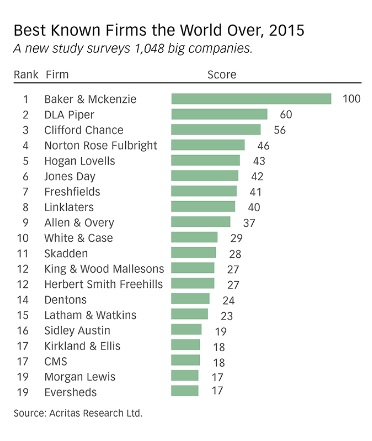
This week saw the publication of Acritas’ report of the ‘Best Known Firms the World Over, 2015‘.

For regular readers of this blog, my views of reports of this kind should be pretty well known by now (hint: I don’t hold them in much stock).

However, this year’s Acritas report goes a step further:- not for who is in the report, but for who isn’t.

And who might they be?

Well, in Slaughter & May and Quinn Emmanuel, only two of the most profitable law firms in the world.

Which rather goes to show that either:

  • (a) “detailed telephone interviews of 1,059 heads of legal departments, their deputies or chief operating officers at 1,048 companies at randomly selected companies with gross revenues of at least $1 billion” means that neither of these firms is that well known, and/or
  • (b) there’s very little correlation between being well known and being well paid.

Given the choice though of coming top of a league of well known law firms or top of a table of most profitable law firms (profits per equity partner), I know which I’d choose.