client value

VLSB evidence shows AI’s ‘benefits’ may not yet be ‘benefits’

Late last week (30 October 2026), the Victorian Legal Services Board (VLSB) and Commissioner’s Legal Services Research Centre published their The Evolving Use of Generative AI: Findings from the 2026 Victorian Lawyer Census.

The voluntary census received responses from 2,221 Victorian qualified lawyers and found:

  • 55% were using AI in legal practice, up from 37% in 2025;
  • 78% of AI users had increased their use during the year;
  • 79% of AI users relied on general-purpose products such as ChatGPT, Claude, Gemini and Copilot; and
  • adoption differences between career stages had largely disappeared among lawyers aged under 60.

Some other significant AI-related takeaways from the Report:

  • Among AI users in fee-charging practice, 26% said AI had produced lower fees for clients. Fee reductions were more common among lawyers principally serving B2B clients.
  • 46% of client-facing lawyers reported clients arriving with inaccurate or misleading information obtained through AI
  • 41% had received AI-generated documents or correspondence requiring correction.
  • Only 10% reported clients arriving with a better understanding of their legal issues because of AI.

One of the biggest red flags to come out of the Report: 46% of lawyers said it increased the time and effort required to deliver services.

Clearly we have a way to go, and while adoption is up its use still needs improvement.

Interesting though, use of general-purpose AI platforms is much higher than I had thought. Which leads to the question: Where’s the governance?

Link to Report

rws_01

When it comes to how much you can charge clients, the size of your firm matters!

The size of your firm has no bearing on the amount you can charge clients.

Now if you have read the above quote and thought to yourself “of course the size of your firm has no bearing on the amount you can charge clients, clearly Smith has lost it again!“, then bear with me.

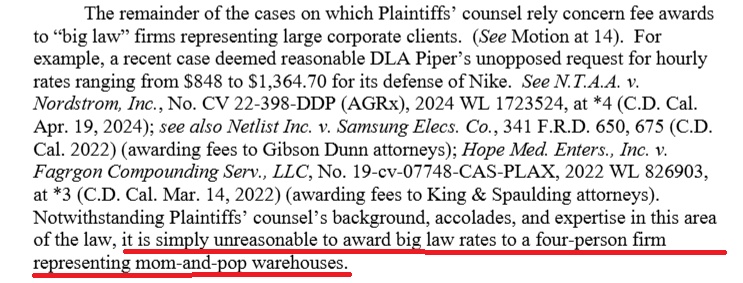
In a recent matter before the Central District of California, the Honorable Michael W Fitzgerald disagreed with the notion that the size of a law firm should have no bearing on the amount you can charge clients when he stated:

“it is simply unreasonable to award big law rates to a four-person firm representing mom-and-pop warehouses.”

In what is otherwise far reaching commentary on the history and application of the billable hour (well worth a read in itself), Fitzgerald’s ruling is troubling; not least because it is based on a premise that bigger means better — and better means more expensive. Now that could be true. But it doesn’t make it so.

Conversely, should I, as a client, be happy to pay more because the attorney acting on my matter works in a firm that has seven floors over one that has one? Surely the answer here is “no”, I’m paying for outcomes over inputs.

But that’s not the case here. If we follow Fitzgerald’s reasoning in this case, the real drivers of price: (a) Perceived expertise and relevance; (b) Client experience and accessibility; and (c) Outcome certainty and risk management, are certainly consideration, but no longer primary.

rws_01