business development

Stress in legal affects more than just lawyers

Business Development image

I want to start this post by acknowledging how far the discussion around mental health and wellbeing has moved within the Australia legal industry since the death of Tristan Jespon in October 2004. In part I put the moving of this needle down to the work of my good friend Justin Whealing while he was editor of Lawyers Weekly and in part I put this down to the continued work of Jerome Doraisamy, also of Lawyers Weekly and Minds Count (the new name for The Tristan Jepson Memorial Foundation). Don’t get me wrong though, there are many many others who have played both active front-line and support roles in ensuring the issue of mental health and wellbeing is taken more seriously in our profession (see RUOKAY Day for example).

That said, while I think all of these initiatives and discussions are fantastic and are standouts that should make us extremely proud of the direction the industry is taking in Australia, almost every single conversation that I have been involved in on this issue has related to the mental health and wellbeing of lawyers – and, more specifically, junior lawyers. So it was great to see a report published earlier this month by fSquared Marketing on the issue of ‘Legal Marketing Mental Wellness’.

The subtitle of this report – ‘Stress in legal affects more than just lawyers’ – sets out the parameters of the journey the reader is about to undertake. And if you are left in any doubt about this, one of the first paragraphs of the Report cuts to the rub of the issue and totally grabs your attention and is also so very true.

It reads:

What about the legal marketing and business development professionals who are tasked with growing firms how is their mental health? They work in the same high-pressure environment as attorneys after all, and often under their direct management. Might the traditional pyramid structure, with equity partners at the peak, lead to stress cascading down the hierarchy to fall on the shoulders of the marketing and BD staff?

As someone who has worked on the front-line for over a decade my response is – ABSOLUTELY!

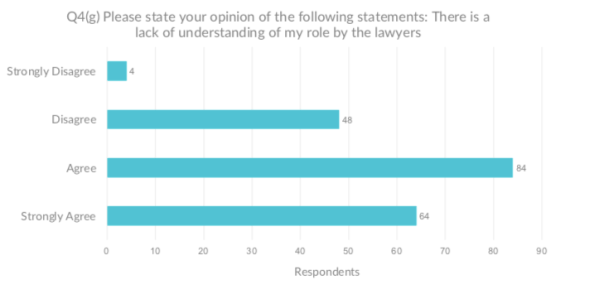
Taking a look at some of the responses I was particularly saddened, although not overly surprised, by these two graphs:
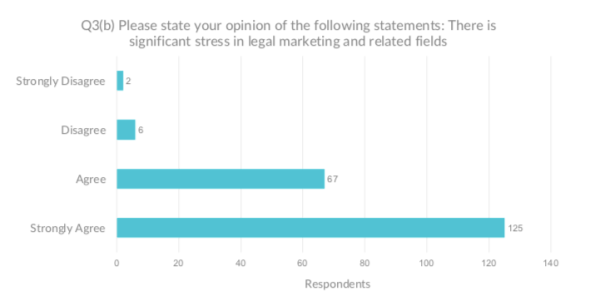
Screen Shot 2019-09-25 at 8.50.11 pm

Screen Shot 2019-09-25 at 8.58.37 pm

both of which were followed up by:

  • When reflecting on their own experiences, 83% of respondents listed their level of stress as at least a 7 on a scale of 1-10. No respondents reported feeling “very little to no stress”.
  • 71% of respondents agreed or strongly agreed with the statement: “I have too much work assigned to me.”
  • 76% agreed or strongly agreed with the statement: “There is a lack of resources in my department/assigned to marketing.”

And the following two highlighted comments made me sad that I personally am not delivering on my duty to my team and that the industry more generally really needs to address this issue:

“Much of the stress would be alleviated with stronger leadership from firm management, as well as from growing the marketing/business development team.”

“It is unfortunate that law firms segregate mental health awareness between lawyers and non-lawyers. Somehow they feel that staff (with whom they work directly) do not suffer from the same level of stress that the lawyers do.”

As damning as that last statement is – and never underestimate how damning it is, I want to end this post on a positive note, and that is this:

62% agreed or strongly agreed with the statement: “My team’s ‘wins’ in marketing are celebrated”.

I certainly hope my wonderful team think so!

rws_01

*if you are having issues in this area, no matter what firm you are from, never feel shy to reach out. I don’t promise to have the answer (frankly I won’t), but I will try and help you find that answer.
Would you use an unlicensed or unqualified legal advisor?

Last Friday’s (April 26) The Soul of Enterprise Free Rider Friday podcast (Millionaires, Marxists, and Minimum Wage) with Ron Baker and Ed Kless, included a ‘stack’ (their term not mine) by Ed on the news that “Kim Kardashian Is Right: Lawyers Shouldn’t Have to Attend Law School”. As someone who knows absolutely nothing about the Kardashian family (nor wishes to), not much in that – apart from the comment that Ed and Ron go on to make in respect of Episode #225 of their series of podcasts in relation to “occupational licensure”.

In short Ron and Ed talk about the fact that there are some jobs around the world where you need a ‘licence to practice’ – examples: a barber (hat tip to Ron’s Dad there), an accountant, and even a lawyer.

On the back of the Kim Kardashian issue, Ed and Ron then go on to ask this question:

If you know someone isn’t qualified (e.g., don’t have a law degree) or isn’t licensed (e.g. have a practising certificate), should you still be able/allowed to ask them for professional advice – provided that you sign a waiver/agreement/whatever stating that you know that persons isn’t qualified or licensed to provide the requested advice?

Never, no way, stupid idea.

And I would agree with you.

But wait, we’re all adults here and should be allowed to determine our own future and make our own decisions.

Exhibit A: this is an excerpt from the British Government’s website (April 2017) in relation to obtaining legal advice in Thailand:-

“There is no restriction on any Thai national , with or without a law degree [bolded and underlined for emphasis by me], to offer you legal advice.”

Now Thailand is a civil law jurisdiction with a codified law, but still…

…leaving aside the whole issue of how stupid you may or may not need to be take legal advice from a non-licensed, non-qualifed expert (bought a pre-pack will lately?) – here’s a precedent.

There are “lawyers” who advise “on the law” who are not educationally qualified (as opposed to possibly life) or institutionally licensed.

Interesting as that all is though, that’s Thailand – hardly the US, UK or Australia.

Well hang on a second…

Listening to Ed and Ron’s podcasts there are States in the US where you can now obtain ‘legal’ advice from someone who isn’t qualified or licensed, provided that you sign a waiver saying that you knew this to be the case.

And, in my view the following comment from legalfutures.com – reporting on The UK Legal Services Consumer Research Report 2019 yesterday:-

A smaller majority (58%) would be prepared to use freelance solicitors, due to arrive this November with other Solicitors Regulation Authority rule changes, if they could save money on fees.

means they are not a long way behind.

As always though, interested in your thoughts/views/feedback.

rws_01

* if I have misrepresented or misunderstood my take-outs from Ed and Ron’s podcast, then I apologise to them.


The perfect storm for #OldLaw?

In my last post I mentioned that I may post some further thought I had on this year’s Altman Weil Chief Legal Officer Survey.

One further comment on the Survey findings I did want to make relates to what I consider to be ‘the perfect storm’ brewing for the so-called #OldLaw or Traditional Law firm model.

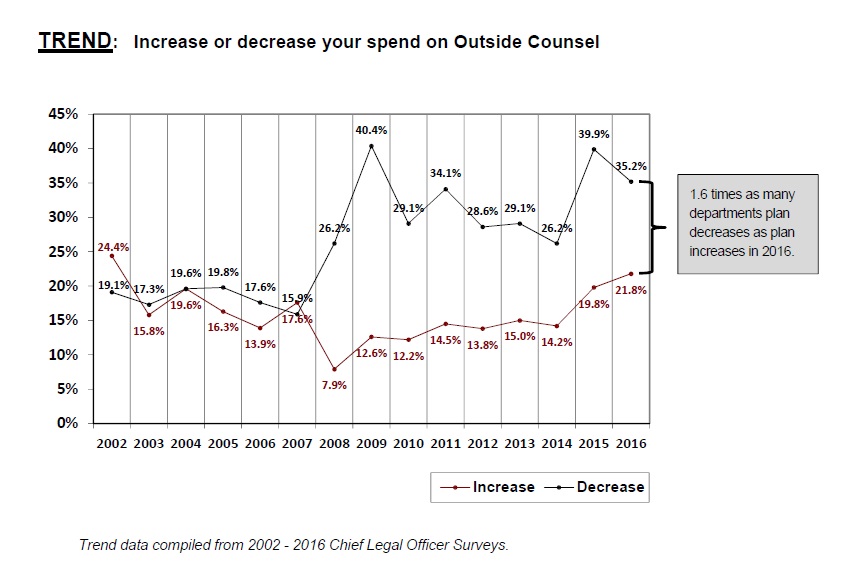
And the best thing about this post is that my point can be made by showing you the following three easy to read charts from the Survey:

Chart 1

QUESTION: What are the chances you’ll be spending more money with me – your outside counsel – in the medium to long-term?

aw-1

[click on chart to expand]

ANSWER: Not an awful lot!

Chart 2

QUESTION: If you are not giving me – your outside counsel – the work, then who are you giving it to (ie, who is my main competitor)?


aw2

[click on chart to expand]

ANSWER: Yourself!

Chart 3

QUESTION: When you do give me work, what are the chances that you are going to ask me for a discount?

aw3

[click on chart to expand]

ANSWER: Very likely indeed!

Have to say, reading these three charts I’m left with the feeling that outside counsel are in for a very rough ride unless they are 100% focussed on what they want to do, and who they want to do it for!

RWS_01

The BIG takeout from this year’s Altman Weil CLO Survey

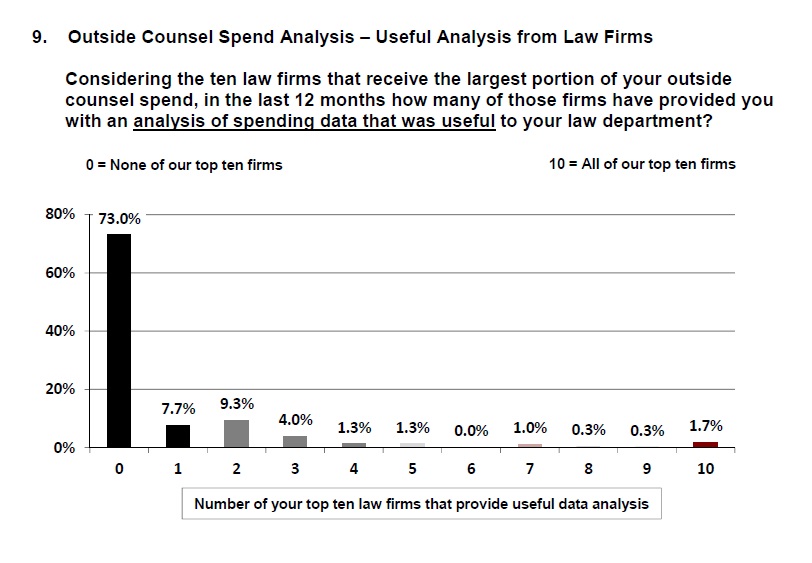
Altman Weil published the 2016 edition of its Chief Legal Officer Survey overnight Australian time. I may well post some more of my thoughts on this year’s content in the coming days, but what I wanted to share with you immediately is what I consider to be one of the most damning charts I have ever seen as it relates to business development, legal spend, and client relationship management:

altman-weil-clo-survey

That’s right, when asked the question:

Considering the ten law firms that receive the largest portion of your outside counsel spend, in the last 12 months how many of those firms have provided you with an analysis of spending data that was useful to your law department?

An overwhelming majority of CLOs (73%) responded “none”.

So, if you work for a law firm looking to differentiate your services; then the answer is it really isn’t that difficult.

RWS_01

Why asking someone to work 2,000 billable hours a year will kill their spirit

Business Development image

According to a post by Casey Sullivan of Bloomberg, earlier this week US law firm Crowell & Moring announced that it would increase its billable hour requirement for associates, from 1,900 hours per year to 2,000 per year. This new target will take effect 1 September 2016, but on the plus side 50 pro bono hours will count as billable.

15 Years ago I would have cried out “all kudos to you”. Back then my yearly billable target for an English ‘Magic Circle’ firm was 1,400 hours and I flogged my guts out to achieve that. So if you can effectively put 50% of billables on top of what I was doing (and trust me when I say I wasn’t going home at least one day a week), then you’re a better person than I (or so I would have said then).

But if you really need validation of what asking someone to work 2,000 billable hours a year means, then I would like to recommend you read “The Truth about the Billable Hour” by no less an institution than Yale University. In that publication, Yale caution aspiring lawyers that if you are being asked to “bill” 2201 hour, you need to be “at work” (includes travel time and lunch, etc.) 3058.

Taking that further, from an Australian law perspective, if you are being asked to bill 2,000 hours a year then you need to bill 8.3 hours a day (assuming a 48 week year and you never get sick; which, if you are being asked to do this, you most likely will be). That means you are very likely going to need to be “in the office” around 12 hours a day – and that assumes no write-off by your partner or leakage.

But here’s the question: “What difference does this make?

I ask this because I wholly agree with the following comment my friend Kirsten Hodgson made when I posted a link to this article on LinkedIn:

“why would you reward the number of hours someone spends working? Surely it would be better to focus on how to deliver value smarter and more quickly. This doesn’t incentivize innovation or any type of process improvement.”

Exactly right, you’re measuring all the wrong things!

Leaving aside the Balance Scorecard argument, asking someone to do 2,000 billable hours a year doesn’t take into account:

  • client satisfaction
  • realisation (it’s a utilisation metric)
  • working smarter
  • innovation

or many other metrics.

And for those who may point out the benefits of this including 50 hours pro bono I say this: the Australian Pro Bono Centre National Pro Bono ‘Aspirational Target’ (ie, where we would like to get to), is 35 hours per lawyer per year.

But probably more importantly than all of this is this:

–  if you ask someone to do this, then you really leave them very little time to do anything else.

This really should be a concern, on the business front because you leave almost no time whatsoever to train them in the business of law – ie, you kill any entrepreneurial spirit they may have. And, crucially, the only metric that really counts to them is that all important 2,000 billable hours (keep in mind that like I was, they’re very young). Which for a profession that has the mental health issues we do, is not good.

For all of these reasons, I’m hoping no other law firm follows this. But sadly I think they will.

Oh, and if you are a law firm client reading this post you might just want to look up whether your local jurisdiction has a “Lemon Law” rule that applies to provision of a service.

RWS_01

Survey: The role pricing specialists play [or don’t] in RFP responses

Last week the USA’s J Johnson Executive Search, Inc and the UK’s Totum published their combined ‘RFP Survey Responses: U.S. and U.K. Data 2016‘.

A fairly evenly distributed demographic of large (defined as being 600+ lawyers), mid-sized (defined as being 100-600 lawyers) and small (up to 100 lawyers, for the U.S. only) law firm respondents, insights from the survey include time spent responding to RFPs, persons within firms charged with project managing responses, as well as tools and expertise made available to responding teams, in both the U.S. and the U.K.

As with most surveys of this nature however, it is the role that pricing plays that typically grabs my attention and given this survey’s combined U.S. and U.K. perspective even more so in this case.

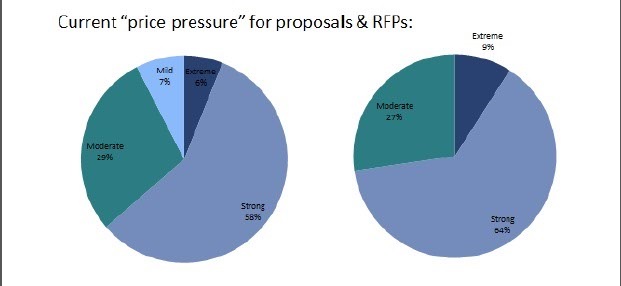
Given ongoing market pressures, it should surprise no one that responses of “strong” from the U.S. (58%) and the U.K. (64%) to the question of what current “price pressure” for proposal & RFPs were fairly similar.

rws-5


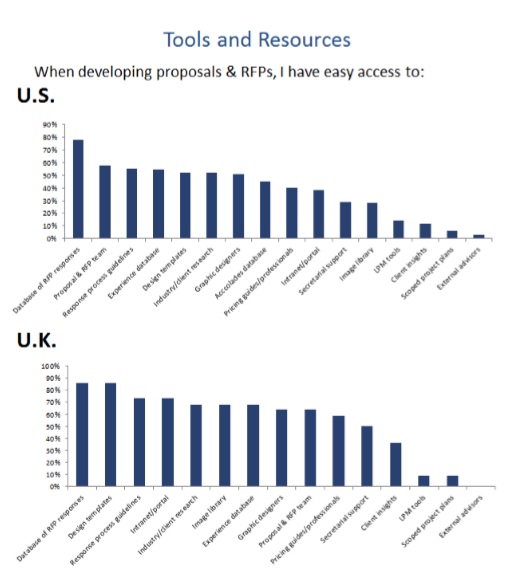
A little more surprising to me was the difference in responses between the U.S. (40%) and the U.K. (60%) to the question “when developing proposals and RFPs, I have easy access to” the answer was “pricing guides/professionals“.


rws-7


Now don’t get me wrong, even these days I think it is particularly progressive and somewhat comforting to know that 60% of my colleagues in the U.K. have access to some sort of “pricing guide/professional”.

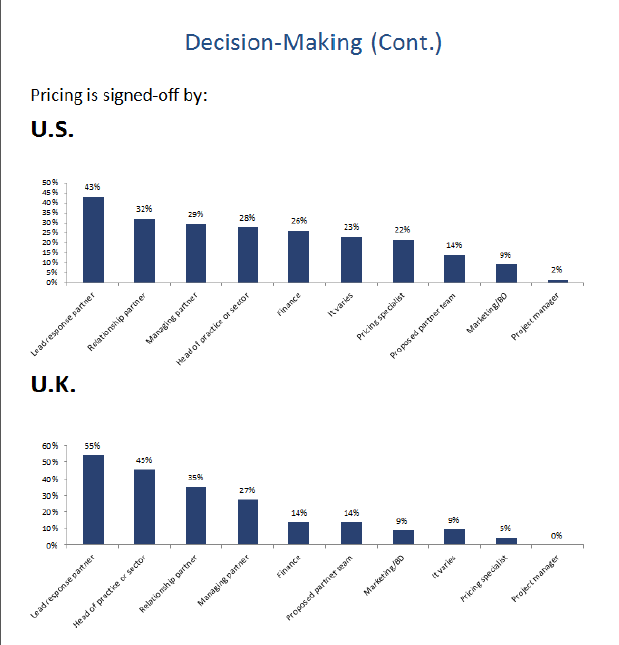
Until, that is, you get to see who actually gets to sign-off (i.e., the “decision maker”) on the all important issue of pricing in RFPs in the U.K.. Here, and I kid you not, the response in the U.K. of “pricing specialist” (that same person who 60% claim to have some form of access to – either via guides or in person) was 5%.

I think that is worth repeating – 5%.

Put into context, that means in the U.K. pricing in your RFP is more likely to be signed off by Marketing & BD (9%) or Finance (14%). Indeed, in the U.K., “It varies” is likely to have more of a say on final pricing in the RFP response than the so-called pricing specialist.

rws-4

I’m not so sure why the results of this particular survey so surprise me. After all, time and time again survey results show that we typically say one thing about pricing, but do quite another.

What I will say though is this: if you have access to a pricing specialist, and pricing by your pricing specialist is being determined in 5% or less of your RFP responses, my guess is going to be one of two things: (a) you have no idea if you are making money from your RFP “wins”, or (b) more likely, you are leaving money on the table big time!

RWS_01

* images should be enlargeable, apologies if they appear a little blurred.

How long before we see a ‘Red Team’ service in #Auslaw?

Business Development image

Of note overnight (OZ time) was news that Bernero & Press (Wendy Bernero and Aric Press) have launched a service called: ‘The Red Team’.  Described as being “A Lifeline for Marketing and Business Development Departments” the aim of The Red Team is to provide:

“…high-quality, experienced marketing, communications, and business development professionals to law firms on a project basis or to fill temporary needs.”

Sounds very similar to the sort of lawyer placement service we are seeing from the likes of Crowd & Co here in Australia, only in this case the target market is specifically support services.

I have to say that outsourcing back office services such as marketing and business development was something I saw becoming popular in Asia during the Asian Financial Crisis in late 1998 and I have often wondered when we would see such a move take hold in the West.

Today may just be that day.

RWS_01

Independence Day & The Billable Hour

Two things got my attention on Friday. The first was the decision by the UK to exit the EU (so-called “independence Day” by some of the more fanciful politicians and “Brexit” to most of the rest of us). On a much smaller scale, the second was an article in The Australia Financial Review that “Ditching the billable hours case a struggle“. (print edition – NB: online the article title is “Billable hours to always hold a place in law firms“).

With the first of these two items, I have very little to no control over and am left at the mercy of others.

The second on the other hand is absolute rubbish!

To be clear, mention of the billable hour in the opening four (4) paragraphs of this article are all to internal metrics; specifically how many hours fee earners need to bill each day to make budget (and a side note here, anyone else note how this changed from an annual figure of 1,400 hours to a daily figure of between 6 and 7.5 hours depending on which firm you work for? Is this because a daily figure is much easier to live with than an annual figure that daunts you by its task? If so, kind of simplistic thinking towards people who are supposed to be in the top 1%).

Anyhow I digress as this has nothing to do whatsoever with how clients are charged, much less how they want to be charged, and whether or not the billable hour needs to remain the “go to” fee arrangement of choice by firms and paragraph five (5) of the article tackles this issue head on when it says:

“However, the majority of firms said they worked with clients and offered alternative fee arrangements if suitable.”

You’re kidding right?

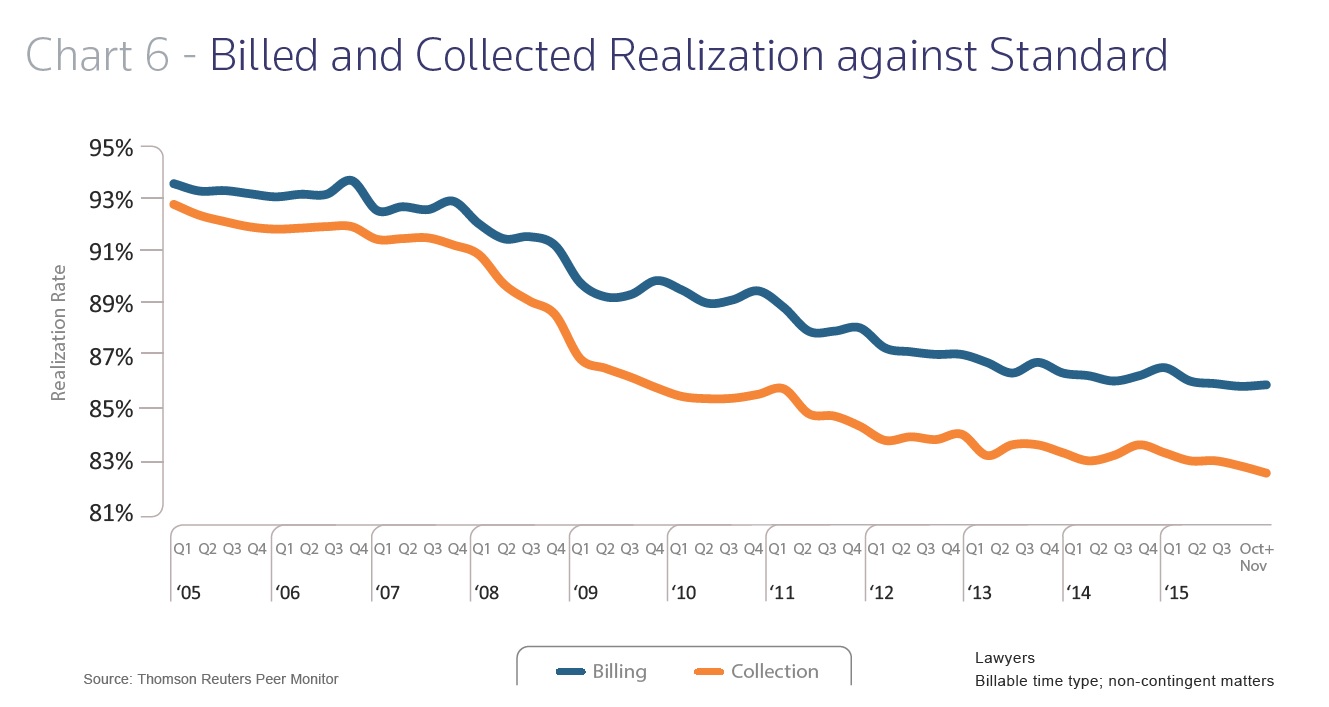
For those of you who have not seen it lately, here is the Thomson Reuters Peer Monitor ‘Chart of Billed and Collected Realization Against Standard‘ for the period 2005 to 2015:

realise

That squiggly little line in free-fall tells you realization rates have fallen from roughly 93 cents in the dollar in 2005 to just over 83 cents in the dollar in late 2015. It also tells me that you are not doing a very good job if you are working with your clients vis-a-vis how you charge them for the work you do and it puts to rest any attempt to suggest that billable hours are the preferred method of clients to be billed (unless, that is, you’re suggesting that clients know they can get discounts, or just not pay, bills that accrue on an hourly basis).

So over the weekend I got to think: like the article says, pretty much all of the reasons why the billable hour continues to be a struggle to ditch are down to internal measurement metrics. So, maybe, just maybe, like the UK did on Friday, it’s time for Australian law firms to opt out of the known and disruptive itself – and maybe the rest of the world with it!

RWS_01

Will a ‘One Asia’ strategy work for BLP?

Business Development image

I spent just over a decade in Asia between the 1990s and mid-2000s. In all the time I spent there I never considered the Region as ‘One Market’ – but rather as a multitude of diverse and different markets.

By way of example, almost everything we did in Asia was “ex-Japan“. This wasn’t because we didn’t see Japan as part of “Asia” – as it very much is – but rather because the international legal market there (NB, the Japanese local legal market is a very different issue) has far more in common with the US market than the Asian. As a result, we lumped Japan in with the US when discussing strategy (and you’re free to question that thinking/strategy).

Likewise, any strategy discussions we had that involved Singapore almost always included India, the Middle East and the Philippines. Similarly, strategy discussions that involved Hong Kong included not only mainland China but also Indonesia.

Finally, SE Asia (Thailand – where I was located, Myanmar, Laos, Cambodia and Vietnam) was its own regional discussion.

All up then, when discussing “Asian” strategy we had four or five discussions – not one.

That said, I worked with (but not for) firms (notably Herbert Smith as it was then) who operated on a fly-in fly-out basis. In my day we called this the “hub and spoke” approach, where the expertise went to the client need and, I have to assume, strategic discussions were done on a Regional basis.

While not criticising firms who took this approach – some did very well out of it – I didn’t think it worked for the firms I worked with as we held the view that, probably more so than any other market in the world, Asia operates on a relationship basis. Our experience was that relationships trumped expertise, and in the very family operated business world of Asia at that time, cost.

So why the history lesson?

Last week, in the Asian Lawyer, I read Bob Charlton – Asia Managing Partner of Berwin Leighton Paisner (BLP) – comment, following the firm’s Asian retreat, that:

“…in broad terms we agreed we must have a one Asia approach.”

Interesting, I wonder what BLP could mean by “a one Asia approach“?

Fortunately the article sets out exactly what that means:

“BLP’s “one Asia” strategy means the firm is doing away with the concept of geographic and practice area distinctions, focusing instead around sector groups. These groups include aviation, construction, oil and gas, private wealth and shipping.”

Now that really is interesting because, frankly, I’m not sure it is going to work.

A sector focus in Asia is a sensible move. A sector only approach to market in Asia is gutsy to say the least.

I say this for two reasons: (1) ‘relationships still trump in Asia’, and (2) Asia is not now, nor will it be for a very long time (if ever), one economic zone. That’s the case both for inbound and outbound work. And even if you don’t want to have people on the ground (which I would strongly recommend you do), you need to consider the geo-political economic implications separately.

And I’ve said all of this without mentioning the elephant in the room: “AdventBalance”. I wonder if they take a sector approach to their strategic thinking in Asia…

RWS_01

$180K for a First-Year Associate – so what!

Business Development image

One of the big news items this week has been the decision by Cravath, Swaine & Moore to raise its starting salaries for first year associates to $180,000. Cries of “Not worth it!” and “What value do first year associates provide clients?” (answer: probably none) can be heard from all four corners of the planet.

My view on this though is so what? I don’t really care what you pay your first year associates. In the same way I don’t really care what you pay your other associates or partners. Nor do I really care what your rent is costing you.

Unless, that is, I get to thinking that: I am the one paying for all this. In which case, I suddenly become very interested.

But here’s the thing: I’d only really start to think that I’m the one paying for all your luxuries – the boat you have moored at the marina, the sports car you drive, the house you live in, the first year associate you can call on day and night – if I didn’t value the service you provide me. In other words: If I didn’t think I was getting value for money.

So if you’re one of the many private practitioners questioning the move by Cravath, Swaine & Moore, my only comment/question is this:

If you are providing your clients with a value for money service offering – and you are able to communicate this, why should it bother you?

RWS_01