Australian firms

Which would you prefer: to be well known, or well paid?

Untitled

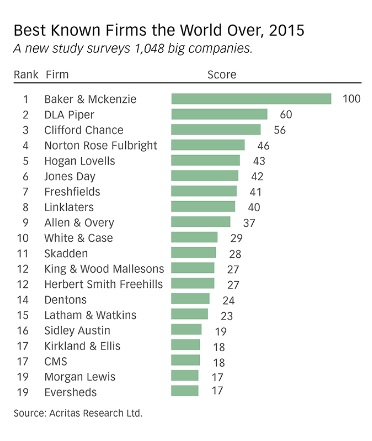
This week saw the publication of Acritas’ report of the ‘Best Known Firms the World Over, 2015‘.

For regular readers of this blog, my views of reports of this kind should be pretty well known by now (hint: I don’t hold them in much stock).

However, this year’s Acritas report goes a step further:- not for who is in the report, but for who isn’t.

And who might they be?

Well, in Slaughter & May and Quinn Emmanuel, only two of the most profitable law firms in the world.

Which rather goes to show that either:

  • (a) “detailed telephone interviews of 1,059 heads of legal departments, their deputies or chief operating officers at 1,048 companies at randomly selected companies with gross revenues of at least $1 billion” means that neither of these firms is that well known, and/or
  • (b) there’s very little correlation between being well known and being well paid.

Given the choice though of coming top of a league of well known law firms or top of a table of most profitable law firms (profits per equity partner), I know which I’d choose.

3 ways you can grow your book of business today

Business Development image

It’s very much been a story of doom and gloom in the Australian legal marketplace of late. Demand is down. The Aussie Dollar has fallen through the floor and seems to keep going. It’s nightmare and has been for some time.

As someone who advises law firms on business growth strategies, all this doom and gloom can be down right depressing. If, that is, you let it.

As for me, I prefer to talk things up and I enjoy looking around for the opportunities rather than dwelling too long on the negative. With that in mind, here are three ways and places you could be growing your book of business today:

  1.  Thailand

tweet 1

Rohini Kappasath (handle @TalkingAsia on twitter) recently tweeted that there are 180 Australian companies – large and small SMEs – operating in Thailand who are looking for growth and guidance.

When I questioned Rohini where these numbers came from, he told me (vid DM) they were provided by DFAT (Department of Foreign Affairs and Trade).

Think about that for a second: 180 Australian companies operating in Thailand who are looking for growth and guidance. I wonder how many of these companies are currently represented by Australian law firms? Having lived in Thailand for 12 years myself, I’d hazard a guess not too many.

Massive opportunity going begging here.

  2.  Malaysia

Headline in yesterday’s The Star Online:

“Domestic F&B players strive to expand into Australia”

with a lead paragraph that reads:

“The domestic food  and  beverage (F&B) sector is striving to expand into the high-value Australian market as reflected from the participation of 18 Malaysian exhibitors at the Fine Food Australia 2015.”

18 Malaysian exhibitors at the Fine Food Australia 2015 with,

“Ninety-five business meetings with over 80 potential business partners were arranged by Matrade for the Malaysian companies during the event”

and not a single law firm in sight (from what I can see).

Massive opportunity going begging here.

3. Inbound M&A

Headline from yesterday’s Australian:

“Foreign takeovers tipped to surge”

with the following graph:

inbound M&A

Other than, “massive opportunity going begging here”, not really sure I need to add anything to that!

So if you practice law in Australia and you are wondering what you can do about your ever dwindling revenue stream, all I can say is the work is out there: you just need to go looking for it.

* did you notice how I didn’t need to mention China once in this post… …quite clever that really.

Currency woes strike again!

dreamstime_m_34802664

It’s that time of the year again when law firms in the UK (at least those with LLP status) publish their annual accounts and, once again, it would appear that currency exchange fluctuations have played a significant part in the profit and loss (P&L) sheets of most with international operations (‘Currency woes hit growth‘ – subscription required).

As I pointed out back in March 2013, and then again in August 2014, the Australian operations of international law firms were not going to be sitting pretty when it came to reporting full year earnings in GBP or US$. At the time the experts were predicting mid 80 cents on the US$, and things can only be said to have taken a turn for the worse since then.

Failing a dramatic turnaround in commodity prices, it doesn’t take a genius to work out this will remain the same unless – or until – the Australian arm of international firms can muscle in on the [hopefully much more attractive US$] rates their offshore partners set up for them on advisory or transactional matters (see my post ‘Can a falling A$ make selling Australian legal services easier overseas?‘).

Alternatively, if you are an international firm with operations in Australia you could do what I have seen a number of firms doing during this reporting season and talk up you Australian earnings in “local currency contributions“. Because all things being equal, these firms have worked hard over the past 12 – 18 months to get their strategy on track and have most likely seen real growth in local currency contribution terms.

What are my pricing options?

what are my pricing options

You hear a lot these days about ‘pricing‘. This might be as it relates to Alternative Fee Arrangements (AFAs) or Value-based pricing (VBP).

Indeed, all the noise around this issue can get daunting at times.

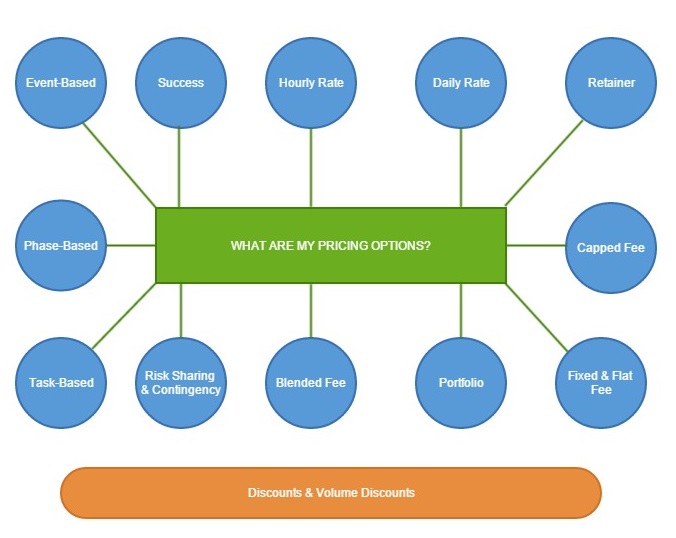
So for today’s post I thought I would share a graphic that I have created from the many RFTs (tenders), RFQs (quotes), RFPs (proposals) that I have been involved in over the years and which I have named: “What are my pricing options?“.

Also, I’ll let you in on a little secret:- there’s isn’t such as thing as an “Alternative Fee Arrangement” – only pricing options or fee arrangement. Likewise, if properly explained and clearly transparent, all pricing options are value-based.

There’s one caveat I have though: any pricing option that includes a ‘discount’ or ‘volume discount’ component isn’t a pricing option – as you’re not getting your asking price!

I hope your find the graphic useful and if this is a subject you are interested in learning more about I would suggest you start with the Association of Corporate Counsel’s (ACC) Value-based fee primer.

To succeed in the future, law firms need to specialise

dreamstime_m_34802664

Over the course of the past week I have seen two news items that include comments by prominent industry experts advocating that for law firms to success in the future they will need to specialize.

The first item was a short [1 minute 40] video interview of David Lat (editor of Above the Law) titled More ‘Shakeout’ Coming for Big Law, Says Above the Law Editor in which (the recently married – congratulations David) Lat touches on the issue that for firms to survive going forward, they will need to get much better at the specialization game.

The second item, from the same day (11 September), was an article (‘How future-ready is your law firm?‘) on the Australasian Lawyer website that included comments by Keynote speech presenter Jordan Furlong of Edge International and Tim Williams of Ignition Consulting Group at last week’s ALPMA (Australasian Legal Practice Management Association) Annual Conference on the Gold Coast (at which I was not a participant).

In essence the article promulgates the experts opinion that the “future of law firms will be specialisation, rather than expansion” and that “In reality, clients have changed from wanting to be loyal to a full service firm to shopping around for the best firm suited to a particular project.

Both the article and Lat’s interview video raise an interesting issue and I have to say that while I largely agree with William’s view that:

“Buyers [today] are seeking best in class solutions to their problems. They no longer need to fall back on a generalist firm that they can count on for everything in their hometown.”

it has yet to be fully explained to me why some, but certainly not all, full service firms cannot also claim that they provide “best in class solutions to their clients’ problems”.

The 4 Cs you need to attain “trusted advisor” status

4 Cs of Trust

Following the breakthrough work of David Maister in 2000, gaining The Trusted Advisor status has become the Holy Grail of all private practising lawyers. Not many, however, fully understand what this entails. While many may be able to name one or two elements what follows constitutes the 4 Cs you will need to demonstrate in order to attain “trusted advisor” status with clients and your work colleagues:

 C1 = Credibility: delivering what you promised, when you promised it
 C2 = Competence: having the right expertise and the right track record for the job – and being able to evidence this (as well as being able to say you DON’T have the right expertise to do the job!).
 C1 = Compatibility: being able to work collegiately (as part of a team)
 C2 = Consistency: delivering over a period of time

NB: this post was inspired by a recent post by Rachael Wheatley on PM Forum South West: “The Trusted Advisor is Dead. Long Live The Trusted Advisor

Survey: One in four Australian law students are not sure about their future intentions

Business Development image

We often talk about the lack of opportunities that current Australian law students face when looking for work in what counts as the ‘New Normal’ in the world of legal in  Australia.

It was interesting to read, then, in a recently published survey of the 1,403 law students undertaken on behalf the Women Lawyers’ Association of NSW that:

“One in four law students were not sure about their future intentions, and one in ten intended not to practise as a lawyer.”

Of those students who did intend to practise as a lawyer (61%), only half (both female and male) anticipated working as a solicitor in private practice; while close to one third intend to work as a government lawyer, in-house corporate lawyer or as a barrister.

Those law students who do not intend practising law after graduation said they anticipated working in banking and financial services, government/politics or in corporate strategy.

Interestingly, given the cut backs in this area, one in five law students were proposing to work as a community-based legal service lawyer, with female law students the more likely to be studying law for altruistic reasons; including “having an interest in social justice“.

Less surprisingly, male law students were more likely to cite “a good income that a career in the law offers” and “the prestige and status that a career in the law would bring” as being their main drivers for studying the subject. Which probably proves beyond any reasonable doubt that females are smarter than males!

All in all, I’m not sure the outcome of this survey would have varied dramatically in my days studying law at university 20 years ago. That said, I know that my aspirations – in studying the subject – were to be a lot more like Geoffrey Robertson QC than the partner of a Magic Circle law firm.

As it turns out, I ended up being neither. Which is why survey’s like this are important in reminding us that we probably need to hold off telling law students that it’s all doom and gloom in the world of the “New Normal” and start with actually asking them what they want to do with their lives.

Successful lawyers don’t sell, they educate

Business Development image

Don’t sell, educate

One of the first pieces of advice I was given when I entered this profession was not to be selling, but to always be educating.

Over the lifetime of my career I’ve found this small bit of advice to be invaluable. Yes, both the audience [from clients to partners] and the content [the law to coaching] of the ‘educating’ has changed over time – which is only natural given the many varying roles I have had in this profession, but by and large the principle has remained.

Given the above, I find it strange that a growing number of consultants have jumped on the bandwagon that “lawyers don’t sell time, they sell value“, when the reality is they sell neither – what they do sell is expertise.

Which is to say: successful lawyers educate their clients on the potential outcomes of a particular activity or inactivity.

In other words, in “A+B = C”, your lawyer should be educating you on what ‘C’ is before you do ‘A+B’ or else advising you how you can get out of the problems that being in ‘C’ is causing you.

As always, ultimately it will be up to you, as the client, to determine whether or not you wish to proceed with your lawyer’s advice; but, in any event, that lawyer is neither selling you ‘time’ nor ‘value’.

Yes, the currency in which the lawyer is getting paid may be determined [at least in part] by time and/or perceived value, but this is not the same as saying the product being sold is time or value.

So, the next time a legal industry consultant tells you not to sell time but rather to be selling value, I would like to suggest that you respond:

“I don’t sell, I educate.”

3 more surveys on the state of the legal market were published this week

Business Development image

Hot on the heels of a post I posted two weeks ago summarising three reports on the state of the legal market, the last week of August has seen the publication of a further three survey reports.

  1.  The US Survey Report 

The first survey report (Surveys Find Mixed Demand, Moderate Pay for Corporate Counsel) is out of the USA and summarises the findings from a questionnaire sent to 1,300 chief legal officers (CLOs) of the Association of Corporate Counsel (ACC) – who now have a Chapter in Australia.

This ACC survey covered wide ground, including pay rises (3%) and areas of in-house recruiting growth (compliance, contracts and corporate generalists), but probably my favourite take-out was the following two paragraphs:

“Organizations are looking for corporate counsel who can facilitate the business process, according to Peters. Counsel should become familiar with what the company does, take an interest and act as a support, instead of simply focusing on the legalities of whatever is presented to them, she said.

For example, corporate counsel might tour the company’s plant and observe the manufacturing process to better understand how the company works, according to Peters. This might allow the lawyer to help get the product to market quicker. “It behooves the lawyer to be involved and become an integral part of the company. Partnering with the business, you add and keep value,” she said.”

Private practice lawyers could move a lot further along the trusted advisor paradigm just by following that piece of advice.

2.  The UK Survey Report

The second survey report (Mind the Gap: GCs, Firms Wide Apart in Perception)  is actually a one-page infographic [downloadable here] done by the team at Briefing Magazine in the UK and provides further evidence, if ever we needed it, that there is a growing ‘value gap’ in the perception of the relationship between in-house counsel and their outside law firms & law firm managers.

This survey polled 125 GCs, 67% from companies with more than £1.1 Billion in revenue a year and more than 1000 employees, along with 86 managers (NB: Briefing Magazine‘s target readership is law firm leaders and managers) from the top 120 law firms in the UK.

Two take-outs from this survey of note are:

  • on whether the process of buying legal services had moved to the in-house legal team’s procurement department, 80% of in-house GCs said they – and not the procurement department – had the say on who to send legal work to, whereas almost three quarters (74%) of law firms said exactly the opposite (ie, procurement had the say here).
  • on the issue of AFAs (alternative fee arrangements), 76% of law firms believe that in-house GCs want to move away from the billable hour, whereas only 58% of GCs said they do.

Interesting as they are, both of these responses really highlight to me that most law firms out there are not having proper conversations with their clients around how legal services are being procured and, importantly, paid for.

3.  The Australian Survey Report

The third survey report of the week was the most comprehensive.

Authored by Joel Barolsky and published by The Melbourne Law School and Thomson Reuters Peer Monitor, the 2015 Australia: State of the Legal Market report sets out the dominant trends impacting the Australian legal market in 2015 and the key issues likely to influence the market in 2016 and beyond [a copy of which is downloadable here].

As you would imagine, a survey report of this nature (15 pages) packs a punch and there are way too many take-outs to summarises them all here so if you are interested in the finding of this report, but don’t have the time to read the whole thing, I would like to suggest you take a look at Joel’s post on LinkedIn – Key takeouts from major new legal market report – summarising the findings.

For me, it was interesting to see the survey confirm a trend I identified last year in the market, namely that the biggest competition private practising lawyers have these days is actually in-house counsel. I think this is further evidence that private practice lawyers are not doing enough to explain to their in-house counsel the benefits of using outside counsel.

In short, to my mind the conversation should not simply be: “I’m spending $150,000 on external legal each year, I can hire a lawyer and bring this work in-house“. Although I very much fear that is exactly the conversation that is taking place. And when you keep in mind that the two principal areas of concern for in-house counsel are compliance and risk, you’d think this provides external legal with exactly the right platform to have the conversation around why taking work in-house should not be a growing trend.
‘Technology Can Help Lawyers Add Value’

Business Development image

If you haven’t seen it, SeyfarthLean Consulting LLC  – a wholly subidary of US law firm Seyfarth Shaw LLP – Seytlines Changing the Practice of Law blog for the 18th August by Kenneth Grady was on the issue of ‘Lawyers Need an App for That‘.

Overall a really good read, but in my opinion the gem takeout of this post comes under the final paragraph headed “Technology Can Help Lawyers Add Value” and reads:

“As technology noses into the delivery of legal services, lawyers must become more focused on where they add value. Understanding the core human thing, the social experience, is a defining difference. By using technology creatively, such as an app to speed communication on matters in ways that enable continuous improvement, lawyers can facilitate client problem solving and higher quality communication. This type of differentiation will separate lawyers from minute-counters.”

If you forget everything else this week, remember this.