The most recent – 2026 – Citi Hilderbrandt Client Advisory Survey Report published earlier this month contains some interesting commentary on how US law firms faired in 2025. None more so than the finding that:
a growing number of firms estimating that more than half their revenue will come from pre-negotiated discounts. (page 23)
Pre-negotiated discounts
The Report does not explicitly define “pre-negotiated discounts”; however it refers to alternative fee arrangements (AFAs) as including fixed, capped or blended rates. It is, therefore, reasonable to interpret “pre-negotiated discounts” as encompassing agreed reductions to standard charge-out rates, volume-based discounts and other upfront pricing concessions.
Viewed positively, this trend signals a shift away from reactive, end-of-matter discounting towards earlier and more deliberate pricing discussions. In principle, this should create a stronger foundation for meaningful conversations about value-based pricing, particularly where clients are seeking price certainty, predictability and risk sharing. From that perspective, pre-negotiated pricing is not inherently problematic — and may in fact represent a necessary transitional step.
The more concerning implication, however, is that for many firms these discussions appear to be anchored primarily in discounting, rather than in value definition. Where pricing conversations begin and end with rate reductions, firms risk reinforcing a price-taker mindset rather than asserting their role as price-setters. Left unchallenged, this dynamic contributes to margin erosion, commoditisation of legal services and an imbalance in client-firm relationships that becomes increasingly difficult to unwind.
AFAs as a pricing option
Despite persistent commentary throughout 2025 that artificial intelligence (ai) will fundamentally disrupt — or even eliminate — the billable hour, the data in this Report suggests otherwise. The proportion of revenue derived from AFAs has remained effectively flat, increasing only marginally from 23.5% in 2024 to a projected 23.6% in 2025.
Setting aside the fact that many commonly cited AFAs are, in reality, variations of the billable hour by another name, and acknowledging that it may still be too early to fully assess AI’s structural impact on pricing legal services, one conclusion is unavoidable: the billable hour remains very much alive.
The way forward
With 74% of firms expecting a growing proportion of revenue to come from AFAs by 2027, the issue is not whether pricing models will continue to evolve, but how deliberately firms choose to engage with that evolution; and whether AFAs are used as strategic tools or simply as discounted billing mechanisms.
In sum
Taken together, the findings in this Report further highlight a profession at an inflection point. While the billable hour continues to dominate, the steady rise of pre-negotiated discounts and the anticipated growth in AFAs suggest mounting client pressure for greater certainty, transparency and perceived value.
The critical question for law firms now is not whether they should offer alternative pricing arrangements, that horse has bolted, but whether they are prepared to move beyond discount-led negotiations and engage in genuine upfront value-based pricing conversations.
Firms that continue to compete primarily on price risk entrenching themselves as price-takers in an increasingly sophisticated procurement environment. Those that invest in articulating value, pricing outcomes and structuring risk intelligently will be far better positioned to protect margins and strengthen client relationships in the years ahead.
The decision on the way forward now rests with the firms themselves.
Tesla, Elon Musk’s EV carmaker, published its Q3 results earlier today (Australia time). Profits plunged 44 per cent. But, from my perspective this was the interesting part: “after it cuts prices to boost sales“.
Let’s unpack that for a second: Tesla “slashed prices by around 25 per cent in the United States during the last year” – “putting the priority on sales rather than profit“.
As it happens, this is also a common trait of professional services firms: prioritizing getting the deal done over making an actual profit – including agreeing to heavy “volume discounts”.
As the Tesla results show though, any price discount you give comes directly from profit – not sales revenue.
So the price discount you offer your clients is essentially compounded on your bottom line – 10% is not 10%, it’s more like 30%.
Or in the case of Tesla: a 25% price discount has resulted in a 44% plunge in profit.
Something to think about when you are next thinking about what pricing options you have available to you.
And please, don’t follow this advice:
“I view it as a way to defend market share at the expense of margin” .
Kevin Roberts, director of industry insights and analytics at CarGurus, an online auto sales site
In professional services firms, market share should never Trump (pun intended) profit.
As usual, if you need any help with any of this, feel free to reach out.
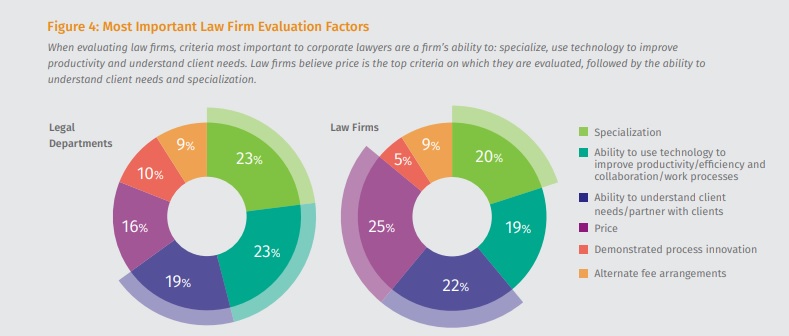
In last week’s post I looked at the Top 5 Reasons Clients Switch Firms as recently reported by Wolters Kluner. Conveniently this same Survey also reports on the ‘6 most important criteria in-house consider when evaluating law firms‘ – so here’s a quick look at what they are:
The in-house view
1. Specialization
In recent years I have heard it said on a number of occasions that in-house counsel no longer differentiate lawyers/law firms they ask to do work for them on the issue of ‘specialisation’ – it is a given that you know your topic and this merely gives you a seat at the table.
The results of this Survey clearly show that impression to be wrong – specialisation (at 23%) remains top of mind to in-house.
Unfortunately the term used in the Survey is ‘specialisation’ as opposed to ‘niche’. While there may not appear to be much of a difference between these two terms, for many there is and I would be interested to see the results if this was an option.
2. Technology
The fact that a lawyer’s ability to use technology ranks equal top (23%) with specialisation shouldn’t be too much of a surprise in a survey conducted on technology adaptation in law firms.
That said, the use of technology in collaboration efforts should raise some eye-brows as it clearly shows, in my opinion, further evidence that in-house counsel want shared platforms and that knowledge sharing among law firms who continue to develop stand-alone technology platforms are likely wasting their money.
3. Ability to understand client needs
At first the fact that ‘ability to understand client needs‘ came third in the list at 19% surprised me.
But then I thought: not many clients truly know what their needs are – maybe this question would have been better phrased as: ‘Understanding our business/sector?’
4. Price – and 6. AFAs
Price gets 16% of the vote. AFAs gets 9%. If you combined them, they get 25%. And would top the table.
But they are not combined.
They are seperate.
Which make me wonder: Why?
Also: if your law firm is really offering value – price, whether it be hourly rates or AFAs, would be the last thing that matters.
5. Process innovation
I found the fact that process innovation only got 10% of the vote interesting, because if you read the rest of this survey a core message is that law firms need to get better at demonstrating efficiencies.
This result somewhat undermines that message.
The law firm view
I was pleasantly surprised how consistent the law firm view was to that of their in-house clients.
Of course there will always be one significant difference of opinions between law firms and their clients (in the law firm’s mind) as to why they were chosen: ‘Price’.
And what this Survey shows, as many before it have, is that law firms need (finally) to start moving away from that needle.
As always, these just represent my thoughts and always interested to hear your views.
For an industry that claims to make its livelihood on the definition, use and interpretation of words, in my opinion the legal industry has become rather lax in our use of the word ‘alternative’.
Big claim. So what do I mean by this?
Well, let’s look at the word ‘alternative’:- post GFC we hear the term ‘alternative’ almost daily in respect of ‘alternative fee arrangements’ (AFAS); and, ever increasingly, we now hear ‘alternative’ in respect of ‘alternative legal service providers’.
But how often do we ask – ‘alternative to what’?
Are we talking about ‘alternative’ to what we already have and do?
Because if that’s the case then we are not being true to our esprit de corps, namely ‘words have meaning’.
i.e. there is nothing ‘alternative’ in the term ‘alternative fee arrangements’. There are merely hourly rates, fixed fees and some sort of risk sharing arrangement fee agreement. In short, fee agreements.
And, as Heather Suttie eloquently put in her post today, there are no “alternative” legal service providers. There are just legal service providers (some of which, surprise surprise, serve different clientele).
But that’s just my take – as always, would be interested in your thoughts, views, feedback.
Over the holiday’s I finally got time to read D. Casey Flaherty’s ‘Unless You Ask: A Guide For Law Departments To Get More From External Relationships‘ published by the Association of Corporate Counsel (ACC).
Casey’s publication is excellent and very insightful. Although written for in-house legal departments, it contains information that every private practice lawyer should be across. If for no other reason than it has an array of sample questions they may be asked.
But, it is a brief piece in the publication on asking for discounts on hourly rates/bills that I wanted to share with you all. Because Casey has managed to put into words, both succinctly and comprehensively, my own feelings on discounts.
So here it is (see pages 64 & 65):
Without some grounding in value, discounts just become a game.
First, you can only push the discount lever so many times. A recession hits or you run a convergence initiative. You get your firms to take a big haircut. What’s next? It will probably be a few years before you can return to that well in any meaningful way. Continuous improvement, on the other hand, should be a constant. There is always some process to refine, some assumption to question, or some technology to take better advantage of. Discounts can be part of a strategy. But a strategy that relies entirely on discounts is hollow.
Second, there is a huge volume of data that suggests that while most clients see themselves as negotiating progressively deeper discounts, what they are really doing is negotiating down the size of the rate increase. Last year, the client got a 10% discount off a $500 rate. This year, the client gets an 11% discount off a $520 rate. What really happened is that that firm increased the rate from $450 to $463. You can perform this trick—4% rate increase, additional 1% discount—for a quite long time before the rate flattens out. How long? 66 years. In 2081, the paid rate ($1,600/hr) would finally stop increasing as the discount (75% off a published rate of $6,399/hr) caught up to the rate increase.
Third, while almost every law department will proudly refer to the deep discounts they’ve negotiated, only about half even get one. That’s because a true discount is not calculated versus a lawyer’s published rate—of which there may be several—but is calculated by reference to something called a standard rate, an internal firm number used to determine realizations, profitability, etc. With a few exceptions, almost no one pays published rate and therefore everyone thinks they are getting a discount. But only about half of clients actually pay below standard rate. And even they are not getting as deep a discount as they think.
Fourth, if you count discounts as savings, please stop. If you’ve reduced rates below what you were paying previously, that’s one thing, especially if you also have a mechanism to monitor and hold the line on hours. But if you are just counting the delta between the published rate and your paid rate, it introduces some bizarre incentives. It encourages firms to jack up published rates so they can offer you the optical illusion of a bigger discount. It encourages you to select higher priced firm so you can report greater ‘savings’—i.e., you show double the savings by paying $700/hr to a lawyer with a published rate of $900/hr than you do paying $350/hr to a lawyer with a published rate of $450/hr. And your savings accumulate with every extra hour of work the firm bills. There is something inherently perverse about a savings metric that makes you look better the more you spend.
Fifth, finally, and most importantly, undue emphasis on discounts tends to confuse unit price with total cost. Rate differences are linear. Hours can differ by orders of magnitude. The $350/hr associate might look relatively cheap until it takes them ten hours to deliver work half as good as what the $800/hr partner delivered in one. Attention to the unit price ($350 v. $800) will obscure both quality and total cost ($3,500 v. $800). We intuitively understand the difference experience can make. Systems—the proper integration of process and technology to augment expertise in delivering legal services—are experience institutionalized. Systems merit attention in trying to understand the relationship among quality, unit price, and total cost. Discounts are only a small fraction of one piece of that puzzle.
There you have it: why discounts should not be anywhere near the front of your pricing arsenal.
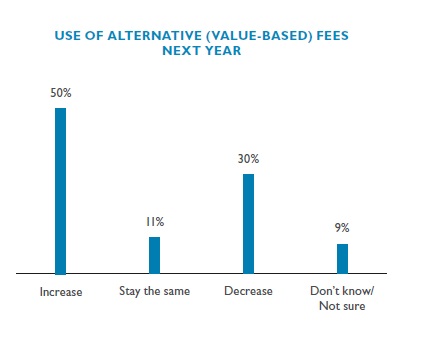
Okay, so a fair amount was made of a chart in a ‘ACC Report – Law Department Management: Establishing Value In An Evolving Business World’ published late last year which predicted a 50% increase in the use of Alternative Fees this year. Given the ACC is the leading voice for in-house counsel globally, including, now, Australia, pretty clear evidence of the future direction of AFAs you’d think.
But, to my knowledge, little has been made of the fact that the same chart foresaw a 30% decrease in the use of Alternative Fees this year by those same in-house counsel.
And so I asked myself: Given their popularity, what could possibly be driving in-house to contemplate a reduction in their use of AFAs? This is especially so given that the ACC has very much been at the forefront of championing their use? And, potentially, in such large numbers?
The truth is, I don’t know the answer to this question. It could be as simple as the fact that in-house counsel expect to instruct out less work that fits the AFA model. But I also hazard a guess that with some in-house counsel it will have something to do with one or all of the following three possible reasons:
AFAs are not transparent – no one, apart from the person who sets them, knows how they got to tat price. As such, it’s really difficult to compare them.
AFAs don’t represent value. Despite a belief that they represent value over hourly billing, in the view of many in-house counsel they simply don’t. Therefore, much easier to use the foe you know (hourly billing with discounts).
AFAs are not alternatives. Simply put, the core to most AFAs proposed by law firms remains: Units of Labour (manpower) x Time x Rate = Price. QED, they are not “alterative”. Indeed, their very names even suggest it with “blended”, “phase”, “task”, “volume”, “flat”.
To be clear, I don’t want to see the demise of value pricing. Indeed, quite the opposite. Nor am I particularly an advocate of hourly billing. I am however, wholly against the use of the term “alternative” when they clearly aren’t. And so I’m not overly surprised that 30% of in-house counsel are saying they will see a decline in their use this year.
Given the glacial speed of change in the the industry, I’ll wait to see if there is any change here this year. My gut tells me though not to hold my breath and that we are likely to be in the same place next year as we are now.
“The growth of AFAs has been much slower than many predicted, remaining at roughly 16% of revenue in 2015…
… Most of the resistance has come from clients who are not comfortable with what law firms have proposed as AFAs, and would rather stay with hourly rates and discounting.”
I completely understanding why clients feel frustrated with the so-called Alternative Fee Arrangements (AFAs) that law firms often propose to them and are pushing back on these. Whenever you discuss AFAs with law firms, all you tend to hear is talk of ‘fixed fees’, ‘capped fees’, ‘success fees’, ‘risk collars’ and other such loft terms, more often than not being held as if they were innovative disruptors in the way we price legal services when the reality is 99.9% of them have the billable hour underpinning them and have been on the pricing menu for more than two decades. So why shouldn’t clients just go with a standard billable hour and get a 10% discount at the end of the matter – much simpler and proven route (and, as a side note, interesting to see the report continues to show realization rates on the slide!).
No, as a profession, the time has come to accept that if we want to be real about offering clients alternatives to the billable hour then we must get on the front foot and become more creative about what we are offering them. And the best, and possibly only, way we will achieve this is if we start to have conversations with our clients about this.
And herein lies both a solution and a way forward!
Given this was a survey of 429 attorneys and operational professionals working in corporate legal departments by Thomson Reuters, you would think it would be a good indicator of in-house aptitude (side note: notice only 1% mention Reverse auctions? Definitely not reflective of the noise being made in the market around these!)?
Anyhow, here’s a Holidays thought for those law firms looking for alternatives to the billable hour that might actually (a) pay them some money, and (b) have the support of their clients:
go and speak to your client about use of budgets for matters.
After all, surely all those pricing directors, legal project managers, process improvement directors, innovation officers, etc talk with each other every now and then and come up with something helpful and original along these lines!
The Ninth Annual Law Department Operation Survey was published late last month (Nov 2016). A survey of – a record number of – 133 law department professional, one of the questions asked in this year’s survey was:
‘What percentage of legal spend is via alternative fee arrangement?’
Unlike other legal market surveys undertaken during the course of the year, the results here are telling in that they are from those running the legal department, as opposed to those practising, and therefore, arguably, are more reflective of the market’s aptitude to Alternative Fee Arrangements (AFAs).
Overwhelmingly – at 87 percent – US in-house law departments make some use of AFAs with their private practice suppliers. Tellingly though, only 14.1% of this is over 50% of spend and more than a third – 34.4% – is in the one to 10 percent space (making me wonder if this is just discounts disguised as AFAs).
Of note overnight (OZ time) was news that Bernero & Press (Wendy Bernero and Aric Press) have launched a service called: ‘The Red Team’. Described as being “A Lifeline for Marketing and Business Development Departments” the aim of The Red Team is to provide:
“…high-quality, experienced marketing, communications, and business development professionals to law firms on a project basis or to fill temporary needs.”
Sounds very similar to the sort of lawyer placement service we are seeing from the likes of Crowd & Co here in Australia, only in this case the target market is specifically support services.
I have to say that outsourcing back office services such as marketing and business development was something I saw becoming popular in Asia during the Asian Financial Crisis in late 1998 and I have often wondered when we would see such a move take hold in the West.







 RWS_01's B[D]log