Legal business development news

Musings on the announced closure of Clifford Chance’s Bangkok office

At the end of last week I read with sadness the decision by Clifford Chance (CC) to close its Bangkok office. While I’m always saddened to hear that a law firm will be closing the doors on one of its offices, in the case of CC Bangkok it’s personal.

Let me take you back to 1998

The year was 1998, and what would become known as the Asian Financial Crisis (AFC) had just come crashing through the door like an unwanted drunk guest to spoil what as a pretty good party. At the time this was still known as the ‘Tom Yum Goong‘ crisis in the local Thai press and the horrific murder of Australian accountant Michael Wansley (shot 8 times) was still a few months away (10 March 1999).

In short, the full measure of the financial mess, both in Thailand and the region, was only just becoming known.

What was clear however was the fact that a number of international law firms were making serious noises about entering the local market. Allen & Overy, Linklaters, Herbert Smith, Mallesons, White & Case, Freehills, Freshfields, Coudert Brothers, as well as Clifford Chance all had some form of ‘fly-in, fly-out’ operation and were either opening a local offices or expressing an interest in doing so.

Meanwhile, Baker & McKenzie had been around for so long that almost anyone who was anyone in the local Thai legal world had ‘graduated’ from that firm.

Working with one of Thailand’s leading local firms at the time – Wirot International – I was privileged to have had a front seat to much of this activity.

If you had asked me early in that year (1998) who Wirot Poonsuwan – Founder, Managing Partner and Owner of Wirot International – would have merged with (and yes, he was fortunate enough to have several dance partners), my answer would likely have been Herbert Smith.

In the end Clifford Chance offered him a sweater that he simply couldn’t refuse and we all moved over to what would become known in Thailand as Clifford Chance Wirot (CCW) on 1 January 1999.

I often wonder what would have happened if Wirot had gone with Herbert Smith? Local legal history would have been very different, that’s for sure.

As it is, over the course of the next two years core members of what was Wirot International would leave CCW for Linklaters, Freshfields, Courdert Brothers (anyone remember them? They took on Freshfield’s operations when they departed Thailand)  and, eventually, Norton Rose (which itself was a sort of offshoot of Linklaters).

1999 would be a big year for CC. Not only was it the year the firm ‘merged’ with Wirot International, but they would also merge with Rogers & Wells in the US that year (we would joke that it was a three way merger and some may argue with the same level of success!). It would also be the year that CC’s Managing Partner at the time, Tony Williams, would step down and go on to found the highly successful Jomati Consulting (probably a wise move in hindsight).

And yet, from the start I was never quiet sure what CC’s strategic aims were in having a Bangkok office.

Were they looking to pick-up a large amount of debt recovery/restructuring work that was going on around town? Possibly, Wirot Poonsuwan had been at the forefront of discussions to changes to Thailand’s insolvency law to allow for US-style Chapter 11 restructurings to occur (Wirot wrote a weekly article in the Bangkok Post at that time [1998]).

Were they looking for the growing amount of divestment work going on? Possibly. Wirot did some of this work, but Simon Makinson and his team did more of it and they would go and join A&O (with whom Simon had a relationship as a trainee lawyer).

Were they looking for the NGO / Infrastructure work? Not really, Linklaters picked up Wilailuk Okanurak – who would go on to succeed Chris King as Managing Partner of the Bangkok office – to run a very successful infrastructure practice (although she does lots of other things).

What they did do was bring in the wonderful Andrew Matthews from Italy (along with his Ferrari if I recall correctly). But his practice at the time was aircraft financing, not the sort of thing you’d have expected to see done from Bangkok: but hey, why not…

My own view at that time then was that CCW’s strategic reasoning for being in Thailand was muddled. In part that was one reason I would leave CCW to join my good friend (and previous colleague at Wirot International) Pichitphon Eammongkolchai at Linklaters (where I would go on to enjoy 7 more years of fantastic times and memories).

Fast forward to 2017

Despite this, and despite the fact that there was some real hitters on the local scene at the time (late 1990s) in Siam Premier (to have a JV with Australia’s Allens – must be something with Allens and JVs!) and Chandler & Thonk-Ek (now part of the Japanese firm Mori Hamada & Matsumoto) to name two, the firm that was CCW would go on to to survive almost two decades.

That’s quiet and achievement in this marketplace.

And while much has changed – Wirot is no loner there, nor is Tim Jefferies; much remains the same – Andrew was there the last time I checked and current Managing partner Fergus Evans was a very junior lawyer back in the day.

So clearly something worked.

And so I will be very sad when I hear the firm has closed its doors for the last time. Particularly so given I believe the strategic decision for doing so is [probably once more] completely wrong.

Moving their ASEAN focus to Singapore is something CC should have done in 1998, not 2018. Having persevered to 2017, it seems short-sighted to close the office so shortly after the establishment of the ASEAN Economic Community (AEC) gives it access to a market of US$2.6 trillion and over 620 million people.

But that’s just my view.

rws_01

Linklaters, Schrage and rewarding the team not the individual

On June 30, 2015 Michael Schrage – a research fellow at MIT Sloan School’s Center for Digital Business (and author of Serious Play, Who Do You Want Your Customers to Become? and The Innovator’s Hypothesis) wrote a fabulous article on the Harvard Business Review website titled ‘Reward Your Best Teams, Not Just Star Players‘.

I remember reading Scharge’s article and thinking to myself at the time that law firm managers could learn a lot from it. I may even have posted a link to the article on my LinkedIn feed.

In the article, Scharge sets out that “top management should seek out talented teams, not just gifted individuals” and that “people need to feel that the benefits of being team players measurably outweigh the perceived and real costs of compromise and self-sacrifice“.

Scharge then goes on to set out that getting the incentives right and appropriately aligned in an organisation – such as a law firm – requires the firm embracing what he calls the 5 As:-

  • Acknowledge
  • Attribute
  • Assign
  • Award
  • Assess/Analyze

Concluding that “The 5 As are the essential ingredients for facilitating a transformation in teamwork incentives. They can put the right “I” in your teams.

With news overnight (Australian time) that my alumni firm Linklaters is “to ditch individual partner metrics to target team performance“, we may just be on the way to achieving Schrage’s goals.

And it may just be me, but doesn’t it make more sense to reward “client-winning, business development, training and innovation” as collaborative efforts rather than at individual partner level?

rws_01

Do senior BD people have a seat at the top table?

I’ve often wondered if senior business development professionals in law firms truly have a seat at the executive table. People often tell me they do, but my gut has always had this niggling suspicion that maybe they actually don’t.

Well, a review of ‘Aligning Marketing and Business Development Resources for Law Firm Growth‘ – Results from the joint Legal Marketing Association and Bloomberg Law® research study  published overnight my time (Australia) would appear to answer some of these doubts – at least from a US standpoint, as one of the first charts in the report looks at exactly this issue:

image20170330

My take on this chart is that most law firms see the role of BD as being the executors/executers of a law firm’s business strategy, but not necessarily the developers of that strategy.

In other words, only about 36% of senior business developers can truly claim to have a seat at the top table.

rws_01


The BIG takeout from this year’s Altman Weil CLO Survey

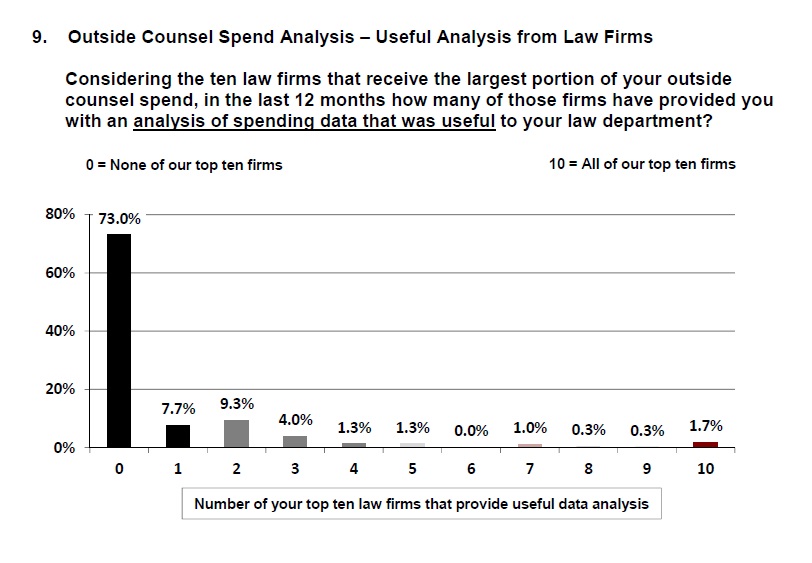
Altman Weil published the 2016 edition of its Chief Legal Officer Survey overnight Australian time. I may well post some more of my thoughts on this year’s content in the coming days, but what I wanted to share with you immediately is what I consider to be one of the most damning charts I have ever seen as it relates to business development, legal spend, and client relationship management:

altman-weil-clo-survey

That’s right, when asked the question:

Considering the ten law firms that receive the largest portion of your outside counsel spend, in the last 12 months how many of those firms have provided you with an analysis of spending data that was useful to your law department?

An overwhelming majority of CLOs (73%) responded “none”.

So, if you work for a law firm looking to differentiate your services; then the answer is it really isn’t that difficult.

RWS_01

Why asking someone to work 2,000 billable hours a year will kill their spirit

Business Development image

According to a post by Casey Sullivan of Bloomberg, earlier this week US law firm Crowell & Moring announced that it would increase its billable hour requirement for associates, from 1,900 hours per year to 2,000 per year. This new target will take effect 1 September 2016, but on the plus side 50 pro bono hours will count as billable.

15 Years ago I would have cried out “all kudos to you”. Back then my yearly billable target for an English ‘Magic Circle’ firm was 1,400 hours and I flogged my guts out to achieve that. So if you can effectively put 50% of billables on top of what I was doing (and trust me when I say I wasn’t going home at least one day a week), then you’re a better person than I (or so I would have said then).

But if you really need validation of what asking someone to work 2,000 billable hours a year means, then I would like to recommend you read “The Truth about the Billable Hour” by no less an institution than Yale University. In that publication, Yale caution aspiring lawyers that if you are being asked to “bill” 2201 hour, you need to be “at work” (includes travel time and lunch, etc.) 3058.

Taking that further, from an Australian law perspective, if you are being asked to bill 2,000 hours a year then you need to bill 8.3 hours a day (assuming a 48 week year and you never get sick; which, if you are being asked to do this, you most likely will be). That means you are very likely going to need to be “in the office” around 12 hours a day – and that assumes no write-off by your partner or leakage.

But here’s the question: “What difference does this make?

I ask this because I wholly agree with the following comment my friend Kirsten Hodgson made when I posted a link to this article on LinkedIn:

“why would you reward the number of hours someone spends working? Surely it would be better to focus on how to deliver value smarter and more quickly. This doesn’t incentivize innovation or any type of process improvement.”

Exactly right, you’re measuring all the wrong things!

Leaving aside the Balance Scorecard argument, asking someone to do 2,000 billable hours a year doesn’t take into account:

  • client satisfaction
  • realisation (it’s a utilisation metric)
  • working smarter
  • innovation

or many other metrics.

And for those who may point out the benefits of this including 50 hours pro bono I say this: the Australian Pro Bono Centre National Pro Bono ‘Aspirational Target’ (ie, where we would like to get to), is 35 hours per lawyer per year.

But probably more importantly than all of this is this:

–  if you ask someone to do this, then you really leave them very little time to do anything else.

This really should be a concern, on the business front because you leave almost no time whatsoever to train them in the business of law – ie, you kill any entrepreneurial spirit they may have. And, crucially, the only metric that really counts to them is that all important 2,000 billable hours (keep in mind that like I was, they’re very young). Which for a profession that has the mental health issues we do, is not good.

For all of these reasons, I’m hoping no other law firm follows this. But sadly I think they will.

Oh, and if you are a law firm client reading this post you might just want to look up whether your local jurisdiction has a “Lemon Law” rule that applies to provision of a service.

RWS_01

How long before we see a ‘Red Team’ service in #Auslaw?

Business Development image

Of note overnight (OZ time) was news that Bernero & Press (Wendy Bernero and Aric Press) have launched a service called: ‘The Red Team’.  Described as being “A Lifeline for Marketing and Business Development Departments” the aim of The Red Team is to provide:

“…high-quality, experienced marketing, communications, and business development professionals to law firms on a project basis or to fill temporary needs.”

Sounds very similar to the sort of lawyer placement service we are seeing from the likes of Crowd & Co here in Australia, only in this case the target market is specifically support services.

I have to say that outsourcing back office services such as marketing and business development was something I saw becoming popular in Asia during the Asian Financial Crisis in late 1998 and I have often wondered when we would see such a move take hold in the West.

Today may just be that day.

RWS_01

$180K for a First-Year Associate – so what!

Business Development image

One of the big news items this week has been the decision by Cravath, Swaine & Moore to raise its starting salaries for first year associates to $180,000. Cries of “Not worth it!” and “What value do first year associates provide clients?” (answer: probably none) can be heard from all four corners of the planet.

My view on this though is so what? I don’t really care what you pay your first year associates. In the same way I don’t really care what you pay your other associates or partners. Nor do I really care what your rent is costing you.

Unless, that is, I get to thinking that: I am the one paying for all this. In which case, I suddenly become very interested.

But here’s the thing: I’d only really start to think that I’m the one paying for all your luxuries – the boat you have moored at the marina, the sports car you drive, the house you live in, the first year associate you can call on day and night – if I didn’t value the service you provide me. In other words: If I didn’t think I was getting value for money.

So if you’re one of the many private practitioners questioning the move by Cravath, Swaine & Moore, my only comment/question is this:

If you are providing your clients with a value for money service offering – and you are able to communicate this, why should it bother you?

RWS_01

The law firm disconnect in two images

This week saw the publication of LexisNexis’s Bellwether Report 2016. titled:- ‘The Riddle of Perception‘.

Based on structured interviews with 122 independent lawyers and 108 clients (all UK-based I believe), this year’s Report provides valuable insight into the thinking of lawyers and law firms and, incredibly, how far removed that thinking still appears to be from the views of their clients.

None so is this more starkly brought home to me than in two separate images in the Report in response to questions put forward around the issue of fixed fees.

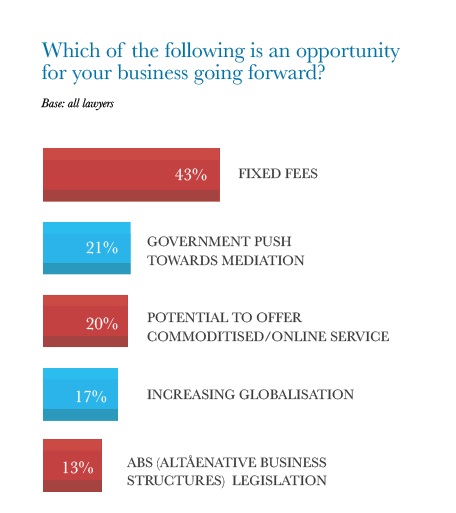
The first (which is actually the second in the Report) can be found on page 22:-

Image 1

[click on image to enlarge]

where, in response to “Which of the following is an opportunity for your business going forward?” – 43% answered: fixed fees.

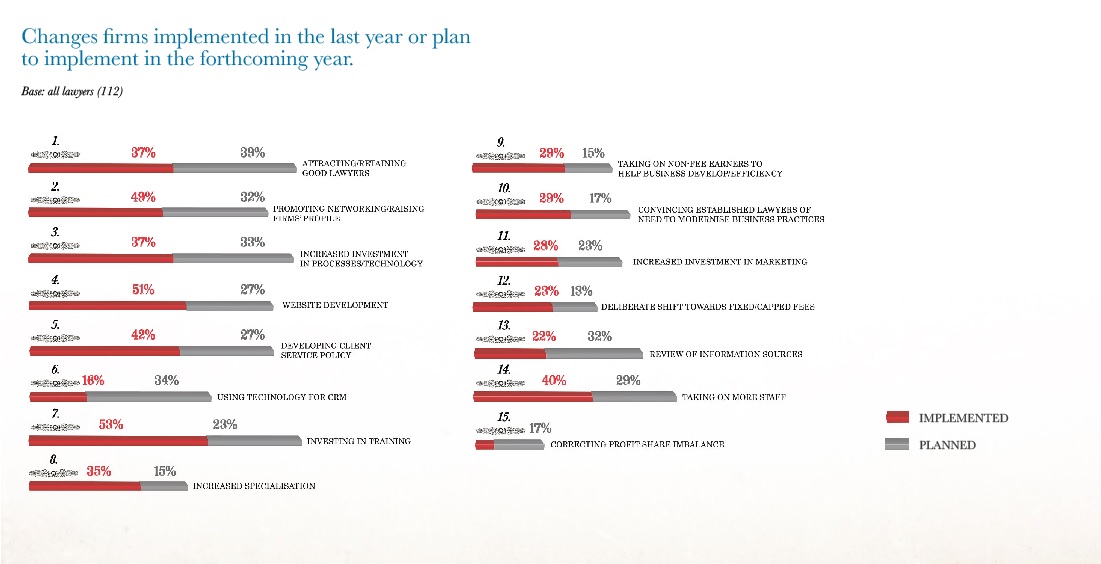
The second is found earlier in the Report on page 18, where when asked what “Changes forms implemented in the last year or plan to implement in the forthcoming year?” – a “deliberate shift towards fixed/capped fees” raked 12th. with only 13% saying there was anything planned around this for the forthcoming year.

Image 2

[click on image to enlarge]

Now call me crazy, but that seems to be as close as you can get to madness.

Read the Report though, it really is very good.

RWS_01

Exiting the ‘Valley of Despair’: Tips on rebuilding a book of business

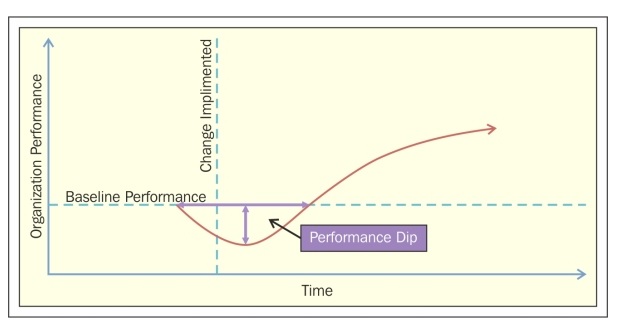
Valley of despair

source: Emily Carr:- ‘Practical Change Management for IT Projects

The ‘Valley of Despair‘ is a term used in IT process improvement projects to describe the period of time where productivity decreases immediately after the implementation of a new process. In essence it describes that period of time during which you shift away from what you know and are comfortable with to what is new and unknown (but which will ultimately, hopefully, results in better processes).

Although a term commonly associated with process improvement, to me this has also become a good way to best describe a growing trend in the modern lawyer’s life; namely that particularly difficult period during which a disruptive element impacts on their book of business. Examples would include:

  • economic: with the GFC most securitization lawyers lost their practices overnight.
  • panel: when your firm loses a panel appointment with your practice’s biggest client as a result of the client rationalizing the number of its panel firms.
  • relationship: the key contact at your biggest client moves to a company your firm has no relationship with; or, worse, is promoted to a role where they no longer have influence over who gets the legal instructions.

There are many others, but you get the gist: your performance hits a wall called ‘change‘.

In my experience, partners who face this scenario come face-to-face with Elizabeth Kuber-Ross’ “Five Stages of Grief“:-

Denial —> Anger —> Bargaining —> Depression —> Acceptance

To overcome the Valley of Despair you need a sixth element: a desire to move forward.

  • Step 1: Accept your fate

The first step in any recovery program is accepting you have an issue. Too often law firm partners stick their heads in the sand and refuse to accept that anything is wrong until the Managing Partner is knocking on their door asking them what their plans are for the future (wink, wink: it’s not with us!). By then, you are well and truly in to the ‘bargaining’ and ‘depression’ phases. If you want to rebuild your book of business you need to be much further ahead of the game than that.

  • Step 2: Do an audit

Here’s the thing: things in life are rarely as bad as they first seem. So, as soon as you become aware of a change agent – such as those above – get out your pen and a piece of paper and write down a list of who you know, when was the last time you contacted them, what type of work could you be doing for them, are you already doing that type of work, etc.

In short, take stock of what you have and who you could be doing it for.

  • Step 3: Make a plan

Alan Lakein is reported to have said: “Failing to plan is planning to fail“. I’m not sure if he actually did, but it’s pretty accurate and if you want to rejuvenate your book of business then you will need a plan of how to go about this.

This plan should include the obvious, like:

  1. what type of work do I want to be doing?
  2. who do I want to do this work for?
  3. what do I know [commercially] about these businesses [tip: if the answer is “not a lot”, get a research assistant on to it ASAP]?
  4. who are the decision makers at these companies?
  5. how likely are they to give you / your firm the work [tip: rank the likelihood from 1 – 5 (very – unlikely)]?

Your plan also needs to include things you may not think of, such as:

  1. will my partners give me relief while I try and rebuild my book of business? If so, how long?
  2. what level of fees do I need to generate (cost +, times 3, times 5)?
  3. what rates will I need to charge to generate that level of fees? will the target client accept these rates? if I need to discount, will my partners accept me discounting to win work when their clients are paying full freight?
  4. who is currently doing the work for the target and what am I bringing to the table that would make the target move the work to me?
  5. how will my competition react to me invading their turf?
  • Step 4: Execute on the plan

I’ve heard it said that: “a plan without an action is a wish“. In the world of professional services, we see a lot of wishing!

So, as soon as you have your plan in place you need to get out from behind your desk and start to execute on it. Look at what

  • inbound and outbound related activities you need to do;
  • networking events are taking place and when;

then set yourself a 30-60-90 day action plan to work towards.

Most importantly, always be responsive and never, ever quit.  Building a book of business takes patience and repetition, you cannot adopt a “lottery mentality” as one shot actions nearly always lead to failure.

So if at first you don’t succeed, try again. That way, you’ll give yourself the very best chance of rebuilding your book of business and moving forward.

RWS_01

Launched today – The Asian Business Law Institute

dreamstime_m_34802664

Today, 21 January 2016, the Asian Business Law Institute (ABLI) was formerly launched in Singapore.

According to the ABLI’s website, the:

“…Institute based in Singapore that initiates, conducts and facilitates research and produces authoritative texts with a view to providing practical guidance in the field of Asian legal development and promoting the convergence of Asian business laws.

Among ABLI’s core tasks are:

  • to evaluate and stimulate the development of Asian law, legal policy, and practice, and in particular make proposals for the further convergence of business law among Asian Countries;
  • to study Asian approaches regarding business laws and practice in drafting legal instruments, restatements of law or model rules;
  • to conduct and facilitate pan-Asian research, in particular to draft, evaluate or improve principles and rules which are common to the Asian legal systems; and
  • to provide a forum, for discussion and cooperation, between the business community and the legal fraternity including, inter alia judges, lawyers, academics and other legal professionals, who take an active interest in Asian business law development.”

With the establishment of the ASEAN Economic Community (AEC) in December 2015 and the formal launch of the  Asian Infrastructure Investment Bank (AIIB) this month, there can be little doubt that it’s exciting times with plenty of potential for the legal industry in Asia at the moment so an initiative like ABLI should be warmly applauded.

If you’re on Twitter, the ABLI handle is @ABLIasia. Should be worth a follow.