My son has just entered daycare. Nothing too special about that, after all he is 2! But, he came home recently signing a song that well, frankly, needs to be the theme tune for law firm partnerships!
Slippery fish
The song in question is ‘Slippery Fish‘ and here is how the lyrics go:
Slippery fish, slippery fish, sliding through the water, Slippery fish, slippery fish, Gulp, Gulp, Gulp!
Oh, no! It’s been eaten by an …
Octopus, octopus, squiggling in the water. Octopus, octopus, Gulp, Gulp, Gulp!
Oh, no! It’s been eaten by a
Tuna fish, tuna fish, flashing in the water, Tuna fish, tuna fish, Gulp, Gulp, Gulp!
Oh, no! It’s been eaten by a …
Great white shark, great white shark, lurking in the water, Great white shark, great white shark, Gulp, Gulp, Gulp!
Oh, no! It’s been eaten by a …
Humongous whale, humongous whale, spouting in the water, Humongous whale, humongous whale, Gulp! … Gulp! … Gulp! … BURP!
It’s that strange time of the year when we start all over again as if the previous 12 months didn’t happen. Only it is not quite as simple as that. From today:
most lawyers will be charging clients 10% or more extra for their services, with little or no explanation about where the extra value is being delivered and with the new fee rate being completely and totally justified by the date in the calendar and CPI rate increases.
judging by the LinkedIn notifications I have been receiving, a fair number of lawyers will be promoted to new roles – “congrats all”. Along with those promotions comes increased fees charged to clients!
So while we are all enjoying the various EOFY parties over the next few weeks, or simply enjoying some downtime over the school holidays: keep in mind that you need to have a carefully crafted value message to explain to your clients why you justify that higher fee rate; and if you want to ensure that your realisation rate stays healthy I suggest it be better crafted than “we are in a new financial year”.
And if you are struggling with any of that, feel free to reach out to me for a chat.
Came across the term “Burden partners” in this article in the Australian Financial Review today. “Burden partners” is a term denoting those partners within a partnership whose cost to the partnership is greater than their contribution.
In simple terms, partners who withdraw more from the kitty than they have deposited.
The reality is that by its very nature (due to economic cycles), there will – from time-to-time – be partners who have years in which they withdraw more than they have deposited that year; but in most cases these partners will have previously made significantly higher deposits than withdrawals and are effectively withdrawing savings (having said that, retained earnings is not a given with law firm partnerships so this is more a reputational issue than financial one).
It is circumstances in which this is a prolonged (and often unfixable) trend where this becomes a problem.
You can also often see this with new partners who have probably been made-up too soon and don’t really have the book of business yet to justify their promotion to partnership ranks.
Either way, if the term “burden partners” sounds familiar and you want to discuss ways of how this can be fixed, feel free to reach out to me for a chat.
As readers of this blog will hopefully have observed, I’m a very keen observer of up-and-coming developments in the legal industry. Frankly it’s my job to follow and understand emerging market developments and, particularly, how they may affect the way we serve our clients.
And so it was, with such a mindset, that almost two decades ago I came across a concept being touted as the next BIG thing: ‘unbundled legal services‘.
Along with ‘covenant lite loans‘ (this was pre-2008 after all), ‘unbundled legal services’ were going to transform and change the way we serviced our clients; particularly those sophisticated purchasers of legal services.
Then, just like that, ‘unbundled legal services’ went exactly…
…nowhere – never to be heard of again in polite conversation!
Return of the Jedi!
I’m here to tell you that, following a recent report by the Solicitors Regulation Authority (SRA) [England and Wales] – published on 15 June 2023, ‘unbundled legal services’ are back from the dead!
Before I go into what the SRA’s report says, and why it might be important, let’s take a helicopter look at what ‘unbundled legal services’ meant back in the early 2000s and what ‘unbundled legal services v2.0’ means today.
Unbundled legal services v1.0
From the outset ‘unbundled legal services’ were also known as ‘limited scope representation’, I think in part because this was the term more commonly used in the USA – although I’m happy to stand correct on that. Anyhow, at the name suggests, ‘limited scope representation’ means exactly that: your lawyer won’t do everything for you on your matter and it is up to you and your lawyer to divvy-up what they do and what you do.
For this reason ‘unbundled legal services’ were seen as being extremely sexy because you – the client – got to choose what your law firm did [and charged you for] and what you kept in-house. Even better, you – the client – now had the option to appoint subject matter experts for the “grey haired work” (as Maister would call it), but for more menial work you could appoint an LPO (anyone remember “Legal Process Outsourcing”?).
Such radically thinking could even lead to such a thing as ‘coopetition’ (as I have blogged on previously!).
But, despite the obvious benefits of growing headline revenue with ‘unbundled legal services’, I would hazard a guess that 20 years later less than 1% of most law firms’ revenue is derived from this product. Evidence of my thinking here is, I believe, substantiated by a recent article in the Law Society Gazette: ‘Unbundling? Never heard of it, say 40% of firms’ by John Hyde.
Unbundled legal services v2.0
So back to the SRA report and why unbundled legal services appears to be back in vogue.
While limited to “family law” issues, the SRA report includes two important comments:
The first, more a definition, is: “Unbundling describes the process of dividing tasks in a service between the consumer and provider. This can, among other things, make them more affordable and accessible.” and
the second, going to the crux of the issue: “Solicitors providing ‘unbundled’ services could make legal help affordable for those whom it is currently too expensive“.
QED, a possible solution to the Access to Justice (A2J) issue?
While I think both of those comments are correct, I want to quickly pause and cover a few of the other comments made in the Report. These include:
We found that unbundling does have the potential to increase access to justice as it makes some legal services more affordable.
Law firms could attract more clients as those clients knew they could in fact afford an unbundled deal.
There are low levels of awareness of what unbundling is and how widely available it is, even though a number of providers already offer this.
All of which, in my experience, are true in the broader aspects of unbundling.
To finish up..
To finish up I’m going to use the SRA’s own wording in the Report; which is that the unbundling of legal services comes with complications that include:
We found no significant difference in the level of satisfaction between consumers who used unbundled legal services and those who used an end-to-end service.
Some consumers also wanted to have more control over their case.
Some [law firm] providers would like to expand what they do but there are concerns around the impact on firms’ insurance premiums and the possibility of legal action if things go wrong which they were not responsible for.
Let’s not beat about the bush: Points 1 and 2 are relatively damning; but it is that last point where, in my opinion, unbundled legal services have died the death of a million cuts: while most firms and lawyers would consider offering this service, most insurers of professional indemnity [PI] insurance have no ideal of what it is or how to price the risk.
The last point is especially the case given the fact that most law firms have no real understanding of how to provide a letter of engagement to their clients with clearly defined scopes of services that don’t include a million assumptions and caveats or: “it depends” clauses.
Anyhow, setting aside all of the above, I continue to hope we will see a growth in ‘unbundled legal services’ while remaining sceptical it’ll happen.
If you need some help with how you can use unbundled legal services to successfully differentiate your firm’s offering, feel free to reach out to me for a chat.
Many of us in Business Development who work in this market day-in, day-out believe that it is.
Evidence we often provide to back this claim up includes:
The sheer number of panel appointments: both at Government (Commonwealth, State and Local Council) and private sector (nearly every ASX100 company is now panelled), means we are tendering year round.
If we are not tendering for panels, then we are tendering for projects and sub-panels. Most major law firms in Australia will be doing 250+ tenders a year!
Client fluidity. Tenders are one part of this, but client movement among firms is increasing. The stickiness we used to see is no longer there and, frankly, it is getting harder and harder to keep clients in this market. We need to be on top of our game, ALL THE TIME!
Law firm consolidation: we have seen a fair amount of this in the past 10 years. Anyone remember HDY, Herbert Geer, Dibbs Barker, Kemp Strang? These days, when it rains, I can play a game of “spot the law firm umbrella that has outlasted the law firm“!
But perhaps one of the biggest signs of how competitive the market is here is the sheer number of partner lateral movement we see each year. I’m sure other markets, such as the US, have higher numbers of actual lateral partner movement; but, I suspect pro rata number of partners, Australia would be in the top 2 or 3 in this field.
So those of us who live and work in Business Development in Oz can put our hands up and say: “We live and work in one of the world’s most competitive markets”, where brand differentiation is difficult, and almost everyone relies on innovation and technology to set themselves apart from the pack.
If all above is true: What can we do about it?
Well, not a lot actually.
But, and here is the good news, over the weekend I read a blog post by Seth Godin which gave me hope that, actually, it doesn’t really matter.
In ‘Too much competition‘ Seth states something so profoundly obvious I have to wonder why I have cared about how competitive our market is for so long.
So what is that Seth said?
Focus on the customer
Here you go:
Focus on the customers who care enough about your idiosyncratic and particular offerings that they’ll not only happily walk away from the lesser alternatives, but they’ll tell the others.
Simple really!
Only it’s not. So if you need some help with how to successfully differentiate your firm in tenders, feel free to reach out to me for a chat.
On the client side, demand for legal services is projected to remain strong — 41% of clients say they plan to increase legal spending this year, and only 20% expect legal spending to decline.
On average, law firms are allocating 1% to 2% of revenues to marketing & business development budgets.
So, 41% of your clients are saying they plan to increase their legal spend this year, but you [as law firm management/managing partner] are only willing to allocate 1 to 2% of revenue to your business development and marketing efforts (which must be an all time low in the B2B sector).
And, let’s keep in mind that’s business development + marketing combined.
And, we all know the big winners in that expense allocation equation are marketing, not business development – the funnel, not the conversion.
But, like anything in life, law firm business development teams cannot succeed if they are not properly funded. If you want to:
pick the low hanging fruit
grow your share of client wallet
or any variation thereof, you need to make sure you invest in this critical function – and, frankly, 1 to 2% of revenue ain’t going to cut it!
I have read a lot recently about how AI and ChatGPT in particular is going to kill the billable hour. That may well end up happening. What I do suspect though is that it is unlikely to happen soon. And if the billable hour is to be killed off, technology – such as AI and ChatGPT – may well play a part, but it will be the cultural/behavioural change that’s needed that will be the final nail in this coffin.
Don’t believe me?
Here is a quote (of kinds) by Aarash Darroodi, Fender’s General Counsel, at the recent Legal Marketing Association’s annual gathering in Hollywood, Florida:
…the mere fact that he’s being billed by the hour isn’t a problem — but that the billable hour’s implementation can be.
In other words, Darroodi doesn’t mind that his law firm(s) charge him (his company) by the hour, but he does mind if you take him for a fool.
And until this mindset changes, you’re not going to see the death of the billable hour anytime soon.
Darroodi’s comments on the RFP process – should clients do an “open day” before tendering?
While Darroodi’s comments on the billable hour were interesting, his comments on the approach law firms should take to the RFP process were even more insightful. To quote from the article:
[Darroodi] described receiving template-based RFP responses from law firms — an approach he called “fundamentally a mistake.”
Instead, he would like to see a law firm respond to an RFP with an offer to come look at the company’s operations in-depth, gaining a better picture of his organization before a proposal is prepared.
“First of all, it shows initiative on your part. It shows the fact that you care,” he said. “And plus, it shows us that you’re going to submit something that’s directly related to our existing organization.”
Now I’m more than sure that not all GCs will take this approach. And before everyone in Australia says this would likely breach procurement protocols (after the RFP has been issued), I know.
But, wouldn’t it be interesting – and just a little more relevant, if clients did an “open day” before they issued the RFP? Particularly in cases where the tender is by invitation only?
In my view it would certainly make sense and would undoubtably result in more directly relevant and related (and probably eminently more readable) tender responses.
Not only is it highly insightful – so “thanks for posting it Jeremy”, but it contains this nugget – again from Darroodi – on his views about client events (and if you are anEvents Manager in a law firm, stop reading now 🤣):
“I don’t want to spend time with my lawyers,” Darroodi said to laughter, comparing the idea to hanging out with his dentist.
Ouch!
In the meantime, if you need help with your pricing or RFP responses, feel free to reach out to me.
As usual, the Report is a very interesting read; but by far the two standouts for me were:
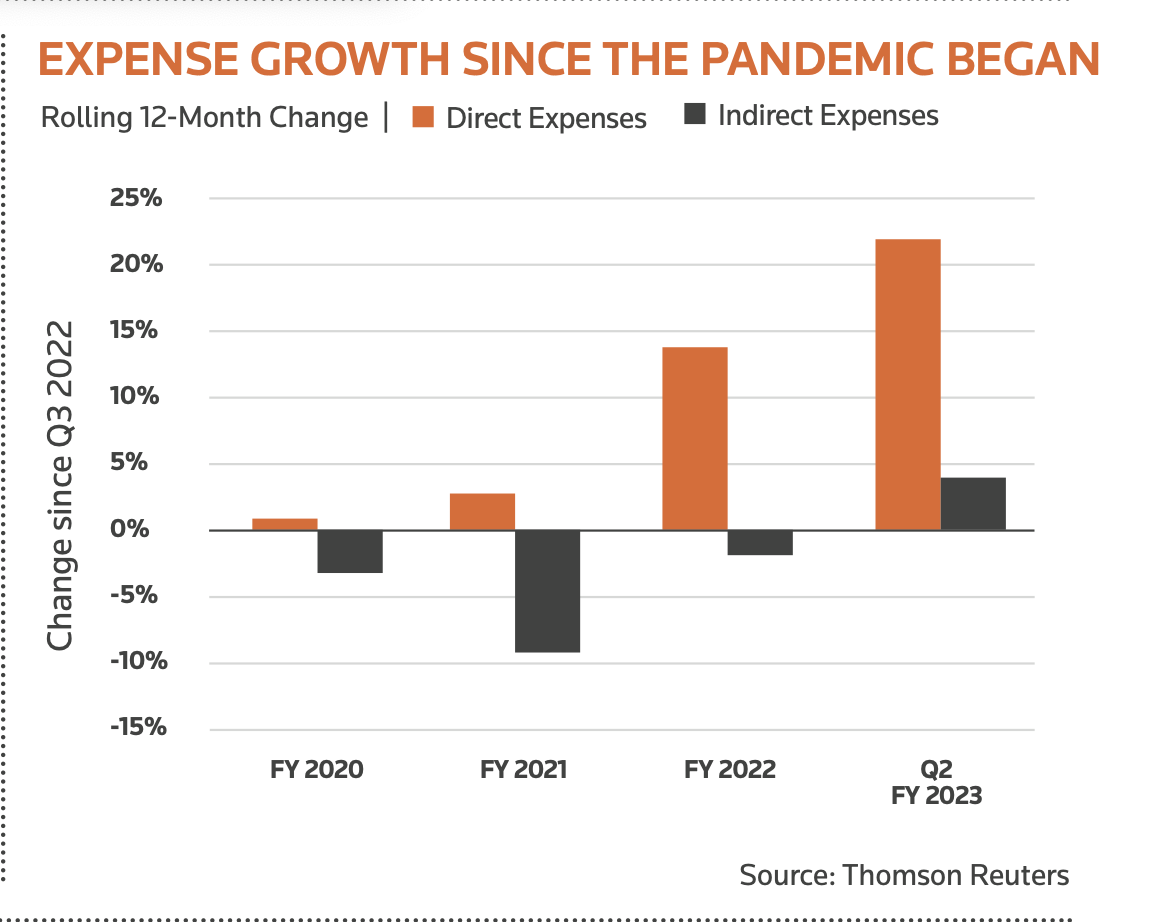
Expense Growth
Notice that rise in Direct Expenses?
That’s down to the pay rises you just gave to your 2 to 6 year PQE lawyers who are now sitting around very under utilised!
Where will clients need help?
The other chart in the Report that caught my attention was where clients anticipate their spend over the next 6 months.
Given the hangover from COVID, Workplace doesn’t surprise me too much.
Dispute Resolution, in difficult economic times, will always be a winner.
But, why Regulatory? We have moved past most of our Royal Commissions…
…and unless I’m missing something there is no growth mentioned for either Privacy or Cyber.
Given the ongoing changes in privacy regulation in Australia just announced, and global concerns around cyber (with IPH Ltd going into a trading halt following a potential cyberattack on two of its member firms this week), this must be an oversight.
If this all sounds too close to home to be true, feel free to drop me a line to talk through how we can fix this up.
I have only tried to predict what might happen in the next 12 months in the world of AusLaw once. It was exactly 10 years ago – 2013 – and I got it so horribly wrong that many would argue I should never, ever, touch this subject again!
Of course, countering that I would argue that getting numbers #2 and #3 close to right, at that time, showed major insight – and surely you can gift me #6.
But there has to be a reason why I have not done a prediction post since and that reason is: Because I’m rubbish at it!
Instead, these days, I review the predictions of others and opine on whether – from my lofty hight of ‘know it all‘ – they can call it better than I can – which, they usually can!
And so that is why this year I would like to draw your attention to the 2023 Citibank-Hildebrant Consulting LLC ‘Client Advisory Report‘.
In its 15th Year, this Report has done a whole lot better at guessing what the future holds for law firms than I have ever done; and Part II: ‘Looking ahead to 2023 and beyond‘, Section B: ‘Key trends to watch in 2023‘, sets out 16(ish) trends to watch-out for in the next 12 months.
So let’s take a look at what these suggested trends are, and I will then add some comments I might have on them.
THE REPORT’S FORECASTED 2023 TRENDS
The evolution of the hybrid work model to a “more flexible” work model
The growth and reshaping of lawyer leverage
Equity partner growth at more firms
Greater focus on both revenues and expense-related operation efficiencies, including: I. Rethinking space II. Redesigning the professional staff leverage model III. More outsourcing IV. Increased use of project management V. Thinking twice about business travel VI. More investment in technology VII. Improving realization
AFAs
Pre-negotiated discounts
Continued focus on improving the billing and collections process VIII. Greater focus on cross-selling opportunities IX. Financing growth
MY COMMENTS
And here I go with my 2c.
The jury is out with this one – on the part of both the employee and the employer. I read a report the other day that stated employees wanted back in the office with rising cost of living expenses (read gas and electricity, but also inflation more generally). If that is true. get a couple of 30+ degree days in a row running the aircon all day, employees may well want to be working back in the office pronto (anyone else remember going to there cinema to cool-down?). On the other hand, employers are looking to reduce their footprint – after all, rent is up there with salaries winning the Biggest Overhead cost award. Some compromise is inevitable but it would not surprise me if we see a hybrid of a model introduced into Auslaw about a decade ago by Herbert Smith Freehills where you see most lawyers in the office 3 or 4 days a week, but back-office support staff (or Allied Professionals) working mostly from home.
There’s a recession on the way. It has already arrived in many parts of the world. And with a recession comes something called ‘stickiness’ – where lawyers, especially at Special Counsel level, keeping work they could otherwise be passing down to more junior lawyers makes sure they (a) make bonus, and (b) keep their jobs [after all, Special Counsel is the biggest loss leading level in most law firms]!
Unlikely – 5 generations in the workforce and a recession. I’d think you need to be very special to be looking at equity partner entry level at the moment. Now if we are talking salary partner, I would agree. And keep in mind that roles like ‘Managing Associate’ and ‘Special Counsel’ were born out of the 2008 GFC, so we may see more of these job descriptions appearing in job adverts in the near-ish future.
Absolutely, but let’s look at this a little closer: I.’Rethinking space’ – yes, see my response in 1 above II. ‘Redesigning the professional staff leverage model’ – no, see my answer in 2 above III. ‘More outsourcing’ – I wish, see number 8 from my 2013 prediction list! IV. ‘Increased use of project management’ – we have been talking about this for over a decade and if we still haven’t got this right then we don’t deserve to keep putting this on our ‘wish list’ V. ‘Thinking twice about business travel’ – absolute no brainer! Partners’ use of their airmails for upgrades will be a growing trend in the next 12 months! VI. ‘More investment in technology’ – yes and no. Yes if it is for cyber-security (especially client-driven cyber-security requirements), and yes if it is for time-based billing. But no if it is for anything else. VII. Improving realization – AFAs – Pre-negotiated discounts – Continued focus on improving the billing and collections process So much to say here, but all I will say is – rubbish. And what on earth is a ‘pre-negotiated discount’, is that a contractually agreed volume discount? If so, it is not an AFA! VIII. Greater focus on cross-selling opportunities – as I’m currently reading Heidi Gardner and Ivan A. Matviak’s ‘Smarter Collaboration: A New Approach to Breaking Down Barriers and Transforming Work‘ (didn’t realise they were married before I read this) I would hope so. But experience has shown me that partnership deeds drive cross-selling opportunities and not altruistic behaviour a lot better than HBR top-selling books! IX. Financing growth – ahh, maybe we wait and see how the other predictions go! And keep in mind that financial growth does not necessarily mean ‘profit growth’, which should be the main game for any law firm!
Anyhow, as usual comments are my own. And I hope everyone has a great 2023!
According to a post in Lawyers Weekly today, Clyde & Co is celebrating its 10th birthday here in Australia – “Happy Birthday!” .
How time flies; and there is no doubt that Clydes has done well here in Australia. As the LW article points out, the firm has enjoyed:
“a growth rate of 115 per cent in the country since 2018.”
Which, to be fair, is not a one-off year as the financial figures show:
“The firm has maintained yearly growth rates of over 20 per cent for the past five years.”
As sustainable growth, which over 5 years you have to assume it is, and an underlying culture that must be driving this growth, everyone would say have to say – “wow, can we have some of that!”.
As impressive as these accolades are – and I’m a huge fan* of how this one time shipping insurance firm has been able to pivot into one of the world’s leading cyber/privacy/technology firms which has resulted in Australia currently ranking its global operations as:
“Clyde & Co’s third-largest country by fees generated”
I have a concern.
And that is this:
“Clyde & Co exceeds $100m in annual revenue in Australia”
Followed by this:
As I first pointed out way back in 2013 and several times since, Australian-based law firms primarily earning/reporting revenue in Australian Dollars, but with accounting systems and tax years based on British Pounds (or US$s), face the dragon known as ‘exchange rates’.
So what does that mean?
The answer is in that chart, it is also in the Lawyers Weekly headline, but I suspect – most importantly – it is in the individual Australian partners’ direct contribution, because that chart tells me there is every chance they could be the third biggest revenue earning geographic zone for the firm globally, and a hell of a long way down the pecking order when it comes to partner distribution.
Anyhow, “Happy Birthday Clydes!”
As usual, comments are my own (*although in this case I will add that while I don’t, now ever have, worked at Clydes I do know a lot of people who do and I greatly admire the work they do).











 RWS_01's B[D]log