Author: RWS_01

Over 20 years’ experience developing and implementing effective business development strategies in law firms across Australia and Asia.

Which kinds of businesses are most threatening to your firm’s future?

The December/January edition of Briefing magazine includes a supplementary report looking at the Legal IT Landscapes 2019. It’s a very enjoyable read, and includes the following graphic (answering the question from which the title of this blog is taken):
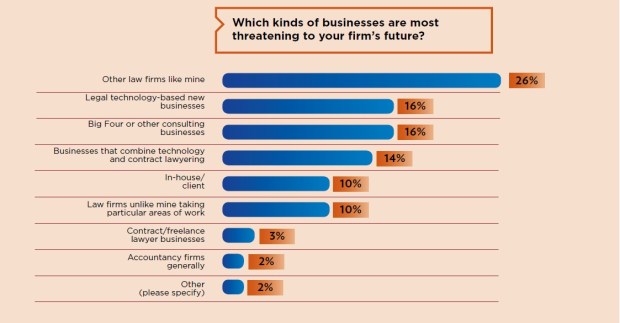
image 201901

What this indicates is that despite my having blogged about this issue as far back as September 2017 (‘Do you know who your competitors are?‘) senior managers of law firms still hold that other law firms like theirs are the greatest threat to their ongoing commercial success (at 26%).

As I wrote back then,

With the level of work that clients are now taking back in-house, or not bothering to do at all, they are without doubt the “overwhelming competitive threat” to the current law firm business model. And, this is not cyclical but structural.

Crucially, understanding this is of paramount importance if firms wish to survive the next 5, 10, 15 years. Because it reshapes everything we do. How we try and win work. The type of work we are trying to win. And even the nature of the relationship we have with our client.

In the long term it will determine the way we measure and reward. It will dictate how we charge, and it will determine whether we succeed or fail.

and I still hold now, this view is misplaced at best, and out and out wrong at worst.

As the following quote taken directly from the National Profile of Solicitors 2016 report (most recent I could find) published by the Law Society of New South Wales, in Australia the seriousness of the threat that in-house legal teams have on  the viability of your firm’s future success should not be underestimated:

Legal employment sectors are shifting. The great majority of Australian solicitors continue to work in private practice, with 69% employed in a law firm. However, the proportion of solicitors working in private practice has dropped from 75% to 69% over the last five years. This is due to a significant growth in the number of solicitors working in the corporate sector and government.

Between 2011 and 2016, there was a 59% increase in the number of solicitors working in the corporate sector, compared to a 17% increase working in the private sector.

Let that sink in for a second: a 59% increase in the number of solicitors working in the corporate sector [in Australia] over a 5 year period post the GFC.

Even coming from a relatively low baseline, that’s a staggering shift (indeed, some may even argue seismic)!

But ask senior management of law firms and only 10% will tell you that “in-house/client” is a business that is most threatening to their firm’s business.

Misguided pershaps?

As always, would be interested in your thoughts, views, feedback.
rws_01

Lawyers and ‘the amplifying factor’

On 11 January Seth Godin blogged ‘Good intentions (how to be on time)‘. Typical Seth, it’s a relatively short post; and typical Seth, it contains an important message – ‘The amplifying factor‘.

In Seth’s words:

The amplifying factor is that when they’re late, people wait for them.

So why is this relevant to your firm?

The answer:- how familiar does this [2015] post by Bruce MacEwen (Adam Smith, esq) sound:

(3) We recently had a meeting scheduled with the partner on the matter at the firm’s offices in midtown. (I was not present.) Our representative—one of the two wardens of St. Michael’s—arrived about five minutes early and ran into the partner in the firm’s reception area; he was heading for the elevator to go out to get coffee.

He kept going.

My colleague sat in the conference room for 15-20 minutes awaiting his return. When he did appear, the plan was to conference in the other St. Michael’s warden on the speakerphone. He didn’t know how to do that.

This is a perfect example of ‘the amplifying factor‘. And in law firms I see this behaviour every single day…

As always, would be interested in your views.

rws_01

Survey: The 5 Biggest Challenges Facing Australian Law Firms in 2019

Screen Shot 2019-01-01 at 9.29.51 pm

Happy New Year and Welcome to 2019!

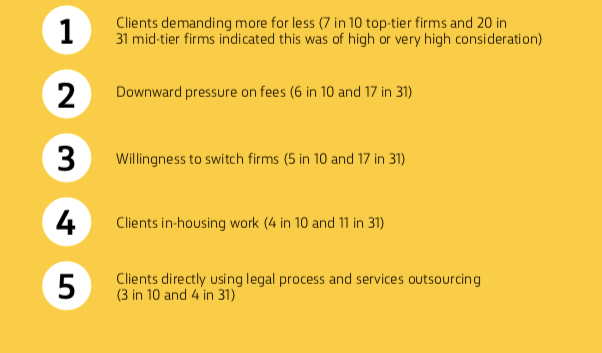
The recent (December 2018) Commonwealth Bank ‘Professional Services’ report highlights five challenges law firms in Australia are likely to experience further pressure on in 2019, which are:

  1. ‘Clients demanding more for less’
  2. ‘Downward pressure on fees’
  3. ‘Willingness to switch firms’
  4. ‘Clients in-housing work’
  5. ‘Clients directly using legal process and services outsourcing ‘

Each of these has it merits, while none is particularly new. So let’s take a quick look at each and assess them on their merit.

The call for ‘more for less’

It’s true, the call for ‘more for less’ continues. But I believe we may be misinterpreting the call a little here between what in-house really want (see Ann Klee, VP of Global Operations — Environment, Health & Safety, at General Electric Company – ‘less for less’) and what law firms believe they should be providing – a Rolls Royce service for a Toyota price tag.

My take: Neither client nor law firm are currently getting what they want and the net result is that nobody is happy with the relationship. Law firms need to get a better understanding of what is being asked of them. Scoping work properly – by experts – and then the subsequent professional project management of that is where the greatest return can come from here.

‘Downward pressure on fees’

Admission time!!:-

“I have never really understood the ‘downward pressure on fees’ argument”

Why?

Because, in order to be putting downward pressure on fees, surely you need to know upfront what that fee is – right?

However, if what you are saying is that this is actually a downward pressure on hourly rates argument, then I get where you are coming from.

But this is not the same thing as a downward pressure on fees argument, because there is little doubt in my mind that clients are willing to pay a premium on fees when the value of those fees have been fully explained and justified.

My take: despite the rhetoric, law firms still have a long way to go in understanding what in-house General Counsel are actually saying when they say “no surprises” on fee issues. And here’s a working reason why:- because while the GC can talk to legal issues the company faces, it’s the CFO who is responsible for explaining costs; and in more Australian companies than not, the GC reports to the CFO. A lesson in that for most private practice firms here.

A ‘Willingness to switch firms’

I often laugh when I see this one, because, really, ask yourself this: if most of your partners and lawyers are willing to switch to another firm, why shouldn’t your clients?

My take: if you want client stickiness, why not start with re-engaging with your own staff and get loyalty in your firm brand (something that hasn’t really happened since 2008 in Oz). Because while attrition will never be zero, if you can get your own staff on board as brand advocates you may find it a lot easier to convince your clients to hang-around.

‘Client in-housing work’

Without a doubt the biggest change in my working life has been the increase in in-house practitioners. A career in-house is now a very viable option for someone leaving university, something that was never even thought of in my day!

My take: the biggest competitors most law firms are not other law firms. It’s not even the #Big4. Don’t get me wrong, these are competitors, but nothing compared to the CFO of your major client working out its cheaper to hire a new lawyer in-house than pay your fees (see here for more on my views on your in-house competitors).

‘Clients directly using legal process and services outsourcing’

Not 100% sure what is meant by ‘outsourcing’ here. If this includes ‘on-shoring’, then I agree it’s a real threat.

My take: law firms in Australia will face a number of challenges over the next 12 to 24 months. Outsourcing, on-shoring will be among them, but I’m not sure I give them the same weight as the Commonwealth Bank Report does.

Some of the other issues I believe law firms here need to be aware of include further consolidation of the market (it remains too big for such a small market), staff retention issues, profit squeezes, technology and process improvements (and how, through change management champions, these are being handled within law firms because currently we are failing badly).

And finally, some 750 words into this post, we can mention the “innovation” word 🙂 .

Anyhow, guess you get the gist of where I am going with these so best of luck for 2019!

As always, would be interested in your views.

rws_01

2018 was a great year for AusLaw firms*!

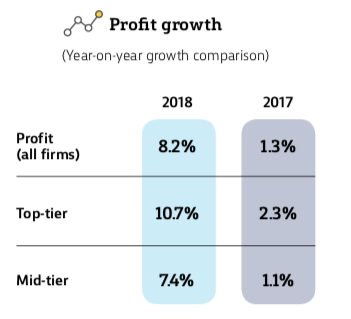
As we close out the year that was 2018, the graph below – from the recent (December 2018) Commonwealth Bank ‘Professional Services’ report – would appear to support the fact that 2018 has been a financially beneficial one for all those involved in private practice in Australia:

Screen Shot 2018-12-30 at 8.37.01 pm

The question I have though is this: is this a true correction?

And what I’m really asking here is this:

  1. have the underlying structural changes that we all know need to be made been put in place?
  2. if so, are we starting to see the benefits of these, or does this chart represent a false dawn?

And as we entered 2019 I’m going to leave those two questions out there, as I think many of us know what the real answers are here.

As always, would be interested in your views.

rws_01

* or was it?

My comments on today’s Lawyers Weekly article: ‘Observations on NewLaw in Australia in 2018’

Today (28 December 2018), Lawyers Weekly in Australia published an article by Lachlan McKnight, CEO of LegalVision in which Lachlan comments on his ‘Observations on NewLaw in Australia in 2018‘.  At the outset I should state that I don’t know Lachlan, and this post is no way directed at him, but is just a numbered-point muse on the interesting observations he makes in his article.

  1. ‘NewLaw’ (which is as meaningless a term as ‘Mid-tier’) is now an ‘industry’ – now that’s interesting.
  2. Agree with Lachlan’s comment in #1.
  3. While I agree with Lachlan’s comments in #2, I also believe the attitude here is changing within the more ProgressiveLaw firms. ProgressiveLaw firms realise that with greater risk (which fixed fees actually are), there should be a premium (much as there is with any insurance premium). EvolutionaryLaw firms go one step further and start to have a conversation about ‘value’ pricing.
  4. Three is an interesting comment: aren’t LegalVision in part owned by G&T  – as an aside (re #3 above), didn’t Danny Gilbert recently state that he thinks that clients don’t want move away from the #BillableHour?. Nevertheless, I agree with a lot of what Lachlan says in #3 but would probably set the bar at $75 million (we still only have a population of 25 million and IBISWorld still only puts the WHOLE legal industry revenue in Australia at $20bn [NB: the top 30 law firms in Australia make over $50m a year – in an industry this small!]).
  5. I would totally disagree with Lachlan’s comments in 4 and in my opinion you only need to look at the stuff MinterEllison and KWM are doing (with whom I have no association) to see this point – to me – is misplaced. In fact I would go 180 and say many BigLaw firms are going through their Arthur Andersen/Accenture moment (the original ‘child eat parent’?).
  6. The biggest challenge NewLaw (and Mid-tier law if such a thing exists) has to #5 isn’t OldLaw, it’s the #Big4.
  7. Number 6 is a point I have tried raising several times this year – scale. Law (Old and New) see ‘scale’ as being bodies (in part because of time-based billing). If it ever was it not longer is and any law firm, new or old, that get’s the right answer to scale will have a point of difference and in such a competitive market this is crucial. The reality is that potentially the biggest winners here should be the so-called Mid-tier (who have a lot of the grey haired industry knowledge without, currently, the scale – but I fear they have missed the boat because of lack of investment).
  8. For #7, see my comment in #3 re G&T.

As always, would be interested in your views.

rws_01

The R.U.L.E.S – again!

R.U.L.E.S.:

  • Realization
  • Utilization
  • Leverage 
  • Expense(s)
  • Speed

Taken from Robert J Arndt’s 1988 publication ‘Identifying profits (or losses) in the law firm‘ a flawed metric to determine:

  • which lawyers and partners were making a profit,
  • which practice areas were making a profit,
  • which matters were more profitable than others, and
  • which clients were more profitable than others.

But, is this really the way forwards when planning for 2019?

Would be interested in your views.

rws_01

Okay you can keep the ‘Legal’ tag; but it’s just Project Management!

I’ve been ‘white-boarding’ legal matters since my days helping out on front-end major projects back in 1996; so the concept of ‘mapping out’ how a transaction might progress, what may be ‘in scope’ and ‘out of scope’, the approximate amount of time the transaction may take and how we are going to resource it are not new to me. In more recent times (largely following the GFC in 2008) the legal industry has formalised my approach of ’white-boarding’ matters to become Legal Project Management. 

While I was never really that sure over the years how Legal Project Management differed from the more general Project Management, I have been assured – on numerous occasions – that there is a difference. When asked how, the most common response I received was that:-

  • Legal Project Management is the discipline of project managing ‘tacit knowledge’ – as ‘knowledge workers’, while
  • Project Management is the discipline of project managing tangible products, e.g., the construction of a hospital.

And until the last month or so I thought that was a pretty good answer.

So what changed?

Well, in the last month and a bit I have attended a collective 5 day (2 day and then a 3 day) course on Project Management Fundamentals run by PM-Partners Group here in Sydney.

The two day Fundamentals (essentially, theory) session was outstanding and broken-down into the following nine (9) modules:

  1. What makes projects succeed (and by implication, fail)
  2. The essential project management philosophy
  3. The project life cycle
  4. Project planning – project definition and scoping
  5. Project planning – creating the WBS & schedule
  6. Project planning – estimating
  7. Project risk
  8. Project execution & control
  9. Project closure

In turn, if you were on a course where you learnt all about: 

  • scope creep
  • the difference between what a risk is and what an issue is (hint, one has happened and the other hasn’t)
  • how to do a business case and a project plan
  • the triangle of scope, cost, time and quality
  • the four dependency types [finish-start; start-start; finish-finish; and start-finish], and
  • you get to work on creating a Work Breakdown Structure and Estimating (Optimistic, Pessimistic and Most Likely – also looking at the Cone of Uncertainty)

Wouldn’t you think you had been on one of the best Legal Project Management training courses around?

Well, that’s exactly what the two day PM-Partners run Project Management Fundamentals course taught me and I have walked away from that course thinking to myself that you can keep the classify ‘Legal’, at the end of the day it’s project management and it’s this type of project management we need to get better at.

My biggest take-out though?

Understanding the difference between a risk and an issue, because anyone doing pricing should get their head around this because it really is as important (and probably goes hand-in-hand with) as what happens with scope creep [helpful extra tip: want to understand scope creep, look up what happens with the formula: n (n – 1) /2].

Get in touch if you want to hear/find out more, otherwise get yourself on a really good PM Fundamentals course because I can guarantee it will pay for itself!

rws_01

#RIP to the #RFT?

I came to Australia in 2007 to fill a tender writing role. Till then, while I was familiar with responding to tenders, I hadn’t comprehended that responding to tenders could be a full time role.

Since 2007 though, on average, I’d guess that I have responded to one RFT – panel or project – per week (and I should add that during this period my roles have changed from tender heavy to tender light to tender heavy without that much difference in tender workload). I would guess that I also probably respond to one Request for Quote (RfQ) every two days and I must assist with at least two capability statements per week.

What I’m trying to say is this:- I’ve worked on a lot of proposals over the past decade.

And why wouldn’t I have? So far as I’m aware, in Australia:-

  • every level of government – Federal, State, Territory and Local – is panelled to some extent. A number of states, including NSW, QLD, Vic and WA also have collective Local Council panels.
  • approximately 80% of the ASX 200 is panelled.

That’s an awful lot of tenders – some of which are public and others invitation only.

Right about now you’re probably asking why this all matters?

The answer is this,  last Friday Corporate Counsel reported that ‘Barclays Looks to Shake Up Law Firm Panel Model in Coming Years‘, going on to state that:-

“Beginning in 2021, Barclays will ditch RFPs and adopt a more flexible approach to outside counsel management.”

[Noting that the terms RFP and RFT are largely inter-changeable]

Having been at the coal-face of requests for tenders for so long, this is music to my ears!

Only, as a half decent tenderer can tell you, on closer inspection it isn’t.

Chris Grant, the head of Barclays’s firm relationships, has come up with guidelines that the Bank hopes will allow them to build better connections with their firms. These include Barclays using a “gateway process” that includes a probationary period for new legal service providers.

Hang on a second – this is suddenly sounding like an ad hoc – as opposed to a structured – RFT process.

Shame really as one day B2B clients will come to realise that legal panels are a very costly and time consuming process.

rws_01

Law firms need to change their definition of “success”

Read an interesting post by Alison Laird last weekend. Interesting as it was, Alison’s post (‘It’s Time’) isn’t the first to call ‘time’ on hourly billing. Nor, in my opinion, will it be the last.

Why do I say this?

Because, as important as the calls for “more for less” and “cost certainty” have been for in-house lawyers and clients more generally, behavioural evidence has shown they’re not really that important to law firms and that clients (in the more general definition of that term) are not willing to push their legal service providers to move away from hourly billing, if – caveat –  they can get a “quote” (read cap or fixed fee expectation).

In short it’s a game. Client says: “we want cost certainty”. Law firm says: “we bill by the hour”. Client says “meet you in the middle – capped/fixed/discounted fees”.

But it doesn’t have to be this way.

What if your law firm really wanted to be “entrepreneurial” and decided to think outside the box – starting by changing its definition of “success”?

What if, instead of defining “success” as being the number of hours a year a lawyer works (note not paid for), and/or the amount of revenue the lawyer earns (note not profit), the definition of “success” becomes:

Success is measured in terms of the value received by the customer and the law firm.

I agree, not perfect.

But imperfect as it is, it’s a start. A start of a conversation we need to have as a profession: “How do we measure success?”.

Because until we have this conversation, all other conversations – including that around hourly billing (not pricing) are meaningless.

rws_01

When Seth Godin’s simple contribution analysis for pricing doesn’t work

Last week Seth Godin wrote a brilliant post titled ‘All other things being equal (simple contribution analysis for pricing)’.

As the title of the post suggests; in his post Seth suggests that if you know your cost of production you can use this as the basis for calculating your go to market price – and ultimately this will effect your profit margin (price – cost = profit).

In Seth’s example he uses the price points of $7 and $9 and states that, with a cost of production of $5-:

.. all other things being equal, you’ll need to sell twice as many at $7 as you’ll need to sell at $9.

($2 profit per unit at $7 as opposed to $4 at $9).

And Seth is right. So what has this to do with law firms?

My answer:

this is exactly how law firms have priced their services (hourly rates) for the last 20 years.

And it totally falls apart because of what we call in the business the “average billing rate”.

Back up: what exactly does that mean?

Well we know what our cost of production is (only we don’t because we will argue all year long over “shared costs” etc) and we know what our “rack rate” is (only we don’t because there are so many of these we never sure which is the “actual” rack rate) so we know the profit margin.

Using Seth’s example, our cost of production is $5- per hour and our rack rate is $7 per hour or $9 per hour. QED, $9 per hour lawyer is making more “profit”.

But…

say $9 per hour’s realisation rate is 70% and $7 per hour lawyer’s realisation rate is 100%…

..then you have a whole different story as now $9 an hour lawyer’s Average Billing Rate is less than $7 an hour lawyer’s.

And suddenly ‘simple contribution analysis’, which law firms have been using ever since I joined the profession over two decades ago, becomes meaningless.

But ultimately Seth is right:

Price is a story, it’s a story we tell ourselves and others about what we have to offer. But price is also the path to being able to stay in business.

and also: his post clearly states “All other things being equal“, which we all know will never be the case in the matrix known as a law firm!

rws_01