RFP

Passed the Association of Proposal Management Professionals Foundation Course!

Super happy to say that I passed the Association of Proposal Management Professionals (APMP) Foundation Course test and so the team at GSJ Consulting are now accredited tender specialists – a rare feat for a tender provider focused on the professional services sector!

APMP is the peak industry body for proposal managers more broadly than professional services – like those tender writers doing submissions for multi-billion dollar construction tenders, so it really is a great honor to be in this esteem company.

Get in touch if you need help resourcing your next tender.

rws_01

A different take on the end of the Billable Hour

I have read a lot recently about how AI and ChatGPT in particular is going to kill the billable hour. That may well end up happening. What I do suspect though is that it is unlikely to happen soon. And if the billable hour is to be killed off, technology – such as AI and ChatGPT – may well play a part, but it will be the cultural/behavioural change that’s needed that will be the final nail in this coffin.

Don’t believe me?

Here is a quote (of kinds) by Aarash Darroodi, Fender’s General Counsel, at the recent Legal Marketing Association’s annual gathering in Hollywood, Florida:

…the mere fact that he’s being billed by the hour isn’t a problem — but that the billable hour’s implementation can be.

In other words, Darroodi doesn’t mind that his law firm(s) charge him (his company) by the hour, but he does mind if you take him for a fool.

And until this mindset changes, you’re not going to see the death of the billable hour anytime soon.

Darroodi’s comments on the RFP process – should clients do an “open day” before tendering?

While Darroodi’s comments on the billable hour were interesting, his comments on the approach law firms should take to the RFP process were even more insightful. To quote from the article:

[Darroodi] described receiving template-based RFP responses from law firms — an approach he called “fundamentally a mistake.”

Instead, he would like to see a law firm respond to an RFP with an offer to come look at the company’s operations in-depth, gaining a better picture of his organization before a proposal is prepared.

“First of all, it shows initiative on your part. It shows the fact that you care,” he said. “And plus, it shows us that you’re going to submit something that’s directly related to our existing organization.”

Now I’m more than sure that not all GCs will take this approach. And before everyone in Australia says this would likely breach procurement protocols (after the RFP has been issued), I know.

But, wouldn’t it be interesting – and just a little more relevant, if clients did an “open day” before they issued the RFP? Particularly in cases where the tender is by invitation only?

In my view it would certainly make sense and would undoubtably result in more directly relevant and related (and probably eminently more readable) tender responses.

If you want to read anymore on either of the issue above, go read ‘Why Curiosity Is Key For Business Development Observations from the general counsel panel at this year’s LMA meeting‘ by Jeremy Barker on the Above The Law website.

Not only is it highly insightful – so “thanks for posting it Jeremy”, but it contains this nugget – again from Darroodi – on his views about client events (and if you are anEvents Manager in a law firm, stop reading now 🤣):

“I don’t want to spend time with my lawyers,” Darroodi said to laughter, comparing the idea to hanging out with his dentist. 

Ouch!

In the meantime, if you need help with your pricing or RFP responses, feel free to reach out to me.

rws_01

Survey: The role pricing specialists play [or don’t] in RFP responses

Last week the USA’s J Johnson Executive Search, Inc and the UK’s Totum published their combined ‘RFP Survey Responses: U.S. and U.K. Data 2016‘.

A fairly evenly distributed demographic of large (defined as being 600+ lawyers), mid-sized (defined as being 100-600 lawyers) and small (up to 100 lawyers, for the U.S. only) law firm respondents, insights from the survey include time spent responding to RFPs, persons within firms charged with project managing responses, as well as tools and expertise made available to responding teams, in both the U.S. and the U.K.

As with most surveys of this nature however, it is the role that pricing plays that typically grabs my attention and given this survey’s combined U.S. and U.K. perspective even more so in this case.

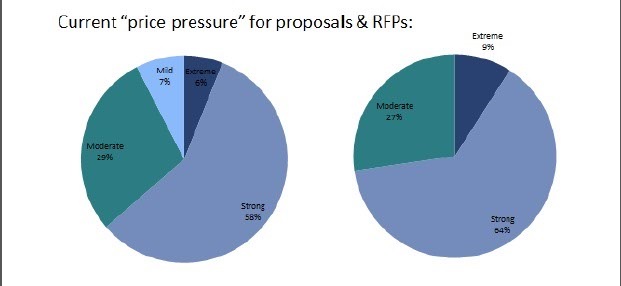
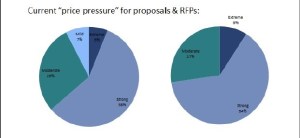
Given ongoing market pressures, it should surprise no one that responses of “strong” from the U.S. (58%) and the U.K. (64%) to the question of what current “price pressure” for proposal & RFPs were fairly similar.
rws-5


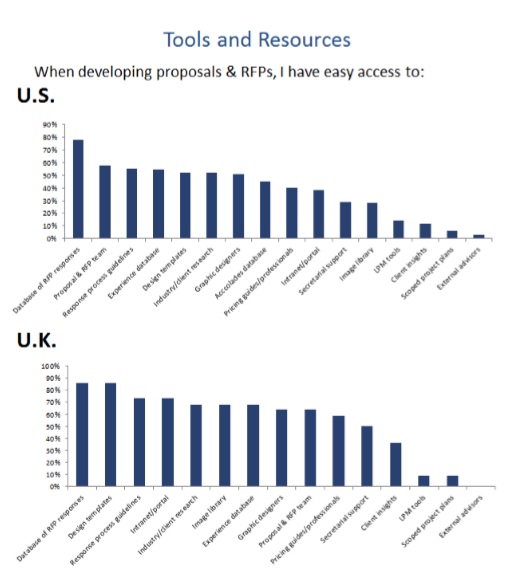
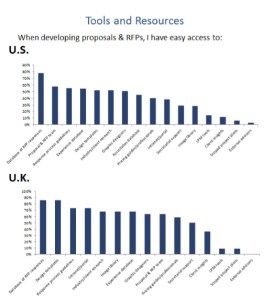
A little more surprising to me was the difference in responses between the U.S. (40%) and the U.K. (60%) to the question “when developing proposals and RFPs, I have easy access to” the answer was “pricing guides/professionals“.
 

rws-7


Now don’t get me wrong, even these days I think it is particularly progressive and somewhat comforting to know that 60% of my colleagues in the U.K. have access to some sort of “pricing guide/professional”.

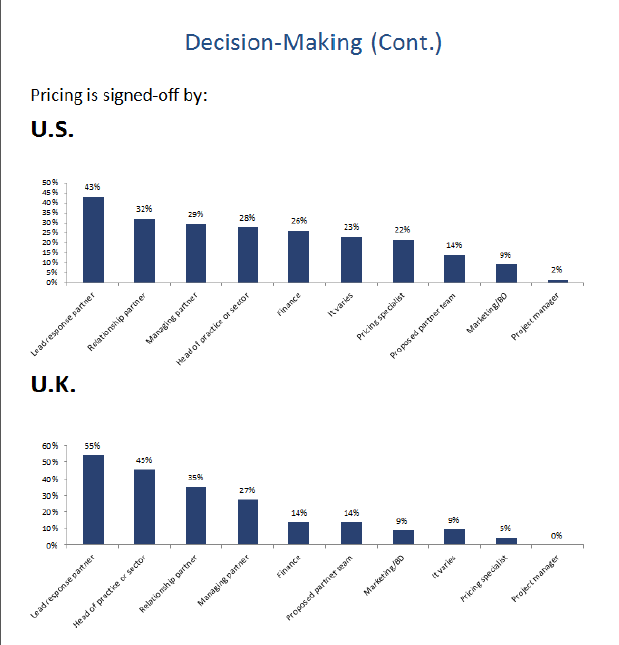
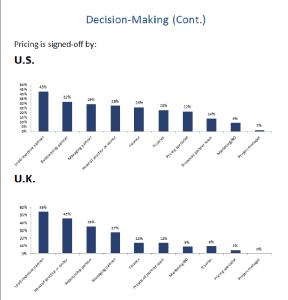
Until, that is, you get to see who actually gets to sign-off (i.e., the “decision maker”) on the all important issue of pricing in RFPs in the U.K.. Here, and I kid you not, the response in the U.K. of “pricing specialist” (that same person who 60% claim to have some form of access to – either via guides or in person) was 5%.

I think that is worth repeating – 5%.

Put into context, that means in the U.K. pricing in your RFP is more likely to be signed off by Marketing & BD (9%) or Finance (14%). Indeed, in the U.K., “It varies” is likely to have more of a say on final pricing in the RFP response than the so-called pricing specialist.
rws-4

I’m not so sure why the results of this particular survey so surprise me. After all, time and time again survey results show that we typically say one thing about pricing, but do quite another.

What I will say though is this: if you have access to a pricing specialist, and pricing by your pricing specialist is being determined in 5% or less of your RFP responses, my guess is going to be one of two things: (a) you have no idea if you are making money from your RFP “wins”, or (b) more likely, you are leaving money on the table big time!

RWS_01

* images should be enlargeable, apologies if they appear a little blurred.

What are my pricing options?

what are my pricing options

You hear a lot these days about ‘pricing‘. This might be as it relates to Alternative Fee Arrangements (AFAs) or Value-based pricing (VBP).

Indeed, all the noise around this issue can get daunting at times.

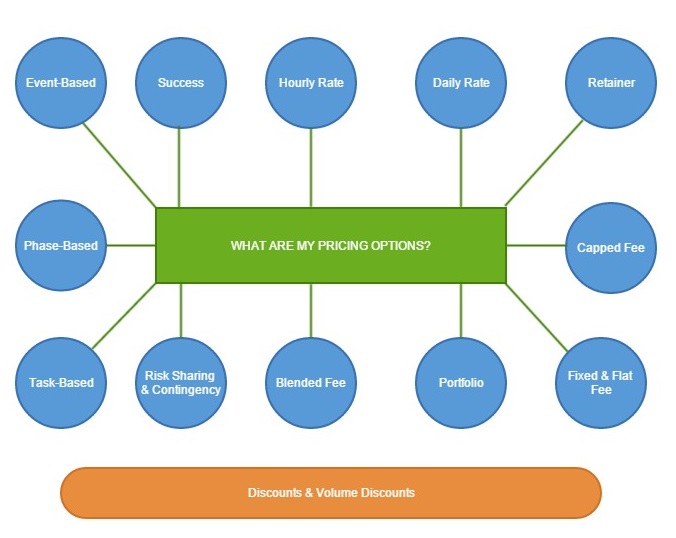
So for today’s post I thought I would share a graphic that I have created from the many RFTs (tenders), RFQs (quotes), RFPs (proposals) that I have been involved in over the years and which I have named: “What are my pricing options?“.

Also, I’ll let you in on a little secret:- there’s isn’t such as thing as an “Alternative Fee Arrangement” – only pricing options or fee arrangement. Likewise, if properly explained and clearly transparent, all pricing options are value-based.

There’s one caveat I have though: any pricing option that includes a ‘discount’ or ‘volume discount’ component isn’t a pricing option – as you’re not getting your asking price!

I hope your find the graphic useful and if this is a subject you are interested in learning more about I would suggest you start with the Association of Corporate Counsel’s (ACC) Value-based fee primer.