If you don’t have time to read Andrew Malocussions article, and I suggest you do because it’s actually very interesting, the long and short of it is that the reason why big (read global) law firms are losing millions in revenue (opportunity) is because…
… their pricing teams are too small.
All I have to say is, “seriously”!
Do yourself a favour, go back in time 5 years and work out for yourself whether or not the fact that law firm pricing teams are too small is the real reason they may or may not be losing millions of dollars in revenue.
For my part, this type of thinking doesn’t pass the pub test!
Feel free to reach out to me if you want to talk through any pricing strategy related issues/questions.
The numbers have been crunched and the results are in: ‘Dynamic Law Firms’ invest considerably more in their business development and marketing activities/departments than static firms are willing to do.
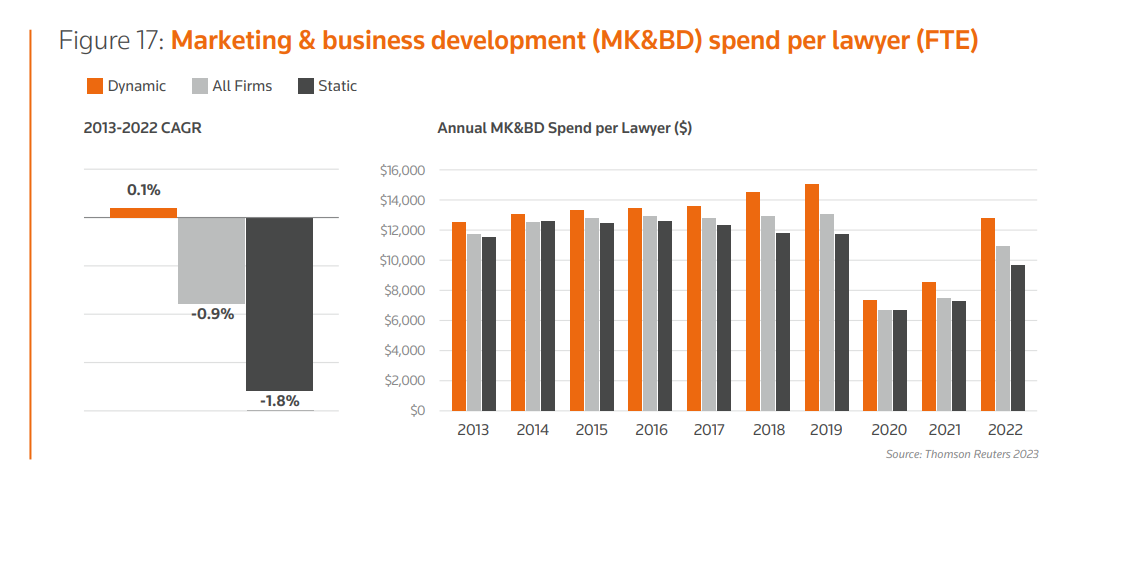
According to the latest (8th) iteration of Thomson Reuters Institute’s 2023 Dynamic Law Firms Report, Dynamic Law Firms consistently invest greater sums in their business development and marketing teams than Static Law Firms:
As you can see from the over graph, in 2022, on average, this investment by Dynamic Law Firms in their business development and marketing teams accounted to over $12,000 per lawyer. Roughly $2,500 more per lawyer than Static Law Firms.
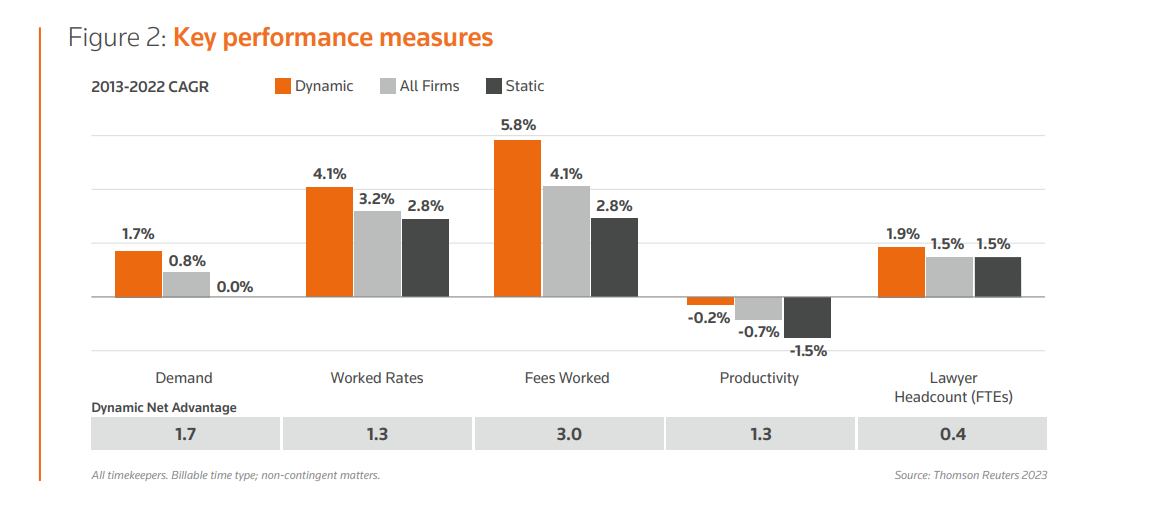
Importantly, this investment in business development pays off:
With Dynamic Law Firms consistently outpacing Static Firms in all growth Key Performance Measures; but, most notably from a business development perspective, in both ‘worked rates’ and ‘fees worked’.
So why is this? After all, business development and marketing is a ‘cost-center’.
Well, as the Report itself states:
“The first goal of MK&BD investment is to raise top-of-mind awareness of the law firm.
Research conducted over the course of many years by the Thomson Reuters Institute has shown that top-of-mind awareness is a vital first step toward winning work – a process that will see a firm move along a continuum from awareness to being viewed favourably, to being considered for and ultimately winning work, and hopefully, to a point where the firm has gained enough experience with the client that they garner credibility in the board room and can begin to box out competitors.”
A fact backed-up by the authors of Simple Heuristics who, in their principle of “recognition” [firm brand or lawyer], state that recognition is number one in any client’s decision process around whether or not to buy something.
And so it goes without saying that this ‘awareness‘ factor is critical in the ‘buying cycle’. If we don’t have this advantage, then we need to hope to hell the other providers aren’t a known commodity so we can proceed to the next level in the buyer’s decision process (typically experience – have they done this before?; then can I trust them not to mess this up and make me look stupid! – SIDE NOTE: price isn’t in the top 3 decision making selection criteria.).
Which is why, if you want to make sure your firm stays one step ahead of its competition, you actually need to be investing more, not less, in your business development team right now.
Yep, the evidence is in. It’s undisputed. Business Development and Marketing is not a ‘cost center’ (not that I ever thought it was). They not only pay for themselves, but they ensure your firms stays ahead of its competitors and earns more $$$s.
So the next time you think to yourself: “I need to cut costs, I’ll cut my business development and marketing budget” – I’m here to tell you that’s dumb – think again, because not only will it hurt you but it will take you on a journey to blandness.
As always, feel free to reach out to me for a chat if you want to talk through how I can help with this.
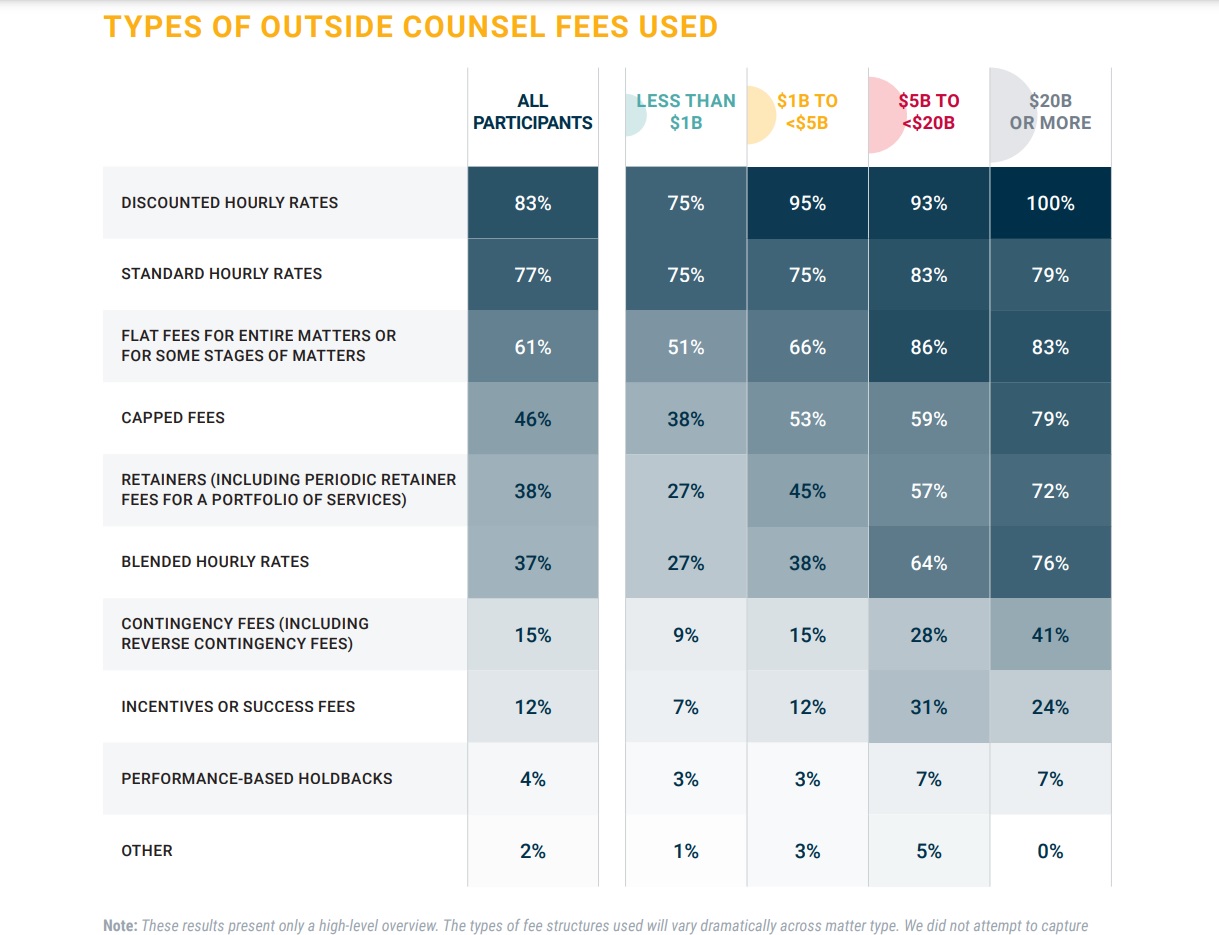
If you are wondering what types of Alternative Fees Arrangements (AFAs) in-house General Counsel are asking their private practice suppliers to provide them with – or, to flip the coin, what AFAs private practice lawyers are charging their in-house GCs, then wonder no longer. The latest market report from the Association of Corporate Counsel (ACC) sets this out in a nice clear table:
Some take-aways:
The #1 AFA fee request of outside counsel is Discounted Hourly Rates. No less than 100% of companies with revenue over $20BN or more use Discounted Hourly Rates with their private practice lawyers! When, oh when, will we learn that Discounted Hourly Rates are NOT a fee structure? On this point, I have been arguing for years (literally, the linked post was from 2018!) that there is no point having a pricing function in your law firm if all you are going to offer clients is discounted hourly rates! Seriously, save yourselves the money.
Say what you want, the #BillableHour is far, far from over if it is the preferred billing method of over three-quarters (77%) of all in-house GCs participants in the survey!
Capped fees are dumb! They are a lose-lose: both for the law firm who if they come under the cap can only charge what is on the clock and if they go over the cap have to wear the additional cost; but also for the in-house team who will get under served as soon as it becomes clear the cap cannot be met (and probably never was going to be). So why are they so prevalent? I can only assume capped fees are driven by the CFO wanting “cost certainty”.
Given the continued popularity of hourly rates, Blended Hourly Rates are nowhere near as popular (at 37%) as you would think. On transactional matters in particular, you would think this rate of use would be a lot higher.
The use of Success Fees is woeful. Is this a reflection of the amount of M&A and privatization work actually being done (where you would expect it to be prevalent, or is it an actual fact that in-house counsel don’t like/understand the benefits of this arrangement? Or could it be, every deal is getting done so why take the uplift risk?)?
An understanding of Performance Based Holdbacks has a long, long way to go.
Importantly though, despite talking about implementing AFAs for over two decades, we are still a long way off actually using them in practice.
Again, take a look at my linked article above where I talk to Patrick Johansen’s Continuum of Fee Arrangements™, where Patrick sets out 16 different types of fee arrangements that can be used:
Hourly
Volume
Blended
Retainer
Capped
Task
Flat
Phase
Fixed
Contingency
Portfolio
Hybrid
Holdback
Risk Collar
Success/Bonus
Value
And ask yourself, how many of these are being actively used in this latest report from the ACC?
Notably missing from the list above? Value Based Billing!
Yes, despite what you may read and hear elsewhere, in practice we are long, long way away from understanding and implementing the appropriate (a term I learned from Toby Brown) use of relevant fee arrangement for the task at hand.
In-house or private practice, if you’re struggling to get to grips with this issue, feel free to reach out to me for a chat.
Ever wondered if there is a difference between ‘customer service’ and ‘customer experience’?
I was fortunate enough to come across this quote by Paul Roberts, CEO at My Customer Lens that, frankly, sums it up better than anyone else I have seen lately:
“It’s important to define the difference between customer service and customer experience. I like to define customer service as what you do, and customer experience is how you make people feel.”
Too often in professional services firms we concentrate on the ‘customer service’ at the expense of the ‘customer experience’; when the reality is that we should be much more focused on the customer experience than we are on the customer service.
As the article states:
“Improving the client experience is about looking at the entire client journey, from initial enquiry through to case completion, and beyond. It’s a rethink and review of every customer touchpoint throughout your organisation; from the way the phone is answered, to your hold music, reception waiting room and website home page.”
Spot on advice.
If you or your firm is struggling to get a grip with this, feel free to reach out to me for a chat.
Woke up this morning – Australia time – to news that had broken overnight that Eversheds Sutherland (ES) and King Wood Mallesons (KWM) had entered into an exclusive alliance, along with a whole lot of DMs (Direct Messages) in my LinkedIn box asked me what my initial thoughts were.
So here I go with some initial, off the cuff, thoughts about this:
With the closure of the 6 KWM offices across the UK, Europe and Middle East, the deal likely brings to a happy end KWM’s sad foray into those markets and puts final closure on the SJ Berwin story.
Both KWM Australia and KWM Hong Kong are not part of the deal. While this is good news for ES’s Hong Kong team – who I hold in very high regard – it seems very odd and shows possible cracks in the Swiss Verin model that is KWM (with KWM China being party to this arrangement). I’ll be very interested to see what this means for KWM Australia in particular.
The arrangement requires – subject to “client preference and conflict clearance” – KWM China to refer all outbound UK, Europe, Middle East, Africa and South America instructions to ES. I understand the “UK, Europe and Middle East”, but why include “Africa and South America” (noting that ES has offices in Africa but not South America that I can tell)? I think this could be particularly telling given both Africa and South America will be geographies in which KWM Australia plays and so there is the potential to see KWM Australia pitching for work against work that ES has been referred from KWM China.
Noting the deal is with “Eversheds International”, there is no mention of whether the consultancy arm of Eversheds is included in the arrangement. If it is, then KWM China has boosted it offering in this space significantly overnight (although there may well be some regulatory restrictions around that [consultancy] in China).
To me though, what will likely make or break this “formal cooperation agreement” however will be:
How are inbound/outbound referrals being tracked?
How are the referring partners being rewarded for the referrals?
And, what will the KWM Australia partners make of all this given access to a network of lawyers in one of their biggest overseas geographic locations, the UK, will be gone? Do they refer work to ES, even though they are not part of the deal? Or do they refer work to lawyers/mates in other law firms who compete with ES in the UK – including, interestingly US firms with news earlier this week that: “Nearly half of the UK’s largest law firms are US-headquartered”.
I guess we will have to wait and watch this space, but my three big observations are:
(1) Not sure what Eversheds is getting out of this deal – do KWM China refer that much work into UK, EMEA and South America?
(2) Looks to be a great deal for KWM China.
(3) Are KWM Australia being left in the wilderness?
It’s that strange time of the year when we start all over again as if the previous 12 months didn’t happen. Only it is not quite as simple as that. From today:
most lawyers will be charging clients 10% or more extra for their services, with little or no explanation about where the extra value is being delivered and with the new fee rate being completely and totally justified by the date in the calendar and CPI rate increases.
judging by the LinkedIn notifications I have been receiving, a fair number of lawyers will be promoted to new roles – “congrats all”. Along with those promotions comes increased fees charged to clients!
So while we are all enjoying the various EOFY parties over the next few weeks, or simply enjoying some downtime over the school holidays: keep in mind that you need to have a carefully crafted value message to explain to your clients why you justify that higher fee rate; and if you want to ensure that your realisation rate stays healthy I suggest it be better crafted than “we are in a new financial year”.
And if you are struggling with any of that, feel free to reach out to me for a chat.
Came across the term “Burden partners” in this article in the Australian Financial Review today. “Burden partners” is a term denoting those partners within a partnership whose cost to the partnership is greater than their contribution.
In simple terms, partners who withdraw more from the kitty than they have deposited.
The reality is that by its very nature (due to economic cycles), there will – from time-to-time – be partners who have years in which they withdraw more than they have deposited that year; but in most cases these partners will have previously made significantly higher deposits than withdrawals and are effectively withdrawing savings (having said that, retained earnings is not a given with law firm partnerships so this is more a reputational issue than financial one).
It is circumstances in which this is a prolonged (and often unfixable) trend where this becomes a problem.
You can also often see this with new partners who have probably been made-up too soon and don’t really have the book of business yet to justify their promotion to partnership ranks.
Either way, if the term “burden partners” sounds familiar and you want to discuss ways of how this can be fixed, feel free to reach out to me for a chat.
As readers of this blog will hopefully have observed, I’m a very keen observer of up-and-coming developments in the legal industry. Frankly it’s my job to follow and understand emerging market developments and, particularly, how they may affect the way we serve our clients.
And so it was, with such a mindset, that almost two decades ago I came across a concept being touted as the next BIG thing: ‘unbundled legal services‘.
Along with ‘covenant lite loans‘ (this was pre-2008 after all), ‘unbundled legal services’ were going to transform and change the way we serviced our clients; particularly those sophisticated purchasers of legal services.
Then, just like that, ‘unbundled legal services’ went exactly…
…nowhere – never to be heard of again in polite conversation!
Return of the Jedi!
I’m here to tell you that, following a recent report by the Solicitors Regulation Authority (SRA) [England and Wales] – published on 15 June 2023, ‘unbundled legal services’ are back from the dead!
Before I go into what the SRA’s report says, and why it might be important, let’s take a helicopter look at what ‘unbundled legal services’ meant back in the early 2000s and what ‘unbundled legal services v2.0’ means today.
Unbundled legal services v1.0
From the outset ‘unbundled legal services’ were also known as ‘limited scope representation’, I think in part because this was the term more commonly used in the USA – although I’m happy to stand correct on that. Anyhow, at the name suggests, ‘limited scope representation’ means exactly that: your lawyer won’t do everything for you on your matter and it is up to you and your lawyer to divvy-up what they do and what you do.
For this reason ‘unbundled legal services’ were seen as being extremely sexy because you – the client – got to choose what your law firm did [and charged you for] and what you kept in-house. Even better, you – the client – now had the option to appoint subject matter experts for the “grey haired work” (as Maister would call it), but for more menial work you could appoint an LPO (anyone remember “Legal Process Outsourcing”?).
Such radically thinking could even lead to such a thing as ‘coopetition’ (as I have blogged on previously!).
But, despite the obvious benefits of growing headline revenue with ‘unbundled legal services’, I would hazard a guess that 20 years later less than 1% of most law firms’ revenue is derived from this product. Evidence of my thinking here is, I believe, substantiated by a recent article in the Law Society Gazette: ‘Unbundling? Never heard of it, say 40% of firms’ by John Hyde.
Unbundled legal services v2.0
So back to the SRA report and why unbundled legal services appears to be back in vogue.
While limited to “family law” issues, the SRA report includes two important comments:
The first, more a definition, is: “Unbundling describes the process of dividing tasks in a service between the consumer and provider. This can, among other things, make them more affordable and accessible.” and
the second, going to the crux of the issue: “Solicitors providing ‘unbundled’ services could make legal help affordable for those whom it is currently too expensive“.
QED, a possible solution to the Access to Justice (A2J) issue?
While I think both of those comments are correct, I want to quickly pause and cover a few of the other comments made in the Report. These include:
We found that unbundling does have the potential to increase access to justice as it makes some legal services more affordable.
Law firms could attract more clients as those clients knew they could in fact afford an unbundled deal.
There are low levels of awareness of what unbundling is and how widely available it is, even though a number of providers already offer this.
All of which, in my experience, are true in the broader aspects of unbundling.
To finish up..
To finish up I’m going to use the SRA’s own wording in the Report; which is that the unbundling of legal services comes with complications that include:
We found no significant difference in the level of satisfaction between consumers who used unbundled legal services and those who used an end-to-end service.
Some consumers also wanted to have more control over their case.
Some [law firm] providers would like to expand what they do but there are concerns around the impact on firms’ insurance premiums and the possibility of legal action if things go wrong which they were not responsible for.
Let’s not beat about the bush: Points 1 and 2 are relatively damning; but it is that last point where, in my opinion, unbundled legal services have died the death of a million cuts: while most firms and lawyers would consider offering this service, most insurers of professional indemnity [PI] insurance have no ideal of what it is or how to price the risk.
The last point is especially the case given the fact that most law firms have no real understanding of how to provide a letter of engagement to their clients with clearly defined scopes of services that don’t include a million assumptions and caveats or: “it depends” clauses.
Anyhow, setting aside all of the above, I continue to hope we will see a growth in ‘unbundled legal services’ while remaining sceptical it’ll happen.
If you need some help with how you can use unbundled legal services to successfully differentiate your firm’s offering, feel free to reach out to me for a chat.
Many of us in Business Development who work in this market day-in, day-out believe that it is.
Evidence we often provide to back this claim up includes:
The sheer number of panel appointments: both at Government (Commonwealth, State and Local Council) and private sector (nearly every ASX100 company is now panelled), means we are tendering year round.
If we are not tendering for panels, then we are tendering for projects and sub-panels. Most major law firms in Australia will be doing 250+ tenders a year!
Client fluidity. Tenders are one part of this, but client movement among firms is increasing. The stickiness we used to see is no longer there and, frankly, it is getting harder and harder to keep clients in this market. We need to be on top of our game, ALL THE TIME!
Law firm consolidation: we have seen a fair amount of this in the past 10 years. Anyone remember HDY, Herbert Geer, Dibbs Barker, Kemp Strang? These days, when it rains, I can play a game of “spot the law firm umbrella that has outlasted the law firm“!
But perhaps one of the biggest signs of how competitive the market is here is the sheer number of partner lateral movement we see each year. I’m sure other markets, such as the US, have higher numbers of actual lateral partner movement; but, I suspect pro rata number of partners, Australia would be in the top 2 or 3 in this field.
So those of us who live and work in Business Development in Oz can put our hands up and say: “We live and work in one of the world’s most competitive markets”, where brand differentiation is difficult, and almost everyone relies on innovation and technology to set themselves apart from the pack.
If all above is true: What can we do about it?
Well, not a lot actually.
But, and here is the good news, over the weekend I read a blog post by Seth Godin which gave me hope that, actually, it doesn’t really matter.
In ‘Too much competition‘ Seth states something so profoundly obvious I have to wonder why I have cared about how competitive our market is for so long.
So what is that Seth said?
Focus on the customer
Here you go:
Focus on the customers who care enough about your idiosyncratic and particular offerings that they’ll not only happily walk away from the lesser alternatives, but they’ll tell the others.
Simple really!
Only it’s not. So if you need some help with how to successfully differentiate your firm in tenders, feel free to reach out to me for a chat.
On the client side, demand for legal services is projected to remain strong — 41% of clients say they plan to increase legal spending this year, and only 20% expect legal spending to decline.
On average, law firms are allocating 1% to 2% of revenues to marketing & business development budgets.
So, 41% of your clients are saying they plan to increase their legal spend this year, but you [as law firm management/managing partner] are only willing to allocate 1 to 2% of revenue to your business development and marketing efforts (which must be an all time low in the B2B sector).
And, let’s keep in mind that’s business development + marketing combined.
And, we all know the big winners in that expense allocation equation are marketing, not business development – the funnel, not the conversion.
But, like anything in life, law firm business development teams cannot succeed if they are not properly funded. If you want to:
pick the low hanging fruit
grow your share of client wallet
or any variation thereof, you need to make sure you invest in this critical function – and, frankly, 1 to 2% of revenue ain’t going to cut it!








 RWS_01's B[D]log