Global law firm issues

Survey: The cost of replacing that departing associate…

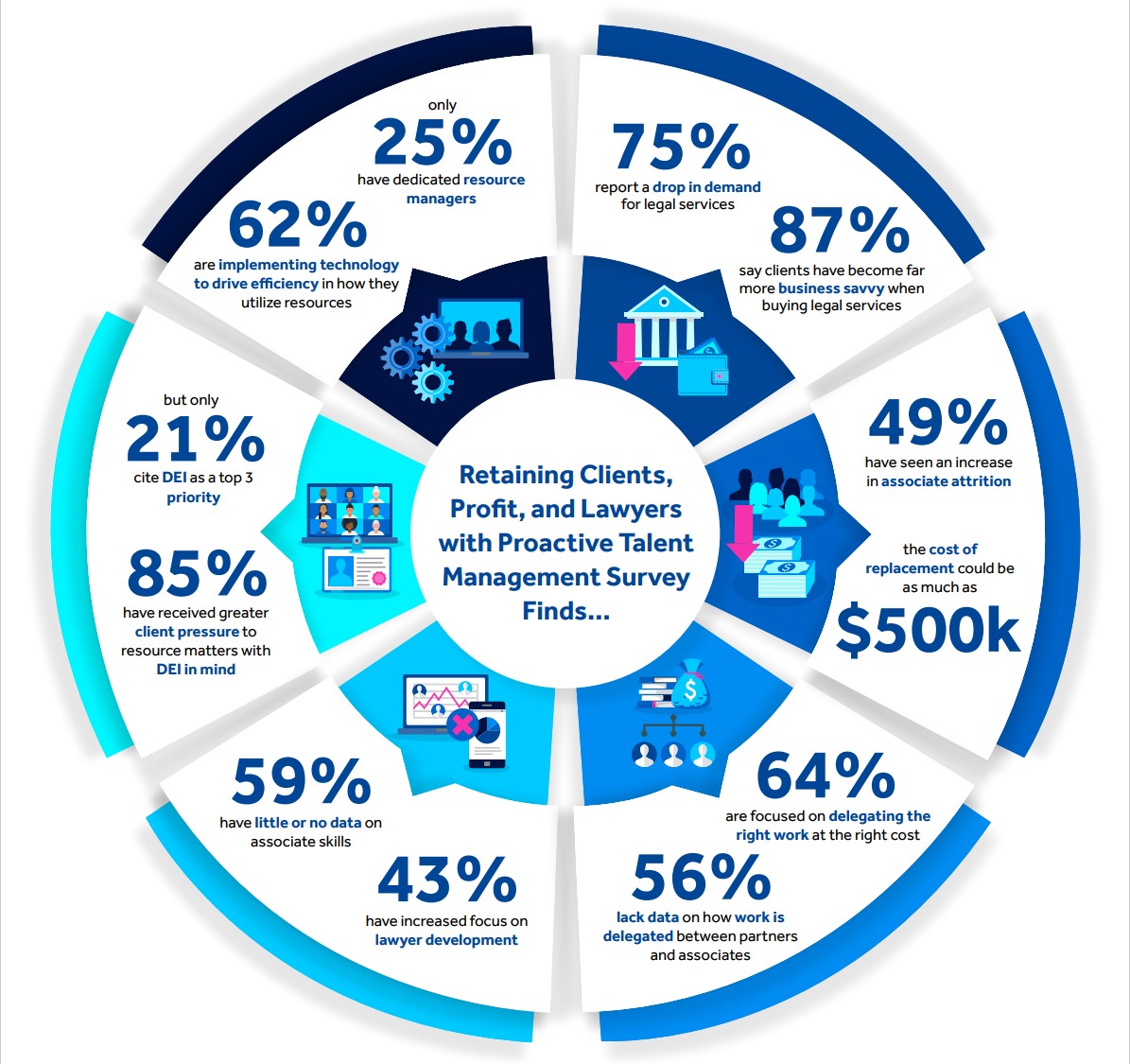
If you’ve wondered how much replacing that associate or senior associate who just left you is going to cost, then a recent report from Big Hand provides the answer: circa $500k.

That’s right, a cool half a million dollars!

Those costs won’t always be upfront and apparent, they will include:

  • a possible increase in salary for your replacement associate over your previous associate’s salary (due to market pressure) – which is somewhat ironic as salary may well be the reason the old associate left you!
  • commissions to talent agents to find you said new associate
  • increasingly – signing on bonuses
  • training costs over the first 12 – 18 months to bring the new associate up to scratch on your firm’s systems and business development strategy.

The list of actual and hidden costs here is almost limitless, and so the overall cost to your firm of replacing that departing associate/senior associate could actually be a lot more than $500k. Which begs the question:

with 49% of surveyed firms having said they had experienced an increase in associate attrition, you have to wonder why this isn’t an area where more firms are focusing their attention?

You also have to ask: Does asking someone to work 2,000 billable hours a year have something to do with these attrition rates among associates?

And with 75% of surveyed firms having said they have seen a drop in demand for legal services, is this a cost you really want to be incurring right now?

If you need help looking at your firm’s strategy, how to retain associates and differentiating your practice from the crowd, get in touch!

rws_01

Where do AFAs rank in the cost savings pyramid?

If you have been wondering where Alternative Fee Arrangements (AFAs) sit on the ladder of cost-saving for in-house counsel, wonder no more. This post [By-the-Hour Billing Torments Legal Departments. So Why Aren’t More Demanding Alternatives?] by Hugo Guzman on law.com yesterday (14/11/2023) will answer all your queries:

  • 66% of respondents said they plan to bring more work in-house as a cost-control strategy
  • 39% plan to shift work from big law firms to smaller ones,
  • 33% plan to leverage the use of technology and AI.

And, drum-roll

  • Expanding AFAs ranked fourth, at 28%.

Not sure how everyone else interprets that data, but it looks like a very sad state of affairs to me.

Feel free to reach out to me if you want to discuss what this might mean to your business or law firm.

rws_01

High-Value Retainers

I put a post up last week on LinkedIn, off the back of a very interesting blog by Jordan Furlong on his Substack feed: ‘The legal world in 10 years (if we’re really lucky)‘, that got some social media traction so I thought I would re-share here.

At the heart of my LinkedIn post was a comment Jordan makes on – what he calls – High-Value Retainers and the effect Gen AI will have on these fee arrangements. To quote:

High-Value Retainers
Thanks to Gen AI’s consumption of many traditional tasks, lawyers have moved up the value ladder, going beyond “bet-the-company” and “run-the-company” work to start offering “grow-the-company” work (or “advance-the-individual”). These are engagements in which lawyers ask: “How can I improve your situation? What are your near-term and long-term goals? How can I help you anticipate problems and prevent them before they happen? How can I bring you more stability and peace of mind? How can I be your advocate and counsellor in whatever you need?”

While I think Jordan’s point is an excellent one, mine was this: “Do you think this could work in 10 years time?

Because if you think it could: Why are you waiting 10 years for AI to develop in order to have this conversation – have this conversation with your clients now!

In that, it’s not a 10+ years from now discussion. It’s not a 10+ years from now problem. It’s a HERE AND NOW problem and a here and now discussion.

rws_01

A lesson in pricing from Tesla

Tesla, Elon Musk’s EV carmaker, published its Q3 results earlier today (Australia time). Profits plunged 44 per cent. But, from my perspective this was the interesting part: “after it cuts prices to boost sales“.

Let’s unpack that for a second: Tesla “slashed prices by around 25 per cent in the United States during the last year” – “putting the priority on sales rather than profit“.

As it happens, this is also a common trait of professional services firms: prioritizing getting the deal done over making an actual profit – including agreeing to heavy “volume discounts”.

As the Tesla results show though, any price discount you give comes directly from profit – not sales revenue.

So the price discount you offer your clients is essentially compounded on your bottom line – 10% is not 10%, it’s more like 30%.

Or in the case of Tesla: a 25% price discount has resulted in a 44% plunge in profit.

Something to think about when you are next thinking about what pricing options you have available to you.

And please, don’t follow this advice:

“I view it as a way to defend market share at the expense of margin” .

Kevin Roberts, director of industry insights and analytics at CarGurus, an online auto sales site

In professional services firms, market share should never Trump (pun intended) profit.

As usual, if you need any help with any of this, feel free to reach out.

rws_01

Where’s the value in client feedback sessions?

This is a REALLY telling – and valuable – statistic from ‘Building client feedback programs that lawyers love: What CMOs say‘ by Jen Dezso – Director of Client Relations / Thomson Reuters:

  • Law firms that conduct formal client feedback programs can earn nearly twice the share of a client’s external legal spend than a firm not engaging in feedback;
  • in 2023, only 27% of clients were asked to participate in a client feedback program by their outside law firms. 

Let’s get a realty check on that: Law firms that have a client experience (CX) feedback program can earn nearly twice the share of a client’s wallet, but less than one in three clients have been asked to participate in a client feedback program.

In business development we often talk about “low hanging fruit” and this seems like a ‘no brainer’ to me!

Get in touch if this is something that interests you. And, frankly, why should it not!

rws_01

#TBT: Why your law firm doesn’t need to hire a head of pricing

This week’s #tbt (Throwback Thursday) recommendation is a post I wrote back in August of 2018 – ‘Why most law firms don’t need to hire a head of pricing‘.

The reason I’d like to suggest that you go back in time and read an article I wrote back in 2018 is because of something I read on law.com earlier this week: ‘How Law Firms Are Still Losing Millions, Even After Hiring Pricing Specialists‘ by Andrew Malocussion.

If you don’t have time to read Andrew Malocussions article, and I suggest you do because it’s actually very interesting, the long and short of it is that the reason why big (read global) law firms are losing millions in revenue (opportunity) is because…

… their pricing teams are too small.

All I have to say is, “seriously”!

Do yourself a favour, go back in time 5 years and work out for yourself whether or not the fact that law firm pricing teams are too small is the real reason they may or may not be losing millions of dollars in revenue.

For my part, this type of thinking doesn’t pass the pub test!

Feel free to reach out to me if you want to talk through any pricing strategy related issues/questions.

rws_01

The Hourly Rate is alive and well: there is no such thing as Alternative Fee Arrangements

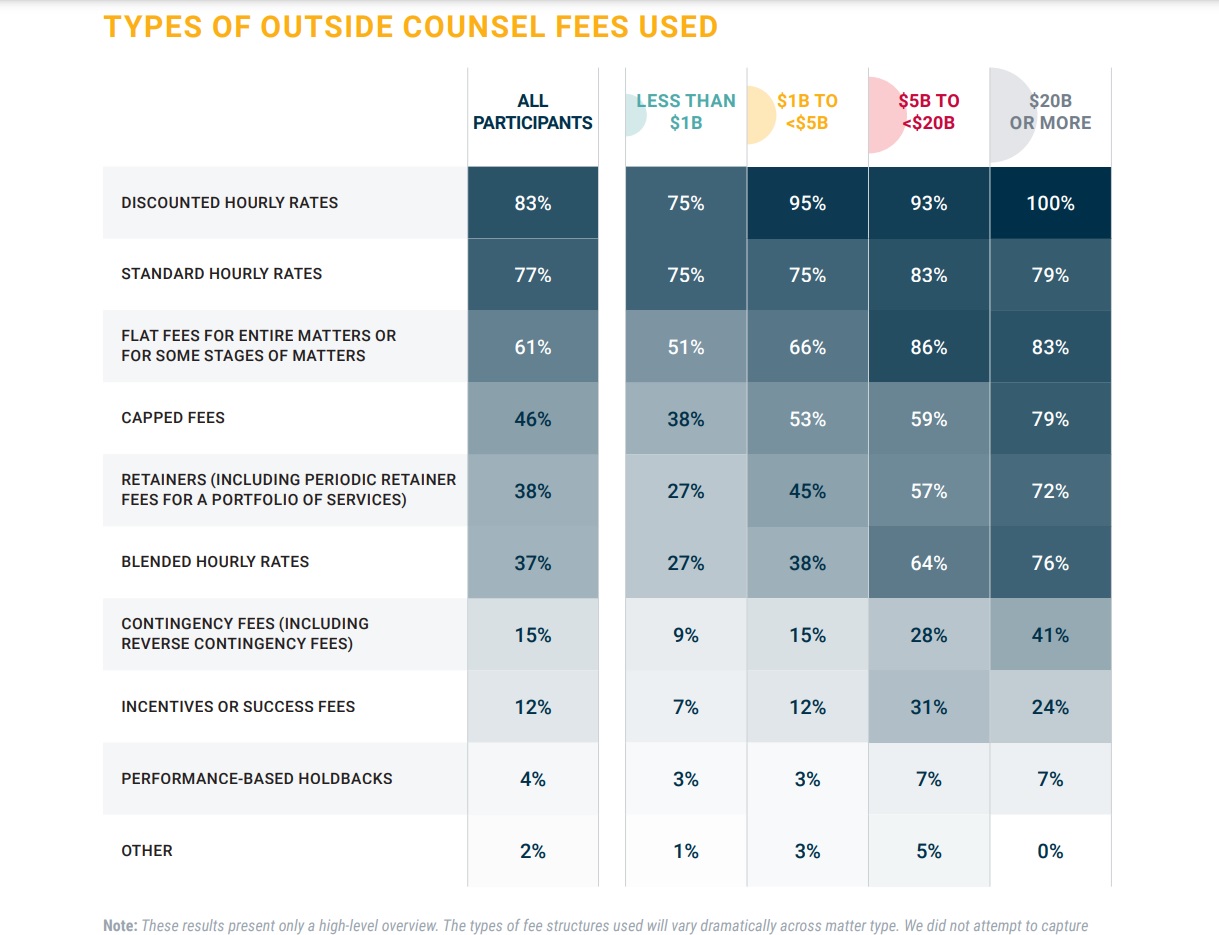
If you are wondering what types of Alternative Fees Arrangements (AFAs) in-house General Counsel are asking their private practice suppliers to provide them with – or, to flip the coin, what AFAs private practice lawyers are charging their in-house GCs, then wonder no longer. The latest market report from the Association of Corporate Counsel (ACC) sets this out in a nice clear table:

Some take-aways:

  • The #1 AFA fee request of outside counsel is Discounted Hourly Rates. No less than 100% of companies with revenue over $20BN or more use Discounted Hourly Rates with their private practice lawyers! When, oh when, will we learn that Discounted Hourly Rates are NOT a fee structure? On this point, I have been arguing for years (literally, the linked post was from 2018!) that there is no point having a pricing function in your law firm if all you are going to offer clients is discounted hourly rates! Seriously, save yourselves the money.
  • Say what you want, the #BillableHour is far, far from over if it is the preferred billing method of over three-quarters (77%) of all in-house GCs participants in the survey!
  • Capped fees are dumb! They are a lose-lose: both for the law firm who if they come under the cap can only charge what is on the clock and if they go over the cap have to wear the additional cost; but also for the in-house team who will get under served as soon as it becomes clear the cap cannot be met (and probably never was going to be). So why are they so prevalent? I can only assume capped fees are driven by the CFO wanting “cost certainty”.
  • Given the continued popularity of hourly rates, Blended Hourly Rates are nowhere near as popular (at 37%) as you would think. On transactional matters in particular, you would think this rate of use would be a lot higher.
  • The use of Success Fees is woeful. Is this a reflection of the amount of M&A and privatization work actually being done (where you would expect it to be prevalent, or is it an actual fact that in-house counsel don’t like/understand the benefits of this arrangement? Or could it be, every deal is getting done so why take the uplift risk?)?
  • An understanding of Performance Based Holdbacks has a long, long way to go.

Importantly though, despite talking about implementing AFAs for over two decades, we are still a long way off actually using them in practice.

Again, take a look at my linked article above where I talk to Patrick Johansen’s Continuum of Fee Arrangements™, where Patrick sets out 16 different types of fee arrangements that can be used:

  • Hourly
  • Volume
  • Blended
  • Retainer
  • Capped
  • Task
  • Flat
  • Phase
  • Fixed
  • Contingency
  • Portfolio
  • Hybrid
  • Holdback
  • Risk Collar
  • Success/Bonus
  • Value

And ask yourself, how many of these are being actively used in this latest report from the ACC?

Notably missing from the list above? Value Based Billing!

Yes, despite what you may read and hear elsewhere, in practice we are long, long way away from understanding and implementing the appropriate (a term I learned from Toby Brown) use of relevant fee arrangement for the task at hand.

In-house or private practice, if you’re struggling to get to grips with this issue, feel free to reach out to me for a chat.

rws_01

‘Customer service’ vs ‘Customer experience’

Ever wondered if there is a difference between ‘customer service’ and ‘customer experience’?

I was fortunate enough to come across this quote by Paul Roberts, CEO at My Customer Lens that, frankly, sums it up better than anyone else I have seen lately:

“It’s important to define the difference between customer service and customer experience. I like to define customer service as what you do, and customer experience is how you make people feel.”

Too often in professional services firms we concentrate on the ‘customer service’ at the expense of the ‘customer experience’; when the reality is that we should be much more focused on the customer experience than we are on the customer service.

As the article states:

“Improving the client experience is about looking at the entire client journey, from initial enquiry through to case completion, and beyond. It’s a rethink and review of every customer touchpoint throughout your organisation; from the way the phone is answered, to your hold music, reception waiting room and website home page.”

Spot on advice.

If you or your firm is struggling to get a grip with this, feel free to reach out to me for a chat.

rws_01

Some initial thoughts on the Eversheds Sutherland and King Wood Mallesons ‘exclusive alliance’

Woke up this morning – Australia time – to news that had broken overnight that Eversheds Sutherland (ES) and King Wood Mallesons (KWM) had entered into an exclusive alliance, along with a whole lot of DMs (Direct Messages) in my LinkedIn box asked me what my initial thoughts were.

So here I go with some initial, off the cuff, thoughts about this:

  • With the closure of the 6 KWM offices across the UK, Europe and Middle East, the deal likely brings to a happy end KWM’s sad foray into those markets and puts final closure on the SJ Berwin story.
  • Both KWM Australia and KWM Hong Kong are not part of the deal. While this is good news for ES’s Hong Kong team – who I hold in very high regard – it seems very odd and shows possible cracks in the Swiss Verin model that is KWM (with KWM China being party to this arrangement). I’ll be very interested to see what this means for KWM Australia in particular.
  • The arrangement requires – subject to “client preference and conflict clearance” – KWM China to refer all outbound UK, Europe, Middle East, Africa and South America instructions to ES. I understand the “UK, Europe and Middle East”, but why include “Africa and South America” (noting that ES has offices in Africa but not South America that I can tell)? I think this could be particularly telling given both Africa and South America will be geographies in which KWM Australia plays and so there is the potential to see KWM Australia pitching for work against work that ES has been referred from KWM China.
  • Noting the deal is with “Eversheds International”, there is no mention of whether the consultancy arm of Eversheds is included in the arrangement. If it is, then KWM China has boosted it offering in this space significantly overnight (although there may well be some regulatory restrictions around that [consultancy] in China).

To me though, what will likely make or break this “formal cooperation agreement” however will be:

  • How are inbound/outbound referrals being tracked?
  • How are the referring partners being rewarded for the referrals?
  • And, what will the KWM Australia partners make of all this given access to a network of lawyers in one of their biggest overseas geographic locations, the UK, will be gone? Do they refer work to ES, even though they are not part of the deal? Or do they refer work to lawyers/mates in other law firms who compete with ES in the UK – including, interestingly US firms with news earlier this week that: “Nearly half of the UK’s largest law firms are US-headquartered”.

I guess we will have to wait and watch this space, but my three big observations are:

(1) Not sure what Eversheds is getting out of this deal – do KWM China refer that much work into UK, EMEA and South America?

(2) Looks to be a great deal for KWM China.

(3) Are KWM Australia being left in the wilderness?

rws_01