
Happy New Year to you all.
May this be the year that all your dreams come true.
Richard
Happy New Year to you all.
May this be the year that all your dreams come true.
Richard

Contrast this:
“…over the last two years the number of Am Law 100 lawyers based in Beijing and Shanghai has declined by 25% from 569 to 424. The decline over a five-year period is 35%.”
With this:
Over the past 12 months, Chinese Law Firms DeHeng, JunHe, Fangda Partners and Han Kun Law Offices have established overseas offices in Singapore, the U.S., Indonesia, South Korea, Vietnam, and the Middle East
Summary, not direct quote, from: by Jessica Seah on law.com 13 December
Having worked with law firms around the world for close to 30 years to help establish their overseas offices (with a particular focus on Asia), I’m not sure I have ever seen such a significant shift in an in-bound/out-bound referral strategy.
In my view, we are now at the dawn of an era when Asian-based law firms are referring more work out of Asia than International law firms are referring work into Asia.
The only question that remains then is this: “How are you positioning your firm/practice to benefit from this shift?“.
Richard

When I was younger, my mother would often say to me: “Because it’s important to you Richard, doesn’t make it important to me“.
My mother had worked with lawyers earlier in her career, and I thought this piece of advice just profound (as you typically do with tidbits your mum says when growing up!). Until one day I was working with a partner who said exactly the same thing to me when I mentioned I had been waiting to see him all day!
So what’s the point I’m trying to make here?
Well, as with most things in life, when we think about what our clients need/want we think of this from the prospective of what we can provide them, rather what their true needs/wants are. To try and minimise this, I often ask my clients: “So What?“.
Asking “So What?” can sound abrasive. But, what it does is help to clarify the message, the reason, the rational we are sending to our clients about why they need our services/products and why they need them now.
And so I thought I would run through a high-level overview of the “So What?” test.
Being required to answer the “So What?” question is a means of evaluating the relevance and impact of your proposal/messaging to clients or prospective clients.
Answering this simple question demands clarity, purpose, and a focus on client outcomes – and helps move the narrative away from the product/service you are trying to sell.
If you are unable to answer this simple question convincingly, then your proposal almost certainly lacks relevance to the client and will not resonate with them.
Aligns your offer with the what the customer values
Sharpens your messaging
Helps build credibility
Ultimately it saves you time!
The “So What?” test isn’t just a question – it’s a discipline. Asking the question allows you the opportunity to refine your message – to sharpen your focus, align your efforts, and ensure you’re solving the right problem, for the right person, with the right tools.
Incorporating the “So What?” test into your business development efforts will result in your business development activities becoming more impactful; your messaging more persuasive; and your win/loss ratio becoming more transformative!
As always, get in touch if you need help with your business development strategy and activities.
Richard & GSJ

There are few more personal ways to thank a person for the support they have shown you and your business over the past 12 month than to send them a handwritten Christmas card.
Unlike e-cards, which to be honest I have never been a massive fan of (but can see both the financial and ecological savings if you are sending several hundred/thousand), a handwritten note in a Christmas card adds that personal touch to the message that, to me, enhances the gratitude being shown.
If you’re going to send a handwritten note in a Christmas card to a key contact or referrer this year, make sure to:
The simple, relatively inexpensive, gesture of sending a handwritten Christmas card can leave a lasting impression on your client. It could well be the small differentiator that you are looking for to stand your business out from its competitors in 2025!
As always, get in touch if you need help with your business development strategy and activities.
Richard & GSJ

“They shall grow not old, as we that are left grow old:
Age shall not weary them, nor the years condemn.
At the going down of the sun and in the morning
We will remember them.”
11.11 – Lest We Forget
As we roll into the holiday season, I thought I would share with you the ‘12 Days of Pricing‘ presentation as authored by ChatGPT.
As always, get in touch if you need help with your business development strategy and activities.
Richard & GSJ

In professional services, we often talk about “standing out from the crowd“. But the truth is, more often than not, we are in the centre of the crowd! So for this week’s BD Tips Wednesday post on LinkedIn we shared what my daughters’ call the ‘3R Test’ when considering/deciding whether a differentiator really is a differentiator and helps that business truly standout from its competition.
The first test is: Is it respectful? Here, what we mean is: Is it honest/true?
More often then not, professional services firms set themselves out as being different to their competitors with motherhood statements and hyperbole. Stress test the point, and it quickly falls apart.
By way of example, how many professional services firms state that they are “client centric”? Do a Google search and I suspect you’ll get a lot of hits!
Now, leaving side the issue for one second if saying such a statement really differentiates you or makes you another in the pack, a broader question arises: ‘Are they being respectful to their clients in saying this?’
A responsible point of difference is one that actually matters to your customers – not you. By having this point of difference, are you trying to make a difference to your clients lives/business, or are you merely trying to standout from the crowd so your business can win more work?
If it is the latter, i.e. you are only trying to win more work and don’t really care about the customer, then this is NOT a responsible point of difference and therefore is not a true differentiator.
An example here would be a claim that your firm provided an ‘efficient‘ services (note, not effective, which would be different). The questions that arise here are: (a) is this actually true?, and (b) who gains from these efficiencies – you or the customer?
Because, assume your claim is actually true, if you – the service provider – are the net winner from the efficient service delivery – at the cost of the overall service delivery to the customer – then it is not a responsible differentiator, and therefore it is not a genuine point of difference!
Is the point of difference resilient? Will it stand being stress-tested – by your customers and competition? Will it survive your competition’s attempts to copy it (if it really is a point of difference)?
In short, will your point of difference stand the test of time?
Assuming your stated point of difference can pass muster on the ‘3R Test‘, you have yourself a genuine differentiator and so go forth and knock the competition into next week!
As always, get in touch if you need help with your business development strategy and activities.
Richard & GSJ

A huge part in the success of your business development efforts lies in what I like to call your: ‘Credibility Score‘.
So for my most recent BD Tips Wednesday post on LinkedIn, I walked through why credibility is so important to the success of your business development activities.
Below it a repeat of that post, but before we go there though, why is credibility an issue?
The internet has resulted in information overload. We all have access to way too much information.
But ‘information‘ is not the same as ‘knowledge‘ – and professionals work (or should be working!) in a knowledge economy.
Which leads to a bigger problem from the client perspective: with so much information out there, how do I know who to trust?
QED: Credibility!
Industries change and so should your knowledge and skills. Keep up with the latest trends, technologies and practices in your field.
If you can show that you’re aware of new developments and can adapt your approach, you’ll be seen as a credible forward-thinking partner.
The starting point in any attempt to being credible is open and transparent communication.
Be honest about what you can and cannot do.
Talking up what you can do for a client and under-delivering on that talk damages your credibility. So keep it simple: Deliver on what you say you can deliver on!
The easiest way to building long-term credibility is by consistently delivering on your promises. Reliability and consistency in performance over time create a strong foundation of trust. Make sure you follow through on timelines, deliverables, and commitments.
If something goes pear-shape, take accountability for it and work to quickly resolve it!
Always tell the truth, even when it’s difficult or uncomfortable. If you make a mistake, admit it. People respect honesty, and owning up to your shortcomings is an important way to build trust.
Also, always maintain ethical standards in your dealings with your clients.
Focus on building relationships rather than simply making deals. The more you invest in your client relationships, the more credible and trustworthy you appear.
Regularly check in on your clients, even when you’re not pitching something new.
Being genuinely interested in your client’s long-term success will enhance your reputation as a credible partner.
—
As always, get in touch if you need help with your business development strategy and activities.
Richard & GSJ
☎️ +61 449 679 986
📩 richard@gsjconsulting.com.au

You’d be amazed at the amount of work I have won for my partners just standing next to the watercooler chewing the fat!
To many it seems like a waste of time, so for this week’s BD Tips Wednesday I thought I’d outline ‘5 Reasons You Need To Have A Watercooler In Your Office‘.
The biggest benefit of small talk is that it serves as a buffer, an icebreaker.
Small talking around a watercooler allows you the double-whammy of not only being able to chat freely, but do so knowing that you’re very unlikely to be judged for the whacky business development ideas you throw out there!
QED: the watercooler is a great place to road test some of your more bizarre business development ideas!
Everyone loves to chat – it’s human nature (trust me, I know – and anyone who knows me well will gladly verify)!
But, small talk is a lot more than just causal chat. It can be the start of a meaningful relationships. It’s also the start of great insights. Because chit-chat/gossip helps break down barriers – you become human to others and that makes people more comfortable talking to you – which in turn makes them more comfortable doing business with you!
Ever wondered where you’re going to turn to next, only to have a chat with some of your colleagues at the watercooler and come away inspired?
Yep, common ground. Common interests. Common desires. Really, really important in the early phases of a business development pursuit.
Central to the success of your business development initiatives is the ability to start, develop and grow a network. This network of shared interests starts by developing relationships with people – and a good place to start that is at the watercooler!
Every watercooler has a trusted advisor – the person we all wait to go and speak to.
The font of all knowledge is found at the watercooler.
Become that font of all [BD] knowledge!
For the SME firms out there – the watercooler is a coffee shop. It’s a chamber of commerce. It’s a gathering point.
Because small talk acts as a bridge between formal business objectives and an individual’s need to build trust!
As always, get in touch if you need help with your business development strategy and activities.
Richard & GSJ
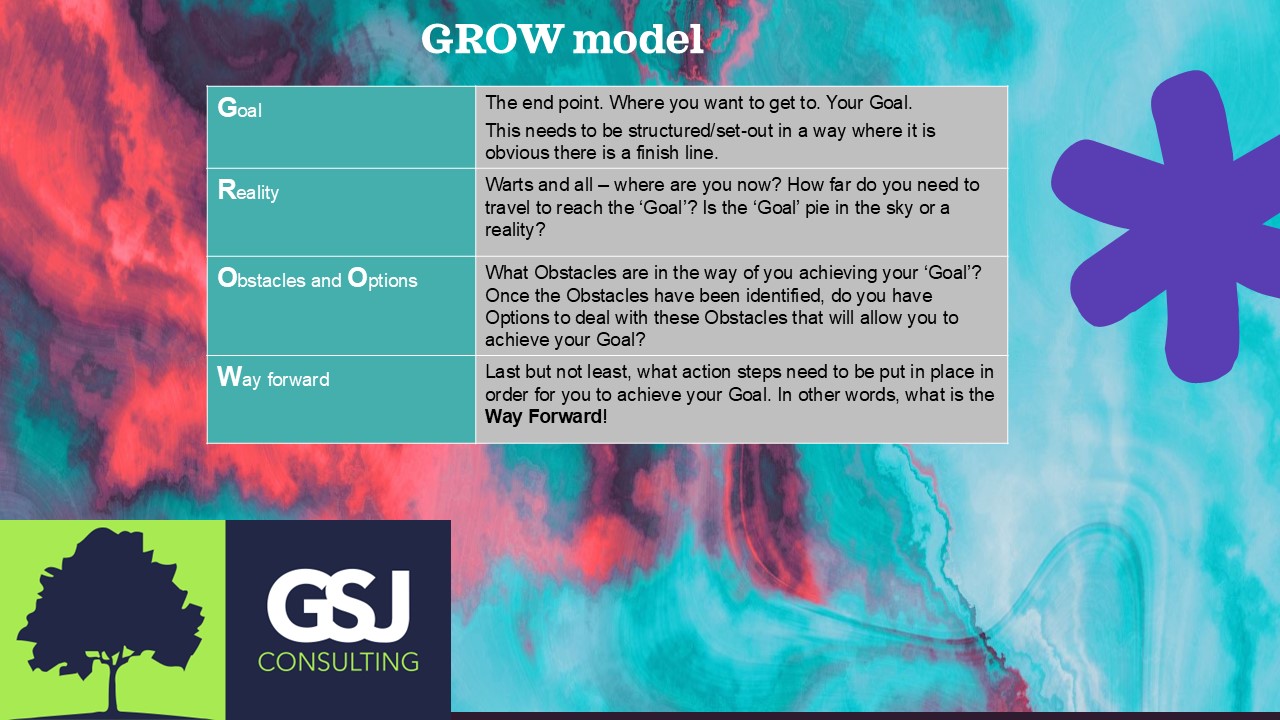
In my most recent BD Tips Wednesday post on LinkedIn, I shared a professional development growth model that has been around since the 1980s and used relatively frequently by coaches such as me.
It’s called the GROW model, named in honor of the GROW acronym, and I thought readers of this blog might like to read about it:
Where:
Goal = The end point. Where you want to get to. Your Goal. This needs to be structured/set-out in a way where it is obvious there is a finish line.
Reality = Warts and all – where are you now? How far do you need to travel to reach the ‘Goal’? Is the ‘Goal’ pie in the sky or a reality?
Obstacles and Options = What Obstacles are in the way of you achieving your ‘Goal’? Once the Obstacles have been identified, do you have Options to deal with these Obstacles that will allow you to achieve your Goal?
Way forward = Last but not least, what action steps need to be put in place in order for you to achieve your Goal. In other words, what is the Way Forward!
Using the GROW model in your business development planning should add a little bit of perspective around the realistic nature of you achieving your Goal. It not only identifies what your Goal is – which is a great start in business development, but its also sets parameters around this so you clearly know when you have completed the Goal.
What I particularly like though is it highlights what the challenges will likely be and allows you to start working through how you can overcome those challenges – rather than waiting for the challenge to hit you on the nose!
Don’t get me wrong, GROW is not the only business development strategy tool you can use – and we will certainly be covering off others on BD Tips Wednesdays of the future, but it is a very useful tool to keep in your toolkit!
As always, get in touch if you need help with your business development strategy and activities.
Richard & GSJ
 RWS_01's B[D]log