And how many law firms out there don’t have events teams who are experts in project managing and holding events that they could monetarize the expertise of while leveraging and cross selling other ‘allied services’ – such as their lawyers?
Value Added Services
Bet I can guess on one hand how many law firms will go for a tender like this because this is a ‘free’ value added service.
Big mistake.
Get in touch if you want to chat about the “allied services” your firm is offering.
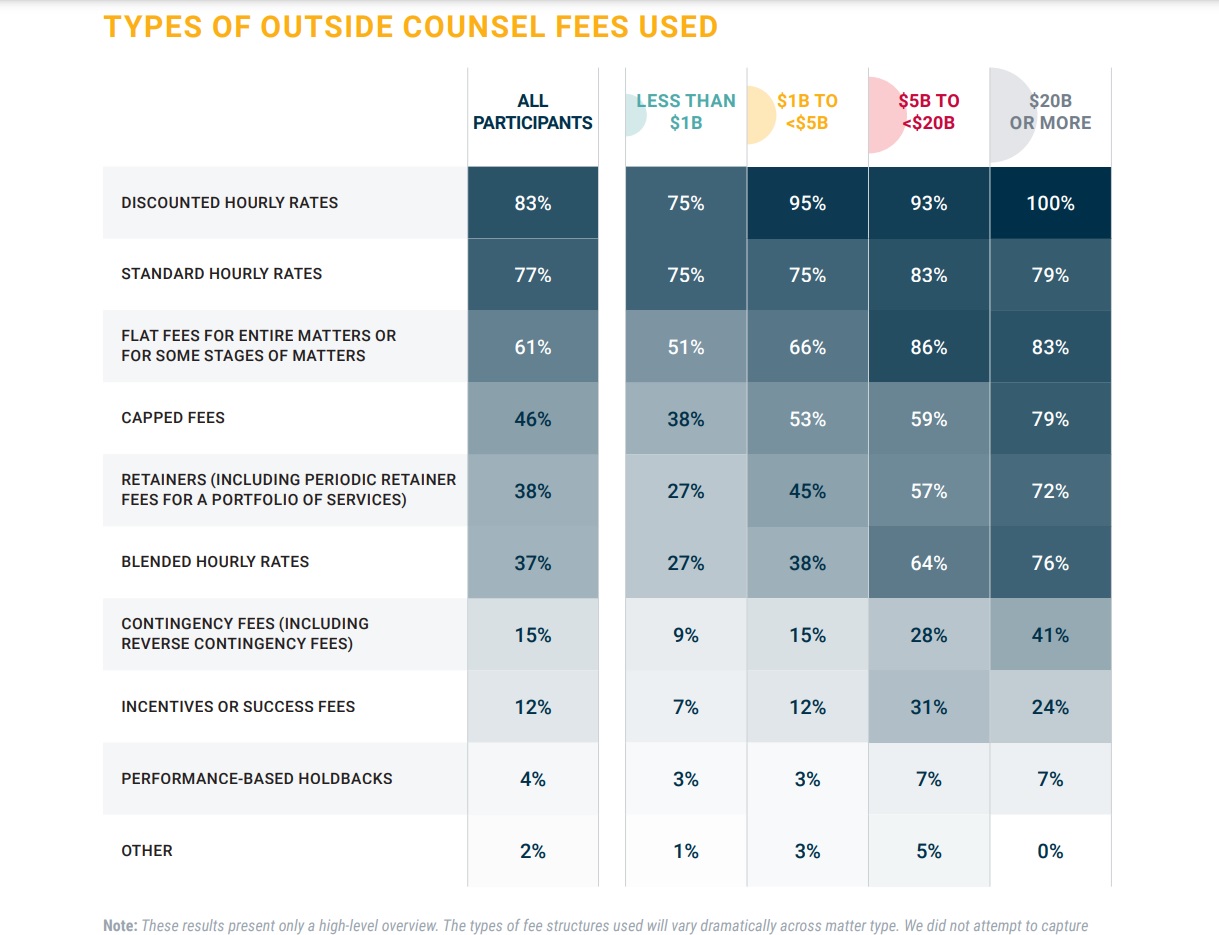
If you are wondering what types of Alternative Fees Arrangements (AFAs) in-house General Counsel are asking their private practice suppliers to provide them with – or, to flip the coin, what AFAs private practice lawyers are charging their in-house GCs, then wonder no longer. The latest market report from the Association of Corporate Counsel (ACC) sets this out in a nice clear table:
Some take-aways:
The #1 AFA fee request of outside counsel is Discounted Hourly Rates. No less than 100% of companies with revenue over $20BN or more use Discounted Hourly Rates with their private practice lawyers! When, oh when, will we learn that Discounted Hourly Rates are NOT a fee structure? On this point, I have been arguing for years (literally, the linked post was from 2018!) that there is no point having a pricing function in your law firm if all you are going to offer clients is discounted hourly rates! Seriously, save yourselves the money.
Say what you want, the #BillableHour is far, far from over if it is the preferred billing method of over three-quarters (77%) of all in-house GCs participants in the survey!
Capped fees are dumb! They are a lose-lose: both for the law firm who if they come under the cap can only charge what is on the clock and if they go over the cap have to wear the additional cost; but also for the in-house team who will get under served as soon as it becomes clear the cap cannot be met (and probably never was going to be). So why are they so prevalent? I can only assume capped fees are driven by the CFO wanting “cost certainty”.
Given the continued popularity of hourly rates, Blended Hourly Rates are nowhere near as popular (at 37%) as you would think. On transactional matters in particular, you would think this rate of use would be a lot higher.
The use of Success Fees is woeful. Is this a reflection of the amount of M&A and privatization work actually being done (where you would expect it to be prevalent, or is it an actual fact that in-house counsel don’t like/understand the benefits of this arrangement? Or could it be, every deal is getting done so why take the uplift risk?)?
An understanding of Performance Based Holdbacks has a long, long way to go.
Importantly though, despite talking about implementing AFAs for over two decades, we are still a long way off actually using them in practice.
Again, take a look at my linked article above where I talk to Patrick Johansen’s Continuum of Fee Arrangements™, where Patrick sets out 16 different types of fee arrangements that can be used:
Hourly
Volume
Blended
Retainer
Capped
Task
Flat
Phase
Fixed
Contingency
Portfolio
Hybrid
Holdback
Risk Collar
Success/Bonus
Value
And ask yourself, how many of these are being actively used in this latest report from the ACC?
Notably missing from the list above? Value Based Billing!
Yes, despite what you may read and hear elsewhere, in practice we are long, long way away from understanding and implementing the appropriate (a term I learned from Toby Brown) use of relevant fee arrangement for the task at hand.
In-house or private practice, if you’re struggling to get to grips with this issue, feel free to reach out to me for a chat.
I have read a lot recently about how AI and ChatGPT in particular is going to kill the billable hour. That may well end up happening. What I do suspect though is that it is unlikely to happen soon. And if the billable hour is to be killed off, technology – such as AI and ChatGPT – may well play a part, but it will be the cultural/behavioural change that’s needed that will be the final nail in this coffin.
Don’t believe me?
Here is a quote (of kinds) by Aarash Darroodi, Fender’s General Counsel, at the recent Legal Marketing Association’s annual gathering in Hollywood, Florida:
…the mere fact that he’s being billed by the hour isn’t a problem — but that the billable hour’s implementation can be.
In other words, Darroodi doesn’t mind that his law firm(s) charge him (his company) by the hour, but he does mind if you take him for a fool.
And until this mindset changes, you’re not going to see the death of the billable hour anytime soon.
Darroodi’s comments on the RFP process – should clients do an “open day” before tendering?
While Darroodi’s comments on the billable hour were interesting, his comments on the approach law firms should take to the RFP process were even more insightful. To quote from the article:
[Darroodi] described receiving template-based RFP responses from law firms — an approach he called “fundamentally a mistake.”
Instead, he would like to see a law firm respond to an RFP with an offer to come look at the company’s operations in-depth, gaining a better picture of his organization before a proposal is prepared.
“First of all, it shows initiative on your part. It shows the fact that you care,” he said. “And plus, it shows us that you’re going to submit something that’s directly related to our existing organization.”
Now I’m more than sure that not all GCs will take this approach. And before everyone in Australia says this would likely breach procurement protocols (after the RFP has been issued), I know.
But, wouldn’t it be interesting – and just a little more relevant, if clients did an “open day” before they issued the RFP? Particularly in cases where the tender is by invitation only?
In my view it would certainly make sense and would undoubtably result in more directly relevant and related (and probably eminently more readable) tender responses.
Not only is it highly insightful – so “thanks for posting it Jeremy”, but it contains this nugget – again from Darroodi – on his views about client events (and if you are anEvents Manager in a law firm, stop reading now 🤣):
“I don’t want to spend time with my lawyers,” Darroodi said to laughter, comparing the idea to hanging out with his dentist.
Ouch!
In the meantime, if you need help with your pricing or RFP responses, feel free to reach out to me.
Leaving aside the whole issue of whether or nor the billable hour is the best way to charge clients, do you think it is fair to charge different client different rates for the same work?
This article by Jordan Rothman on abovethelaw.com would suggest the answer to that question is – ‘yes’.
And I actually don’t disagree with Jordan’s outcome, but do disagree with his thinking of why.
After all, at least here in Australia, we very rarely have the same panel rate for all legal panels we are appointed to so; despite, or rather, the fact that we will be doing similar work under the various panel appointments.
QED – IMO – it’s fair to charge different clients different rates for the same work we do (and, HINT, it all comes out in the wash when you look at the Average Realised Rate – but I will leave that for another post).
But, and here is the critical difference I have with Jordan’s post, different clients will equate a different value to the work being done by you – and so it is more than fair to charge one client more or less than another client perceived on the value of the service they are getting.
For example, and I accept this is somewhat crude, somebody who has never been divorced before and whom your firm ‘looks after’ in a very emotional period of their life is way more likely to value the service your firm provides than someone going through their fifth divorce – so charge them more!
If you want to have a chat about how you can maximise your value opportunities, feel free to reach out.



 RWS_01's B[D]log