Australian firms

A tale of two Asias

Business Development image

Two separate comprehensive reports on the state of the legal market in Asia have recently been published. While both look to have been very thoroughly researched, that, and the shared (as in, this) week in which they were published, is, however, about all the two appear to have in common.

As to the two publications in question: one was published by the UK’s The Lawyer and the other by The Asian Lawyer – part of The American Lawyer stable. As such, the two publication represent a fairly comprehensive review of how international firms are fairing in the ever competitive Asian market.

The Lawyer

Turning first to the The Lawyer publication, the executive summary of which you can read here and the full report of which you can purchase here.

On reading this publication, “teething troubles aside“, you are left in little doubt that international law firms have positioned themselves well for the uptake in demand in the increasingly important Asia-Pacific legal market. Importantly, those who made the decision to invest in Asia a decade or more ago would appear to be seeing that investment finally paying dividends, with international firms in the region recording 5.7 per cent growth [in headcount] between 2013 and 2014.

In addition:

  • international law firms now make up 16 per cent of the Asia Top 50 (which is the same make up as two years ago).
  • five (six if you include KWM) of the Top 10 Asia firms hail from China – but number two in the list, Dacheng, has approved a merger with Dentons and so arguably is now an “international firm”.
  • no doubt because of the abundance of Swiss Verein these days, Australian law firm Minter Ellison sneaks into Top 10 Asia firms despite not being financially integrated but rather because the firm is integrated under “one brand”.
  • continued prosperity for internationals in the region is seen on the back of robust M&A activity and 5+ per cent growth predications by the IMF .

Overall though, content and opinion in this report can largely be summed by the comment that Freshfields Asia managing partner, Robert Ashworth, “is generally bullish about the region“.

The Asian Lawyer

Turning our attention now to The Asian Lawyer publication (and please do because the graph in this article is fantastic!) and we find we get a very different picture being painted of how the market is shaping up for US firms operating in Asia.

The context of this post, based on results of The NLJ 350 Annual Survey of the [US] Nation’s Largest Law Firms, can be summed up from its title: “Signs of Slower Growth for U.S. Firms in Asia“.

Although the post starts out saying: “Asia has been a powerful magnet for international firms over the past decade” – with the number of Am Law 200 attorneys having nearly tripled in that time, the latest year-on-year stats show a near flat-lining in these numbers.

It is also no secret that a number of US firms have been looking closely at their Asia strategy – the latest of which is Latham & Watkins, but even the US arm of DLA Piper has taken a financial interest in the Asia business in the hope of moving things along following some turmoil in the region.

It should not, therefore, be a surprise that this post finishes on the note: “Are more dramatic cuts to Am Law 200 lawyer counts in Asia coming? Stay tuned“.

So who is right?

I think you’ll agree that the two publications are very contrasting and paint different pictures of international law firms operating in the Asia legal market.

In a world of two Asias, a question arises: “Whose version is right?“.

My answer to that question is – probably both.

There is certainly some – finally some cry out! – positive signs for international firms operating on the ground in Asia (as opposed to those who may still operate a fly-in/fly-out operation). The market looks like it might start to deliver on some of the rich rewards it has promised for a long time. But to do this firms have to come to the realisation that they need to get over two crucial hurdles:

  1. they must have a strategy for the whole of Asia and not just China, and
  2. while staffing maybe cheaper in Asia, headcount doesn’t tell the story of financial size or profitability.
What law firms can learn from Taylor Swift

Business Development image

Unless you have been hiding under a rock, or living in a world of news blackout, you’ll of heard about Taylor Swift’s 21st June open letter (via Tumblr) to Apple (‘To Apple, Love Taylor‘).

As you will also undoubtedly known by now, the Tumblr post is Taylor’s way of explaining why she will be holding back her album – 1989 – from the new streaming service Apple Music (an album I understand she also doesn’t permit to be on another music streaming service, Spotify). And while I don’t particularly like Taylor Swift’s music (nor do I really participate in music streaming services), I have to applaud the reasons she outlines for her decision.

In particular, I like – and 100 per cent agree with – Taylor’s remark that:

“Three months is a long time to go unpaid, and it is unfair to ask anyone to work for nothing.”

Taylor’s right on the money there – so to speak, three months is a very long time to go unpaid.

But wait: what’s your law firm’s average lock-up days?

If you firm’s average lock-up days are anywhere near the industry average, then your firm’s lock-up is going to be somewhere between 100 and 120 days. Which means your firm typically gets paid 100 to 120 days after you have done the work for the client.

Aside from being a period of close to four (4) months to go unpaid for your work, you are also providing your client with an interest free working capital loan during this time – a period you will likely be paying interest to your bank on the working capital (overdraft) facility it has extended to you (otherwise known as a double-whammy)!

Simply put, that should be unacceptable and it is time law firms took a take a leaf out of Taylor’s book and started to tell clients (and some law firm partners I might add!) that four months is a long time to go unpaid!

Not possible? Will likely kill the client relationship?

Well, interestingly, in this case the giant corporate might of Apple has listened to Taylor’s complaint and has decided to back down. And I suspect your clients would be more than willing to listen to alternatives you could offer too – but you won’t know unless you have the conversation.

Wikipedia killed the #BigLaw firm star

Business Development image

Reading my notebook from 2013, to check if an industry statistic has progressed from a fad to a trend, at the weekend I came across a note to myself that reads:

“The Googlification of law: The belief that everything is on Google and is free.”

Although it clearly meant enough to me at the time to write it down (and apologies if this belongs to you as I didn’t write a credit in my notes – which usually means I thought it), as I didn’t end up writing a blog about it I must have been trying to process this idea/thought.

Anyhow, the note and a print by Hugh that was on special – which I ended up purchasing – on the Gapingvoid Art website (‘Information / Knowledge‘) got me to thinking:

‘Open source law’ – as some people are calling it – is one thing, but information and knowledge are not automatically one in the same. As such one ought to tread carefully if one is merely buying information, without the accompanying application to turn this information into knowledge.

Indeed, one could go further and as to say that the era of the “knowledge economy” is about the application of knowledge, rather merely knowing. And this will require professionals – including lawyers – needing to move the conversation forward from a belief that I can find the information for “free” (or at least “cheaper”) elsewhere and to start demonstrating [via the application of knowledge] that the solution they are providing to clients’ problems is indeed a better solution than the “free” or cheaper alternative.

The two crucial elements here are:

  1. demonstrable evidence that your experience, service or product offering is of benefit to the purchaser’s problems – i.e. not just a capability statement saying how wonderful you are, but a story with real evidence showing how what you do can be of real benefit to the target/client, and
  2. demonstrable evidence that you are acting in the best interests of the client and not merely a wishy washy statement to that effect.

It won’t be easy, and it will necessitate a move away from technical brilliance and towards commercial excellence.

In short, the legal advisor of the future will be one who is adept at finding solutions to client problems – even for those that haven’t arisen yet – rather than merely highlighting that a problem exists.

But, crucially, it is no longer the role of the client purchaser to consider this ( – are the days of Caveat emptor over?), but rather it is the role of the law firm seller to demonstrate it.

Only 33.3% of corporate counsel recommend their primary law firm to a peer

Business Development image

Anyone who has been in law firm marketing and business development for more than five minutes will tell you that word of mouth referrals are worth their weight in gold. After all, who needs to do marketing if you have enough advocates championing your business with their networks? And aren’t these potential clients going to listen to their trusted contacts way more than they do you?

Of course they are. Which is why cultivating a referrer network has always ranked high among the “to do” list of business development managers.

That’s why for many of these business development and marketing managers it may come as something of an unwanted shock to learn that according to the latest post by BTI Consulting Group’s The Mad Clientist:

Only 33.3% of corporate counsel recommend their primary law firm to a peer

Which marks the second biggest drop in 15 years and which The Mad Clientist puts down to a change in ‘The Client Expectation Gap‘; namely no matter how great or bad, whatever work you just did for your client will be the yardstick your client treats as your new minimum performance standard.

A little unfair maybe: but if only roughly one in every three of your clients is willing to go into bat for you and recommend you to others in their network with like-minded legal issues, then your law firm has an issue and there’s no time to waste getting to work on the firm’s word of mouth referral program and make sure you ask as many advocates of the firm as you can find to champion you within their networks.

How well are we doing at exporting #Auslaw?

Business Development image

Finally, some years after the Australian Government first announced and then consigned to the dustbin  its ‘Australia in the Asian Centurywhitepaper, a fair amount is being written around the issue of exporting Australian professional – read, ‘legal‘ – services, including:

While it is undoubtable that the export of Australian legal and professional services is a trending issue on an upward trajectory, it is still probably a little early to say (as the College of Law post does) that “Australia is now trending on a global scale” (vis-à-vis the export of our professional services) – although, to be fair, the export of Australian lawyers (to which the College of Law would have a particular interest), particularly to the UK and New York, has been ongoing since the early 1980s and continues to this day.

Moreover, given that the Australian International Disputes Centre (AIDC) was established way back in 2010 (with the assistance of the Australian Government and the Government of the State of New South Wales) and still lags behind both the Singapore International Arbitration Centre and the Hong Kong International Arbitration Centre, the export of #Auslaw has undoubtedly been a slow burn.

So while I for one applaud the latest chatter around an impetus to export #Auslaw, I hope that this time we are serious and take the time to have a robust conversation about whether or not we wish to seriously promote (and lobby) the export of #Auslaw overseas. And, assuming we decide we do wish to progress with the export of #Auslaw overseas, we put in place concrete national plans to move this initiative forward rather than taking the lacklustre state-based approach we have to date.

National survey finds that there are 66,211 practising solicitors in Australia

Business Development image

The ‘2014 Law Society National Profile of Solicitors in Australia’ report was released this morning on the NSW Law Society website.

The first time this report has been updated since 2011, key findings include:

  • there are now 66,211 Practising Solicitors in Australia – a 12% increase since 2011.
  • of all practising solicitors in Australia:
    • 34,10 (51.5%) were male, and
    • 32,110 (48.5%) were female.

This represents a significant increase in the proportion of female solicitors since 2011  – when the percentage number ratios were 54.6% male to 43.4% female.

  • while the mean age of Australian solicitors has remained roughly the same at 41.9 years – compared to 42.0 years in 2011, interestingly the largest proportional growth age bracket is occurring in the over 65 years age group (with a 38% increase in this group since 2011).
  • as at October 2014, the majority of practising solicitors in Australia were private practitioners  – 70.2%; with the percentage numbers in other major sectors of the profession in Australia remaining fairly static since 2011 – 15.8% were corporate solicitors and 9.6% worked in the government sector.

Most interestingly, while overall the Australian legal market remains represented by small practices – 2,155 firms (17.3% of the total) had 2 to 4 partner and 514 firms (4.1% of the total) had 5 to 10 partners:

  • there are now 77 law firms across Australia where the number of partners exceed 40 – representing a 300% increase from 2011, and
  • there are now 74 law firms across Australia where the number of partners range from 21 to 39 – representing a 111% increase from 2011.

In addition to potentially showing significant consolidation in the Australian legal market over the past three years (the overall percentage representative number of sole practitioners is actually down roughly 3% in 2014 from 2011), these numbers would appear to indicate that the slow death of large law firms, and the professional more generally, is being greatly over exaggerated in the Australian legal press.

Indeed, one could argue that now more than ever the market in Australia is highly competitive and that it is becoming increasingly important that you and your firm be able to communicate what differentiates you from the crowd.

If you haven’t already, I’d like to recommend that you take a look at the report – it contains some very interesting statistics; including, for the first time, statistics on the representation of Aboriginal and Torres Strait Islanders.

‘Stupid is as stupid does’

Business Development image

In the 1994 movie of the same name, Forrest Gump is asked:

“are you stupid or something?”

to which Forest replies:

“stupid is as stupid does”.

Some 20 years later (yes, it really has been that long!), in general parlance this phrase has come to mean that:

‘an intelligent person who does stupid things is still stupid’ – (Urban dictionary)

and I have to say that this thought went through my mind earlier this week when I read that a third of [UK] commercial firms are likely to raise their rates in a bid to boost their profits (Solicitors Journal 6 May 2015 – “Number of law firms planning to raise charge out rates increases“).

Leaving aside the issue of whether a direct raise in your rates will equate to increased profits (for example, the psychological impact of rising rates/budgets on fee earners with no increased salary (cost)) –  what in the world would make 26 (1/3rd) of so-called intelligent finance directors of the UK’s Top 100 law firms say “it is likely their firms will increase their charge out rates in order to improve profitability in the year ahead“?

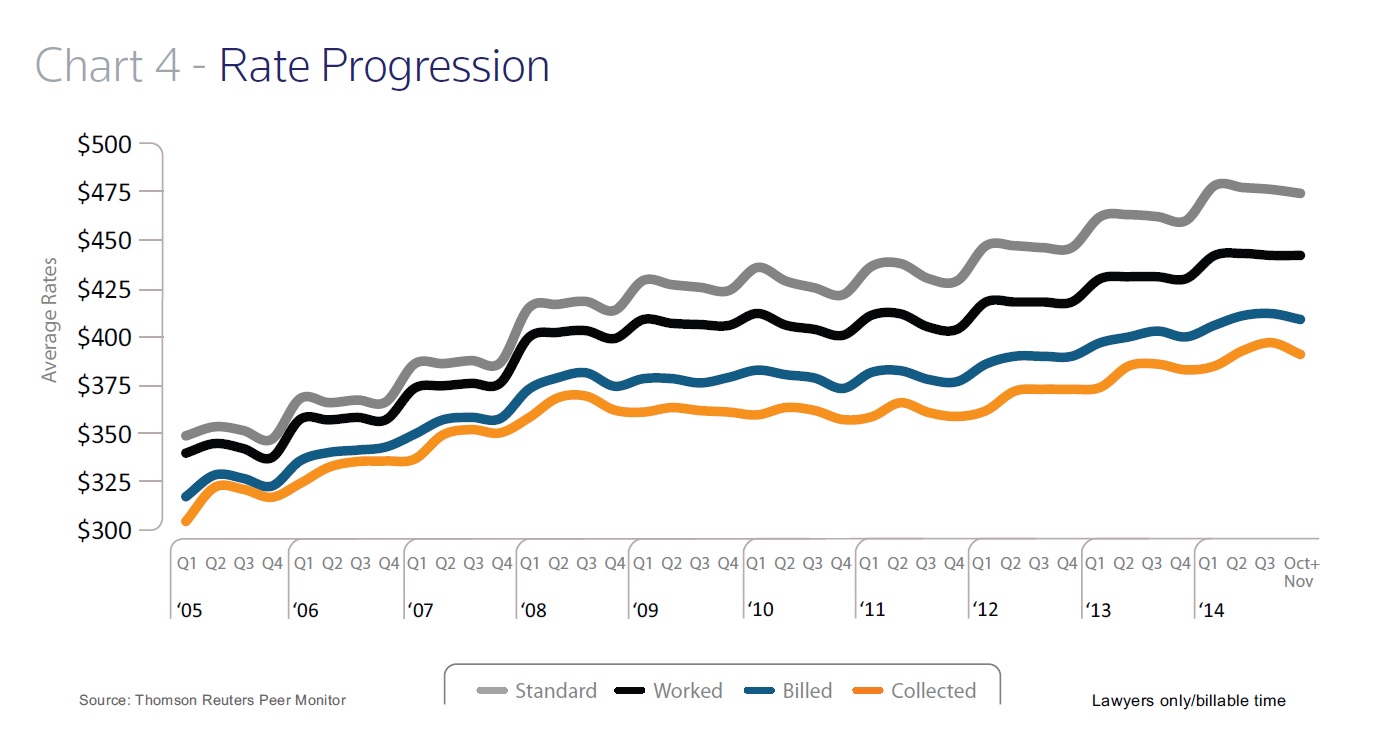
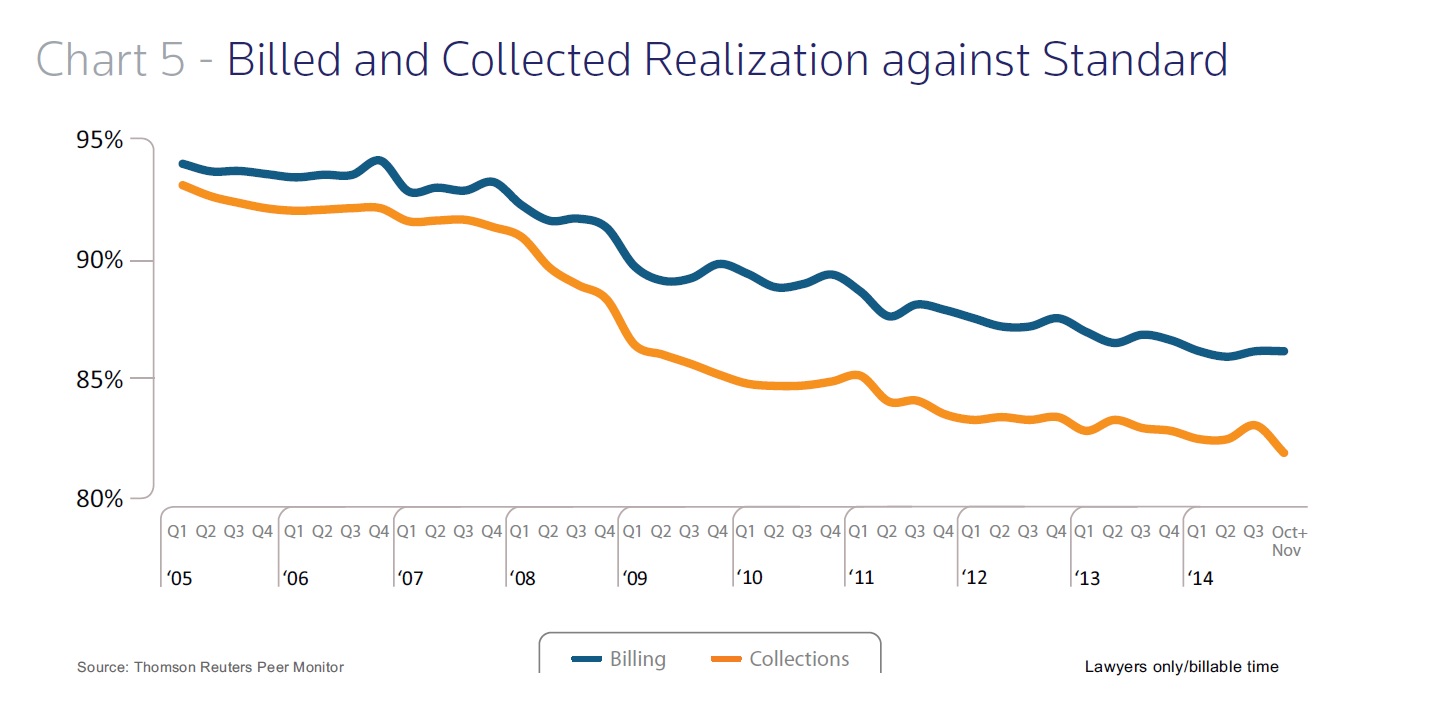
As I have blogged countless times before (the most popular being: ‘Is it time for law firms to break with the RULES when looking at profitability?‘), hourly rates are but one of the metrics in calculating profitability. And it’s probably not even the biggest metric driving your firm’s partner profit levels, which almost certainly would be better achieved via an increase in your realised rate.

Putting this mathematically (admittedly not my strongest area), say my hourly rate is $100 and my realization rate is 90%, then I’m being paid $90-. Taking this forward I’ve decided to increase my hourly charge-out rate to $110-, but find that my realization rate has now fallen to 80%. If my maths is correct, I’m now being paid $88-.

In other words, in real terms, I’m losing money!

Don’t think this could happen? Then take a look at Charts 4 & 5 from the ‘2015 Report on the State of the Legal Market‘ published by The Center for the Study of the Legal Profession at the Georgetown University Law Center and Thomson Reuters Peer Monitor (at page 5)

chart 4


chart 5

Those charts don’t make for pretty reading.

So when, as the article reports:

“…firms realise this is not going to be an easy sell to clients who are likely to negotiate hard to keep fees down, so their approach to increasing charge out rates is likely to be softly softly, rather than gung-ho”

my response would be: “why bother?”.

Instead,

  • try keeping your charge-out rate the same over the next 12 months;
  • try not to give discounts;
  • try to increase your realisation rate (by 3 to 5 cents in the dollar);
  • try to reduce your lock-up days;

and see where you end up.

You may just find that has a better impact on your partner profitability numbers than the likely impact that is going to come your way when you go annoying and off-siding your clients with the almost obligatory 1 July 10% rate increase letter.

But I could be wrong…

From the client’s perspective

Business Development image

Overnight (Australian time) Bruce MacEwen, President of Adam Smith, Esq and a leading commentator on professional services, wrote an outstanding blog post – ‘The Client Seat‘.

The post outlines some of the personal experiences Bruce has recently encountered as part of his role as Chair of the Finance Committee of his local church, St. Michael’s Episcopal Church at West 99th Street and Amsterdam Avenue, who own a vacant corner lot abutting the rear of the sanctuary and are looking for ways to realize some value from the asset; and, specifically, as it relates to the process of interviews the church is going through to select and engage a law firm to assist them in this process.

I anticipate there being a lot of commentary written about Bruce’s post  – if there isn’t already. It raises a number of thought provoking issues of what it feels like to be sitting in the client’s seat as part of this process and some of the gems that lawyers and law firms come out with to try and impress a prospective client into appointing them to do the work – even where they may not be qualified to do the task at hand.

But what really grabbed my attention in the post was the following observation Bruce makes:

The other asymmetry is one of disclosure and, to be pointed about it, candor: The client needs to tell the firm as much as honestly possible about the engagement and what the client knows, while the lawyers’ instinct and practice is to guard information, hedge predictions, and avoid definitive statements. This is true even when the firm is posed direct questions about simple business arrangements and not ultimate outcomes, such as “Who will be working on my matter?”

This is such an on the money observation of the profession, but think about it for a second:

In an age where open candour and transparency around both your personal and your firm’s credentials will most likely win you and the firm the trust of clients and prospective clients, and thus a lot more work in the long run, why do lawyers still feel the need to be guarded and reluctant to give straight answers to straight questions?

How often do you let your clients know the value you provide to them?

Business Development image

Based on interviews with 188 independent lawyers and more than 500 clients, the LexisNexis Bellwether Report 2015: the Age of the Client (published earlier this week) found that:

“80% of lawyers think they’re delivering above average service…

… but only …

…40% of clients say they’re receiving it.”

What does this mean?

Well, either:

  1. You’re not as good as you think you are; or
  2. You’re not communicating well enough to your clients the value you bring to the transaction/relationship.

I’ll leave it for you to decide which you think applies to you.