
Artificial Intelligence

Report: Clio’s 2025 Legal Trends Report For Mid-Sized Law Firms

Clio’s 2025 Legal Trends Report for Mid-Sized Law Firms provides a comprehensive look at how mid-sized law firms in the US are adapting to industry changes; particularly as it relates to AI adoption, billing models, client acquisition, and technology investments.

Although the results are based on data from US-based firms, the results are arguably applicable here in Australia and more broadly so here’s a summary of the key takeaways:

🚀 AI Adoption & Transformation

  • Mid-sized firms (20+ employees) are now leading AI adoption in legal tech, surpassing smaller firms.
  • 93% of surveyed professionals in these firms use AI, with 51% using it widely or universally.
  • Common AI tools include legal research platforms, document automation, eDiscovery, and predictive legal analytics.
  • AI is viewed as a way to increase efficiency, reduce costs, and improve client engagement.

💰 Billing Models & Pricing Trends
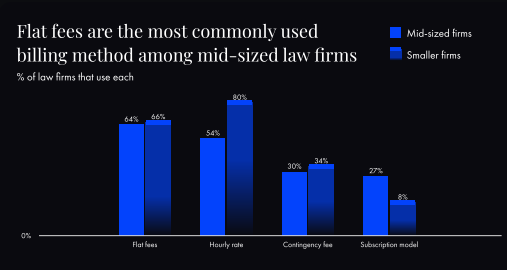
  • Flat fees are now the most common billing method among mid-sized firms, outpacing hourly rates.
  • Firms are shifting away from hourly billing due to AI’s impact on time-based work and client preference for predictable pricing.
  • Subscription models are also gaining traction, especially for ongoing legal services to business clients.
  • Despite the shift, hourly billing remains prevalent, particularly with highly varied rates by role and experience.

📈 Client Acquisition & Marketing Strategies

  • Mid-sized firms use multiple marketing channels: websites, SEO consultants, social media, online reviews, and referrals.
  • They’re less reliant on referrals than smaller firms, but invest more in digital marketing.
  • Tools like e-signatures, intake forms, and online scheduling directly improve conversion rates and revenue (up to 20% higher).
  • Chatbots are underused despite 51% of clients finding them helpful—a missed opportunity.

💸 Spending & Technology Investments

  • Staff salaries dominate expenses (41%), followed by rent, marketing, and office costs.
  • Mid-sized firms spend less on office expenses (5%) than solo and smaller firms, due to economies of scale and flexible work arrangements.
  • Spending on software and professional fees is rising rapidly—showing a strong focus on tech and professional development.

☁️ Cloud Technology Adoption

  • Mid-sized firms lag behind smaller firms in cloud adoption (only 38% vs. 71%).
  • Firms with 20–49 employees are more likely to use cloud tools than larger mid-sized firms.
  • Hesitation around switching legacy systems or internal decision-making bottlenecks may be holding back adoption.

🧭 Strategic Takeaways

  • Mid-sized firms embracing AI + modern billing models + tech investments are poised to outpace competitors.
  • The real threat isn’t automation—it’s firms that adapt faster.
  • Cloud-based tools, client intake tech, and AI are critical for efficiency, growth, and client satisfaction.

You can download the full report here.

Get in touch if you want to discuss the outcomes of this Report or need assistance with your strategy.

📩 richard@gsjconsulting.com.au

High-Value Retainers

I put a post up last week on LinkedIn, off the back of a very interesting blog by Jordan Furlong on his Substack feed: ‘The legal world in 10 years (if we’re really lucky)‘, that got some social media traction so I thought I would re-share here.

At the heart of my LinkedIn post was a comment Jordan makes on – what he calls – High-Value Retainers and the effect Gen AI will have on these fee arrangements. To quote:

High-Value Retainers
Thanks to Gen AI’s consumption of many traditional tasks, lawyers have moved up the value ladder, going beyond “bet-the-company” and “run-the-company” work to start offering “grow-the-company” work (or “advance-the-individual”). These are engagements in which lawyers ask: “How can I improve your situation? What are your near-term and long-term goals? How can I help you anticipate problems and prevent them before they happen? How can I bring you more stability and peace of mind? How can I be your advocate and counsellor in whatever you need?”

While I think Jordan’s point is an excellent one, mine was this: “Do you think this could work in 10 years time?

Because if you think it could: Why are you waiting 10 years for AI to develop in order to have this conversation – have this conversation with your clients now!

In that, it’s not a 10+ years from now discussion. It’s not a 10+ years from now problem. It’s a HERE AND NOW problem and a here and now discussion.

rws_01

A different take on the end of the Billable Hour

I have read a lot recently about how AI and ChatGPT in particular is going to kill the billable hour. That may well end up happening. What I do suspect though is that it is unlikely to happen soon. And if the billable hour is to be killed off, technology – such as AI and ChatGPT – may well play a part, but it will be the cultural/behavioural change that’s needed that will be the final nail in this coffin.

Don’t believe me?

Here is a quote (of kinds) by Aarash Darroodi, Fender’s General Counsel, at the recent Legal Marketing Association’s annual gathering in Hollywood, Florida:

…the mere fact that he’s being billed by the hour isn’t a problem — but that the billable hour’s implementation can be.

In other words, Darroodi doesn’t mind that his law firm(s) charge him (his company) by the hour, but he does mind if you take him for a fool.

And until this mindset changes, you’re not going to see the death of the billable hour anytime soon.

Darroodi’s comments on the RFP process – should clients do an “open day” before tendering?

While Darroodi’s comments on the billable hour were interesting, his comments on the approach law firms should take to the RFP process were even more insightful. To quote from the article:

[Darroodi] described receiving template-based RFP responses from law firms — an approach he called “fundamentally a mistake.”

Instead, he would like to see a law firm respond to an RFP with an offer to come look at the company’s operations in-depth, gaining a better picture of his organization before a proposal is prepared.

“First of all, it shows initiative on your part. It shows the fact that you care,” he said. “And plus, it shows us that you’re going to submit something that’s directly related to our existing organization.”

Now I’m more than sure that not all GCs will take this approach. And before everyone in Australia says this would likely breach procurement protocols (after the RFP has been issued), I know.

But, wouldn’t it be interesting – and just a little more relevant, if clients did an “open day” before they issued the RFP? Particularly in cases where the tender is by invitation only?

In my view it would certainly make sense and would undoubtably result in more directly relevant and related (and probably eminently more readable) tender responses.

If you want to read anymore on either of the issue above, go read ‘Why Curiosity Is Key For Business Development Observations from the general counsel panel at this year’s LMA meeting‘ by Jeremy Barker on the Above The Law website.

Not only is it highly insightful – so “thanks for posting it Jeremy”, but it contains this nugget – again from Darroodi – on his views about client events (and if you are anEvents Manager in a law firm, stop reading now 🤣):

“I don’t want to spend time with my lawyers,” Darroodi said to laughter, comparing the idea to hanging out with his dentist. 

Ouch!

In the meantime, if you need help with your pricing or RFP responses, feel free to reach out to me.

rws_01