ACC

10 Key Findings from the ACC CLO Survey 2024

The Association of Corporate Council (ACC) – the worldwide association that promotes the interests of in-house counsel – recently published its ‘10 Key Findings from the ACC CLO Survey 2024‘.

While I have not read the full report, there are some very interesting take-outs from the Executive Summary, including:

  • 58 percent of [in-house] departments have been impacted by law firm rate hikes
  • 42 percent of CLOs say their legal department received a cost cutting mandate over the past year
  • 23 percent of in-house say that rate increases have been difficult to manage
  • only 9 percent are “very confident” in their organization’s ability to mitigate emerging data risks
  • The top 3 issues that keep CLOs up at night are not what you would think [well, maybe one of them!]
  • The importance of ESG would appear to be a little over cooked – but…
  • …I’ll leave you with this one: 63 percent of CLOs say they are seeking to develop greater business acumen among the lawyers in their department – Good luck with that one!

Check out the link above to read more and as always if need any help feel free to get in touch.

rws_01

The Hourly Rate is alive and well: there is no such thing as Alternative Fee Arrangements

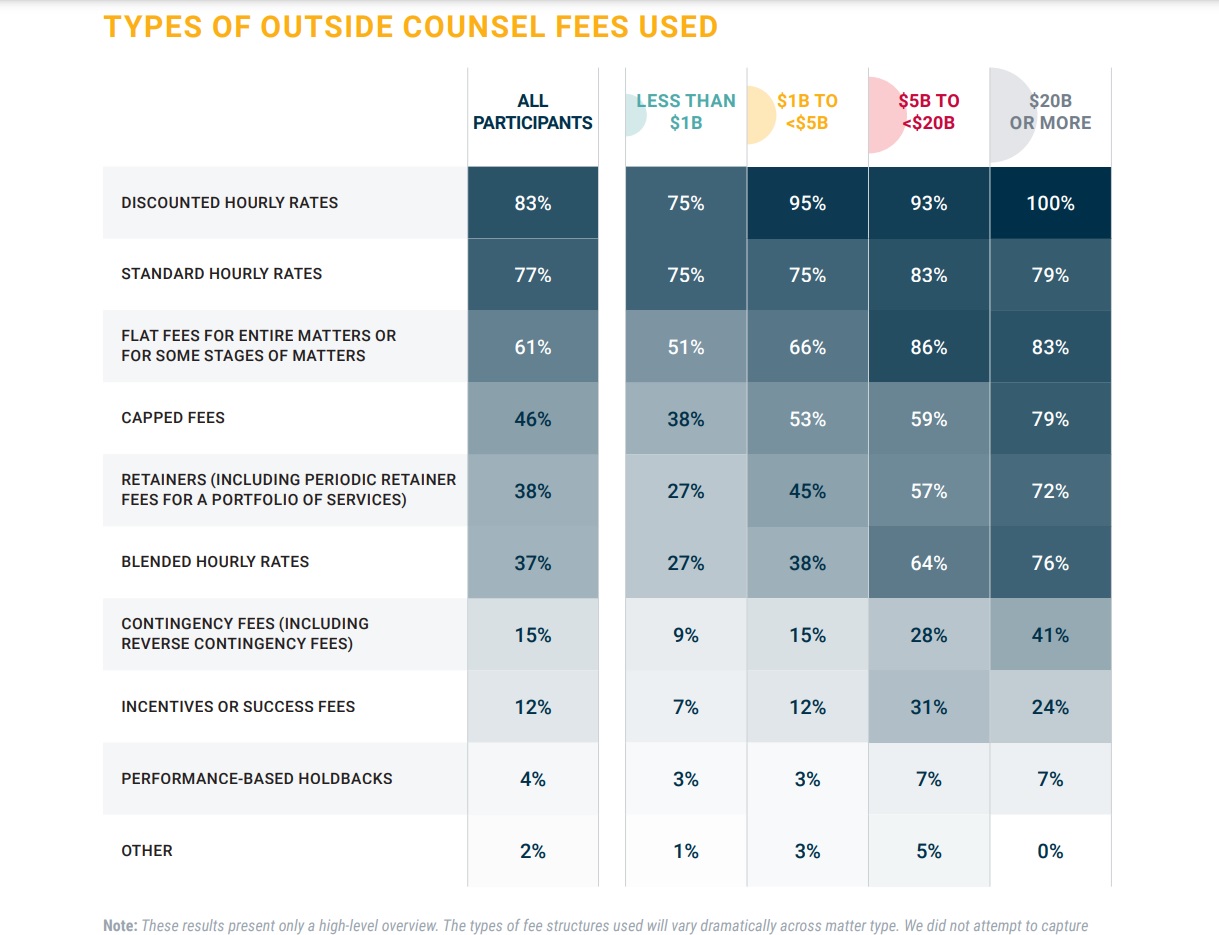
If you are wondering what types of Alternative Fees Arrangements (AFAs) in-house General Counsel are asking their private practice suppliers to provide them with – or, to flip the coin, what AFAs private practice lawyers are charging their in-house GCs, then wonder no longer. The latest market report from the Association of Corporate Counsel (ACC) sets this out in a nice clear table:

Some take-aways:

  • The #1 AFA fee request of outside counsel is Discounted Hourly Rates. No less than 100% of companies with revenue over $20BN or more use Discounted Hourly Rates with their private practice lawyers! When, oh when, will we learn that Discounted Hourly Rates are NOT a fee structure? On this point, I have been arguing for years (literally, the linked post was from 2018!) that there is no point having a pricing function in your law firm if all you are going to offer clients is discounted hourly rates! Seriously, save yourselves the money.
  • Say what you want, the #BillableHour is far, far from over if it is the preferred billing method of over three-quarters (77%) of all in-house GCs participants in the survey!
  • Capped fees are dumb! They are a lose-lose: both for the law firm who if they come under the cap can only charge what is on the clock and if they go over the cap have to wear the additional cost; but also for the in-house team who will get under served as soon as it becomes clear the cap cannot be met (and probably never was going to be). So why are they so prevalent? I can only assume capped fees are driven by the CFO wanting “cost certainty”.
  • Given the continued popularity of hourly rates, Blended Hourly Rates are nowhere near as popular (at 37%) as you would think. On transactional matters in particular, you would think this rate of use would be a lot higher.
  • The use of Success Fees is woeful. Is this a reflection of the amount of M&A and privatization work actually being done (where you would expect it to be prevalent, or is it an actual fact that in-house counsel don’t like/understand the benefits of this arrangement? Or could it be, every deal is getting done so why take the uplift risk?)?
  • An understanding of Performance Based Holdbacks has a long, long way to go.

Importantly though, despite talking about implementing AFAs for over two decades, we are still a long way off actually using them in practice.

Again, take a look at my linked article above where I talk to Patrick Johansen’s Continuum of Fee Arrangements™, where Patrick sets out 16 different types of fee arrangements that can be used:

  • Hourly
  • Volume
  • Blended
  • Retainer
  • Capped
  • Task
  • Flat
  • Phase
  • Fixed
  • Contingency
  • Portfolio
  • Hybrid
  • Holdback
  • Risk Collar
  • Success/Bonus
  • Value

And ask yourself, how many of these are being actively used in this latest report from the ACC?

Notably missing from the list above? Value Based Billing!

Yes, despite what you may read and hear elsewhere, in practice we are long, long way away from understanding and implementing the appropriate (a term I learned from Toby Brown) use of relevant fee arrangement for the task at hand.

In-house or private practice, if you’re struggling to get to grips with this issue, feel free to reach out to me for a chat.

rws_01

What the year 2081 will mean for law firm discounts

Business Development image

Over the holiday’s I finally got time to read D. Casey Flaherty’s ‘Unless You Ask: A Guide For Law Departments To Get More From External Relationships‘ published by the Association of Corporate Counsel (ACC).

Casey’s publication is excellent and very insightful. Although written for in-house legal departments, it contains information that every private practice lawyer should be across. If for no other reason than it has an array of sample questions they may be asked.

But, it is a brief piece in the publication on asking for discounts on hourly rates/bills that I wanted to share with you all. Because Casey has managed to put into words, both succinctly and comprehensively, my own feelings on discounts.

So here it is (see pages 64 & 65):

Without some grounding in value, discounts just become a game.

First, you can only push the discount lever so many times. A recession hits or you run a convergence initiative. You get your firms to take a big haircut. What’s next? It will probably be a few years before you can return to that well in any meaningful way. Continuous improvement, on the other hand, should be a constant. There is always some process to refine, some assumption to question, or some technology to take better advantage of. Discounts can be part of a strategy. But a strategy that relies entirely on discounts is hollow.

Second, there is a huge volume of data that suggests that while most clients see themselves as negotiating progressively deeper discounts, what they are really doing is negotiating down the size of the rate increase. Last year, the client got a 10% discount off a $500 rate. This year, the client gets an 11% discount off a $520 rate. What really happened is that that firm increased the rate from $450 to $463. You can perform this trick—4% rate increase, additional 1% discount—for a quite long time before the rate flattens out. How long? 66 years. In 2081, the paid rate ($1,600/hr) would finally stop increasing as the discount (75% off a published rate of $6,399/hr) caught up to the rate increase.

Third, while almost every law department will proudly refer to the deep discounts they’ve negotiated, only about half even get one. That’s because a true discount is not calculated versus a lawyer’s published rate—of which there may be several—but is calculated by reference to something called a standard rate, an internal firm number used to determine realizations, profitability, etc. With a few exceptions, almost no one pays published rate and therefore everyone thinks they are getting a discount. But only about half of clients actually pay below standard rate. And even they are not getting as deep a discount as they think.

Fourth, if you count discounts as savings, please stop. If you’ve reduced rates below what you were paying previously, that’s one thing, especially if you also have a mechanism to monitor and hold the line on hours. But if you are just counting the delta between the published rate and your paid rate, it introduces some bizarre incentives. It encourages firms to jack up published rates so they can offer you the optical illusion of a bigger discount. It encourages you to select higher priced firm so you can report greater ‘savings’—i.e., you show double the savings by paying $700/hr to a lawyer with a published rate of $900/hr than you do paying $350/hr to a lawyer with a published rate of $450/hr. And your savings accumulate with every extra hour of work the firm bills. There is something inherently perverse about a savings metric that makes you look better the more you spend.

Fifth, finally, and most importantly, undue emphasis on discounts tends to confuse unit price with total cost. Rate differences are linear. Hours can differ by orders of magnitude. The $350/hr associate might look relatively cheap until it takes them ten hours to deliver work half as good as what the $800/hr partner delivered in one. Attention to the unit price ($350 v. $800) will obscure both quality and total cost ($3,500 v. $800). We intuitively understand the difference experience can make. Systems—the proper integration of process and technology to augment expertise in delivering legal services—are experience institutionalized. Systems merit attention in trying to understand the relationship among quality, unit price, and total cost. Discounts are only a small fraction of one piece of that puzzle.

There you have it: why discounts should not be anywhere near the front of your pricing arsenal.

RWS_01