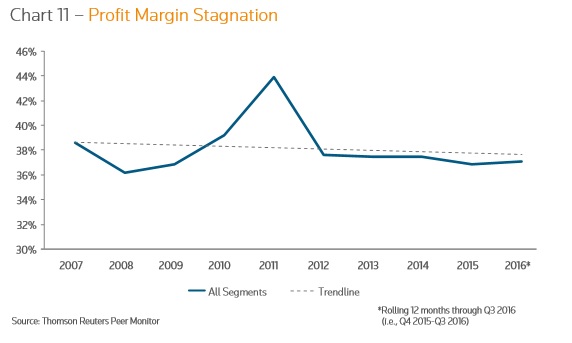
In August 2013 I posted ‘Is it time for law firms to break with the RULES when looking at profitability?‘ on my old blog platform Australian law firm business development. It is without doubt the most read post I’ve ever written. And, as the recent publicity around DLA Piper’s decision to make equity partners clock 7.5 hours a day of time (not necessarily billed) shows, it remains one of the least followed and understood.
So what is the “R.U.L.E.S” system – and, three years after I last posted on this: do we, once again, need to promote its demise?
The R.U.L.E.S.
Taken from Robert J Arndt’s relatively short (at 31 pages) 1988 publication ‘Identifying profits (or losses) in the law firm‘, the acronym R.U.L.E.S stands for:
- Realization – of billing rates
- Utilization – of attorneys
- Leverage – of lawyers
- Expense – control of (both the fixed and variable kind), and
- Speed – of the firm’s billings and collections.
For more than two decades the R.U.L.E.S have been the foundation for law firms looking to mine their financial information beyond the mere top level question of: ‘Did the firm made any money this year?’. Indeed, it could be argued that they were the precursor to the Balanced Scorecard in that they help determine:
- which lawyers and partners are making a profit,
- which practice areas are making a profit,
- which matters are more profitable than others, and
- which clients are more profitable than others.
But, in today’s world the R.U.L.E.S are not without fault. For example,
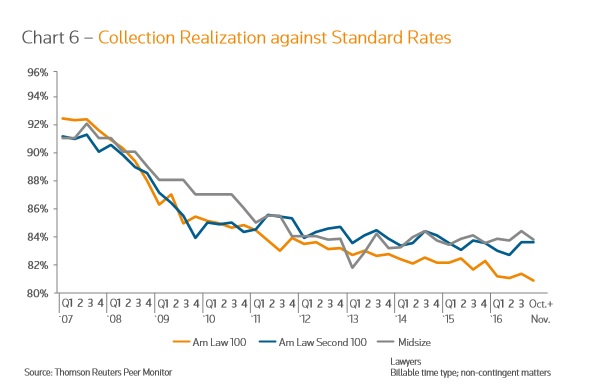
- Realization is generally accepted as being the amount collected (ie, in the bank) against the effort to produce (ie productivity); or, as Altman Weil defines it: “realization is fees collected divided by the standard value of the time worked“.
On an individual fee earner basis, what this means is that if you set your fee earner a standard billable hourly rack-rate of [say] $100, and they charge the client $90 per hour (after write-offs etc) for work done, and for which the client pays $85 per hour (after asking for a discount etc) for the work, then the realization rate is 85% [I note that some firms adopt the practice of looking at realization as being the amount paid against the amount billed (94.44% in this example) but this is not the methodology used in RULES].
On the other hand, if the same fee earner does a fixed fee job for $1,000 and it only takes them 5 hours to do the job (cost of $500), then the realized rate is $200%.
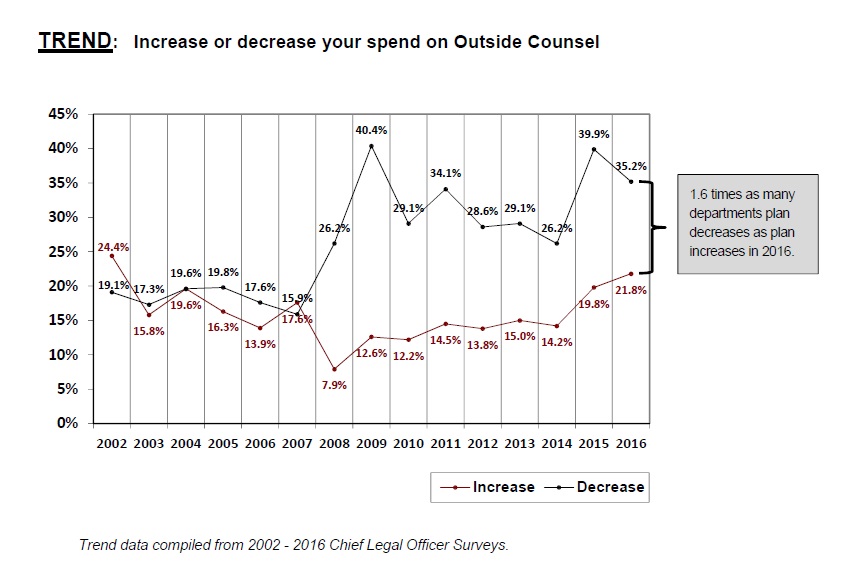
While this may have been a good indicator of individual lawyers’ profitability in the past, increasingly it isn’t – not least because clients see through this BS and will not pay for their lawyers on a fully rack-rated hourly basis.
- Utilization is the yardstick by which we determine how busy fee earners are. To determine this we look at the annual budget of hours the firm has set each relevant fee earner against the amount of billable time they have put on their time-sheets (daily, weekly, monthly or annually).
As I mentioned in 2013 – and nothing has changed – there are two principal flaws with this use of utilization:
- the first, as shown by the likes of Crowell & Moring and others, is that the annual billable hour figure is a moving goal post.
- the second, and more important, reason is that utilization sees an hour billed as “king” – it trumps all.
Today, where clients are looking for, among other things, an understanding of their business (non-billable hours spent attending industry events) and corporate social responsibility, utilization seems an outdated profit related performance metric.
- Leverage is the number of fee earners you have to partners.
A reading of Maister’s Managing the Professional Service Firm will tell you, leverage is a key component of a law firm’s profitability. In order for a law firm to be more profitable, the maximum amount of work possible must be pushed down the chain to the more junior ranking lawyers.
Unfortunately, today this cannot be done so easily. Clients are simply not willing to pay for you to train your junior fee earners!
- Expenses are both fixed (ie rent) and variable (ie salaries and bonuses) and are always going to be an important factor in determining a law firm’s profitability.
- Speed of collection is generally determined as being the time from when you did the work to the time you are paid for that work.
Sometimes known as “lock-up” days, speed of collection will have a massive effect on the firm’s profitability.
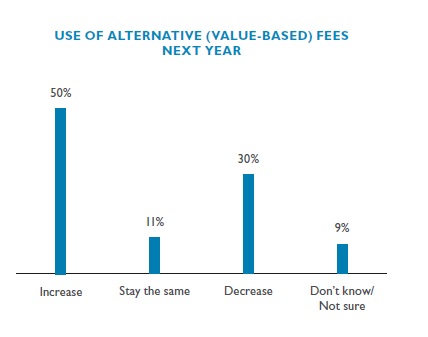
Having bagged the R.U.L.E.S – again, the question remains: ‘What are the alternatives?’ The answer to that is that there are probably far more now than there were three years ago, but they are start from the same place:
(a) Do you have a satisfied client, and (b) Do you understand the value you bring to that relationship?
RWS_01