pricing

‘4,200’ – why it’s a prize not worth winning

Overnight, Australian time, the annual AM Law 100 report for 2019 was published by the American Lawyer.

A fascinating, if not relatively meaningless (with a caveat to follow), look at how the other half live, one insight from this year’s publication worth taking a closer look at is the ever egotistical champion of the industry – the lawyer with the highest number of billable hours.

And this year’s winner comes from the firm of Fox Rothschild (moment of honesty, never heard of them before today) with, wait for it,

bh

While the individual lawyer is not named, nor their rank, let’s put this under the microscope for a second. That’s:

…4,200 (billable hours) in a year / 365 days in a year (2018 wasn’t a leap year) = 11.5 hours of billable time a day (no write offs or, in parlance, ‘time leakage’)…

…every day…

…without a break – for holiday or for sickness…

…billable

…for 365 consecutive days…

…including Christmas Day.

So what does this really mean?

Whenever I’m asked what this really means I always refer people to the excellent Yale school publication – ‘The Truth About the Billable Hour‘.

In that publication a number of different variations are set out, but in order to ‘bill’ 2201 hours, you need to have been “at work” 3058 hours. By their own admission, this doesn’t account for “personal calls at work, training/observing, talking with coworkers, a longer lunch (to exercise or shop perhaps), a family funeral, pro bono work (if not treated as billable hours), serving on a Bar committee, writing an article for the bar journal, or interviewing an applicant.”

– and yet here we are talking about 4,200 billable hours!

So why does this even matter?

Why asking someone to work 2,000 billable hours a year will kill their spirit‘ is by a long way the most read post on my blog. And yet here we are talking more than double this amount.

So I have a few questions:

  • if you are the supervising partner of a lawyer that has billed 4,200 hours a year, do you have a duty of care to ensure that lawyer is mentally okay?
  • if you are the managing partner of a fee earner that has billed 4,200 hours a year, do you have a fiduciary duty to ensure the mental wellbeing of that lawyer?
  • and, most importantly, as a client: do you really want someone who is working 11.5 hours a day, every day, without a break, working on your file (because I know my answer this question)?

As always though, interested in your thoughts/views/feedback.
rws_01

Report: 45% of Australian GCs are forecasting a decrease in their 2019 legal spend – How is this going to be achieved?

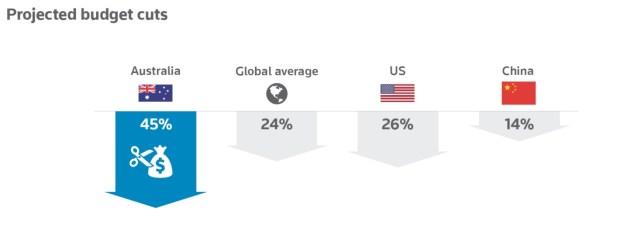
The State of Australian Corporate Law Departments Report 2019 – a joint publication between Thomson Reuters and Acritas – was published earlier this month. With more than 2,000 telephone interviews conducted and 73 interviews with Senior Legal Counsel based in Australia taking place, the sample for this report is robust. And while the usual rhetoric around “more for less” is reflected throughout the Report, one of the standouts is that Australian GCs are forecasting 45% projected budget cuts (over 2018 we have to assume):-

budget cuts

To put that into context, that almost twice the global average.

In a time when we have Royal Commissions being announced almost weekly, and compliance issues are on the front pages of the papers daily, you have to wonder where and how these savings are going to be achieved.

As to the ‘where’, given how much ‘top-end’ reputational compliance work that’s happening in Australia at the moment, and how little cost savings can be made from the margins in low-end commoditised work, you’d have to assume the most likely area will be in the mid-level contract drafting/negotiation/management space [the space in which about 30 out of the top 40 firms in Australia play].

As to the ‘how’, having read the Report my take is that Australian GCs will look to achieve this through:

  • innovation
  • panels, and
  • the elephant in the room

Innovation

‘Innovation’ has been a buzzword in the Australian legal world for over a decade. And, as one of the first jurisdictions to legislation the incorporation of law firms, to many outside Australia our system has been one of envy.

But when you ask Australian GCs to rate the innovation of Australian law firms, only 35% feel they’re working with service providers they find modern and innovative.

innovation

From where I sit this means that 65% of Australian GCs don’t think you’re really doing all that much in the innovation space!

Legal Panels

Led by procurement, the dreaded ‘legal panel’s’ stated aim is to achieve:

  • cost efficiencies and predictability
  • relationship building (de facto another way of cost savings)
  • less administrative burden
  • quality [of work]
  • responsiveness
  • access to experts, and
  • value adds on offer

All great and noble aims if you are looking for a 45% cost saving year-on-year – until you take a closer look at the reality:-

panels

This chart is from the ‘GC Thought Leaders Experiment‘ and it clearly indicates that having a panel in place isn’t saving you anything! Add to that lateral hire movement over the past 5 years, and I very much doubt any of the metrics of having a panel are being met.

It’s worth noting here that swimming against the tide of rationalising panels to fragment legal spend is A Verona Dorch – Peabody’s Energy’s Chief Legal Officer who stated (on the issue of appointing panels) that:

Expanding the pool allowed me to insert a few more midsize and non-money center firms than I otherwise could have. And that’s been incredibly helpful—just a few months in, I’m noticing that those firms are extra eager to impress and put forth their top talent.

So maybe, just maybe, if you get it right there is something to be said for legal panels – only not in the form we currently have them.

The elephant in the room

And so we come to the elephant in the room, where a lot of these savings are likely to be found:

40% of Australian in-house buyers of legal services have used alternative legal service providers (“ALSP”) for support on legal matters, and over half of those who used an ALSP did so as they felt it was a more affordable option.

Private practice we are on notice.

As always though, interested in your thoughts/views/feedback.

rws_01

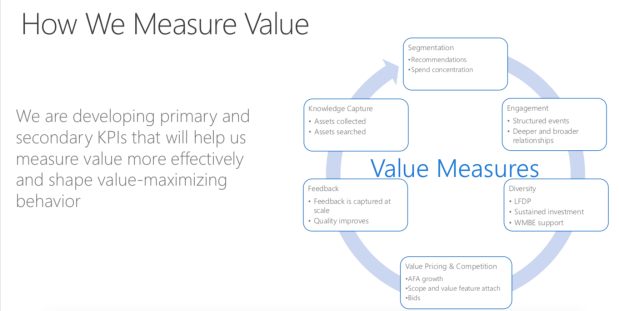
Want to know how Microsoft’s legal team measure value?

Screen Shot 2019-04-10 at 8.45.00 pm

Value” – specially how we create and communicate it – is probably the hottest issue in legal pricing at the moment. So how much would you pay to find out how Microsoft’s legal team measure value?

If you’re smart – nothing.

Instead you will listen in to the ‘Business of Law Podcast‘ where Karen Kepler (Law Procurement Manager at Cargill) talks with Rebecca Benavides (Director of Legal Business at Microsoft Corporation) and Jason Barnwell (Assistant General Counsel of Legal Business, Operations, and Strategy at Microsoft Corporation) about the process of designing and building an outside counsel panel.

And after you have listened to the podcast (around 40 minutes of your time), download the show notes and take a look at the 4 page slide pack on ‘CELA Law Firm Engagement: Strategic Partner Selection Process‘ – because you’ll then be able to recognise where the image at the top of this post comes from.

Big lesson learnt here: Our clients want to talk to us about this, but are we really willing to listen?

As always interested in your thoughts, views, feedback.

rws_01

Question:- Is your firm pricing the issue or the risk?

One of the first things you will be taught in project management is the difference between a ‘risk’ and an ‘issue’. For those not in the know, an ‘issue’ is something that has happened – and we need to fix it (preferably ASAP); whereas a ‘risk’ is something that has not yet happened but may foreseeably happen, so we need to factor this in.

In any discussion around the pricing of legal services we are faced with exactly the same problem:

  • there is an issue – the client has a problem: we can workout how much it will cost to fix it, yet;
  • there is a risk, the part we are not sure about, nor are we sure about the scope.

QED: 9 times out of 10 instead of looking at the issue/risk conundrum rationally, we take on the risk blinkers and either price to the issue and/or tell the client we cannot know how much it will cost outside of the risk (hence hourly rates).

Whereas the smart pricer/legal project manager in the room will typically white-board both the ‘issue’ and the ‘risk’ with the client and say to the client:

  • This is what we know (the issue). It’ll cost you X.
  • This is what we are pretty sure will happen (the risk). It will cost you Y.
  • And this is the remote (bad luck it happened element) – let’s reconvene and discuss.

But this is just my take. As always though, would be interested in your thoughts, views, feedback.

rws_01

Has your law firm considered subscription-based pricing?

Like many lawyers who have worked under billable hours or fixed fees, for most of my career I have pondered the question: “How can I make money while I’m asleep?”, or better yet, awake but not working!

Early in my career I thought I had the answer – subscription-based pricing.

At the time I was working with Linklaters on their Blue Flag program (see this article for an overview of what Blue Flag was all about) which essentially provided compliance related information to subscribers who paid a monthly fee. This was then extended to basic loan documentation that was created using automated software (an early version of HotDocs if I am not mistaken).

As I was to find out though, the problem with this business model is that there is always someone willing to undercut you on price, with little attention to the value you were providing.

And so I never really took it much further.

But I remained interested in the dilemma of how I, as a knowledge provider working on hourly or fixed fee arrangements, could make money while I slept (outside of writing a book and get loads of royalties).

A couple of things recently changed my view on this whole issue though.

First, I listened to Episode #217 of Ed Kless and Ron Baker’s the soulofenterprise.com podcast in which they discuss ‘The Automatic Customer: Creating a Subscription Business in Any Industry’ a book by John Warrillow.

Ed and Ron continue this discussion in Episode #221 (Part II).

One of the big take-outs for me from the podcast was the fact that Porsche has introduced subscription pricing (see here for a story on this).

That’s worth repeating – you can subscribe to drive a Porsche!

And get this, Klaus Zellmer, CEO of Porsche North America, says of subscription-based pricing that:

“We engage people with a brand that they usually wouldn’t,”

As a law firm, imagine…

Second, I recently read that ‘Apple will lean more on subscriptions as iPhone sales drop

That’s right, Apple – as of the date of writing this post – the world’s second biggest business by stock market value is moving towards a subscription-based business.

Which made me think – what’s the biggest doing?

Answer: ever heard of Amazon prime?

So if subscription-based pricing works for these big players, why not your law firm?

As always though, would be interested in your thoughts, views, feedback.

rws_01

Lawyers and ‘the amplifying factor’

On 11 January Seth Godin blogged ‘Good intentions (how to be on time)‘. Typical Seth, it’s a relatively short post; and typical Seth, it contains an important message – ‘The amplifying factor‘.

In Seth’s words:

The amplifying factor is that when they’re late, people wait for them.

So why is this relevant to your firm?

The answer:- how familiar does this [2015] post by Bruce MacEwen (Adam Smith, esq) sound:

(3) We recently had a meeting scheduled with the partner on the matter at the firm’s offices in midtown. (I was not present.) Our representative—one of the two wardens of St. Michael’s—arrived about five minutes early and ran into the partner in the firm’s reception area; he was heading for the elevator to go out to get coffee.

He kept going.

My colleague sat in the conference room for 15-20 minutes awaiting his return. When he did appear, the plan was to conference in the other St. Michael’s warden on the speakerphone. He didn’t know how to do that.

This is a perfect example of ‘the amplifying factor‘. And in law firms I see this behaviour every single day…

As always, would be interested in your views.

rws_01

The R.U.L.E.S – again!

R.U.L.E.S.:

  • Realization
  • Utilization
  • Leverage 
  • Expense(s)
  • Speed

Taken from Robert J Arndt’s 1988 publication ‘Identifying profits (or losses) in the law firm‘ a flawed metric to determine:

  • which lawyers and partners were making a profit,
  • which practice areas were making a profit,
  • which matters were more profitable than others, and
  • which clients were more profitable than others.

But, is this really the way forwards when planning for 2019?

Would be interested in your views.

rws_01

When Seth Godin’s simple contribution analysis for pricing doesn’t work

Last week Seth Godin wrote a brilliant post titled ‘All other things being equal (simple contribution analysis for pricing)’.

As the title of the post suggests; in his post Seth suggests that if you know your cost of production you can use this as the basis for calculating your go to market price – and ultimately this will effect your profit margin (price – cost = profit).

In Seth’s example he uses the price points of $7 and $9 and states that, with a cost of production of $5-:

.. all other things being equal, you’ll need to sell twice as many at $7 as you’ll need to sell at $9.

($2 profit per unit at $7 as opposed to $4 at $9).

And Seth is right. So what has this to do with law firms?

My answer:

this is exactly how law firms have priced their services (hourly rates) for the last 20 years.

And it totally falls apart because of what we call in the business the “average billing rate”.

Back up: what exactly does that mean?

Well we know what our cost of production is (only we don’t because we will argue all year long over “shared costs” etc) and we know what our “rack rate” is (only we don’t because there are so many of these we never sure which is the “actual” rack rate) so we know the profit margin.

Using Seth’s example, our cost of production is $5- per hour and our rack rate is $7 per hour or $9 per hour. QED, $9 per hour lawyer is making more “profit”.

But…

say $9 per hour’s realisation rate is 70% and $7 per hour lawyer’s realisation rate is 100%…

..then you have a whole different story as now $9 an hour lawyer’s Average Billing Rate is less than $7 an hour lawyer’s.

And suddenly ‘simple contribution analysis’, which law firms have been using ever since I joined the profession over two decades ago, becomes meaningless.

But ultimately Seth is right:

Price is a story, it’s a story we tell ourselves and others about what we have to offer. But price is also the path to being able to stay in business.

and also: his post clearly states “All other things being equal“, which we all know will never be the case in the matrix known as a law firm!

rws_01

Fixed or capped fees – as a client which would you go for?

Last week the American Arbitration Association (AAA) announced that it would introduce an alternative fee arrangement (AFA) option on “eligible cases” offering to help resolve B2B disputes through the arbitration process (source prnewswire.com).

The AAA’s claim is this is the “first of its kind to be offered by a national provider of alternative dispute resolution (ADR) services“.

So let’s check it out.

Setting aside the “eligible cases” issue, what are the AFAs being options being offered?

According to the AAA:

  • Fixed Fee Arrangement, whereby an AAA arbitration panel member proposes a fixed fee for the pre-hearing, hearing, and post-hearing phases of arbitration which must be approved by all parties.

  • Capped Fee Arrangement, whereby an AAA arbitration panel member proposes a fee cap for the entire arbitral process which must be approved by all parties.

Wait a second, as you’ll know from my last post, capped fee arrangements are not an AFA and any pricing expert advising you otherwise needs to be shown the door.

But…

Given the choice – as a client of a  law firm client – which would you choose?

My take: depending on how different the two quotes are – which I’m guessing would be done on an “hourly rate x number of hours x which way is the wind blowing calculation“, I’d go capped fee (the exception here, a really low ball fixed fee).

Why – given my objection to this?

Well, because a fixed fee is – fixed. While a capped fee is – capped.

So if your lawyer comes in under cap (using hourly rates), they can only bill you what they have charged. And if the lawyer breaches the cap (using hourly rates), then they cannot charge you any more than the cap – hence it’s name.

So, as a client, I win both ways.

While a fixed fee is fixed. So if the lawyer uses time-sheets (hourly rates) and comes in under the fix, back luck you client. On the flip side, if the lawyer uses time-sheets and comes in over the fix, back luck law firm.

QED: in this case, I’d go the capped fee option.

The sting in the tale here though is these 7 little words:

“which must be approved by all parties.”

which despite India Johnson, President and CEO of the AAA-ICDR, comment that:

“Alternative fee arrangements align with our mission to add cost savings and fee transparency and predictability to the arbitral process; the AAA and its Roster of Arbitrators are proud to be the first arbitral institution to offer an AFA option to parties and counsel seeking to resolve their disputes through arbitration,”

means the reality is it will never happen.

rws_01

Why most law firms don’t need to hire a Head of Pricing

Following a conversation I had recently with John Chisholm, I had reason to revisit Patrick Johansen’s website patrickonpricing.com and re-read both his Continuum of Fee Arrangements™ and his Roll Call of pricing professionals.

Let’s get controversial. Re-reading Patrick’s stuff it occurred to me that there are an awful lot of law firms have hired pricing experts (Patrick has over 300, but it wouldn’t surprise me if that number were closer to 500) on -most likely- really good money who, get this: don’t really need them.

Why do I say that?

Looking again at Patrick’s Continuum of Fee Arrangements, Patrick has sixteen different pricing options available for law firms to offer clients:

  1. Hourly – the ‘go to’ pricing option for law firms. But are hourly rates pricing or billing?
  2. Volume – nope, not a pricing mechanism. It’s a discount. Not even an alternative fee arrangement (AFA).
  3. Blended – isn’t that an hourly rate?
  4. Retainer (Periodic) – okay, now we are talking. Law firms may need some help from a pricing expert on this one. But wait up, how much of a law firm’s revenue is done on a retainer mechanism? Less than 5% would be my guess. Justify the cost of pricing expert on the books (as opposed to freelancing), unlikely.
  5. Capped – OMG don’t get me started on capped fees. Known as the “heads I lose, tails I lose” pricing mechanism for law firms. I understand why clients love capped fees, they cannot lose. But any pricing expert on a law firm’s books who recommends capped fees as an option deserves to be sacked immediately.
  6. Task – okay, but isn’t this really just a fixed fee?
  7. Flat (Transaction) – okay, but again: isn’t this really just a fixed fee?
  8. Phase – sounds like a fancy name for task to me!
  9. Fixed – Nirvana. Now we need a pricing expert.
  10. Contingency – implies it needs to be contingent on something.
  11. Portfolio – my view is that this is one of the most misunderstood and under-used of the various pricing options. I’m not sure there are many pricing experts in commercial law firms who do this well.
  12. Hybrid – yeah right. Are we talking cars now?
  13. Holdback – this isn’t pricing. This is a reward mechanism. I could do all the pricing calculations in the world, but if the legal team provide a rubbish service then the client will withhold a part of the fee.
  14. Risk Collar – is hourly billing with an up and downside calculation mechanism.
  15. Success/Bonus – again, performance related.
  16. Value – right, and how many law firms are really doing this? Few and far between. Hell, most law firms don’t even understand the ‘value’ they provide (see ‘discounts’ and google number one AFA offered by law firms). No, nice to say; but a very long way from getting it.

So looking at this list I ask myself: “How much science is involved in pricing legal services?”. And the answer I come up with is: “Not a lot”.

Taking all this on board, I get why law firms hire ‘pricing experts’ out of accounting teams. And maybe that’s where the real opportunity is being missed.

But trust me, for all but two or three of the above pricing options, you don’t need a pricing expert – you need an accountant. So don’t waste your money hiring one.

rws_01