
Legal business development news

Business Development – ‘I didn’t learn that at university!’

The number of senior business development people, including Director level roles, I have spoken to over the years who “fell” into working in business development roles for professional services firms is remarkable! Yes, in most cases they had a relevant applicable skill-set that could be transferred and used in the new role: whether that be as an ex-lawyer, marketing graduate or communications professional; but, by and large, I think it’s fair to say that almost none of us saw a career advisor at school and asked what undergraduate and post graduate degrees we need in order to have a career in business development for a professional services firm*.

So I was really glad to read today, via the Legal Cheek blog, that Slaughter and May are to launch a business services grad scheme.

Although Slaughters are one of the few Magic Circle firms I never worked at or for, I have really admired them from the sidelines. Their focus on their core strategy is commendable. All of which, in my opinion, is reflected in their newly announce two year ‘Business Services Academy‘ program.

In a similar vein to grad rotations, Legal Cheek is reporting that the Academy program will consist of four rotations of six months each among:

  • people and operations
  • technology legal ops and project management; and
  • clients and business development.

Now, the very clever people you are, you’re think 4 into 3 doesn’t go – and you would be right. But, apparently the forth rotation is with the team you have enjoyed the most on your previous rotations and want to consider a career with, and I kind of like that!

So once again, the team at Slaughter and May are blazing a path, but please do we really need to say this:

It’s worth noting that this scheme does not lead to qualification as a solicitor.

Anyhow, if you are not fortunate enough to work at Slaughters – or, as Legal Cheek points out Addleshaw Goddard or DWF (who have similar programs), and really need to learn a thing or two about how business development in law firms actually works in practice, reach out to me!

rws_01

* I would also add that a lot of that same thinking applies to lawyers trying to do business development, in that they have had no formal training in this skill!

SURVEY REPORT: Half your clients are changing which lawyers they will give work to

An article by Neil Rose on Legal Futures website today (15.5.2023) has a statistics that should have every law firm business development expert shaking in their boots.

To quote:

45% of clients changing which practices they allocate work to in the past year

Nearly half of companies swapped external lawyers in last year

Taken from the latest ‘State of the UK Legal Market 2023‘ by Thomson Reuters, Rose’s report contains even more damning news for those marketers and business developers who thought law firms outranked lawyers in client choice selection:

Reputation has also dropped “dramatically” in importance for keeping a firm top-of-mind

On the positive front,

In the UK, more than in many other regions of the world, clients are focusing on the quality of the whole relationship with their advisers.

But, backing up the reputation comment above, the big takeaway for me has to be,

In a major shift over the past 10 years, the historical reputation of a law firm is no longer enough to keep it top-of-mind in the market. The message is clear: firms need to re-consider how they present and deliver value to clients…

I have deliberately bolded that part of the quote because if this is something that is likely to be concerning you, or if you feel this provides your law firm with a great opportunity, then feel free to reach out to me and let’s have a chat about how you can to work on this!

rws_01

Report: Top growth strategies for law firms for the next three years

Last week saw the publication of the 14th edition of CommBank’s Legal Market Pulse report for 2021. What I recall starting out as a quarterly, then half-yearly, report, now looks to be permanently set as an annual publication (feel free to do a search of my previous posts on the CommBank report to see some of the history behind this).

Anyhow, the overriding message of this year’s Report is that the pandemic had little affect on overall profit growth at most Australian law firms (probably as a result of dramatically reduced costs). And with year-on-year median 12.1% growth in profit, on first look it appears that the profession is going great guns. Which, as someone who advises to the profession, is great news!

But where do law firms think growth will come from over the next 3 years?

How Australian law firms are looking to grow over the next 3 years?

Looking at page 11 of the Report, Australian law firms will primarily look at the following 11 ways to grow their firm’s revenue over the next 3 years:

  1. Marketing and business development activities
  2. Lateral hires from competitor firms
  3. Adopting new technologies
  4. Building/expanding referral networks
  5. Cross- and up-selling strategies
  6. Increasing fees
  7. New models of service delivery
  8. M&A activity
  9. Graduate intake
  10. Boutique/niche practices
  11. Diversified or non-traditional legal services
(more…)

Is the legal industry undergoing its “Fosbury flop” moment?

Last week the Center on Ethics and the Legal Profession at the Georgetown University Law Center and Thomson Reuters Legal Executive Institute and Peer Monitor published their ‘2020 Report on the State of the Legal Market‘. This annual Report sets out the publishers’ views of the dominant trends impacting the legal market in the United States in 2019 and the key issues likely to influence the market in 2020 and beyond.

The Introduction of this year’s Report looks at ‘Incremental Improvement vs. Radical Change‘, as it might apply to the current state of the legal industry.

Drawing on the story of Dick Fosbury’s performance at the Mexico City Olympics in 1968, at which Fosbury stunned the world by setting a new Olympic record in the men’s high-jump event using a technique (the Fosbury flop) that had never been used in competition anywhere else previously, the Introduction to this year’s Report sets a great – and somewhat dramatic – backdrop to what it considers constitutes radical change against incremental change.

The Fosbury flop, without doubt, was radical change to a long held practice in 1968. But, post 1976, when all three medallist used the technique, it can also claim to be the victim of incremental improvement/change, as there hasn’t really been any great leap forward in high jump technique since.

So what has this all to do with the legal industry?

Well, it’s like this, probably since the mid-1980s the legal industry has undergone a series of incremental improvements, without really being the subject of any radical change. But, as the Report eludes, the last 12 to 18 months in the legal industry may have seen a shift here. The re-emergence of the Big 4, growth of legal tech, alternative legal service providers suggest a cusp of radical change is on the horizon (if it hasn’t already arrived).

So has it?

Well, I’m not so sure. Let’s take a look at some of the graphics in the report:

5

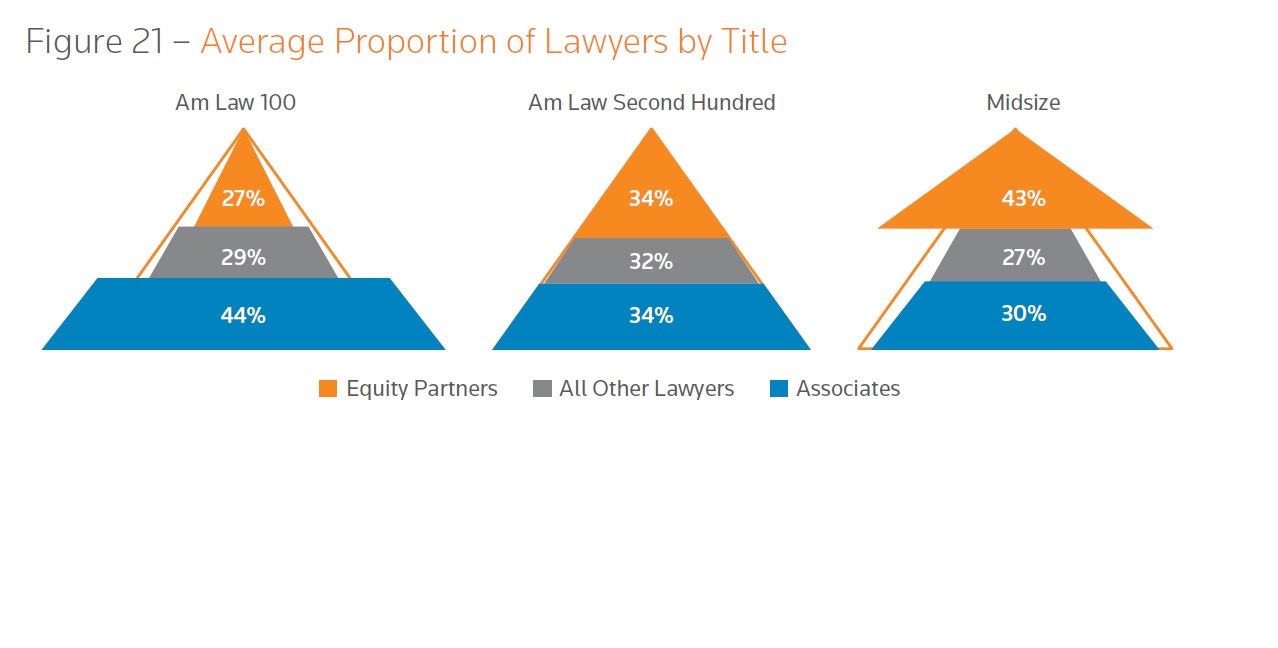
The graphic above looks at leverage of lawyers in US firms. Aside from the ‘Midsize’ firms, where a type of diamond is forming, the AM Law 100 and 200 look like very traditional law firm pyramids to me.

1 This second graph looks numbers of hours worked per lawyer and this looks to have flat-lined since the GFC in 2008. So no real change there.
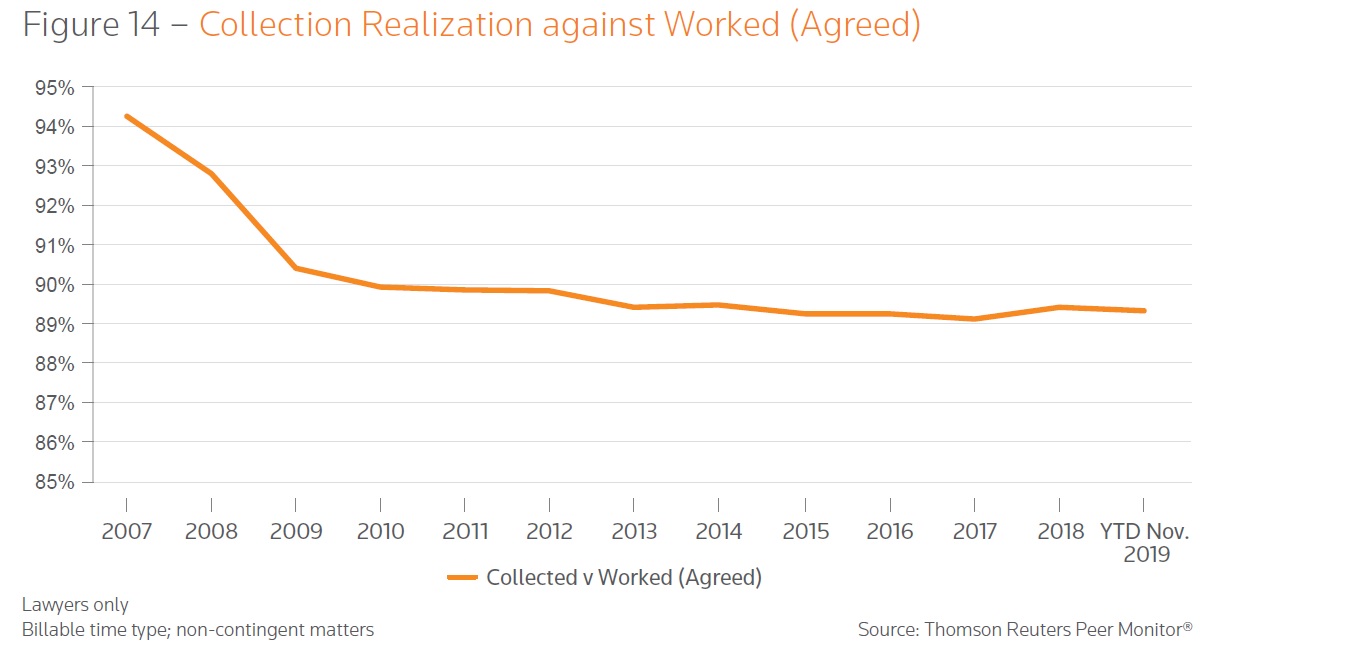
4This third – and last – graphic looks at collection realization against agreed worked and, again, has pretty much flat-lined over the past 5 years at a relatively horrid 89.5%.
Collectively these three graphics paint a rather sad story to me. There may be change in the industry. But it is far from radical. And one may argue it really hasn’t even been that incremental post 2008; with the caveat that you also need to be mindful that not all industry segments are now equal, as some are clearly more equal that others!

As always though, read the Report as I’d be interested in your thoughts/views/feedback.

rws_01

Secondments, labour arbitrage and a new race to the bottom

Follow me:

  • In-house teams have been the biggest ‘growth’ area in legal post 2008 and some in-house teams are now bigger than the law firms they previously outsourced worked to
  • Most GCs report to the CFO
  • GCs are increasingly under pressure from the CFO to reduce their ‘cost’ (including bonuses now linked to reducing cost – note: not external legal spend)
  • GCs have effectively two cost centres: ‘labour’ or ‘ external legal spend’
  • Procurement tells GCs they can reduce both ‘labour’ and ‘spend’ at the same time – secondments (heavily discounted at daily or weekly rates in RFPs – don’t need to advise out and don’t need to hire in-house!)
  • Law firms enter the discounted labour arbitrage market

And a new race to the bottom starts*…

As always, interested in your thoughts/views/feedback.

rws_01

*welcome to the party LoD

KPMG: “We are not trying to be a traditional law firm.”

“We are not trying to be a traditional law firm. Our approach is different, with a focus on offering our clients integrated global legal advice and solutions, where we are able to work seamlessly with existing KPMG clients who are looking for local and multijurisdictional counsel.”

The quote above, by Stuart Fuller of KPMG Australia, in today’s Australasian Lawyer is yet another great example of why law firms need to be on their guard and wary of the Big4’s re-entry back into the legal sector.

Why?

Well, here are my big 3 take-outs from Stuart’s comment:

  1. almost nobody is trying to be a ‘traditional law firm‘ – everyone is innovating and looking to reposition themselves as strategic advisors (the current Holy Grail). In short, if you want to be a ‘traditional law firm’ – unless you are really niche, which, like many, KPMG are not – then your days are numbered in my opinion.
  2. a focus on offering our clients integrated global legal advice and solutions” – what would DLA Piper, Baker & McKenzie, White & Case, Norton Rose, Deacons (just to mention a few) make of that comment? Isn’t that precisely what they would lay claim to be trying to do?
  3. but, crucially, the following sentence is the principal reason why law firms with more than 20 partners should be concerned: “where we are able to work seamlessly with existing KPMG clients“. Why? Because the Big4 get involved earlier in the advisory/transaction life-cycle than law firms have historically done, so if the law firm is only looking to advise on the law, and not act in any consultation phase (even as early as the pre-planning phase), then they are going to be in big trouble.

But that’s just my take – as always, would be interested in your thoughts, views, feedback.

rws_01

Lawyers and ‘the amplifying factor’

On 11 January Seth Godin blogged ‘Good intentions (how to be on time)‘. Typical Seth, it’s a relatively short post; and typical Seth, it contains an important message – ‘The amplifying factor‘.

In Seth’s words:

The amplifying factor is that when they’re late, people wait for them.

So why is this relevant to your firm?

The answer:- how familiar does this [2015] post by Bruce MacEwen (Adam Smith, esq) sound:

(3) We recently had a meeting scheduled with the partner on the matter at the firm’s offices in midtown. (I was not present.) Our representative—one of the two wardens of St. Michael’s—arrived about five minutes early and ran into the partner in the firm’s reception area; he was heading for the elevator to go out to get coffee.

He kept going.

My colleague sat in the conference room for 15-20 minutes awaiting his return. When he did appear, the plan was to conference in the other St. Michael’s warden on the speakerphone. He didn’t know how to do that.

This is a perfect example of ‘the amplifying factor‘. And in law firms I see this behaviour every single day…

As always, would be interested in your views.

rws_01

Is it time for ‘ARMs’ to replace the ‘RFT’ process?

Last Friday, 2 March 2018, Alex Berry, in the UK’s Legalweek, published ‘The end of panels? Barclays adviser shake-up provides vision of RFP-free client relationship‘.

Berry’s article outlines reaction to Barclays Bank’s announced shift away from the traditional [and largely, IME, procurement-driven] panel review process – in that, by the end of this panel term, in 2021, Barclays will not be re-tendering its panel.

The good news for the current private practice client relationship partner(s) – but probably not the many tender writers out there (including me) – is the news that:

“When the latest panel appointments come to an end in 2021, Barclays will fully move over to the new model, with lengthy panel reviews – and the laborious RFPs they entail – becoming a thing of the past.”

Which, begs the question – “What new model?”

The answer according to Berry is something termed:

‘active relationship management’.

Think about that for a second: ‘active relationship management‘ – then ask yourself: “How that differ from BAU (business as usual) in your firm?”.

Berry’s answer:

‘active relationship management’  – “will give the bank more flexibility to manage the size and composition of the panel, with law firms added and removed from the line-up on an ad hoc basis.”

But hang on a second – ‘Isn’t that what the whole RFT process is?’

Isn’t that what we have been talking about for years, vis-a-vis the whole rationalisation of panels?

It would appear not.

In Barclays Bank’s case:-

“Barclays argues that this model will help it to develop deeper relationships with its long-term advisers, while the bank is also looking to increase its use of alternative fee arrangements and move towards the “redundancy” of the hourly rate.”

Really?

Replacing a legal panel with an ARM structure, with no end term, with the aim of helping the client “develop deeper relationships with its long-term advisers”. I’d second that.

But, “the bank is also looking to increase its use of alternative fee arrangements and move towards the “redundancy” of the hourly rate” – sorry, but wrong platform to have a constructive discussion on this issue.

End result:- likely to be a churn a burn until the next RFT.

rws_01

How much do you love your client?

I read an article last week in which Jeffrey Cashdan, a partner at King & Spalding, who represents Coca-Cola, is quoted as saying he had banned all [Coca-Cola] competitor drinks from his home.

Think about that for a second…

…banned all competitor drinks from his home!

That’s a hell of a range. And a hell of a commitment, especially if you have children under the age of 20 running around!

So I started to think:- how many of the products in my home belong to my clients?

And I was pleasantly surprised by the answer – a fair few.

But I was also surprised how many competitor brands were in the house.

So I got to thinking, if we expect loyalty from our clients (whether that’s expertise or brand), how many of us out there are willing to go as far as Jeffrey Cashdan, who would appear to walk the walk when he says:

“I’m all-in for my client,”

rws_01

Altman Weil’s latest report: ‘Cost certainty trumps process efficiency’

Following on from my post last week that the ‘Billable hour remains the pricing method of choice for Australian law firms’, Altman Weil’s ‘2017 Chief Legal Officer Survey’, published later in the week – and now in its eighteenth year – throws a different light on this debate.

The big take-out for me can be found on page vi of the Executive Summary – namely that in-house lawyers now see ‘cost certainty‘ as being more important to them than ‘process efficiency‘.

Specifically, page vi states:

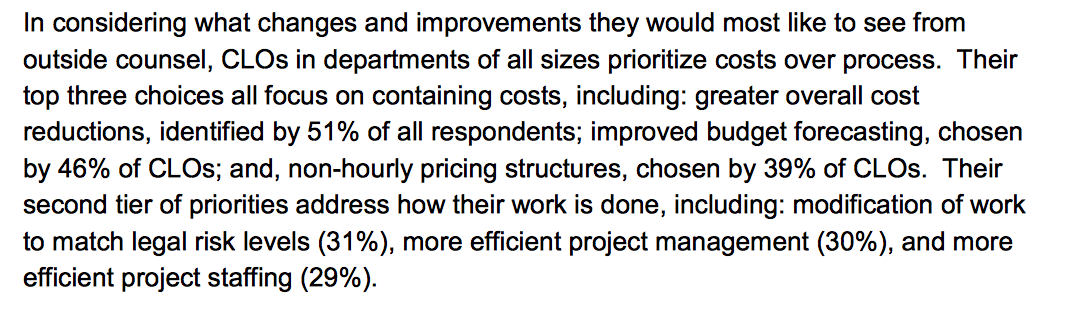
Screen Shot 2017-11-20 at 8.06.11 pm

“Costs over process”.

Think about that for a second – because it’s massive if you happen to be in private practice.

Crucially, though, is this comment (also on page vi of the Executive Summary):-

It is easier for law departments to demand cost reductions from providers and let them determine how to achieve lower fees.

So what do we have here?:-

  • cost certainty over process efficiency, and
  • private practice being allowed to determine how to achieve lower fees.

QED: If you’re in private practice and don’t have, (a) a robust Legal Project Management system/program, plus (b) data and analysis on the profitability of fixed fees that you can/should be offering…

… then your firm is likely in a lot of trouble.

rws_01