The most recent – 2026 – Citi Hilderbrandt Client Advisory Survey Report published earlier this month contains some interesting commentary on how US law firms faired in 2025. None more so than the finding that:
a growing number of firms estimating that more than half their revenue will come from pre-negotiated discounts. (page 23)
Pre-negotiated discounts
The Report does not explicitly define “pre-negotiated discounts”; however it refers to alternative fee arrangements (AFAs) as including fixed, capped or blended rates. It is, therefore, reasonable to interpret “pre-negotiated discounts” as encompassing agreed reductions to standard charge-out rates, volume-based discounts and other upfront pricing concessions.
Viewed positively, this trend signals a shift away from reactive, end-of-matter discounting towards earlier and more deliberate pricing discussions. In principle, this should create a stronger foundation for meaningful conversations about value-based pricing, particularly where clients are seeking price certainty, predictability and risk sharing. From that perspective, pre-negotiated pricing is not inherently problematic — and may in fact represent a necessary transitional step.
The more concerning implication, however, is that for many firms these discussions appear to be anchored primarily in discounting, rather than in value definition. Where pricing conversations begin and end with rate reductions, firms risk reinforcing a price-taker mindset rather than asserting their role as price-setters. Left unchallenged, this dynamic contributes to margin erosion, commoditisation of legal services and an imbalance in client-firm relationships that becomes increasingly difficult to unwind.
AFAs as a pricing option
Despite persistent commentary throughout 2025 that artificial intelligence (ai) will fundamentally disrupt — or even eliminate — the billable hour, the data in this Report suggests otherwise. The proportion of revenue derived from AFAs has remained effectively flat, increasing only marginally from 23.5% in 2024 to a projected 23.6% in 2025.
Setting aside the fact that many commonly cited AFAs are, in reality, variations of the billable hour by another name, and acknowledging that it may still be too early to fully assess AI’s structural impact on pricing legal services, one conclusion is unavoidable: the billable hour remains very much alive.
The way forward
With 74% of firms expecting a growing proportion of revenue to come from AFAs by 2027, the issue is not whether pricing models will continue to evolve, but how deliberately firms choose to engage with that evolution; and whether AFAs are used as strategic tools or simply as discounted billing mechanisms.
In sum
Taken together, the findings in this Report further highlight a profession at an inflection point. While the billable hour continues to dominate, the steady rise of pre-negotiated discounts and the anticipated growth in AFAs suggest mounting client pressure for greater certainty, transparency and perceived value.
The critical question for law firms now is not whether they should offer alternative pricing arrangements, that horse has bolted, but whether they are prepared to move beyond discount-led negotiations and engage in genuine upfront value-based pricing conversations.
Firms that continue to compete primarily on price risk entrenching themselves as price-takers in an increasingly sophisticated procurement environment. Those that invest in articulating value, pricing outcomes and structuring risk intelligently will be far better positioned to protect margins and strengthen client relationships in the years ahead.
The decision on the way forward now rests with the firms themselves.
As we navigate 2025, Australian midsize law firms find themselves at a pivotal crossroads—balancing client expectations, talent retention and the promise (and pitfalls) of technology. The recently released 2025 Australian Midsize Law Firm Priorities Report by Actionstep offers a deep dive into what’s shaping the future for these firms.
Here’s s summary of what you need to know from the Report—and how your firm can stay ahead.
🎯 Client Satisfaction: The Cornerstone of Growth
It’s clear—client satisfaction is king. 71% of midsize firms rank it as their top priority for protecting and growing revenue. But it’s not just about delivering legal outcomes; it’s about building trust-based relationships, offering personalised service and consistently exceeding expectations.
Interestingly, firms are focusing more on deepening relationships with existing clients rather than chasing new business. In fact, 37% see expanding existing client accounts as their primary growth strategy for 2025.
✅ Takeaway: If your firm isn’t investing in client experience, you’re leaving growth on the table.
👥 Talent Retention: Your Secret Weapon
While technology grabs headlines, midsize firms know that people drive performance.
59% of firms highlight attracting and retaining talent as a top strategic priority.
Engaging work, leadership and firm culture outrank pay as key reasons employees stay.
However, when employees consider leaving, pay and remuneration become the decisive factor. This signals a clear message: while meaningful work keeps people engaged, competitive compensation keeps them committed.
✅ Takeaway: Create a workplace where talent thrives—offer challenging work, clear career paths and ensure your pay structures remain competitive.
💻 Technology & Automation: The Untapped Advantage
Despite recognising efficiency challenges, midsize firms remain cautious adopters of automation and AI:
Only 38% are actively using automation tools.
Just 5% have reached AI maturity.
Cybersecurity concerns and data privacy remain top barriers.
There’s also a noticeable gap in digital client experience. While firms excel in personalised, human-centric service, only 41% feel confident in their digital touchpoints like client portals and automated communications.
✅ Takeaway: Embrace technology—not to replace people, but to empower them. Automation can reduce workloads, freeing your team to focus on high-value client interactions.
🔐 Cybersecurity: More Than Just IT’s Problem
With client trust on the line, cybersecurity is non-negotiable. Yet, the biggest risk isn’t technology—it’s human error. Over 63% of firms cite staff behaviour (think password sharing, weak authentication practices) as their top vulnerability.
✅ Takeaway: Build a security-first culture. Regular training, robust protocols, and smart tools like multi-factor authentication are essential to protect both your firm and your clients.
🏆 5 Strategies for Midsize Law Firm Success in 2025
Acknowledge Tech Scepticism: Start small, demonstrate wins, and build confidence in automation.
Prioritise Efficiency: Use automation to tackle time constraints and free up your team for strategic work.
Enhance the Client Experience: Leverage digital tools to complement your personal service.
Strengthen Cybersecurity: Focus on both technology and employee awareness.
Put People First: Foster engaging work environments and ensure competitive compensation.
Final Thoughts
2025 presents both challenges and opportunities for Australia’s midsize law firms. Those that blend human expertise with smart technology, prioritise client relationships, and invest in their people will be best positioned to thrive in an increasingly competitive market.
The latest Law Society (England and Wales) Financial Benchmarking Survey has sparked significant discussion on social media today. The findings highlight some critical financial challenges for mid-sized law firms, particularly in terms of profitability, chargeable hours and cash flow management.
📊 Top 3 Key Findings:
1️⃣ Fee Earners’ Costs vs. Fees Charged
The median hourly cost of a fee earner (based on 1,100 chargeable hours) was £123.40, while the median hourly fees per fee earner stood at £133.01.
🔴 93% of fees earned are being used to cover costs, leaving minimal margin for profitability.
2️⃣ Shortfall in Chargeable Hours
The average recorded chargeable hours per fee earner increased slightly to 773 hours (up from 765 in 2023).
⚠️ However, this is still well below the 1,100-hour target—a shortfall of over 300 hours per year per lawyer.
3️⃣ Increase in Lock-Up Days
Year-end lock-up days (including work in progress and debtors) rose from 143 to 146 days.
This trend indicates longer cash flow cycles, which can put pressure on a firm’s financial stability.
🚨 What Should Law Firms Do?
These figures underscore the urgent need for better financial planning, sustainable profitability strategies, and operational efficiency. Some key focus areas include:
✔️ Improving revenue streams—exploring retainer-based models for better income predictability. ✔️ Enhancing productivity—have a robust and actionable business development plan for all lawyers! ✔️ Optimise cash flow—reduce lock-up days by streamlining billing and collections processes.
📢 Looking to bridge the 300+ hour gap per lawyer? Or interested in strategies for growing a profitable legal practice sustainably? Let’s talk! Get in touch today.
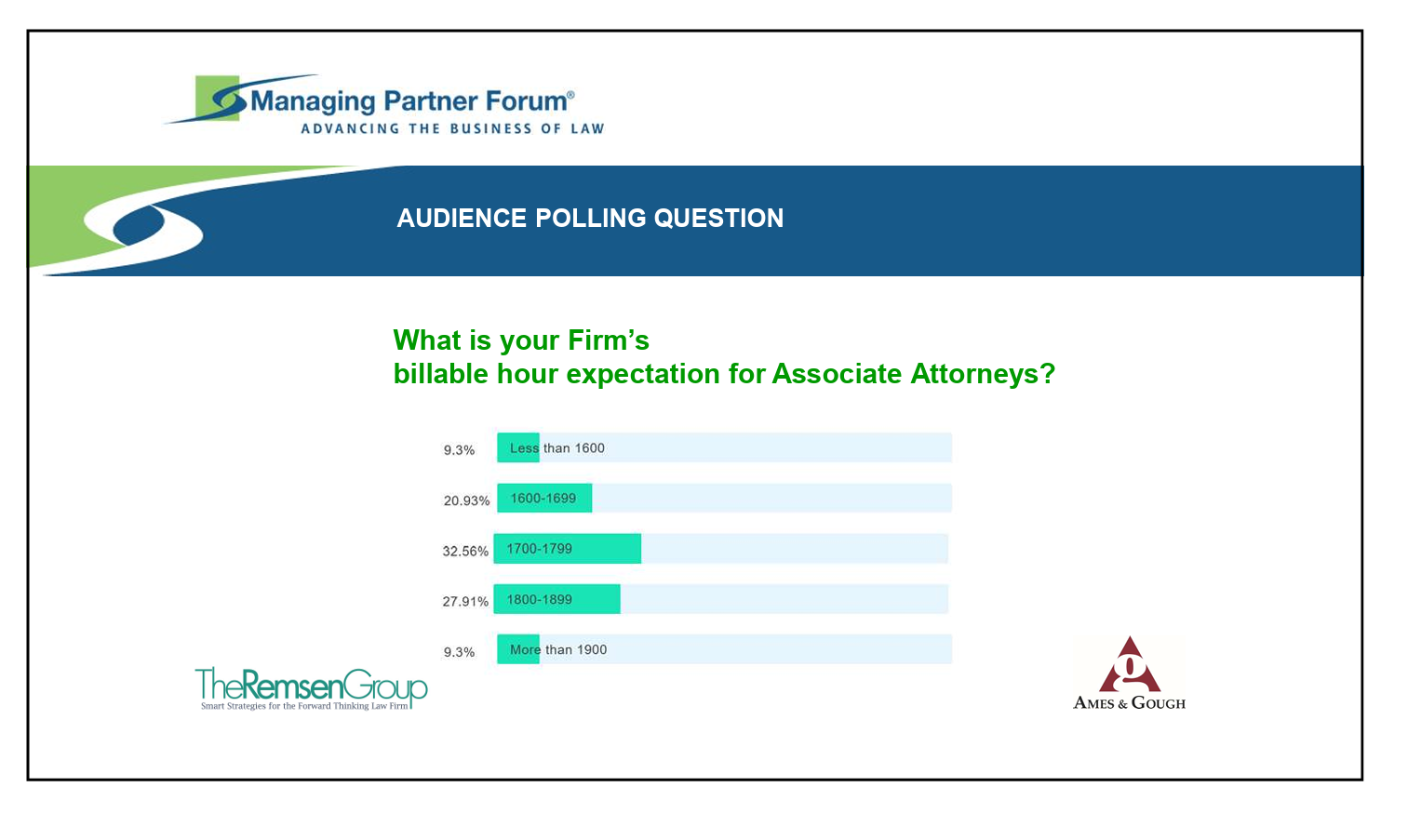
It’s interesting to note that nearly 70% of respondents expect their Associate Attorneys to bill over 1700 hours a year, with almost 10% expecting over 1900 billable hours per year.
That’s a lot of billable hours! And if we consider the ‘10-20-30-40 Leverage Rule‘, then the implication is very bleak for junior lawyers!
And as I say to those entering the legal profession who need some understanding of how many hours they need to work to meet their billable hour target, take a look at Yale Law School’s ‘The Truth About The Billable Hour‘.
While I am all for the profit motive, I maintain that if owners and managers of law firms want to understand why they have a high attrition / burnout rate in their teams, take a close look at what expecting someone to bill 1700 hours a year is actually doing to them!
“…over the last two years the number of Am Law 100 lawyers based in Beijing and Shanghai has declined by 25% from 569 to 424. The decline over a five-year period is 35%.”
Over the past 12 months, Chinese Law Firms DeHeng, JunHe, Fangda Partners and Han Kun Law Offices have established overseas offices in Singapore, the U.S., Indonesia, South Korea, Vietnam, and the Middle East
Having worked with law firms around the world for close to 30 years to help establish their overseas offices (with a particular focus on Asia), I’m not sure I have ever seen such a significant shift in an in-bound/out-bound referral strategy.
In my view, we are now at the dawn of an era when Asian-based law firms are referring more work out of Asia than International law firms are referring work into Asia.
The only question that remains then is this: “How are you positioning your firm/practice to benefit from this shift?“.
For someone like me, who was at the forefront of the early development of international firms expanding into Southeast Asia from 1996 (remember when Dewey & LeBoeuf had a Bangkok office, or DLA Piper Bangkok was a shipping insurance firm?), some of the top level take-outs – that apply as much today as they did then – were:
🎯 “The problem we have in this part of the world is that our brand isn’t as known,” 🎯 firm brands simply do not supersede interpersonal relationships, 🎯 American law firm brands have not penetrated the Southeast Asian market in the same way that American consumerism has. 🎯 The stark truth is that no homegrown Southeast Asian company is more likely to approach any of the elite American firms over British firms such as Clifford Chance, Allen & Overy, and Linklaters, all of which have been entrenched in Southeast Asia for decades [my comment: although CC has closed its Bangkok office] 🎯 While in the U.S. and even in the U.K., it may be obvious which firms are competing for which types of clients, the target clientele in Southeast Asia is ambiguous and unclear.
But the Big 2 take-aways for me were: 🎯 Every jurisdiction within Southeast Asia is different [My comment: So, so true!]. 🎯 Clients want firms that can show what they can bring to the table, how they can add value, and can tell them clearly how much their services cost.
It’s a great article and well worth a read if you are looking to expand into Southeast Asia in the near future.
And if you are, feel free to contact the team at GSJ Consulting , we know what many of the pitfalls are…
Having spent more than a decade of my working life in South East Asia as a lawyer (at least for the most part), and with lots and lots of good friends still there, I found this article in the AFR today interesting.
It is my sincere hope that Australian law firms give it a real go, but track record suggests (see this blog post of mine from 2014!) the journey will not be an easy one.
And if you are a law firm looking to move into South East Asia, feel free to give me a call – after all, I was there pre Linklaters, Clifford Chance (both of whom I worked with), A&O, NRF, DLA and all the others (apart from Bakers who were there, oddly under an Australian Managing Partner 😂).
As always, get in touch if you want to talk through any of the above.
…rarely do international law firms get the return on the investment they make in China that they do in other jurisdictions (for example the Middle East right now; but Malaysia and South East Asia if we want to look closer to home!).
If you don’t believe me, take a quick look at the number of firms who have entered/exited the China market in the past 15 years (tip: focus on US firms).
Law firm’s short-sighted approaches to this issue are typically for two reasons:
lack of knowledge of the market
lack of understanding that Asia is a long-term – multi-generational – investment (not, typically, your law firm investment M/O).
So why the post (other than the shout-out that I have been part of a team that has successful established not 1, nor 2, but 3 international law firms in SE Asia)?
Well because, while the Eversheds / KWM tie-up has a long way to go, comments like those in this article…
The legal process outsourcing market, valued at $8 billion in 2020, is projected to grow at a compound annual rate of 22% from now until 2027, when it is expected to have swelled to $30 billion
Knockless’s article is not, however – in my opinion – without some elements of controversy.
On the one hand,
Jason Winmill, managing partner of the legal consulting firm Argopoint, said the move to outsource legal work to India is motivated by the relentless ongoing pressure to reduce in-house legal spending.
Which, I have no doubt, is true.
On the other hand, however:
India is favored for its low labor costs and high availability of skilled lawyers who are proficient in English.
And, to be clear, when we’re talking about ‘low labour costs’ here, what we are talking about is:
…legal workers earn about $12,000 to $30,000 a year reviewing contracts, handling legal research, subpoena responses and document reviews and completing other tasks…
Which, when you consider
N.Y. law firms raise starting salaries to $215,000 as lawyer pay race continues
But then, having said that “India is favored for its low labor costs and high availability of skilled lawyers who are proficient in English”, this is then qualified with:
Most of the work companies move to India involves record-keeping, compliance and document review—mainly nondisclosure and confidentiality agreements, low-level purchasing contracts and routine aspects of Intellectual property.
But hang on a second, isn’t that exactly what $215K a year first-year is doing?
Nope, looks like I might have got that totally wrong
The move reduces legal spending and frees up U.S.-lawyers for higher-value matters.
To be clear, I have no issue with new lawyers in the US/UK etc making as much money as they can – many have what must feel like life time debts. And I have no issue with businesses – whether that be in-house legal or private practice – making money out of outsourcing work to India.
But, are we doing right by those in the Indian middle?
I spent just over a decade in Asia between the 1990s and mid-2000s. In all the time I spent there I never considered the Region as ‘One Market’ – but rather as a multitude of diverse and different markets.
By way of example, almost everything we did in Asia was “ex-Japan“. This wasn’t because we didn’t see Japan as part of “Asia” – as it very much is – but rather because the international legal market there (NB, the Japanese local legal market is a very different issue) has far more in common with the US market than the Asian. As a result, we lumped Japan in with the US when discussing strategy (and you’re free to question that thinking/strategy).
Likewise, any strategy discussions we had that involved Singapore almost always included India, the Middle East and the Philippines. Similarly, strategy discussions that involved Hong Kong included not only mainland China but also Indonesia.
Finally, SE Asia (Thailand – where I was located, Myanmar, Laos, Cambodia and Vietnam) was its own regional discussion.
All up then, when discussing “Asian” strategy we had four or five discussions – not one.
That said, I worked with (but not for) firms (notably Herbert Smith as it was then) who operated on a fly-in fly-out basis. In my day we called this the “hub and spoke” approach, where the expertise went to the client need and, I have to assume, strategic discussions were done on a Regional basis.
While not criticising firms who took this approach – some did very well out of it – I didn’t think it worked for the firms I worked with as we held the view that, probably more so than any other market in the world, Asia operates on a relationship basis. Our experience was that relationships trumped expertise, and in the very family operated business world of Asia at that time, cost.
So why the history lesson?
Last week, in the Asian Lawyer, I read Bob Charlton – Asia Managing Partner of Berwin Leighton Paisner (BLP) – comment, following the firm’s Asian retreat, that:
“…in broad terms we agreed we must have a one Asia approach.”
Interesting, I wonder what BLP could mean by “a one Asia approach“?
Fortunately the article sets out exactly what that means:
“BLP’s “one Asia” strategy means the firm is doing away with the concept of geographic and practice area distinctions, focusing instead around sector groups. These groups include aviation, construction, oil and gas, private wealth and shipping.”
Now that really is interesting because, frankly, I’m not sure it is going to work.
A sector focus in Asia is a sensible move. A sector only approach to market in Asia is gutsy to say the least.
I say this for two reasons: (1) ‘relationships still trump in Asia’, and (2) Asia is not now, nor will it be for a very long time (if ever), one economic zone. That’s the case both for inbound and outbound work. And even if you don’t want to have people on the ground (which I would strongly recommend you do), you need to consider the geo-political economic implications separately.
And I’ve said all of this without mentioning the elephant in the room: “AdventBalance”. I wonder if they take a sector approach to their strategic thinking in Asia…









 RWS_01's B[D]log