General business development issues

Beware of wolves in sheep’s clothing

Business Development image

“Beware of the false prophets, who come to you in sheep’s clothing, but inwardly are ravenous wolves.” – Matthew 7:15

It might seem a little melodramatic to start a business development related post off with a biblical reference, but when the global leader of EY Law, Cornelius Grossman, says “I don’t think any firm should feel threatened“, vis-à-vis the march of accounting firms into the legal space, and particularly why law firms have nothing to fear from accountants practising law, it seems entirely appropriate.

On further reading, the firms Grossman says he is refusing to target – and thus by extension don’t need to feel threatened by the continued march of accountants into this space – are those doing “the highest level – “bet the company” – work and premier corporate clients” and who “have established their brands over hundreds of years…

In other words, so-called Magic Circle firms, their work and client base are safe from the invasion.

But, as Grossman then goes on to say in this legalweek.com article:

“he believes EY Law will succeed with multi-disciplinary teams doing mid-market transactional work”.

adding further that:

“We [EY Law] want to be known for compliance jobs that span over tens of jurisdictions and for large international reorgansiations.”

In other words, the work that just about 80 per cent of us have been trying very hard to secure for a couple of decades now (and in many case incurring significant losses while we try and secure this work)!

So, while Grossman may believe that:

“The threat of accounting firms to the legal market is overstated.”

and that:

“There’s so much work out there that we all compete for – I don’t think any firm in particular should feel threatened by that.”

unless you work for an elite law firm, I would like to suggest that you be a tad weary of wolves in sheep’s clothing telling you that there really is nothing to be overly concerned about and that there really is enough food out there for all of us to feed on.
From the client’s perspective

Business Development image

Overnight (Australian time) Bruce MacEwen, President of Adam Smith, Esq and a leading commentator on professional services, wrote an outstanding blog post – ‘The Client Seat‘.

The post outlines some of the personal experiences Bruce has recently encountered as part of his role as Chair of the Finance Committee of his local church, St. Michael’s Episcopal Church at West 99th Street and Amsterdam Avenue, who own a vacant corner lot abutting the rear of the sanctuary and are looking for ways to realize some value from the asset; and, specifically, as it relates to the process of interviews the church is going through to select and engage a law firm to assist them in this process.

I anticipate there being a lot of commentary written about Bruce’s post  – if there isn’t already. It raises a number of thought provoking issues of what it feels like to be sitting in the client’s seat as part of this process and some of the gems that lawyers and law firms come out with to try and impress a prospective client into appointing them to do the work – even where they may not be qualified to do the task at hand.

But what really grabbed my attention in the post was the following observation Bruce makes:

The other asymmetry is one of disclosure and, to be pointed about it, candor: The client needs to tell the firm as much as honestly possible about the engagement and what the client knows, while the lawyers’ instinct and practice is to guard information, hedge predictions, and avoid definitive statements. This is true even when the firm is posed direct questions about simple business arrangements and not ultimate outcomes, such as “Who will be working on my matter?”

This is such an on the money observation of the profession, but think about it for a second:

In an age where open candour and transparency around both your personal and your firm’s credentials will most likely win you and the firm the trust of clients and prospective clients, and thus a lot more work in the long run, why do lawyers still feel the need to be guarded and reluctant to give straight answers to straight questions?

How often do you let your clients know the value you provide to them?

Business Development image

Based on interviews with 188 independent lawyers and more than 500 clients, the LexisNexis Bellwether Report 2015: the Age of the Client (published earlier this week) found that:

“80% of lawyers think they’re delivering above average service…

… but only …

…40% of clients say they’re receiving it.”

What does this mean?

Well, either:

  1. You’re not as good as you think you are; or
  2. You’re not communicating well enough to your clients the value you bring to the transaction/relationship.

I’ll leave it for you to decide which you think applies to you.

A conversation with Lucy Fato, General Counsel at McGraw Hill Financial

Business Development image

Last week Bloomberg’s new Big Law Business website published a two-part extract [It’s All About Relationships and ‘Gut Checks’ Are Better than AFAs] from a recent interview Bloomberg had with Lucy Fato, General Counsel of McGraw Hill Financial (among others, parent company of Standard & Poor’s).

Transcripts from the interview make for interesting reading. While not agreeing with all Ms Fato has to say, her take on the following issues run close to how a number of in-house counsel feel here in Australia:

On the role of in-house counsel:

But my view is that the role of in house counsel is, in many ways, to be the face of the company in these situations. Outside counsel can never really have perfect information about what a board or a CEO is thinking. They can never really step into the shoes of in-house counsel.

That’s how in-house lawyers really add value. They can connect all the dots. I think, historically, general counsel deferred more to outside counsel than what you see today. It’s a process that has evolved.

On the role secondments can play in developing personal relationships with in-house counsel:

Secondments are a great way for a firm to build a relationships. The associate is actually here, in our building, getting to know our people, getting to learn our business, and when they go back to the firm, they bring all of that knowledge with them. It’s especially effective when a firm is new to the company.

On the developments going on in in-house departments:

In-house departments have become much smarter about how we manage our departments and how we manage our legal expenses. In-house departments are becoming bigger, more global, and many companies, including ours, spend a lot of money on outside counsel. Getting a handle on that is extremely important.”

On the role data plays on the modern relationship between in-house and external legal:

I’m very big on data and having a lot of information to work with…

E-billing gives you enormous visibility into how law firms make money.

On alternative fee arrangements:

Getting better control over who we’re spending money with, how they are staffing deals, how much time is being spent on matters — taking a hard look at those types of questions is more effective over the longer term than trying to do alternative fee arrangements.

On hourly rates:

But I will say it’s gotten a little out of control. It’s eye popping even for me, and I’ve been doing this a long time, when I see an hourly rate that’s over $1,000 an hour. I look at that and think, “Really?”

Ms Fato makes a number of other good observations and comments, both about the evolving role of in-house counsel and the relationship between in-house departments and their external legal advisers, but I wanted to finish this post with probably my favourite:

Firms have to be mindful that their client is not just the lawyer. It’s also the business person.

Absolutely.

The two types of efficiencies law firm associates need to become familiar with…

Business Development image

Really interesting article [‘What Associates Should Know About In-House Rates and Efficiencies‘] by Gina F. Rubel was published overnight (7 April 2015) on The Legal Intelligencer website – discussing the two types of efficiencies that law firm associates should become familiar with – contains a gem of a quote from an in-house general counsel that I wanted to share/pass on.

First, to put some context around the quote below by Gino Benedetti, as Rubel states:

“There are two types of efficiencies with which lawyers need to be familiar. The first is general efficiency, which is the state or quality of being efficient and the actions designed to achieve optimal results. The second is economic efficiency, which requires optimal production and distribution of a firm’s resources.”

And while both are extremely important to in-house counsel, the following quote in the article by Gino Benedetti, General Counsel of SEPTA, should give some indication to private practice law firm associates which of the two bears more commercial importance to their in-house clients:

“Associates should understand that every case does not require a full-court press,” said Gino Benedetti, general counsel of SEPTA. “Associates add value when they think creatively by identifying the core issue in dispute and focus their case work on things that impact that issue. Often, associates work on an aspect of the case that does not have any meaningful impact on the ultimate outcome. So, associates should appreciate that their time may be less expensive, but that does not justify inefficiency. Associates should communicate often with the partner or the client directly so that the client’s objective is understood and the work is driven by that objective.”

If you haven’t already, I’d like to suggest you go over and read the entire article. It’s full of sage advice from several in-house GCs.

In the meantime, if you are a private practice law firm associate, the next time your supervising partner asks you to undertake a task on behalf of your client why not ask yourself which type of the two types of efficiency you are going to bring to the task…?

Law firms: cannibalisation is the only way you can beat cheaper competitors

Business Development image

The only way for a company to deal with cheaper competition was to set up a different company with an “invitation to kill its parent”

So says Harvard Business School professor Clayton Christensen during a recent visit to Hong Kong – as cited in an interesting article published in the South China Morning Post on Friday 20 March.

With the fairly recent introductions to the legal market of:

to name a few of the internationals, as well as Corrs Chambers Westgarth’s Orbit closer to home, makes me wonder if the legal sector has taken this message to heart and is now processing this strategy to their business.

All of this activity also reminds of the time I once overhead someone saying the day would come when Riverview Law would be bigger than DLA Piper. Might not happen in my working life, but not totally unthinkable in this day and age.

The rising demand for flexible legal resourcing

Business Development image

Lawyers On Demand (LOD) (the so-called ‘alternative legal services provider’ backed by UK-based firm Berwin Leighton Paisner (BLP))  have released data – akin to an annual report – that indicates there is a growing need for ‘flexible resourcing’ within the UK legal market.

Among the more interesting data to be released is that:

  • LOD’s turnover has increased by more than 500% (to circa £9m) in the past four years.
  • LOD’s ‘On Call’ service (launched in June 2013) has completed more than 70 assignments in its first 18 months.
  • more than 150 On Call lawyers have now completed LOD assigned assignments for more than 15 different law firms.
  • LOD is offering clients retainer arrangement of between £2,000 to £50,000 per month, depending on their current resourcing needs.
  • surging demand for On Call lawyers to work on specific transactions has led to the launch of On Call ‘transaction teams’.

Notably, LOD said the On Call teams:

“allowed private practice clients to scale up quickly and cost effectively, protecting their profitability on transactions and responding to client demand.”

So, what has all this to do with the Australian legal market you may ask?

Well, as it happens a number of ‘flexible legal resourcing’ providers have had ‘soft’ launches in the local market of late, including:

  • Crowd & Co – whose tag-line is “Saving you time for what really matters”, and
  • Lexvoco – with a tag-line of “Law on call”.

Both of which are in addition to the recent launch of Orbit by Corrs Chambers Westgarth, and both of which look to offer what appear to be very similar services to LOD’s On Call.

Add to this the recent (2 February 2015) decision by Allen & Overy to expand its ‘Peerpoint’ service to the Hong Kong market, and I think we can safely say that there is clearly a rising demand for flexible legal resourcing – globally, regionally, as well as locally here in Australia – and that all that now remains is for someone to come up with the appropriate acronym.

Are the legal press letting the importance of revenue get in the way of a good story?

Business Development image

An interesting news item appeared on the Global Legal Post website overnight (Australian time). Citing a recently published (January 2015)  Legal Services Market Research Report by IBIS World, the Global Legal Post item, which is titled “Australian firms on the hunt for increased revenues” states that:

Pressure on revenues is forcing Australian firms to look overseas in a bid to increase turnover.

First of all, if I’m allowed to say, this is irony in action!

Given the number of international (mostly British) law firms that have entered the Australian legal market in the past five or so years as a result of perceived or real limitations on growth in their own domestic markets, to now be informed that one of the consequence of this action is that Australian firms now need to look overseas to grow their own revenue is, well, ironic.

More importantly – aside from being wrong as the IBIS Report clearly states that the market in Australia is growing (if admittedly at a snail’s pace) – is that it misses a crucial point; namely, increasing turnover for turnover’s sake is nothing short of a wasted effort!

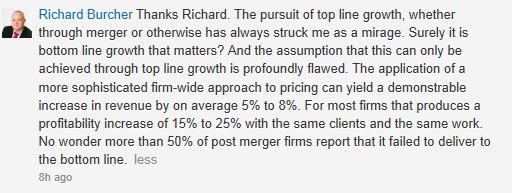
But don’t take my word for it, as the prominent industry strategist and pricing expert Richard Burcher rightly points out in his comment to the link I posted to this on LinkedIn last night:

Surely it is bottom line growth that matters? And the assumption that this can only be achieved through top line growth is profoundly flawed. The application of a more sophisticated firm-wide approach to pricing can yield a demonstrable increase in revenue by on average 5% to 8%. For most firms that produces a profitability increase of 15% to 25% with the same clients and the same work. No wonder more than 50% of post merger firms report that it failed to deliver to the bottom line.

RB image

Precisely Richard.

Unfortunately, however, this is not the only example of this type of legal press reporting/thinking.

Only the same day (Monday) The Australasian Lawyer reported – citing (wrongly in my opinion) another UK website – that the Australian arm of DLA had been “fingered for [the] law firm’s drop in revenue” as if huge levels of shame needs to be attached to this [revenue drop] given that it

follow[ed] a transition period where underperforming partners in the region [Asia] departed.

Well I happen to know a number of the partners who left DLA last year and one thing I can say with absolutely certainty is that they were anything but underperforming. More accurately, what they were was in practices that were no longer strategically aligned to where DLA sees the future of its business (something I think is made clearer in the UK version of this news). And, in a partnership sense, there is nothing wrong with having conversations like that. Indeed, they are to be encouraged.

So as with the discussion around revenue and profit, the discussions around revenue and strategy, while related are two different issues.

And all of this before we even get into the very real discussion of whether or not one law firm’s growth has to come at the cost of another law firm.

Shouldn’t a law firm talk to its clients before agreeing to merge with another firm?


Business Development image

The results of an interesting survey (looking at UK law firm merger activity) of 102 of the UK’s top 200 law firms by legal communications specialists Byfield Consultancy and partnership law experts at Fox Williams is being reported in the UK press overnight.

The headlines that appear to be grabbing the most attention from the survey results are that:

“Almost half of all non-merged UK firms would consider a tie-up over the next two years”

and that:

“As many as 95 per cent of managing partners expect their firms to merge within the next decade”.

Interesting as these numbers are, what grabbed my attention was the surprising – to me at least – fact that only 43 per cent of all merged firms revealed that they “investigated feedback from clients” prior to merging with the other law firm.

When you then take on board that “81 per cent of merged firms cited growth as a reason for joining forces” with their merger partner, doesn’t it seem a little odd that less than half would then discuss whether or not there was any real growth prospect in the merger with their clients and their merger partner’s clients (including any joint clients) prior to merging?

Little wonder, maybe, then that only:

“43 per cent of firms that have merged since 2010 believe that the move was a success”.