‘What would be some of the things I would want to be looking out for in a law firm’s invoice?
So here’s a quick list of my 10 things, but feel free to add your own 🤪 :-
Being charged [for]:
Expenses/disbursement – especially if they are unaccounted for (and particularly on fixed fee matters)
Travel time – especially if your lawyer is in the same town/city as you
‘Reading in’ time – especially when a new lawyer joins the team because one of the original team members has resigned or left the team
Team meetings to discuss your case/matter
Multiple lawyers attending the same meeting – especially if they have different time eateries
‘Out of scope’ work without a corresponding change order
Block billing of numerous tasks without explanation
Promotions – charge-out rates being increased for lawyers on your case because they have gain an additional year of post-qualified experience without adding any additional value
‘Bill padding’/‘Rounding up’ – when your lawyer rounds their time up to the next billable unit
‘Stickiness’ – where senior lawyers are doing work on your file that could be easily have been done by more junior lawyers, but they do it because they need to meet their internal billable targets.have different time.
As I say, feel free to add some of your own in the comments.
My friend John Chisholm hit the big time last week, he made the front-cover of Issue No.5 2021 of Legal Business World. All joking aside, John’s article ‘Who subscribes to your law firm?‘ (starts on page 8) is a really good read.
One of the gems I took away from John’s article is what he calls: ‘The 5Cs of Value’, which are (in his words):
Comprehend value to clients.
Create value for clients.
Communicate the value you create.
Convince clients they must pay for value.
Capture value with strategic pricing based on value, not costs and effort.
These are really good cornerstones to have, even if you don’t subscribe to John’s views of value-based pricing (did you see what an did there 🤪).
In any event, if you are new to the concepts of subscription and value based pricing, read the article because you’ll get a lot out of it.
And if you want to know more about the important topic of value based pricing in law firms, call him – but make sure to extract as much value as you can from him!
My son was born 10 June 2021. Since then, I have been in lockdown for 10 weeks (just starting week 11), homeschooled all of term 3 (currently 8 weeks, start of week 9), have three children under the age of 7 at home 24/7 (including the newborn), and with two working parents to schedule this madhouse around!
All of which is to say, I have been remiss in not blogging for a while, but hopefully you get the picture.
Anyhow, during this time of madness I came across an interesting article by Bhavisha Mistry on the Legal Cheek blog – ‘5 pieces of advice I’d give to my younger self’. Bhavisha is a College of Legal Practice programme committee member trying to help out aspiring lawyers.
Bhavisha’s article got me thinking, ‘What 5 pieces of advice would I give my younger self?’. So, here goes my attempt at an answer:
Expect the unexpected: Having been through the Asian Financial Crisis (1997/1998), the dot.com bubble bust (2001), SARS (2002), the Global Financial Crisis (2008) and now COVID (2019), one thing I can tell you is that the ‘unexpected’ happens on a pretty regular basis. Plan for it and always have a ‘Plan B’, because there are likely going to be more uncertain days than certain.
Back yourself: If you’re starting out in this profession, you’re just about to go through some of the most boring and mundane [very long] days of your life. Having been a massive over-achiever up to this part of your life, you will now go through an apprenticeship that will make you question why you bothered. You’ll hear a lot of comments about “paying attention to detail”. All I can say is:- back yourself and stick with it. There will be challenges. There will be dark days when you question your sanity. But back yourself, because you are here for a reason – and never, ever, be willing to compromise on your personal values to please your peers.
Always be willing to learn new things: While the profession of law probably hasn’t changed all that much since the days of Charles Dickens, the business of law is changing all the time. Always be willing to learn new skills that help you improve how you conduct the business of law – whether that be Legal Project Management (LPM), Design Thinking, AI or whatever fad is still to come our way. Read. Listen to podcasts. Attend webinars/seminars/conferences. And be willing to pay for this if you need to.
Business Development and Marketing are important skills: Following on from 3, know how to market yourself in a P2P (person-to-person) industry is important. Look at your customer buying journey/cycle. See where you need to be and when – and that may be on LinkedIn, but equally it may be having your hair-cut on Saturday when the barber/hairdresser is busy with friendly chat. It could be talking to other lawyers (for referrals), but equally it could mean staying well from them. But having an understanding of this is critical, because it will help you with one of the most important skills you need to succeed in this business: the ability to build relationships with people – both internally [in your firm] and externally.
Budgets are a joke: I’ll leave the best for last, when you start out at a firm you’ll be assigned a budget. That budget is likely going to be 4+ times what you are being paid. It is going to look like a lot of money. You a probably going to think: “If I had that much money I could buy an apartment”. Here’s the thing, these budgets are meaningless. Why do I say they are meaningless? Because at this stage of your career, you’ll have no control over whether you can achieve budget. You’ll have no control over whether you can achieve utilisation. So, if anyone from Finance or Management says you are not making budget, refer them to your supervising partner – because that’s where the buck stops!
As always, the above represent my own thoughts only and would love to hear yours in the comments below.
As far as I’m aware, Apple has never allowed retailers to discount (or have any other say in) its products pricing.
Ever.
As far as I have understood it, Apple’s rational for this because it has always insisted that it – and it alone – has complete control over its pricing.
Why is this important?
In short, because while you will see retailers heavily discounting every other computer software and hardware manufacturers’ products during this year’s EOFY (lockdown) sales, no such offer is made on Apple products.
You don’t see red ink on Apple product price tags.
Ever.
So what can law firms learn from this approach?
Always understand the value you provide to your clients
In 2018, on Canberra radio 2CC, the then Prime Minister of Australia Malcom Turnbull said:
“I actively discourage kids from doing law unless they actually want to be lawyers”.
Although maybe not apparently obvious (unless you are able to tie-in the relevance of the title of this post), Mr Turnbull’s comments were in reference to the number of students opting to study law here in Australia (where law remains part of a 5 year double degree) without any real desire to enter the profession.
As someone who had gone through the (admittedly English 3-year LLB undergraduate degree) university system in the early 1990s, I once heard it said that there were more students studying law than there were lawyers with practising certificates in England and Wales.
But here’s the thing, nearly all of us who had done our research (pre internet of things days), knew it. Most of us knew that a training contract was a far-off dream, especially as Student Loans were starting to kick-in.
Many didn’t even want to work in a Magic Circle firm – high street conveyancing was okay.
So are there too many people studying law?
Almost everyone I studied law with saw a law degree not only as a path to practising law but also as both an intellectual challenge and a gateway degree to better opportunities.
When considering that remark, keep in mind this was an era where having skills like a university degree (let alone one in law) allowed us to go overseas and work/travel (in my case that was 12 years in Asia and 14 years in Australia and I have still yet to see the inside of a court in England and Wales in any professional capacity).
‘Do universities have a duty of care to ensure their students have real work prospects before accepting them onto their undergraduate program?
I think they do, but from many of the responses I received others think otherwise.
Maybe it’s a generational thing, but I believe that if you pay 10s if not 100s of thousand of dollars to do a 5-year undergraduate degree in law, you should have some level of reassurance there is a reasonable chance you can actually be a lawyer. After all, on grades you should be in top 5% or so of students in the country.
10 ‘non-legal’ roles you can do in a law firm with a law degree
On the chance you do happen to do a 5 year law degree, don’t want to be a politician/diplomat and actually want to work in a law firm who aren’t offering you a Training Contract, then here’s my list of 10 alternative ‘non-legal’ roles you can do in a law firm with a law degree:
Management (COO, CEO)
Business Development/Sales
Marketing
IT/Lawtech/Innovation
Pricing
LPM
Legal Design/LPI
KM/Precedents/PSL
HR
Learning & Development
(NB: the use of ‘non-legal’ here is deliberate)
As always, the above represent my own thoughts only and would love to hear yours.
Over the past few weeks I have been reading, with some concern, the level of redundancies being made of legal secretaries at law firms around the world. It’s almost as if COVID has proven this role to be surplus to requirement. And with the recent growth in voice transcription services and other technology related advancements, along with a growing desire (read: “at long last they trust us”) to work from home within the profession, this trend – in team restructuring – should probably not be too surprising.
Yet I’m very concerned with the direction this is taking.
Why?
Well, in part, on the issue of legal secretaries being asked to take redundancies, a spokesperson for UK-based for Dechert recently told The Law Society Gazettethat:
‘To better support our clients and lawyers we are restructuring our secretarial support function in London to a hub model which will include more specialised skills.’
While I support this firm’s attempts to retain as much of its ‘secretarial support’ (read full article to see that) as possible – and while this firm’s comments on the issue of secretarial redundancies are by no means unique to it, I also think everyone commenting on this may be missing a fundamental point in the role legal secretaries play in law firms.
For those of you who may not know it, I have been a bit of a journey-man during my 25 years in the profession. During that time I have worked in-house at 8 different law firms across Australasia. These firms have varied in size and reach from large international law firms to local national firms. I have also consulted, at varying points, to dozens of others. And in all these firms, the legal secretaries have shared common traits – many of which have transcended what might be considered a ‘traditional’ (if there ever was such a thing) secretarial role.
In my experience , these have included being:
practice group/service line/team manager
receptionist
book-keeper
time entry keeper
finance officer
accounts payable clerk
accounts receivable clerk
debt recovery agent
marketing consultant
business development advisor
human resources office
people and culture officer (leave dates anyone?)
events officer
hospitality (coffee and lunch) manager
laundry collection point
massuer
mental health therapist
There are so many other roles I could add to that list – not least of which is ‘mentor’ to the junior lawyers of today who will be their bosses of tomorrow – but I think you get my point.
Legal secretaries are front-line. They are font-line so far as clients are concerned – because that’s essentially who the client talks to 90% of the time. They are front-line for anyone working in the business of a law firm because, frankly, you will never get access to a partner without going through their secretary.
More importantly, the role of legal secretary is the engine room of a law firm. They have retained knowledge of the firm and its relationship with clients that transcend lateral partner movements and succession plans.
Redefine the role description, absolutely. Make it redundant- NEVER!
As always, the above represent my own thoughts only and would love to hear yours.
There’s a saying that overnight successes take 20 years to happen. I generally agree with that; it is rare indeed to come across a true overnight success. With the incredible ascent of the Legal Operations role within the legal ecosystem over the past five years, I am, however, willing to make an exception to this saying.
Background
CLOC – the Corporate Legal Operations Consortium – was co-founded by Mary O’Carroll and Betsi Roach in 2016. From my background reading I understand Mary and Betsi started CLOC as quasi book club membership group for quirky people with a legal operations title or elements of legal operation within their role.
Within a very short period of time, CLOC had set parameters around what they called the ‘Core 12’ skill-sets/roles of a Legal Operations professional. These include:
Business Intelligence
Financial Management
Firm & Vendor Management
Information Governance
Knowledge Management
Organization Optimization & Health
Practice Operations
Project/Program Management
Service Delivery Models
Strategic Planning
Technology
Training & Development
So far, so good. Nothing too exciting about this.
Legal Operations: Where are we today?
‘Fast’ forward (if you can) six years and CLOC and the role of Legal Operations has a massive global footprint, as evidenced by the release of two reports in that past month that clearly highlight the rapid ascent of this role within in-house legal teams.
This Report contains the following telling graph – the massive increase in the percentage of [legal] departments with at least one legal operations professional.
Take that graph in for a second.
Now let’s give it some context.
In 2020, just before COVID, when discussing CLOC and its role in ‘Episode 27: Legal Operation is it the new legal business game changer‘ of The Legalpreneurs Sandbox, the panel of presenters at the Centre for Legal Innovation (lead by the wonderful Terri Mottershead), took the best past of an hour explaining who CLOC where and what the Legal Operations role was.
This is in no way a negative comment on the Centre – far from it. They are a leading edge think-tank of highly knowledgeable people talking an audience that know what is going on at the forefront of legal innovation.
Frankly, they’re a clever bunch.
And yet, even for them, the ascent of this ‘Legal Operations’ role was – not to put too fine a point on it – mind-blowing.
The Gartner Graph
So we come to the second graph, which comes from a Gartner report that I read earlier today.
Again, this graph blows my mind. But, in this case, so far as I am concerned, the mind-blowing detail isn’t in the astronomical rise of Legal Operations role (which I think relies heavily on the ACC graph above), as it is in the number of so-called ‘non-lawyers’ who are doing this role.
If the growth in that yellow box doesn’t have you shaking your head, go back and take another look at the skill in CLOC’s Core 12 above. Then tell yourself that a ‘non-lawyer’ is in charge of those skills.
So what does this mean for law firms going forward?
The honest answer is, I don’t know.
I have yet to to decide exactly where the role of Legal Operations fits. Clearly this is an important role that will have a significant role to play in the day-to-day running of a legal team. But how do the tasks of Firm Vendor Management, Service Delivery Models and Strategic Planning fit with the role Procurement plays?
Truth is, I don’t yet know.
What these charts do show me though is that the role of Legal Operations here is to stay. We best get used to. And we best get used to working with them. So make sure it a discussion topic within your firm. And, I suspect you will actually be seeing this role playing out in your firm – with a ‘non-lawyer’ in charge!
As always, the above represent my own thoughts only and would love to hear yours.
I have long held (see this post from September 2017 [‘Do you know who your competitors are?‘] and this post from July 2014 [‘5 steps to take when you client becomes your biggest competitor‘]) that in a hyper competitive legal market, your client – and not any of your more traditional law firm competitors in private practice – is actually the biggest competitor you face when trying to win new work.
Take note all you private practice lawyers, in a three year period between 2018 and 2020, ‘The ratio of legal spend in-house vs outside‘ moved from 50.2% / 49.8% in 2018 to 57% / 43% in 2020.
That equates to a 13% swing of legal spend in-house over this timespan.
In a period when legal spend on outside lawyers actually grew! (Probably providing a false sense of security!).
And, these numbers pre-date COVID. So it is highly likely this movement of work in-house has, and will continue to, grown.
So, next time your firm is doing a SWAT and/or Competitor Analysis, make sure to keep some room for the biggest competitor out there – your client!
In the early days of what we now call COVID-19, I saw the meme below. It made me laugh out loud. It was so accurate!
The only problem is, as with most memes, it turned out not be as true, accurate, and funny as I had first thought.
In 2020 I ended up working from home 174 days. Others that I know, especially those in Melbourne, ended up working from home a lot more (if that’s possible).
But here’s the thing,
How were we able to work from home for all that time, so quickly?
From where I sit, the answer to this question is that most law firms (of any size at least):
Were already #FutureReady.
We should be thanking the CTO, CIO, and Head of KM. They did an amazing job in 2020. I hope they get amazing bonuses.
In the meantime, let’s go out there, and enjoy what challenges the year ahead brings us (without trying to predict a thing!).
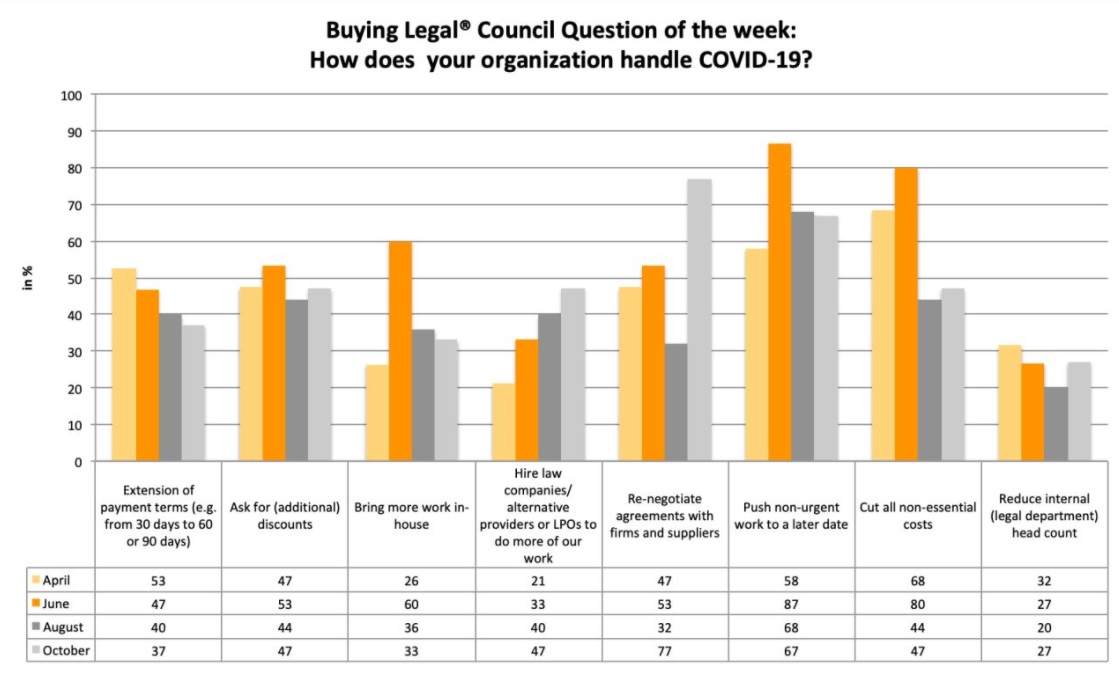
Tracking the responses to this question over a six month period (see graph above) has been interesting.
Extending payment terms; which I thought would have ballooned, has actually contracted.
Ask for (additional) discounts; which I would have thought would be leading the pack, has actually held relatively steady.
Bring more work in-house (outside of a blip in June) has held relatively steady. But more on this one in a second.
Hire alternative legal providers has actually ballooned, and may go some way to explaining why may believe the alternative legal services providers have been the real winners from COVID-19 – there time has come.
Renegotiating terms with law firms – more on this one below.
Pushing non-urgent work to a later date. No surprises with this one, makes perfect sense.
Cut non-essential costs: this one has shrunk relatively significantly since April. Not sure if that tells us there isn’t much ‘fat’ in in-house teams?
Reduce internal head count; is on the increase again and would seem to suggest a conflict with the “bring more work in-house” response above. Alternatively, in-house teams are really busy at the moment, which coupled with the rise in the use of alternative legal providers could well be very true.
Anyhow, the purpose of this post was to remake on the significant rise in clients ‘renegotiating terms with law firms’.
While this BLC reports (from what I could find) doesn’t define how this renegotiation process is happening, my experience has been that since May of 2020 there has been a significant increase in pitch and tender activity. Many clients are looking for significant savings and are looking to lock law firms into those savings for lengthy periods of time.
And I would have to say that I expect this trend to grow, so if you are a private practice lawyer who hasn’t yet locked-in expert pursuit/pitch/pricing expertise, you’re probably in for a rough 2021.
In any event, keep an eye on BLC – seeing where this trend tack us will be interested in the coming months.
As always, the above represent my own thoughts only and would love to hear yours.










 RWS_01's B[D]log