Happy Thanksgiving to all those who celebrate. So much to be thankful for this year with the crew GSJ Consulting – so a big shout out to all those who are helping us out on our journey of a thousand steps!
Yesterday (13/11) was World Kindness Day, and while I think that’s a great idea/concept – with the level of mental health issues that we have in the legal profession, you have to ask yourself:
Why doesn’t every law firm office have one of these benches?
I put a post up last week on LinkedIn, off the back of a very interesting blog by Jordan Furlong on his Substack feed: ‘The legal world in 10 years (if we’re really lucky)‘, that got some social media traction so I thought I would re-share here.
At the heart of my LinkedIn post was a comment Jordan makes on – what he calls – High-Value Retainers and the effect Gen AI will have on these fee arrangements. To quote:
High-Value Retainers Thanks to Gen AI’s consumption of many traditional tasks, lawyers have moved up the value ladder, going beyond “bet-the-company” and “run-the-company” work to start offering “grow-the-company” work (or “advance-the-individual”). These are engagements in which lawyers ask: “How can I improve your situation? What are your near-term and long-term goals? How can I help you anticipate problems and prevent them before they happen? How can I bring you more stability and peace of mind? How can I be your advocate and counsellor in whatever you need?”
While I think Jordan’s point is an excellent one, mine was this: “Do you think this could work in 10 years time?“
Because if you think it could: Why are you waiting 10 years for AI to develop in order to have this conversation – have this conversation with your clients now!
In that, it’s not a 10+ years from now discussion. It’s not a 10+ years from now problem. It’s a HERE AND NOW problem and a here and now discussion.
The number of senior business development people, including Director level roles, I have spoken to over the years who “fell” into working in business development roles for professional services firms is remarkable! Yes, in most cases they had a relevant applicable skill-set that could be transferred and used in the new role: whether that be as an ex-lawyer, marketing graduate or communications professional; but, by and large, I think it’s fair to say that almost none of us saw a career advisor at school and asked what undergraduate and post graduate degrees we need in order to have a career in business development for a professional services firm*.
So I was really glad to read today, via the Legal Cheek blog, that Slaughter and May are to launch a business services grad scheme.
Although Slaughters are one of the few Magic Circle firms I never worked at or for, I have really admired them from the sidelines. Their focus on their core strategy is commendable. All of which, in my opinion, is reflected in their newly announce two year ‘Business Services Academy‘ program.
In a similar vein to grad rotations, Legal Cheek is reporting that the Academy program will consist of four rotations of six months each among:
people and operations
technology legal ops and project management; and
clients and business development.
Now, the very clever people you are, you’re think 4 into 3 doesn’t go – and you would be right. But, apparently the forth rotation is with the team you have enjoyed the most on your previous rotations and want to consider a career with, and I kind of like that!
So once again, the team at Slaughter and May are blazing a path, but please do we really need to say this:
It’s worth noting that this scheme does not lead to qualification as a solicitor.
Anyhow, if you are not fortunate enough to work at Slaughters – or, as Legal Cheek points out Addleshaw Goddard or DWF (who have similar programs), and really need to learn a thing or two about how business development in law firms actually works in practice, reach out to me!
* I would also add that a lot of that same thinking applies to lawyers trying to do business development, in that they have had no formal training in this skill!
Tesla, Elon Musk’s EV carmaker, published its Q3 results earlier today (Australia time). Profits plunged 44 per cent. But, from my perspective this was the interesting part: “after it cuts prices to boost sales“.
Let’s unpack that for a second: Tesla “slashed prices by around 25 per cent in the United States during the last year” – “putting the priority on sales rather than profit“.
As it happens, this is also a common trait of professional services firms: prioritizing getting the deal done over making an actual profit – including agreeing to heavy “volume discounts”.
As the Tesla results show though, any price discount you give comes directly from profit – not sales revenue.
So the price discount you offer your clients is essentially compounded on your bottom line – 10% is not 10%, it’s more like 30%.
Or in the case of Tesla: a 25% price discount has resulted in a 44% plunge in profit.
Something to think about when you are next thinking about what pricing options you have available to you.
And please, don’t follow this advice:
“I view it as a way to defend market share at the expense of margin” .
Kevin Roberts, director of industry insights and analytics at CarGurus, an online auto sales site
In professional services firms, market share should never Trump (pun intended) profit.
As usual, if you need any help with any of this, feel free to reach out.
Law firms that conduct formal client feedback programs can earn nearly twice the share of a client’s external legal spend than a firm not engaging in feedback;
in 2023, only 27% of clients were asked to participate in a client feedback program by their outside law firms.
Let’s get a realty check on that: Law firms that have a client experience (CX) feedback program can earn nearly twice the share of a client’s wallet, but less than one in three clients have been asked to participate in a client feedback program.
In business development we often talk about “low hanging fruit” and this seems like a ‘no brainer’ to me!
Get in touch if this is something that interests you. And, frankly, why should it not!
If you don’t have time to read Andrew Malocussions article, and I suggest you do because it’s actually very interesting, the long and short of it is that the reason why big (read global) law firms are losing millions in revenue (opportunity) is because…
… their pricing teams are too small.
All I have to say is, “seriously”!
Do yourself a favour, go back in time 5 years and work out for yourself whether or not the fact that law firm pricing teams are too small is the real reason they may or may not be losing millions of dollars in revenue.
For my part, this type of thinking doesn’t pass the pub test!
Feel free to reach out to me if you want to talk through any pricing strategy related issues/questions.
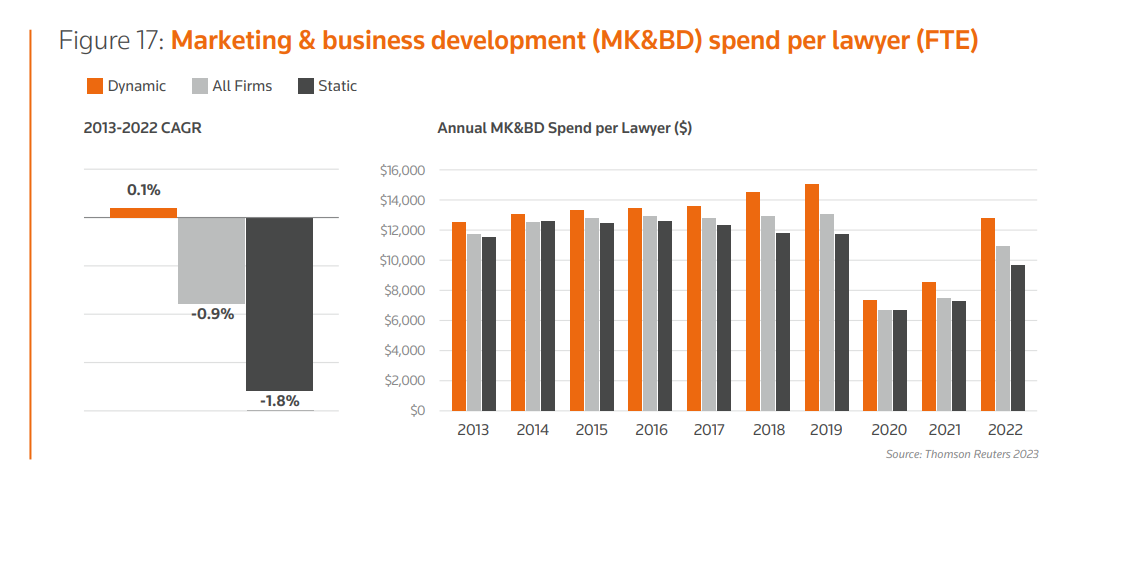
The numbers have been crunched and the results are in: ‘Dynamic Law Firms’ invest considerably more in their business development and marketing activities/departments than static firms are willing to do.
According to the latest (8th) iteration of Thomson Reuters Institute’s 2023 Dynamic Law Firms Report, Dynamic Law Firms consistently invest greater sums in their business development and marketing teams than Static Law Firms:
As you can see from the over graph, in 2022, on average, this investment by Dynamic Law Firms in their business development and marketing teams accounted to over $12,000 per lawyer. Roughly $2,500 more per lawyer than Static Law Firms.
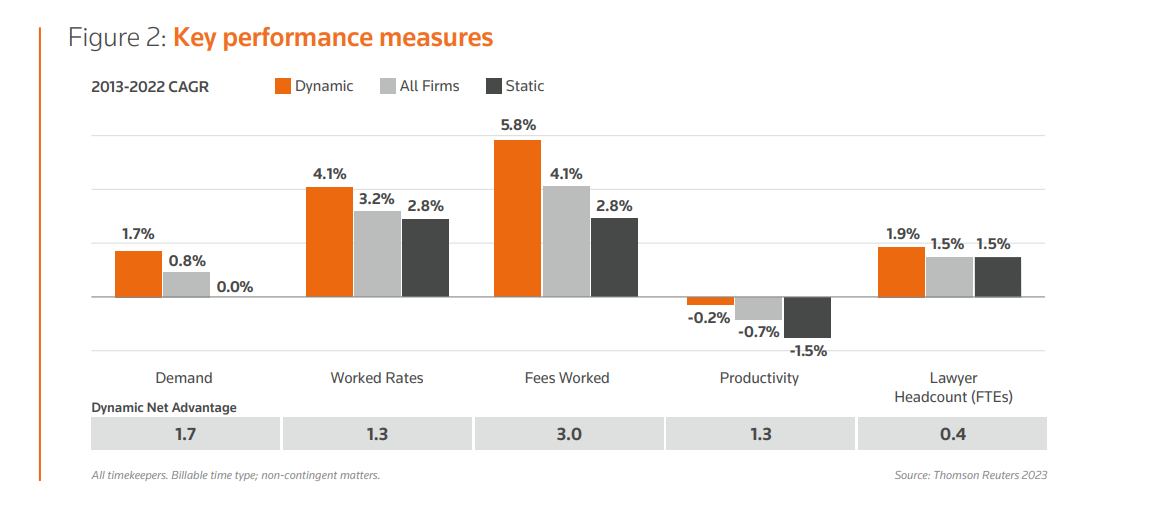
Importantly, this investment in business development pays off:
With Dynamic Law Firms consistently outpacing Static Firms in all growth Key Performance Measures; but, most notably from a business development perspective, in both ‘worked rates’ and ‘fees worked’.
So why is this? After all, business development and marketing is a ‘cost-center’.
Well, as the Report itself states:
“The first goal of MK&BD investment is to raise top-of-mind awareness of the law firm.
Research conducted over the course of many years by the Thomson Reuters Institute has shown that top-of-mind awareness is a vital first step toward winning work – a process that will see a firm move along a continuum from awareness to being viewed favourably, to being considered for and ultimately winning work, and hopefully, to a point where the firm has gained enough experience with the client that they garner credibility in the board room and can begin to box out competitors.”
A fact backed-up by the authors of Simple Heuristics who, in their principle of “recognition” [firm brand or lawyer], state that recognition is number one in any client’s decision process around whether or not to buy something.
And so it goes without saying that this ‘awareness‘ factor is critical in the ‘buying cycle’. If we don’t have this advantage, then we need to hope to hell the other providers aren’t a known commodity so we can proceed to the next level in the buyer’s decision process (typically experience – have they done this before?; then can I trust them not to mess this up and make me look stupid! – SIDE NOTE: price isn’t in the top 3 decision making selection criteria.).
Which is why, if you want to make sure your firm stays one step ahead of its competition, you actually need to be investing more, not less, in your business development team right now.
Yep, the evidence is in. It’s undisputed. Business Development and Marketing is not a ‘cost center’ (not that I ever thought it was). They not only pay for themselves, but they ensure your firms stays ahead of its competitors and earns more $$$s.
So the next time you think to yourself: “I need to cut costs, I’ll cut my business development and marketing budget” – I’m here to tell you that’s dumb – think again, because not only will it hurt you but it will take you on a journey to blandness.
As always, feel free to reach out to me for a chat if you want to talk through how I can help with this.










 RWS_01's B[D]log