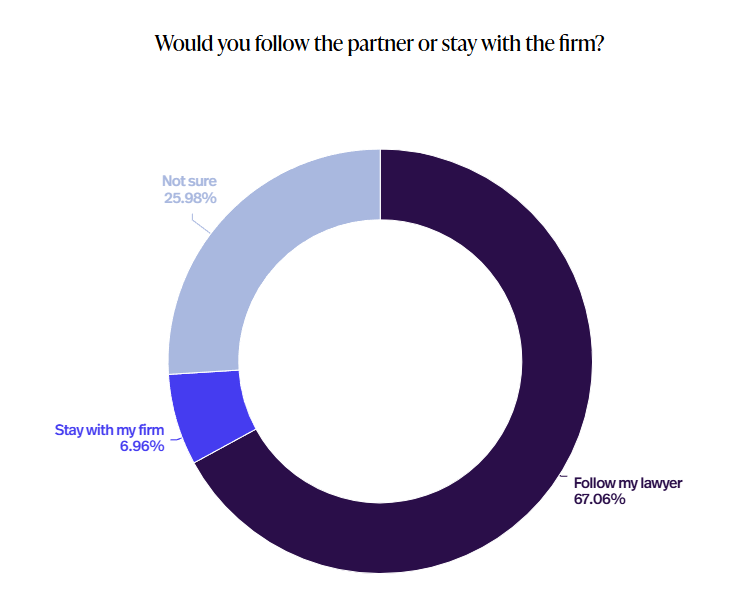
Source: Will Lewallen, Clients ten times more likely to follow their partner after a move, new data shows, Legal Business, 16 November 2026
For years, law firm management teams have talked about the importance of institutionalising client relationships. Significant sums have been invested in key client programmes, client relationship management systems, cross-selling initiatives and client listening programmes.
But how effective have these investments been if, when a partner leaves, the client follows?
New research from Legal 500, reported by Will Lewallen in Legal Business on 16 November 2026, should make uncomfortable reading for managing partners. Drawing on feedback from 10,000 US general counsel and other client referees, the research found that:
- 67% would follow their lead partner to another law firm.
- Only 7% would remain with their existing law firm.
Put another way, respondents were approximately ten times more likely to follow their partner than express a preference for staying with their firm.
While the research measures stated intentions rather than actual client departures, the implications for law firm management are significant.
Have law firms created their own problem?
The interesting question is whether law firms, through their remuneration models and approach to partner performance, have inadvertently created the very commercial risk they are now trying to manage. As firms place greater emphasis on individual revenue generation, origination credits and personal books of business, they create powerful financial incentives for partners to retain control of client relationships.
Why would a partner actively encourage another partner to develop an independent relationship with one of their largest clients if doing so could dilute their origination credit, weaken their position within the partnership or reduce their negotiating power when remuneration is determined?
Firms cannot reasonably expect partners to behave collaboratively if their remuneration systems reward individual ownership of client relationships. There is a fundamental contradiction in wanting to build institutional client relationships, while rewarding partners for maintaining personal ones.
The importance of associates in client retention
Arguably, the most interesting finding from the Legal 500 research is not the number of clients who would follow their partner. It is what might persuade them to stay. Of the service attributes examined, associate quality was the only one associated with a greater likelihood of clients remaining with their existing firm.
This should prompt managing partners to reconsider how they view their senior associates.
Too often, associates are regarded primarily as fee earners whose performance is measured by billable hours, utilisation and profitability. Yet these same individuals may represent some of the firm’s most important client retention assets. They regularly interact with clients, understand the history of their matters, know their internal processes and are often the people clients turn to when they need something done quickly.
In other words, associates may provide the continuity that clients value when a senior partner departs.
This also raises an important question about whether firms are investing sufficiently in the business development and client relationship management capabilities of their associates, rather than waiting until they become partners.
For more on this read my article on Legal Practice Intelligence: ‘A Senior Associate Squeeze in a K-shaped Legal Market‘.
The risks of the increasingly portable law firm
An increasingly competitive lateral recruitment market compounds the problem. Firms are not simply competing for talented lawyers; they are competing for revenue streams, client relationships and, increasingly, entire teams capable of generating that revenue (see: ‘Squeezed From All Sides: Can Mid-Market Firms Cope?‘).
For the acquiring firm, a partner with a substantial portable book of business represents an attractive growth opportunity. For the departing firm, that same partner represents a significant concentration risk.
There is also an irony here. A law firm that recruits a lateral partner largely because of their ability to take clients from another firm should recognise that the same partner may subsequently be capable of taking those clients elsewhere.
Unless the acquiring firm successfully integrates those relationships into its wider business, it has not necessarily acquired a sustainable revenue stream. It may simply have rented one for the duration of the partner’s tenure.
Client concentration is not just about clients
When law firms assess their client concentration risk, they typically look at the percentage of revenue generated by their largest clients. However, a firm with a diversified client base can still have significant revenue concentration risk if a disproportionate number of those relationships are controlled by a small number of partners.
Consider a partner responsible for 15% of a firm’s revenue across 20 different clients. On a traditional client concentration analysis, the firm may appear reasonably diversified. From a partner dependency perspective, however, the picture could be very different.
Managing partners should be asking not only how dependent the firm is on individual clients, but also how dependent it is on the individuals who manage those relationships.
What should managing partners be doing?
As part of their 2027 strategic planning, law firm management teams should consider five questions:
- Revenue at risk: How much revenue could be lost if any one of our leading partners departed tomorrow?
- Relationship depth: How many of our major clients have meaningful relationships with multiple partners and senior associates?
- Partner remuneration: Does our remuneration model encourage partners to share client relationships or protect them?
- Associate development: Are we actively developing associates as trusted client advisers and future relationship leaders?
- Succession planning: Do we have credible client relationship succession plans that operate well before a partner announces their departure or retirement?
These questions should form part of an ongoing assessment of the firm’s commercial resilience, rather than an exercise undertaken in response to an unexpected resignation.
Building client loyalty beyond the individual
None of this means that firms should discourage strong personal relationships between partners and clients. Those relationships are fundamental to the delivery of professional services.
Nor should institutionalising a client relationship mean indiscriminately introducing more partners to a client in the hope of generating additional fees.
The objective should be to create a relationship in which the client genuinely benefits from the collective capabilities, knowledge and experience of the firm, rather than deriving almost all their value from their relationship with one individual.
Ultimately, it is the client’s decision which law firm they instruct. Neither the partner nor the firm owns the client.
But if a law firm’s clients see little compelling reason to remain when their relationship partner leaves, perhaps the firm needs to reconsider what value it provides independently of that partner.
The real test of a law firm’s client relationship management strategy is not how many clients it can win when a partner joins, but how many it can retain when a partner leaves.
Get in touch if you want to discuss this further.
Further reading: Will Lewallen, Clients ten times more likely to follow their partner after a move, new data shows, Legal Business, 16 November 2026.

