law firms

The Client Cost Conundrum: Legal Service Pricing in a Post-Recession Market – A White Paper by the ALA

Business Development image

A post yesterday by Patrick Johansen, CLM, CPP, National Practice Manager at Seyfarth Shaw (on his ‘Patrick on Pricing‘ blog) alerted me to a newly published White Paper by the Association of Legal Administrators (ALA) titled “The Client Cost Conundrum: Legal Service Pricing in a Post-Recession Market“.

To start with, if you are going to publish a White Paper titled “The Client Cost Conundrum: Legal Service Pricing in a Post-Recession Market“, then, in my book, you have licence to write an absolute cracker.

Add to that your intent that:

“This white paper will identify economic factors that influenced relationship changes between clients and law firms after the Great Recession; pinpoint current legal service pricing best practices; highlight pricing strategies that can attract and retain clients; and help law firms learn to address efficiency and other factors that may affect many pricing scenarios.”

and throw in quotes from some of the industry’s leading pricing consultants – including Patrick himself, Colin Jasper of Jasper Consulting, Toby Brown of Akin Gump and Timothy Corcoran of Corcoran Consulting Group, and you’ve grabbed my attention.

So what did I find?

A very disappointing read, that had me both wondering what decade I had woken up in and really questioning whether the industry could survive for much longer.

What do I mean by this?

Well, judge for yourself: here are just some of the quotes from this paper:-

  • “Sixty-eight percent of law departments say they received discounts from firms in 2015. The number of law departments that received a discount of more than 10 percent has increased 4 percent in the past two years; the amount of firms receiving a 6 to 10 percent discount grew by nearly 9 percent”

–  Discounts are not a pricing strategy, period.

  • “In an effort to strengthen client relationships, some law firms are working to better understand their clients’ needs. Approximately 29 percent of firms say they’re working to identify each client’s unique pricing preferences to support the firm’s overall pricing strategy.”

–  29% of firms are working to identify each client’s unique pricing preference. Seriously, what are the other 71% doing: throwing darts in a dart board and hoping for the best?

  • “To better comprehend what clients want, 85 percent are initiating direct conversations about pricing and budgets.”

–  “initiating direct conversation”: as opposed to what exactly, being told?

  • “Twenty-two percent of firm leaders say they thoroughly understand their top 20 clients’ business models, earnings and growth strategy”

–  I have no idea what the other 78% are thinking of, but I’m suddenly very glad I cannot invest [financially] in a law firm.

  • “29 percent of firms say their knowledge of their clients’ business and client relationships give them a key competitive advantage”

–  what is the key competitive advantage for the other 71% I wonder?

  • “Sixty-one percent of firms say overcapacity is diluting their firm’s profitability.”

–  that’s too laughable to even be laughable. I mean seriously, are the other 39% saying it’s the Friday Night Drinks that’s the issue…?

And on that note, I shall end this post with this: read the White Paper, it is really well researched and a look at the Index itself is worth the download; just don’t expect to be blown away with how progressive the industry has become towards pricing.

RWS_01


Do you know your ABR?

Business Development image

There has been a fair amount written in recent days following an article published in the Wall Street Journal that ‘Legal Fees Cross New Mark: $1,500 an Hour‘. Most of the published articles I’ve read talk to the outrage of commanding such a high hourly charge-out rate, but this article by Stephen Harper caught my attention.

In the article, citing data from ‘The 2016 Report on the State of the Legal Market‘ by Georgetown University Law Center and Thomson Reuters Peer Monitor, Harper states that:-

“In 2005, collections totaled 93 percent of standard rates, the report found. By the end of 2015, the realization rate was down to 83 percent.”

Although US-based, this sad statistic very much reflects on an issue I touched on in my post on fixed fees in the Australian market yesterday; namely that 25% of Australian law firm revenue is now derived from “discounted” hourly rates.

If we say then that roughly 1/4 of a law firm’s revenue comes from discounted hourly rates, and that the firm is being paid approximately 83c in the $1, [compounded] we have a very serious profitability problem.

On these numbers alone, any law firm looking at its profit margin should be rushing into fixed fees – while admittedly upskilling themselves (including tracking data) on how to do this better.

And part of this process should also include an understanding of, as well as tracking, what each individual lawyer’s Average Billing Rate (ABR) is.

In the many hundreds of tenders I have done and the numerous conversations I have had with lawyers over the years, I have never once come across either a request for what the particular lawyer’s ABR is, nor heard the lawyer freely admit this rate. I have, on the other hand, heard daily the hourly rates that particular lawyers charge as if this were the reason why they were hired (there being an assumption that the higher your charge-out rate, the better value you provide!).

And therein lies the problem, as Harper says:-

“How much a firm bills doesn’t matter; what it actually brings in the door does.”

Too right. So the next time you hear a lawyer talk up their hourly rate, you might want to ask them what their ABR is – because that’s going to be a far better indicator of the value their clients see them providing. And if you get an answer, you might then want to talk to them about the benefits of fixed fee pricing.

When will a law firm have its Enron moment?

Business Development image

I’ve just read an interesting article about how disruptive Dyson has been. More specifically, the subject of the article was whether #NewLaw (as it is being called) will be as disruptive on the legal industry as Dyson was to vacuums?

But my outtake on reading the article was this: law isn’t ready for positive disruption (innovation), as we’re yet to have a really shockingly bad, client related, negative shock-wave (failure in client service).

What am I talking about?

Simply this, to my knowledge law has yet to have its Enron/Worldcom moment in the same way Arthur Andersen did for the accountants (anyone remember ‘Big 5’?).

More specifically, in our haste to be the “extension of your in-house legal team“, or “your trusted adviser“, or any one of about a million other fad terms out there today, I believe we may be forgetting one of the biggest (if I remember rightly it made #3 on the list) recommendations in the US Securities and Exchange Commission’s “Report of Investigation” into the collapse of Worldcom to [in the future] “… cure the principal failing that gave rise to the fraud: a lack of effective checks and balances on the power of senior management …“:

A corporate culture in which the advice of lawyers is sought and respected; and

So while, as a business developer, I whole support and encourage “getting to know your client better”, in doing so I would ask that you keep at the back of your mind this question:

Are we trying to “pillow talk” our clients?

Because almost two decades after the collapse of Worldcom, my takeout is that we need to have an Enron/Worldcom moment before we have a Dyson moment in order for the profession to move forward.

rws_01

Report: ‘HSF bets growth on Asia’

dreamstime_m_34802664

The Australian‘s weekly Legal Affairs section is reporting (subscription required) today that global law firm “Herbert Smith Freehills will seek to more closely integrate its Australia and Asia practices.

Sorry to be blunt, but what!?!

According to the Lawyers Weekly website, HSF officially merged on 1 October 2012 to open as the “largest fully integrated law firm in Asia Pacific based on number of lawyers“.

That was 3 years ago.

This begs the question: are all of the recent global law firm entrants to Australia going through the same issues?

My guess here is “yes”. Even though nearly all of them (arguable K&L Gates used US-Australia as its strategic reason for opening in Australia) made specific mention of using Australia as a springboard into Asia, pretty much none of them – to my knowledge – has a specific liaison Business Development Manger person (or higher) located in Australia who assists with joint business development activities.

As I understand it, there may be cost related issues involved in this (who pays for the resourcing – Australia or Asia). There may also be personnel issues involved.

Who knows; but the short answer is that for the life me I cannot understand how 3 years or more (in some cases) on from when the global firms arrived in Australia they still don’t seem to:

  • have dedicated Asia-wide practice and support teams
  • be able to tell you the number of referrals across jurisdictions (inbound and outbound)
  • be able to tell you which partners are referring work [championing] across jurisdictions
  • be able to tell you how many referrals are going to other firms within the jurisdiction where they have an office – particularly where there may have been a relationship prior to the merger (in Australia’s case, would you like to take a punt that Gilbert & Tobin gets referrals from international firms with an on the ground presence in Australia?)
  • know which of their clients are referring work to them across multiple jurisdictions.

To me, this says that both the back-end and front-end operations of the merged firm are still working in geographic and practice group silos (which they most certainly would appear to be from today’s article).

Don’t get me wrong, it’s great that HSFs is seeking to more closely integrate its Australia and Asia practices. I hope other firms follow suit. I’m just frustrated that this initiative is probably about 2 and half years late!

Forget the Gadens merger, the big news today is Olswang’s announced ‘Revenue Share Scheme’

dreamstime_m_34802664

Pretty much all anyone involved in the Australian legal sector will read about in the industry news today will be the reported three way tie-up between Global behemoth Dentons, Australian law firm Gadens and Singaporean firm Rodyk & Davidson, which is still subject to a partner vote but you assume is pretty much a done deal.

Although this may have a profound effect on the Australian legal market in years to come, in much the same way as the K&L Gates / Middeltons merger has hardly set the sector alight, I somehow doubt this merger will too.

There is, however, another piece of news being reported this morning that could very well have a massive effect on the local market – and that is the news that Olswang has established a ‘Revenue Share Scheme’ that it hopes will incentivise staff (it is being reported the scheme is open to all employees at the firm, from partners through to business services staff) to refer clients to the firm through a referral bonuses scheme that will pay an employee who introduces a new client who subsequently spends more than £20,000 in the first year instructing the firm, 10 per cent of the instruction fees in the next year.

I worked under a scheme very similar to this is Asia just after the Asian Financial Crisis and I can vouch that provided you get your conflicts worked out (because trust me, this leads to a lot more potential conflict situations), then this type of scheme can be very incentivising.

While I doubt this type of scheme will be introduced widely here in Australia too soon – after all, why do we get paid salaries, I can see this becoming more prevalent and certainly having a more profound effect on market practice globally.

It’ll be left to the test of time however to see whether – in five years time – everyone is discussing their 10 per cent bonus or the Gadens-Dentons tie-up!

‘Drive for show, Putt for dough’

Business Development image

According to a post earlier this week on the LexisNexis Business of Law Blog:

“A new legal spending trends report finds big law billing rates grew notably – pushing a 6% increase in the gap between the top two tiers of law firms, by attorney headcount, from 38% to 44%.”

Indeed:

“Median partner rates at the “Largest 50” law firms – those with more than 750 lawyers – rose to $711 per hour, based on 12 months of data ending June 30, 2015. That number is up from the last report where median partner rates came in at $675 per hour for the 12 months ending December 31, 2014.”

As I have posted before, however, this [rising headline hourly rates] is absolutely meaningless if your realization rates are in decline – an issue this particular report appears to remain silent on.

I have never understood, beyond ego, why a partner would be more interested in their hourly rate than their average realized billable rate (ARBR). After all, the ARBR amount is the amount that clients are willing to pay you – money in the bank – and is a more accurate reflection of your true worth/value.

Eventually you have to ask yourself which you would prefer: a headline charge-out rate of $1,000- with an ARBR of $700-, or a charge-out rate of $800- with an ARBR of $800-?

And that’s without going into how much easier it is to have the conversation with your clients around rising your realization rather than informing them on 1 July each year that you will be raising your rates by 10% again this year!

Alternatively, you can keep on driving for show and not worry too much about the dough you’re making.

BTI’s The Mad Clientist: New Business for the Taking: Corporate Counsel Shift Work Back to Law Firms

dreamstime_m_34802664

In private practice and looking for a good news story to read this weekend? Then BTI Consulting Group’s The Mad Clientist may well just have it.

According to his latest blog post,

“After 4 years of feverishly bringing work in-house [following the GFC] corporate counsel are reversing course.”

Is that cries of joy I hear ring out?!? If so, the news only gets better. Because not only are in-house counsel shifting work back to law firms, but the type of work they are sending out is the sweet spot big ticket matters. Indeed, according to BTI’s study of 322 corporate counsel, “Chief Legal Officers expect a tripling of bet-the-company litigation, increases in class actions, and substantially more securities litigation.

But before you go clambering over your other partners to get on the phone to your in-house counsel contacts, keep in mind that (1) the study was done in the USA, and (2) BTI is of the opinion that:

“The big winners will present themselves to clients as strategists and discuss risks and exposures before the matters ever start. The bigger winners will discuss prevention, potential settlement postures and learn about the business risks posed by the new matters.”

Putting that aside for a second though, we can but hope that the tide is turning here and that the pendulum has once again swung back in favour of private practice. But in order to be best placed to take advantage of this development, you need to be working through your client plans (including engagement and communication actions) now so that you can be ready to take full advantage of whatever 2016 throws at you!

Until then, “have a great weekend!”

A ‘Failure To Deselect’?

A Failure To Deselect

Read a fantastic rant by Barrie Seppings – Director of Creative Strategy at wordsearch, the world’s leading marketing network for architecture, property and real estate – on the Firebrand Ideas Ignition Blog yesterday titled “Copywriters: What the %$@#* are you saying?“.

Barrie’s post get my approval merely for quoting Don Watson, Paul Keating’s former speechwriter, brilliant book Death Sentence – and if you have ever written a tender and not read Don’s book, please do!

Anyhow in his post Barrie makes mention to something I had not heard of before and which he terms a ‘Failure to deselect‘, being:

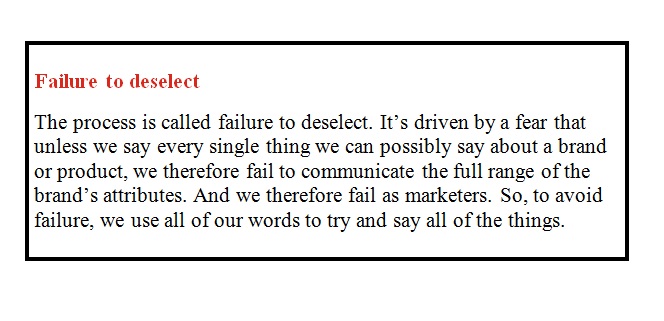
“… a fear that unless we say every single thing we can possibly say about a brand or product, we therefore fail to communicate the full range of the brand’s attributes. And we therefore fail as marketers. So, to avoid failure, we use all of our words to try and say all of the things.”

Now, swap out ‘brand or product‘ and ‘marketer‘ and replace it with ‘law or regulation‘ and ‘lawyer‘ and does this sound familiar to you?

It certainly did to me. And in this time of ‘doing more for less‘ in law, it got me to thinking: are we actually suffering from a ‘failure to deselect’?

Which would you prefer: to be well known, or well paid?

Untitled

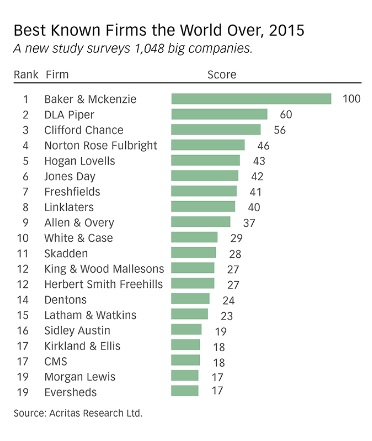
This week saw the publication of Acritas’ report of the ‘Best Known Firms the World Over, 2015‘.

For regular readers of this blog, my views of reports of this kind should be pretty well known by now (hint: I don’t hold them in much stock).

However, this year’s Acritas report goes a step further:- not for who is in the report, but for who isn’t.

And who might they be?

Well, in Slaughter & May and Quinn Emmanuel, only two of the most profitable law firms in the world.

Which rather goes to show that either:

  • (a) “detailed telephone interviews of 1,059 heads of legal departments, their deputies or chief operating officers at 1,048 companies at randomly selected companies with gross revenues of at least $1 billion” means that neither of these firms is that well known, and/or
  • (b) there’s very little correlation between being well known and being well paid.

Given the choice though of coming top of a league of well known law firms or top of a table of most profitable law firms (profits per equity partner), I know which I’d choose.

Currency woes strike again!

dreamstime_m_34802664

It’s that time of the year again when law firms in the UK (at least those with LLP status) publish their annual accounts and, once again, it would appear that currency exchange fluctuations have played a significant part in the profit and loss (P&L) sheets of most with international operations (‘Currency woes hit growth‘ – subscription required).

As I pointed out back in March 2013, and then again in August 2014, the Australian operations of international law firms were not going to be sitting pretty when it came to reporting full year earnings in GBP or US$. At the time the experts were predicting mid 80 cents on the US$, and things can only be said to have taken a turn for the worse since then.

Failing a dramatic turnaround in commodity prices, it doesn’t take a genius to work out this will remain the same unless – or until – the Australian arm of international firms can muscle in on the [hopefully much more attractive US$] rates their offshore partners set up for them on advisory or transactional matters (see my post ‘Can a falling A$ make selling Australian legal services easier overseas?‘).

Alternatively, if you are an international firm with operations in Australia you could do what I have seen a number of firms doing during this reporting season and talk up you Australian earnings in “local currency contributions“. Because all things being equal, these firms have worked hard over the past 12 – 18 months to get their strategy on track and have most likely seen real growth in local currency contribution terms.