
Law firm

5 Reasons why your business development team should be working on your business strategy and not just putting out fires!

A recent article in the Global Legal Post by Ben Edwards: ‘Law firm marketing and business development teams spend more time firefighting than on strategy‘ threw up some very interesting – if not predictable – stats:

  • Two thirds (65%) of marketing and business development teams [in law firms] are spending more time firefighting then developing strategy
  • 80% of that 65% spend at least 2/3rds of their working year extinguishing fires, over providing strategic thinking
  • Just over half (57%) have a seat at the head table [when it comes to strategy input]
  • 69% of respondents said they spent most of their time on addressing short-term issues rather than focusing on long-term initiatives.

And the number #1 reason given for why law firm marketing and business development teams were running from one fire to another – a lack of investment in resources.

All of which leads me to ask this question:

Do law firm partners value the service they get from their business development and marketing teams?

Another way of putting that question is this:

Do law firm partners understand the strategic value that their business development and marketing teams can provide?

Because the evidence would suggest that they don’t.

By putting – let’s be frank – high paid personnel on firefighting tasks, your firm will not be getting good value for money.

So here are my 5 reasons why your business development team should be working with you on your firm’s strategy and not just putting fires out:

1. Industry focused

    Most business development professionals are laser-focused on industry expertise. They understand a particular industry sector – such as energy, resources, financial services, FMCG, property – and by and large stay in their lanes. As such, many have a deeper understanding of what is happening in that industry sector than the partners they work with.

    2. Market knowledge

    Really good business developers are on top of market trends and competitor intelligence. They should be able to tell you what your competitors are up to, how your competitors are ranked in the market, which clients your competitors are acting for and the relevant lateral movement in your sector.

    3. Relationship Building

    A critical skill of good business development professionals is building relationships. They should be able to not only tell you who the General Counsel at client and target clients are, but also who the lead procurement team will be on a pursuit or tender opportunity.

    4. Data analysts

    A good business developer should be able to look at a set of data and provide you insights. For example: should you be worried if the number of instructions you are receiving is on the decrease, but the value per file is significantly increasing?

    5. Results driven

    Every good business development professional will tell you they are only as good as their last result! By nature, they are very results driven and don’t rest on their laurels.

    So there you go, my 5 reasons why you need your business development team working with you on your next strategy day rather than just putting out fires!

    Also, get in touch if you need help with any of the above.
    rws_01

    Survey: The cost of replacing that departing associate…

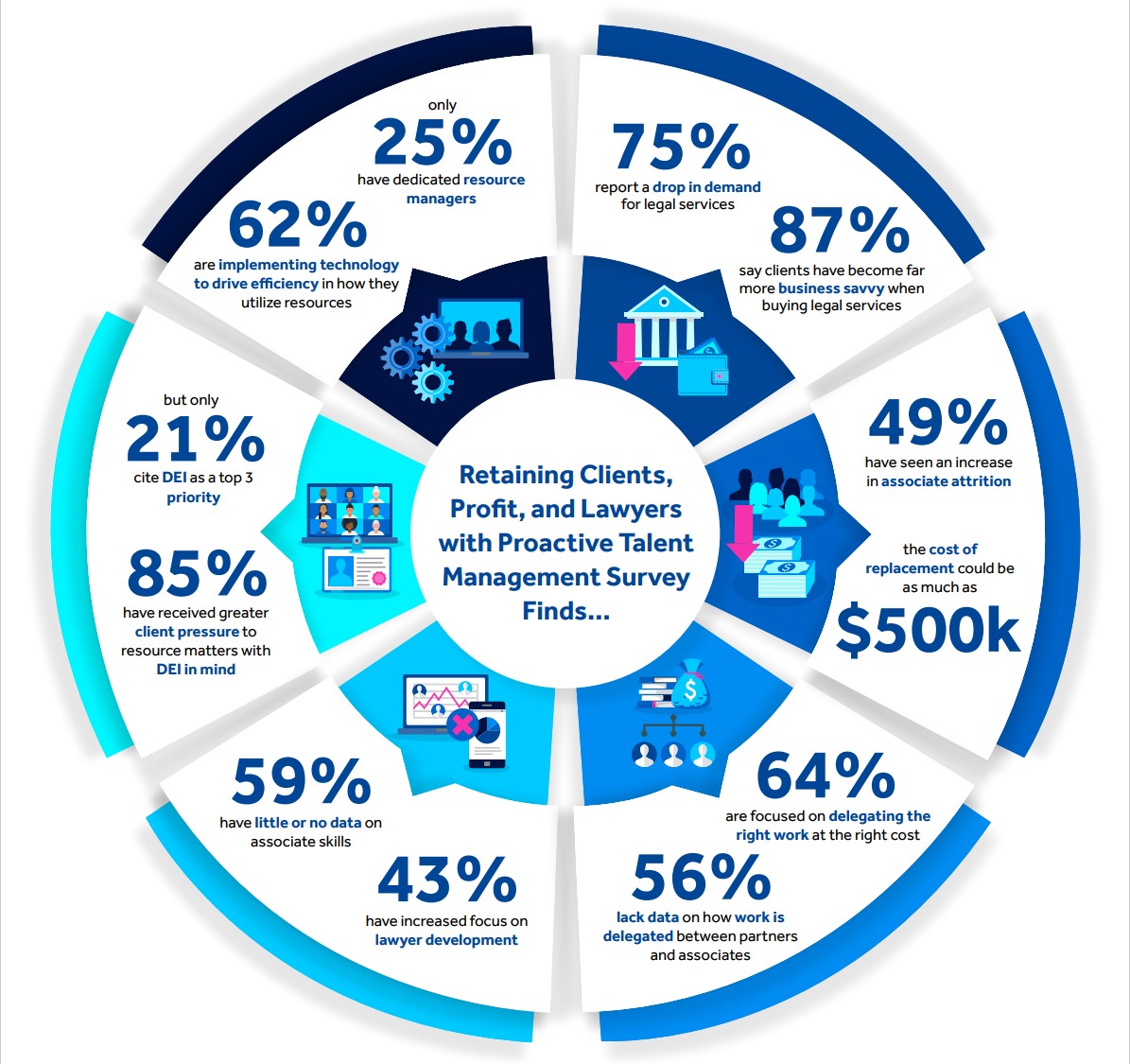
    If you’ve wondered how much replacing that associate or senior associate who just left you is going to cost, then a recent report from Big Hand provides the answer: circa $500k.

    That’s right, a cool half a million dollars!

    Those costs won’t always be upfront and apparent, they will include:

    • a possible increase in salary for your replacement associate over your previous associate’s salary (due to market pressure) – which is somewhat ironic as salary may well be the reason the old associate left you!
    • commissions to talent agents to find you said new associate
    • increasingly – signing on bonuses
    • training costs over the first 12 – 18 months to bring the new associate up to scratch on your firm’s systems and business development strategy.

    The list of actual and hidden costs here is almost limitless, and so the overall cost to your firm of replacing that departing associate/senior associate could actually be a lot more than $500k. Which begs the question:

    with 49% of surveyed firms having said they had experienced an increase in associate attrition, you have to wonder why this isn’t an area where more firms are focusing their attention?

    You also have to ask: Does asking someone to work 2,000 billable hours a year have something to do with these attrition rates among associates?

    And with 75% of surveyed firms having said they have seen a drop in demand for legal services, is this a cost you really want to be incurring right now?

    If you need help looking at your firm’s strategy, how to retain associates and differentiating your practice from the crowd, get in touch!

    rws_01

    5 Questions to ask before responding to an RFP/RFT

    Our sister company – Bid Wizard – has published a blog on ‘5 Questions to ask before responding to an RFT/RFP‘ that some of you may enjoy reading.

    Their advice on ‘Do we have a team/depth of experience?’ is worth the ticket price alone!

    Feel free to reach out to me if this is a topic close to your heart!

    rws_01

    Where do AFAs rank in the cost savings pyramid?

    If you have been wondering where Alternative Fee Arrangements (AFAs) sit on the ladder of cost-saving for in-house counsel, wonder no more. This post [By-the-Hour Billing Torments Legal Departments. So Why Aren’t More Demanding Alternatives?] by Hugo Guzman on law.com yesterday (14/11/2023) will answer all your queries:

    • 66% of respondents said they plan to bring more work in-house as a cost-control strategy
    • 39% plan to shift work from big law firms to smaller ones,
    • 33% plan to leverage the use of technology and AI.

    And, drum-roll

    • Expanding AFAs ranked fourth, at 28%.

    Not sure how everyone else interprets that data, but it looks like a very sad state of affairs to me.

    Feel free to reach out to me if you want to discuss what this might mean to your business or law firm.

    rws_01

    Who is sitting with you on your ‘Buddy Bench’?

    Yesterday (13/11) was World Kindness Day, and while I think that’s a great idea/concept – with the level of mental health issues that we have in the legal profession, you have to ask yourself:

    Why doesn’t every law firm office have one of these benches?

    rws_01

    High-Value Retainers

    I put a post up last week on LinkedIn, off the back of a very interesting blog by Jordan Furlong on his Substack feed: ‘The legal world in 10 years (if we’re really lucky)‘, that got some social media traction so I thought I would re-share here.

    At the heart of my LinkedIn post was a comment Jordan makes on – what he calls – High-Value Retainers and the effect Gen AI will have on these fee arrangements. To quote:

    High-Value Retainers
    Thanks to Gen AI’s consumption of many traditional tasks, lawyers have moved up the value ladder, going beyond “bet-the-company” and “run-the-company” work to start offering “grow-the-company” work (or “advance-the-individual”). These are engagements in which lawyers ask: “How can I improve your situation? What are your near-term and long-term goals? How can I help you anticipate problems and prevent them before they happen? How can I bring you more stability and peace of mind? How can I be your advocate and counsellor in whatever you need?”

    While I think Jordan’s point is an excellent one, mine was this: “Do you think this could work in 10 years time?

    Because if you think it could: Why are you waiting 10 years for AI to develop in order to have this conversation – have this conversation with your clients now!

    In that, it’s not a 10+ years from now discussion. It’s not a 10+ years from now problem. It’s a HERE AND NOW problem and a here and now discussion.

    rws_01

    A lesson in pricing from Tesla

    Tesla, Elon Musk’s EV carmaker, published its Q3 results earlier today (Australia time). Profits plunged 44 per cent. But, from my perspective this was the interesting part: “after it cuts prices to boost sales“.

    Let’s unpack that for a second: Tesla “slashed prices by around 25 per cent in the United States during the last year” – “putting the priority on sales rather than profit“.

    As it happens, this is also a common trait of professional services firms: prioritizing getting the deal done over making an actual profit – including agreeing to heavy “volume discounts”.

    As the Tesla results show though, any price discount you give comes directly from profit – not sales revenue.

    So the price discount you offer your clients is essentially compounded on your bottom line – 10% is not 10%, it’s more like 30%.

    Or in the case of Tesla: a 25% price discount has resulted in a 44% plunge in profit.

    Something to think about when you are next thinking about what pricing options you have available to you.

    And please, don’t follow this advice:

    “I view it as a way to defend market share at the expense of margin” .

    Kevin Roberts, director of industry insights and analytics at CarGurus, an online auto sales site

    In professional services firms, market share should never Trump (pun intended) profit.

    As usual, if you need any help with any of this, feel free to reach out.

    rws_01

    Where’s the value in client feedback sessions?

    This is a REALLY telling – and valuable – statistic from ‘Building client feedback programs that lawyers love: What CMOs say‘ by Jen Dezso – Director of Client Relations / Thomson Reuters:

    • Law firms that conduct formal client feedback programs can earn nearly twice the share of a client’s external legal spend than a firm not engaging in feedback;
    • in 2023, only 27% of clients were asked to participate in a client feedback program by their outside law firms. 

    Let’s get a realty check on that: Law firms that have a client experience (CX) feedback program can earn nearly twice the share of a client’s wallet, but less than one in three clients have been asked to participate in a client feedback program.

    In business development we often talk about “low hanging fruit” and this seems like a ‘no brainer’ to me!

    Get in touch if this is something that interests you. And, frankly, why should it not!

    rws_01