law firm management

What law firms can learn from Taylor Swift

Business Development image

Unless you have been hiding under a rock, or living in a world of news blackout, you’ll of heard about Taylor Swift’s 21st June open letter (via Tumblr) to Apple (‘To Apple, Love Taylor‘).

As you will also undoubtedly known by now, the Tumblr post is Taylor’s way of explaining why she will be holding back her album – 1989 – from the new streaming service Apple Music (an album I understand she also doesn’t permit to be on another music streaming service, Spotify). And while I don’t particularly like Taylor Swift’s music (nor do I really participate in music streaming services), I have to applaud the reasons she outlines for her decision.

In particular, I like – and 100 per cent agree with – Taylor’s remark that:

“Three months is a long time to go unpaid, and it is unfair to ask anyone to work for nothing.”

Taylor’s right on the money there – so to speak, three months is a very long time to go unpaid.

But wait: what’s your law firm’s average lock-up days?

If you firm’s average lock-up days are anywhere near the industry average, then your firm’s lock-up is going to be somewhere between 100 and 120 days. Which means your firm typically gets paid 100 to 120 days after you have done the work for the client.

Aside from being a period of close to four (4) months to go unpaid for your work, you are also providing your client with an interest free working capital loan during this time – a period you will likely be paying interest to your bank on the working capital (overdraft) facility it has extended to you (otherwise known as a double-whammy)!

Simply put, that should be unacceptable and it is time law firms took a take a leaf out of Taylor’s book and started to tell clients (and some law firm partners I might add!) that four months is a long time to go unpaid!

Not possible? Will likely kill the client relationship?

Well, interestingly, in this case the giant corporate might of Apple has listened to Taylor’s complaint and has decided to back down. And I suspect your clients would be more than willing to listen to alternatives you could offer too – but you won’t know unless you have the conversation.

Wikipedia killed the #BigLaw firm star

Business Development image

Reading my notebook from 2013, to check if an industry statistic has progressed from a fad to a trend, at the weekend I came across a note to myself that reads:

“The Googlification of law: The belief that everything is on Google and is free.”

Although it clearly meant enough to me at the time to write it down (and apologies if this belongs to you as I didn’t write a credit in my notes – which usually means I thought it), as I didn’t end up writing a blog about it I must have been trying to process this idea/thought.

Anyhow, the note and a print by Hugh that was on special – which I ended up purchasing – on the Gapingvoid Art website (‘Information / Knowledge‘) got me to thinking:

‘Open source law’ – as some people are calling it – is one thing, but information and knowledge are not automatically one in the same. As such one ought to tread carefully if one is merely buying information, without the accompanying application to turn this information into knowledge.

Indeed, one could go further and as to say that the era of the “knowledge economy” is about the application of knowledge, rather merely knowing. And this will require professionals – including lawyers – needing to move the conversation forward from a belief that I can find the information for “free” (or at least “cheaper”) elsewhere and to start demonstrating [via the application of knowledge] that the solution they are providing to clients’ problems is indeed a better solution than the “free” or cheaper alternative.

The two crucial elements here are:

  1. demonstrable evidence that your experience, service or product offering is of benefit to the purchaser’s problems – i.e. not just a capability statement saying how wonderful you are, but a story with real evidence showing how what you do can be of real benefit to the target/client, and
  2. demonstrable evidence that you are acting in the best interests of the client and not merely a wishy washy statement to that effect.

It won’t be easy, and it will necessitate a move away from technical brilliance and towards commercial excellence.

In short, the legal advisor of the future will be one who is adept at finding solutions to client problems – even for those that haven’t arisen yet – rather than merely highlighting that a problem exists.

But, crucially, it is no longer the role of the client purchaser to consider this ( – are the days of Caveat emptor over?), but rather it is the role of the law firm seller to demonstrate it.

Only 33.3% of corporate counsel recommend their primary law firm to a peer

Business Development image

Anyone who has been in law firm marketing and business development for more than five minutes will tell you that word of mouth referrals are worth their weight in gold. After all, who needs to do marketing if you have enough advocates championing your business with their networks? And aren’t these potential clients going to listen to their trusted contacts way more than they do you?

Of course they are. Which is why cultivating a referrer network has always ranked high among the “to do” list of business development managers.

That’s why for many of these business development and marketing managers it may come as something of an unwanted shock to learn that according to the latest post by BTI Consulting Group’s The Mad Clientist:

Only 33.3% of corporate counsel recommend their primary law firm to a peer

Which marks the second biggest drop in 15 years and which The Mad Clientist puts down to a change in ‘The Client Expectation Gap‘; namely no matter how great or bad, whatever work you just did for your client will be the yardstick your client treats as your new minimum performance standard.

A little unfair maybe: but if only roughly one in every three of your clients is willing to go into bat for you and recommend you to others in their network with like-minded legal issues, then your law firm has an issue and there’s no time to waste getting to work on the firm’s word of mouth referral program and make sure you ask as many advocates of the firm as you can find to champion you within their networks.

How well are we doing at exporting #Auslaw?

Business Development image

Finally, some years after the Australian Government first announced and then consigned to the dustbin  its ‘Australia in the Asian Centurywhitepaper, a fair amount is being written around the issue of exporting Australian professional – read, ‘legal‘ – services, including:

While it is undoubtable that the export of Australian legal and professional services is a trending issue on an upward trajectory, it is still probably a little early to say (as the College of Law post does) that “Australia is now trending on a global scale” (vis-à-vis the export of our professional services) – although, to be fair, the export of Australian lawyers (to which the College of Law would have a particular interest), particularly to the UK and New York, has been ongoing since the early 1980s and continues to this day.

Moreover, given that the Australian International Disputes Centre (AIDC) was established way back in 2010 (with the assistance of the Australian Government and the Government of the State of New South Wales) and still lags behind both the Singapore International Arbitration Centre and the Hong Kong International Arbitration Centre, the export of #Auslaw has undoubtedly been a slow burn.

So while I for one applaud the latest chatter around an impetus to export #Auslaw, I hope that this time we are serious and take the time to have a robust conversation about whether or not we wish to seriously promote (and lobby) the export of #Auslaw overseas. And, assuming we decide we do wish to progress with the export of #Auslaw overseas, we put in place concrete national plans to move this initiative forward rather than taking the lacklustre state-based approach we have to date.

National survey finds that there are 66,211 practising solicitors in Australia

Business Development image

The ‘2014 Law Society National Profile of Solicitors in Australia’ report was released this morning on the NSW Law Society website.

The first time this report has been updated since 2011, key findings include:

  • there are now 66,211 Practising Solicitors in Australia – a 12% increase since 2011.
  • of all practising solicitors in Australia:
    • 34,10 (51.5%) were male, and
    • 32,110 (48.5%) were female.

This represents a significant increase in the proportion of female solicitors since 2011  – when the percentage number ratios were 54.6% male to 43.4% female.

  • while the mean age of Australian solicitors has remained roughly the same at 41.9 years – compared to 42.0 years in 2011, interestingly the largest proportional growth age bracket is occurring in the over 65 years age group (with a 38% increase in this group since 2011).
  • as at October 2014, the majority of practising solicitors in Australia were private practitioners  – 70.2%; with the percentage numbers in other major sectors of the profession in Australia remaining fairly static since 2011 – 15.8% were corporate solicitors and 9.6% worked in the government sector.

Most interestingly, while overall the Australian legal market remains represented by small practices – 2,155 firms (17.3% of the total) had 2 to 4 partner and 514 firms (4.1% of the total) had 5 to 10 partners:

  • there are now 77 law firms across Australia where the number of partners exceed 40 – representing a 300% increase from 2011, and
  • there are now 74 law firms across Australia where the number of partners range from 21 to 39 – representing a 111% increase from 2011.

In addition to potentially showing significant consolidation in the Australian legal market over the past three years (the overall percentage representative number of sole practitioners is actually down roughly 3% in 2014 from 2011), these numbers would appear to indicate that the slow death of large law firms, and the professional more generally, is being greatly over exaggerated in the Australian legal press.

Indeed, one could argue that now more than ever the market in Australia is highly competitive and that it is becoming increasingly important that you and your firm be able to communicate what differentiates you from the crowd.

If you haven’t already, I’d like to recommend that you take a look at the report – it contains some very interesting statistics; including, for the first time, statistics on the representation of Aboriginal and Torres Strait Islanders.

A quick test to help determine if you’re providing value to your client

Business Development image

In today’s legal world you often here people talking about “doing more for less” and/or that they are providing “value” to their clients, without much of an explanation as to what constitutes “value” – with the best shot usually being:

value, like beauty, is in the eye of the beholder“.

Indeed many thousands, if not millions, of words have been written about making sure you “add value” – not to be confused with “added value”, which is a whole different subject – but very few of those written words have made any real attempt [from what I can see] to try and nail down a definition of “value” from a client’s point of view.

And while there is little doubt that every single person’s definition of value will be different – and in many cases, each individual person’s definition of value will alter depending on the circumstances they face at the time they are asked to define “value” to them – the following two-part questionnaire suggested by Nathaniel Slavin (of Wicker Park Group) in his recent post on the Bloomberg Big Law Business website, ‘The Perception of Value Differs Among Clients‘, probably goes closer than anything I’ve seen so far to answering this conundrum:

  1. Does my lawyer understand how I define success and all the myriad components that impact that success?; and
  2. Do they accomplish that goal in a manner, financially and otherwise, that helps us further our business goals?

And if, as a private practising lawyer, you can answer “yes” to both those questions – while you cannot be certain you are delivering “value” – you can be pretty sure you are delivering overall client satisfaction levels that are going to get you as close as you can possibly get to a modern day definition of “delivering value to your client“.


Some reasons why every lawyer should be encouraged to do fee estimates

Business Development image

Fascinating blog post over on the pmhut.com website recently (30 April 2015) by Terry Bunio, Principal Consultant at Protegra, on “Why I Like Estimates” that should be add to the “must read” list of every lawyer and law firm business developer who hasn’t already read it and adopted its principles.

Some of the things that Terry sets out that really resonated with me in this post included:

  • Estimates make me think through a solution

“When I estimate I am forced to examine project details and technology and think through the deliverables at a detail level and how we would build them. This helps to identify issues early and give the team and client lead time to decide on a resolution. When you discover issues late in the game, your options are limited and client anger usually follows.”

Precisely the same reason why lawyers should be doing cost estimates before agreeing to undertake a matter. It makes you think through what the issue(s) is/are, how you are going to deliver the desired result to the client and what sort of resourcing you’ll need. You should also be able to determine at this time what you cannot deliver to the client.

  • Estimates create a shared understanding

“…the discussions that occur while estimating are invaluable. These discussions create a shared understanding throughout the entire team.”

Terry is absolutely spot on here. It should also allow you to assign what work the firm will do, and what work will be outsourced (to an LPO) or insourced (to the in-house team). It sets out a task management process from the offset and reduces the risk of scope creep or out of service work being done. QED, if you follow this process at the end of the day you are much less likely to have an upset client.

  • Estimates allow Clients to allocate post Minimum Viable Product budget to other initiatives

“Clients are not going to reserve large budgets just in case an Information Technology project needs it. Clients have a very limited budget and there are always more initiatives than budget. Allowing clients just to stop projects at any point does not recognize the lost opportunity cost by not starting additional initiatives that could have placed them ahead of their competitors.

Again Terry is right. While lawyers rarely want to get their hands dirty talking money upfront on a matter, it should be kept in mind that money is a limited resource to your client (as it is to your firm) and every dollar your client spends with you is an opportunity cost to the client’s business – vis-a-vis that dollar being spent elsewhere. It should therefore be incumbent upon you not only to ensure that your client understands how much they will likely be required to pay for the matter but also for you to reduce any likelihood of your firm either having to write down time or simply not be paid for out of scope work done by your team.

In short, as Terry writes: “Estimates matter” and going through a robust matter cost estimate process with your client before any instruction to act on a matter should be recommended and adopted as best practice by all lawyers.

How about applying the “Moscow” process to your next costing letter

Business Development image

Over the weekend I read a post over on the www.pmhut.com website by Chuck Snead – An Agile Primer: Agile Estimating and the “MoSCoW Process” – which contained an interesting process that I would like to share with you today.

Although the www.pmhut.com website (the “pm” here standing for “Project Management”) doesn’t do posts that relate directly to either law firm business development or marketing, I enjoy reading their posts as I find many of the concepts they cover can easily be applied to the industry. As was the case this weekend, with a guest post by Snead which threw up a very interesting acronym and concept that I had not previously heard of – the “MoSCoW Process”  – and which I now believe should be tailored to form part of any law firm costing/engagement/fee proposal letter process with your client.

So here goes.

Snead stipulates that:

MoSCoW is an acronym for prioritizing feature development along the following guidelines:

  • MUST have features that are required for the project to be called a success.
  • SHOULD have features that have a high priority, but are not required for success.
  • COULD have features which would be nice to have, but are not high priority.
  • WON’T have features that stakeholders agree should be in a future release.

Now let’s apply this to the law firm costing/engagement/fee proposal letter process you go through with your client and agree that your next costing/engagement/fee proposal will include the following:

  • a section in the letter setting out all of the actions/tasks that MUST be done in order for the client’s objective to be met [Category 1 critical]. Here, assign who will be given the task and either the fixed or estimated cost to achieve these tasks; next
  • a section in the letter setting out the actions/tasks that would it would be ‘nice’ (SHOULD) if they were done, but they are not critical to the achievement of the client’s objective(s)[Category 2 critical]. Again, assign who would be given the task if there is sufficient time/budget/desire, etc and either the fixed or estimated cost to achieve these tasks; next
  • a section in the letter setting out the actions/tasks that are [remote] ‘possibles’ (COULD) that may arise out of the client undertaking the action they are planning to take. It should be noted that this should be remote variables/possibilities [Category 3 – variables]. Again, assign who would be given the task if one of these remote variables were to arise and wherever possible attach a fixed fee or estimate against the task; finally
  • set out clearly in the letter those actions the law firm WON’T be taking (is not instructed to take). Now it could be the case that these actions are still needed in order for the client’s objectives to be met, but they will be undertaken elsewhere (eg, in-house or through an LPO) [Category 4 – won’t dos]. Note, this is not a ‘disclaimer’ or limitation on liability section per se, but assigning tasks so that each party knows exactly what is and what is not required of them.

Anyone else out there think we may just have a few less angry client complaints if we went through a process like this each time we took on a new matter?

This process might not be perfect, and it could well need a tweak here and there, but I do think it will go a long way to helping lawyers fully understand the scope and nature of the instruction(s) they receive from their client(s) and lead to less misunderstanding in the industry.

And if that’s the case, the result is a win-win all round.

‘Stupid is as stupid does’

Business Development image

In the 1994 movie of the same name, Forrest Gump is asked:

“are you stupid or something?”

to which Forest replies:

“stupid is as stupid does”.

Some 20 years later (yes, it really has been that long!), in general parlance this phrase has come to mean that:

‘an intelligent person who does stupid things is still stupid’ – (Urban dictionary)

and I have to say that this thought went through my mind earlier this week when I read that a third of [UK] commercial firms are likely to raise their rates in a bid to boost their profits (Solicitors Journal 6 May 2015 – “Number of law firms planning to raise charge out rates increases“).

Leaving aside the issue of whether a direct raise in your rates will equate to increased profits (for example, the psychological impact of rising rates/budgets on fee earners with no increased salary (cost)) –  what in the world would make 26 (1/3rd) of so-called intelligent finance directors of the UK’s Top 100 law firms say “it is likely their firms will increase their charge out rates in order to improve profitability in the year ahead“?

As I have blogged countless times before (the most popular being: ‘Is it time for law firms to break with the RULES when looking at profitability?‘), hourly rates are but one of the metrics in calculating profitability. And it’s probably not even the biggest metric driving your firm’s partner profit levels, which almost certainly would be better achieved via an increase in your realised rate.

Putting this mathematically (admittedly not my strongest area), say my hourly rate is $100 and my realization rate is 90%, then I’m being paid $90-. Taking this forward I’ve decided to increase my hourly charge-out rate to $110-, but find that my realization rate has now fallen to 80%. If my maths is correct, I’m now being paid $88-.

In other words, in real terms, I’m losing money!

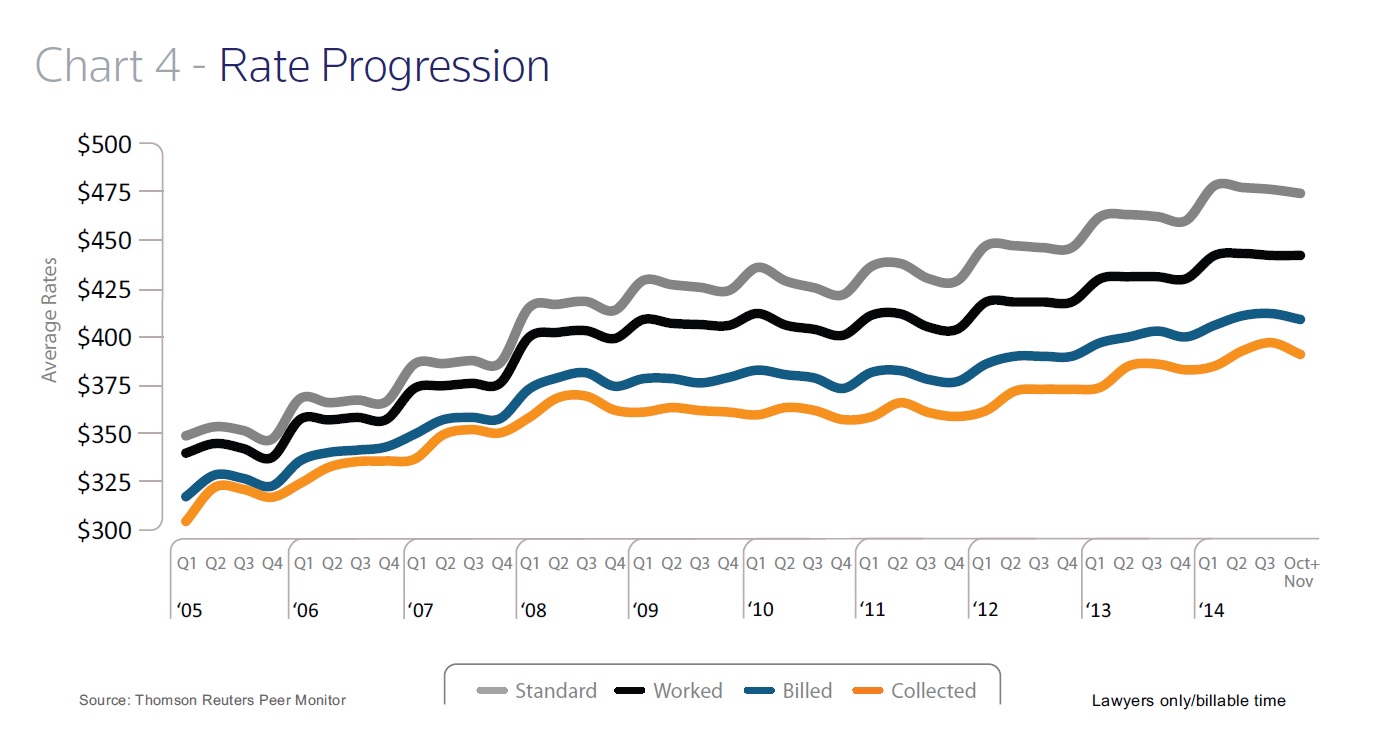
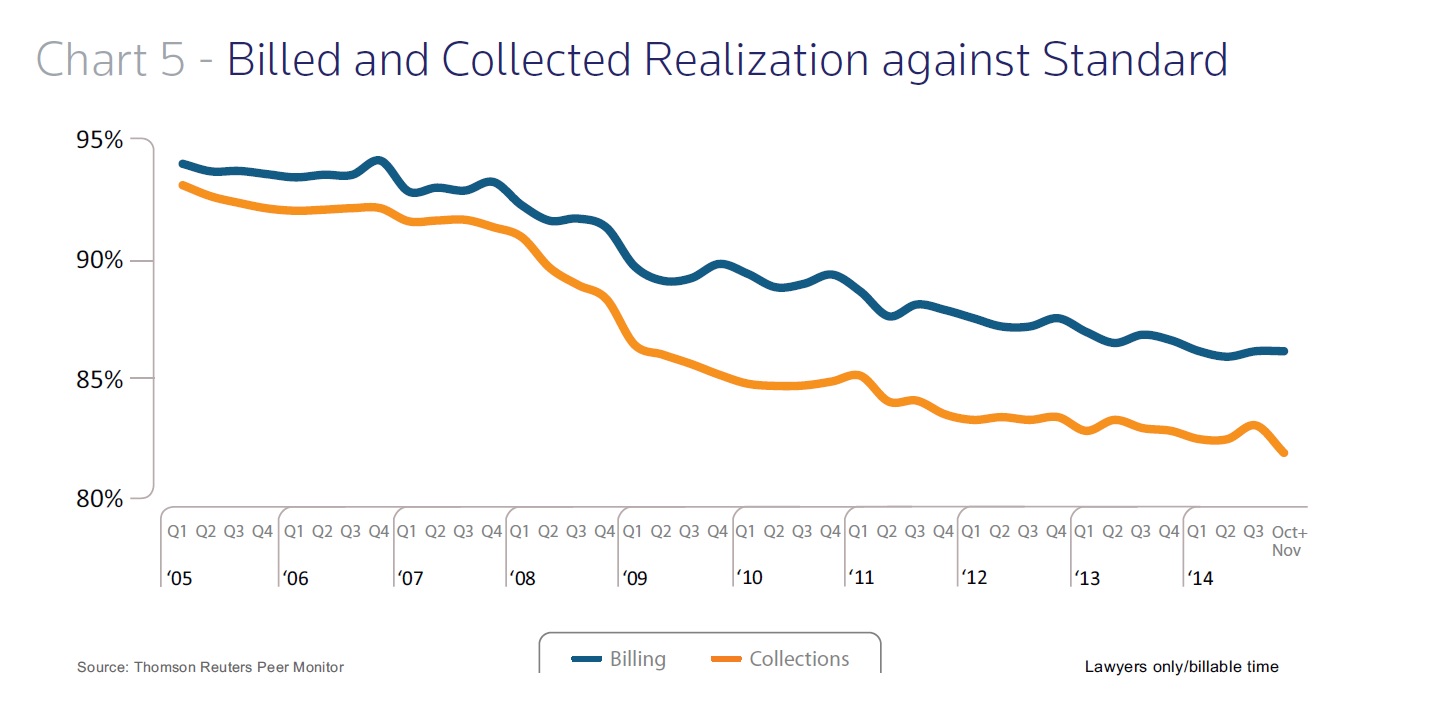
Don’t think this could happen? Then take a look at Charts 4 & 5 from the ‘2015 Report on the State of the Legal Market‘ published by The Center for the Study of the Legal Profession at the Georgetown University Law Center and Thomson Reuters Peer Monitor (at page 5)

chart 4


chart 5

Those charts don’t make for pretty reading.

So when, as the article reports:

“…firms realise this is not going to be an easy sell to clients who are likely to negotiate hard to keep fees down, so their approach to increasing charge out rates is likely to be softly softly, rather than gung-ho”

my response would be: “why bother?”.

Instead,

  • try keeping your charge-out rate the same over the next 12 months;
  • try not to give discounts;
  • try to increase your realisation rate (by 3 to 5 cents in the dollar);
  • try to reduce your lock-up days;

and see where you end up.

You may just find that has a better impact on your partner profitability numbers than the likely impact that is going to come your way when you go annoying and off-siding your clients with the almost obligatory 1 July 10% rate increase letter.

But I could be wrong…