law firm clients

How well are we doing at exporting #Auslaw?

Business Development image

Finally, some years after the Australian Government first announced and then consigned to the dustbin  its ‘Australia in the Asian Centurywhitepaper, a fair amount is being written around the issue of exporting Australian professional – read, ‘legal‘ – services, including:

While it is undoubtable that the export of Australian legal and professional services is a trending issue on an upward trajectory, it is still probably a little early to say (as the College of Law post does) that “Australia is now trending on a global scale” (vis-à-vis the export of our professional services) – although, to be fair, the export of Australian lawyers (to which the College of Law would have a particular interest), particularly to the UK and New York, has been ongoing since the early 1980s and continues to this day.

Moreover, given that the Australian International Disputes Centre (AIDC) was established way back in 2010 (with the assistance of the Australian Government and the Government of the State of New South Wales) and still lags behind both the Singapore International Arbitration Centre and the Hong Kong International Arbitration Centre, the export of #Auslaw has undoubtedly been a slow burn.

So while I for one applaud the latest chatter around an impetus to export #Auslaw, I hope that this time we are serious and take the time to have a robust conversation about whether or not we wish to seriously promote (and lobby) the export of #Auslaw overseas. And, assuming we decide we do wish to progress with the export of #Auslaw overseas, we put in place concrete national plans to move this initiative forward rather than taking the lacklustre state-based approach we have to date.
National survey finds that there are 66,211 practising solicitors in Australia

Business Development image

The ‘2014 Law Society National Profile of Solicitors in Australia’ report was released this morning on the NSW Law Society website.

The first time this report has been updated since 2011, key findings include:

  • there are now 66,211 Practising Solicitors in Australia – a 12% increase since 2011.
  • of all practising solicitors in Australia:
    • 34,10 (51.5%) were male, and
    • 32,110 (48.5%) were female.

This represents a significant increase in the proportion of female solicitors since 2011  – when the percentage number ratios were 54.6% male to 43.4% female.

  • while the mean age of Australian solicitors has remained roughly the same at 41.9 years – compared to 42.0 years in 2011, interestingly the largest proportional growth age bracket is occurring in the over 65 years age group (with a 38% increase in this group since 2011).
  • as at October 2014, the majority of practising solicitors in Australia were private practitioners  – 70.2%; with the percentage numbers in other major sectors of the profession in Australia remaining fairly static since 2011 – 15.8% were corporate solicitors and 9.6% worked in the government sector.

Most interestingly, while overall the Australian legal market remains represented by small practices – 2,155 firms (17.3% of the total) had 2 to 4 partner and 514 firms (4.1% of the total) had 5 to 10 partners:

  • there are now 77 law firms across Australia where the number of partners exceed 40 – representing a 300% increase from 2011, and
  • there are now 74 law firms across Australia where the number of partners range from 21 to 39 – representing a 111% increase from 2011.

In addition to potentially showing significant consolidation in the Australian legal market over the past three years (the overall percentage representative number of sole practitioners is actually down roughly 3% in 2014 from 2011), these numbers would appear to indicate that the slow death of large law firms, and the professional more generally, is being greatly over exaggerated in the Australian legal press.

Indeed, one could argue that now more than ever the market in Australia is highly competitive and that it is becoming increasingly important that you and your firm be able to communicate what differentiates you from the crowd.

If you haven’t already, I’d like to recommend that you take a look at the report – it contains some very interesting statistics; including, for the first time, statistics on the representation of Aboriginal and Torres Strait Islanders.

A quick test to help determine if you’re providing value to your client

Business Development image

In today’s legal world you often here people talking about “doing more for less” and/or that they are providing “value” to their clients, without much of an explanation as to what constitutes “value” – with the best shot usually being:

value, like beauty, is in the eye of the beholder“.

Indeed many thousands, if not millions, of words have been written about making sure you “add value” – not to be confused with “added value”, which is a whole different subject – but very few of those written words have made any real attempt [from what I can see] to try and nail down a definition of “value” from a client’s point of view.

And while there is little doubt that every single person’s definition of value will be different – and in many cases, each individual person’s definition of value will alter depending on the circumstances they face at the time they are asked to define “value” to them – the following two-part questionnaire suggested by Nathaniel Slavin (of Wicker Park Group) in his recent post on the Bloomberg Big Law Business website, ‘The Perception of Value Differs Among Clients‘, probably goes closer than anything I’ve seen so far to answering this conundrum:

  1. Does my lawyer understand how I define success and all the myriad components that impact that success?; and
  2. Do they accomplish that goal in a manner, financially and otherwise, that helps us further our business goals?

And if, as a private practising lawyer, you can answer “yes” to both those questions – while you cannot be certain you are delivering “value” – you can be pretty sure you are delivering overall client satisfaction levels that are going to get you as close as you can possibly get to a modern day definition of “delivering value to your client“.


Some reasons why every lawyer should be encouraged to do fee estimates

Business Development image

Fascinating blog post over on the pmhut.com website recently (30 April 2015) by Terry Bunio, Principal Consultant at Protegra, on “Why I Like Estimates” that should be add to the “must read” list of every lawyer and law firm business developer who hasn’t already read it and adopted its principles.

Some of the things that Terry sets out that really resonated with me in this post included:

  • Estimates make me think through a solution

“When I estimate I am forced to examine project details and technology and think through the deliverables at a detail level and how we would build them. This helps to identify issues early and give the team and client lead time to decide on a resolution. When you discover issues late in the game, your options are limited and client anger usually follows.”

Precisely the same reason why lawyers should be doing cost estimates before agreeing to undertake a matter. It makes you think through what the issue(s) is/are, how you are going to deliver the desired result to the client and what sort of resourcing you’ll need. You should also be able to determine at this time what you cannot deliver to the client.

  • Estimates create a shared understanding

“…the discussions that occur while estimating are invaluable. These discussions create a shared understanding throughout the entire team.”

Terry is absolutely spot on here. It should also allow you to assign what work the firm will do, and what work will be outsourced (to an LPO) or insourced (to the in-house team). It sets out a task management process from the offset and reduces the risk of scope creep or out of service work being done. QED, if you follow this process at the end of the day you are much less likely to have an upset client.

  • Estimates allow Clients to allocate post Minimum Viable Product budget to other initiatives

“Clients are not going to reserve large budgets just in case an Information Technology project needs it. Clients have a very limited budget and there are always more initiatives than budget. Allowing clients just to stop projects at any point does not recognize the lost opportunity cost by not starting additional initiatives that could have placed them ahead of their competitors.

Again Terry is right. While lawyers rarely want to get their hands dirty talking money upfront on a matter, it should be kept in mind that money is a limited resource to your client (as it is to your firm) and every dollar your client spends with you is an opportunity cost to the client’s business – vis-a-vis that dollar being spent elsewhere. It should therefore be incumbent upon you not only to ensure that your client understands how much they will likely be required to pay for the matter but also for you to reduce any likelihood of your firm either having to write down time or simply not be paid for out of scope work done by your team.

In short, as Terry writes: “Estimates matter” and going through a robust matter cost estimate process with your client before any instruction to act on a matter should be recommended and adopted as best practice by all lawyers.

How about applying the “Moscow” process to your next costing letter

Business Development image

Over the weekend I read a post over on the www.pmhut.com website by Chuck Snead – An Agile Primer: Agile Estimating and the “MoSCoW Process” – which contained an interesting process that I would like to share with you today.

Although the www.pmhut.com website (the “pm” here standing for “Project Management”) doesn’t do posts that relate directly to either law firm business development or marketing, I enjoy reading their posts as I find many of the concepts they cover can easily be applied to the industry. As was the case this weekend, with a guest post by Snead which threw up a very interesting acronym and concept that I had not previously heard of – the “MoSCoW Process”  – and which I now believe should be tailored to form part of any law firm costing/engagement/fee proposal letter process with your client.

So here goes.

Snead stipulates that:

MoSCoW is an acronym for prioritizing feature development along the following guidelines:

  • MUST have features that are required for the project to be called a success.
  • SHOULD have features that have a high priority, but are not required for success.
  • COULD have features which would be nice to have, but are not high priority.
  • WON’T have features that stakeholders agree should be in a future release.

Now let’s apply this to the law firm costing/engagement/fee proposal letter process you go through with your client and agree that your next costing/engagement/fee proposal will include the following:

  • a section in the letter setting out all of the actions/tasks that MUST be done in order for the client’s objective to be met [Category 1 critical]. Here, assign who will be given the task and either the fixed or estimated cost to achieve these tasks; next
  • a section in the letter setting out the actions/tasks that would it would be ‘nice’ (SHOULD) if they were done, but they are not critical to the achievement of the client’s objective(s)[Category 2 critical]. Again, assign who would be given the task if there is sufficient time/budget/desire, etc and either the fixed or estimated cost to achieve these tasks; next
  • a section in the letter setting out the actions/tasks that are [remote] ‘possibles’ (COULD) that may arise out of the client undertaking the action they are planning to take. It should be noted that this should be remote variables/possibilities [Category 3 – variables]. Again, assign who would be given the task if one of these remote variables were to arise and wherever possible attach a fixed fee or estimate against the task; finally
  • set out clearly in the letter those actions the law firm WON’T be taking (is not instructed to take). Now it could be the case that these actions are still needed in order for the client’s objectives to be met, but they will be undertaken elsewhere (eg, in-house or through an LPO) [Category 4 – won’t dos]. Note, this is not a ‘disclaimer’ or limitation on liability section per se, but assigning tasks so that each party knows exactly what is and what is not required of them.

Anyone else out there think we may just have a few less angry client complaints if we went through a process like this each time we took on a new matter?

This process might not be perfect, and it could well need a tweak here and there, but I do think it will go a long way to helping lawyers fully understand the scope and nature of the instruction(s) they receive from their client(s) and lead to less misunderstanding in the industry.

And if that’s the case, the result is a win-win all round.

‘Stupid is as stupid does’

Business Development image

In the 1994 movie of the same name, Forrest Gump is asked:

“are you stupid or something?”

to which Forest replies:

“stupid is as stupid does”.

Some 20 years later (yes, it really has been that long!), in general parlance this phrase has come to mean that:

‘an intelligent person who does stupid things is still stupid’ – (Urban dictionary)

and I have to say that this thought went through my mind earlier this week when I read that a third of [UK] commercial firms are likely to raise their rates in a bid to boost their profits (Solicitors Journal 6 May 2015 – “Number of law firms planning to raise charge out rates increases“).

Leaving aside the issue of whether a direct raise in your rates will equate to increased profits (for example, the psychological impact of rising rates/budgets on fee earners with no increased salary (cost)) –  what in the world would make 26 (1/3rd) of so-called intelligent finance directors of the UK’s Top 100 law firms say “it is likely their firms will increase their charge out rates in order to improve profitability in the year ahead“?

As I have blogged countless times before (the most popular being: ‘Is it time for law firms to break with the RULES when looking at profitability?‘), hourly rates are but one of the metrics in calculating profitability. And it’s probably not even the biggest metric driving your firm’s partner profit levels, which almost certainly would be better achieved via an increase in your realised rate.

Putting this mathematically (admittedly not my strongest area), say my hourly rate is $100 and my realization rate is 90%, then I’m being paid $90-. Taking this forward I’ve decided to increase my hourly charge-out rate to $110-, but find that my realization rate has now fallen to 80%. If my maths is correct, I’m now being paid $88-.

In other words, in real terms, I’m losing money!

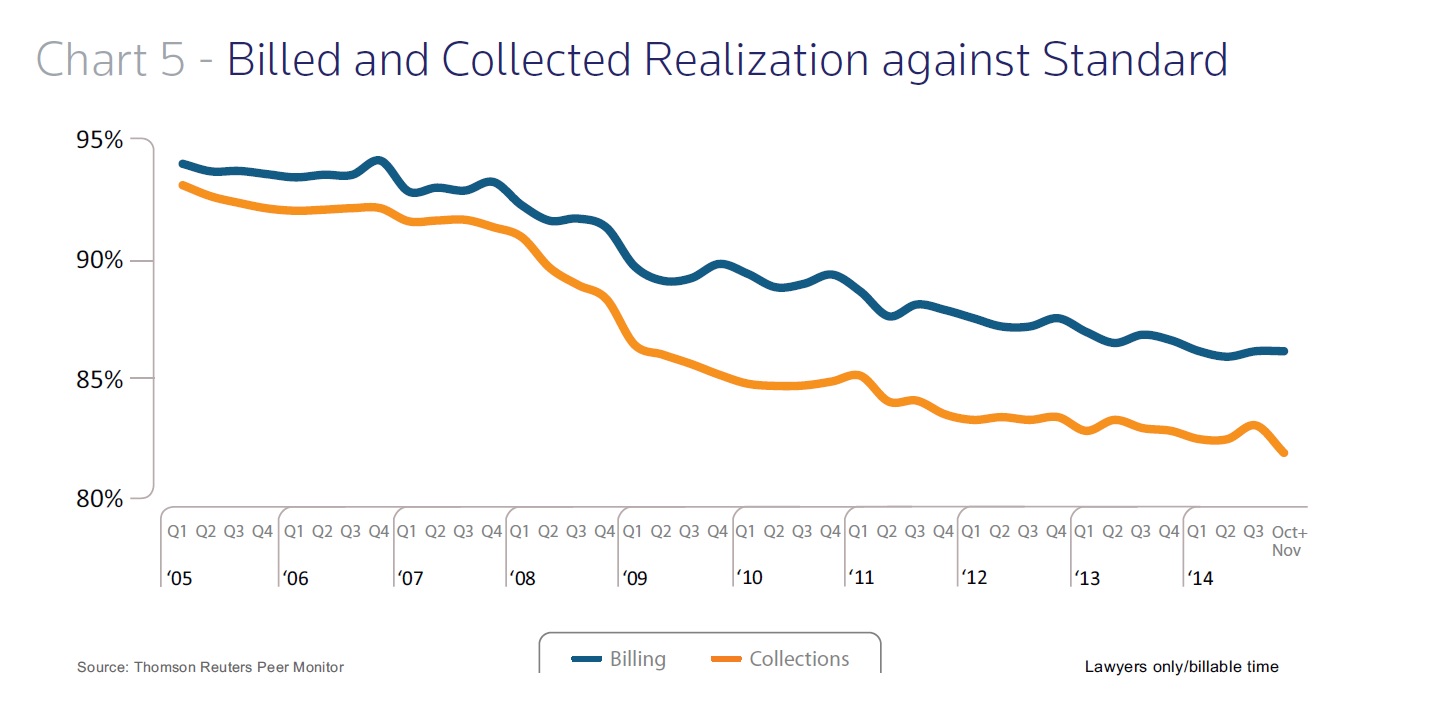
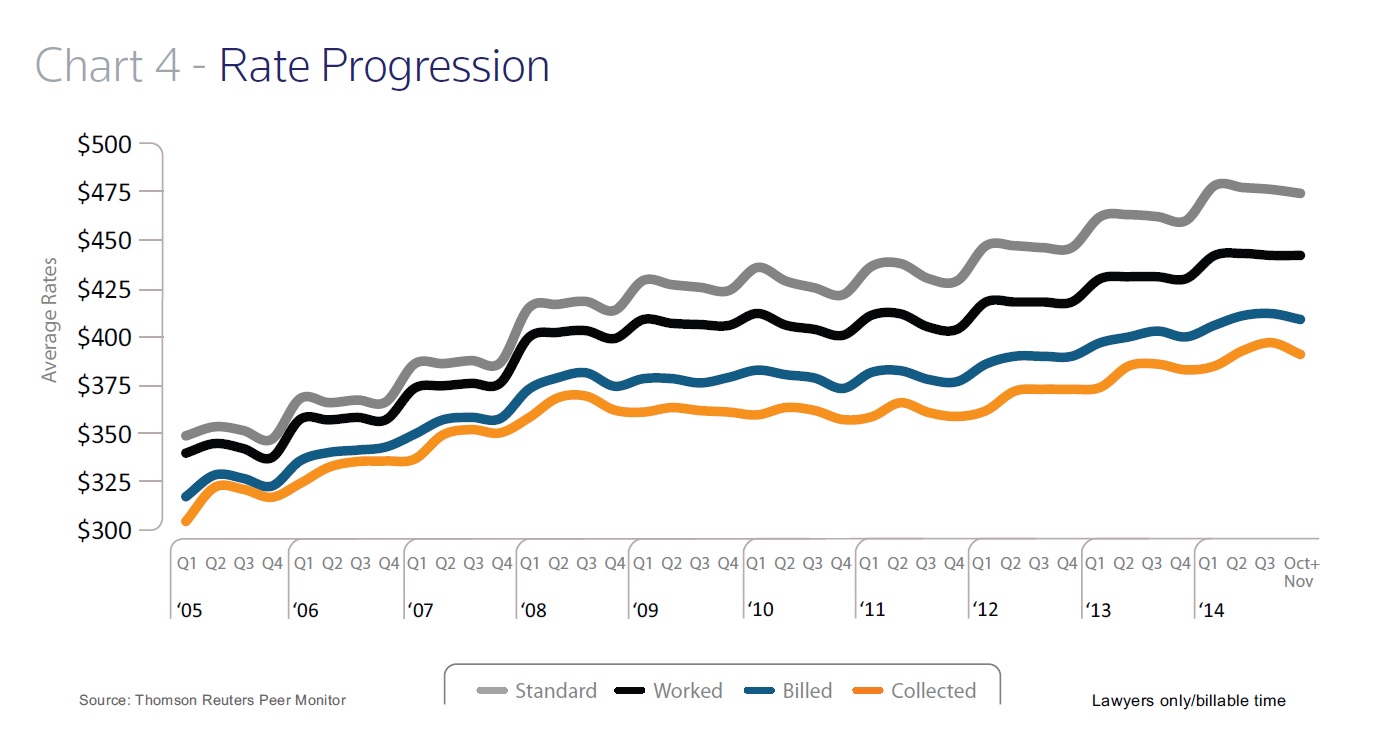
Don’t think this could happen? Then take a look at Charts 4 & 5 from the ‘2015 Report on the State of the Legal Market‘ published by The Center for the Study of the Legal Profession at the Georgetown University Law Center and Thomson Reuters Peer Monitor (at page 5)

chart 4


chart 5

Those charts don’t make for pretty reading.

So when, as the article reports:

“…firms realise this is not going to be an easy sell to clients who are likely to negotiate hard to keep fees down, so their approach to increasing charge out rates is likely to be softly softly, rather than gung-ho”

my response would be: “why bother?”.

Instead,

  • try keeping your charge-out rate the same over the next 12 months;
  • try not to give discounts;
  • try to increase your realisation rate (by 3 to 5 cents in the dollar);
  • try to reduce your lock-up days;

and see where you end up.

You may just find that has a better impact on your partner profitability numbers than the likely impact that is going to come your way when you go annoying and off-siding your clients with the almost obligatory 1 July 10% rate increase letter.

But I could be wrong…

Beware of wolves in sheep’s clothing

Business Development image

“Beware of the false prophets, who come to you in sheep’s clothing, but inwardly are ravenous wolves.” – Matthew 7:15

It might seem a little melodramatic to start a business development related post off with a biblical reference, but when the global leader of EY Law, Cornelius Grossman, says “I don’t think any firm should feel threatened“, vis-à-vis the march of accounting firms into the legal space, and particularly why law firms have nothing to fear from accountants practising law, it seems entirely appropriate.

On further reading, the firms Grossman says he is refusing to target – and thus by extension don’t need to feel threatened by the continued march of accountants into this space – are those doing “the highest level – “bet the company” – work and premier corporate clients” and who “have established their brands over hundreds of years…

In other words, so-called Magic Circle firms, their work and client base are safe from the invasion.

But, as Grossman then goes on to say in this legalweek.com article:

“he believes EY Law will succeed with multi-disciplinary teams doing mid-market transactional work”.

adding further that:

“We [EY Law] want to be known for compliance jobs that span over tens of jurisdictions and for large international reorgansiations.”

In other words, the work that just about 80 per cent of us have been trying very hard to secure for a couple of decades now (and in many case incurring significant losses while we try and secure this work)!

So, while Grossman may believe that:

“The threat of accounting firms to the legal market is overstated.”

and that:

“There’s so much work out there that we all compete for – I don’t think any firm in particular should feel threatened by that.”

unless you work for an elite law firm, I would like to suggest that you be a tad weary of wolves in sheep’s clothing telling you that there really is nothing to be overly concerned about and that there really is enough food out there for all of us to feed on.

How often do you let your clients know the value you provide to them?

Business Development image

Based on interviews with 188 independent lawyers and more than 500 clients, the LexisNexis Bellwether Report 2015: the Age of the Client (published earlier this week) found that:

“80% of lawyers think they’re delivering above average service…

… but only …

…40% of clients say they’re receiving it.”

What does this mean?

Well, either:

  1. You’re not as good as you think you are; or
  2. You’re not communicating well enough to your clients the value you bring to the transaction/relationship.

I’ll leave it for you to decide which you think applies to you.

A conversation with Lucy Fato, General Counsel at McGraw Hill Financial

Business Development image

Last week Bloomberg’s new Big Law Business website published a two-part extract [It’s All About Relationships and ‘Gut Checks’ Are Better than AFAs] from a recent interview Bloomberg had with Lucy Fato, General Counsel of McGraw Hill Financial (among others, parent company of Standard & Poor’s).

Transcripts from the interview make for interesting reading. While not agreeing with all Ms Fato has to say, her take on the following issues run close to how a number of in-house counsel feel here in Australia:

On the role of in-house counsel:

But my view is that the role of in house counsel is, in many ways, to be the face of the company in these situations. Outside counsel can never really have perfect information about what a board or a CEO is thinking. They can never really step into the shoes of in-house counsel.

That’s how in-house lawyers really add value. They can connect all the dots. I think, historically, general counsel deferred more to outside counsel than what you see today. It’s a process that has evolved.

On the role secondments can play in developing personal relationships with in-house counsel:

Secondments are a great way for a firm to build a relationships. The associate is actually here, in our building, getting to know our people, getting to learn our business, and when they go back to the firm, they bring all of that knowledge with them. It’s especially effective when a firm is new to the company.

On the developments going on in in-house departments:

In-house departments have become much smarter about how we manage our departments and how we manage our legal expenses. In-house departments are becoming bigger, more global, and many companies, including ours, spend a lot of money on outside counsel. Getting a handle on that is extremely important.”

On the role data plays on the modern relationship between in-house and external legal:

I’m very big on data and having a lot of information to work with…

E-billing gives you enormous visibility into how law firms make money.

On alternative fee arrangements:

Getting better control over who we’re spending money with, how they are staffing deals, how much time is being spent on matters — taking a hard look at those types of questions is more effective over the longer term than trying to do alternative fee arrangements.

On hourly rates:

But I will say it’s gotten a little out of control. It’s eye popping even for me, and I’ve been doing this a long time, when I see an hourly rate that’s over $1,000 an hour. I look at that and think, “Really?”

Ms Fato makes a number of other good observations and comments, both about the evolving role of in-house counsel and the relationship between in-house departments and their external legal advisers, but I wanted to finish this post with probably my favourite:

Firms have to be mindful that their client is not just the lawyer. It’s also the business person.

Absolutely.

The two types of efficiencies law firm associates need to become familiar with…

Business Development image

Really interesting article [‘What Associates Should Know About In-House Rates and Efficiencies‘] by Gina F. Rubel was published overnight (7 April 2015) on The Legal Intelligencer website – discussing the two types of efficiencies that law firm associates should become familiar with – contains a gem of a quote from an in-house general counsel that I wanted to share/pass on.

First, to put some context around the quote below by Gino Benedetti, as Rubel states:

“There are two types of efficiencies with which lawyers need to be familiar. The first is general efficiency, which is the state or quality of being efficient and the actions designed to achieve optimal results. The second is economic efficiency, which requires optimal production and distribution of a firm’s resources.”

And while both are extremely important to in-house counsel, the following quote in the article by Gino Benedetti, General Counsel of SEPTA, should give some indication to private practice law firm associates which of the two bears more commercial importance to their in-house clients:

“Associates should understand that every case does not require a full-court press,” said Gino Benedetti, general counsel of SEPTA. “Associates add value when they think creatively by identifying the core issue in dispute and focus their case work on things that impact that issue. Often, associates work on an aspect of the case that does not have any meaningful impact on the ultimate outcome. So, associates should appreciate that their time may be less expensive, but that does not justify inefficiency. Associates should communicate often with the partner or the client directly so that the client’s objective is understood and the work is driven by that objective.”

If you haven’t already, I’d like to suggest you go over and read the entire article. It’s full of sage advice from several in-house GCs.

In the meantime, if you are a private practice law firm associate, the next time your supervising partner asks you to undertake a task on behalf of your client why not ask yourself which type of the two types of efficiency you are going to bring to the task…?