business development

My 2023 predictions – only they are not!

I have only tried to predict what might happen in the next 12 months in the world of AusLaw once. It was exactly 10 years ago – 2013 – and I got it so horribly wrong that many would argue I should never, ever, touch this subject again!

Of course, countering that I would argue that getting numbers #2 and #3 close to right, at that time, showed major insight – and surely you can gift me #6.

But there has to be a reason why I have not done a prediction post since and that reason is: Because I’m rubbish at it!

Instead, these days, I review the predictions of others and opine on whether – from my lofty hight of ‘know it all‘ – they can call it better than I can – which, they usually can!

And so that is why this year I would like to draw your attention to the 2023 Citibank-Hildebrant Consulting LLC ‘Client Advisory Report‘.

In its 15th Year, this Report has done a whole lot better at guessing what the future holds for law firms than I have ever done; and Part II: ‘Looking ahead to 2023 and beyond‘, Section B: ‘Key trends to watch in 2023‘, sets out 16(ish) trends to watch-out for in the next 12 months.

So let’s take a look at what these suggested trends are, and I will then add some comments I might have on them.

THE REPORT’S FORECASTED 2023 TRENDS

  1. The evolution of the hybrid work model to a “more flexible” work model
  2. The growth and reshaping of lawyer leverage
  3. Equity partner growth at more firms
  4. Greater focus on both revenues and expense-related operation efficiencies, including:
    I. Rethinking space
    II. Redesigning the professional staff leverage model
    III. More outsourcing
    IV. Increased use of project management
    V. Thinking twice about business travel
    VI. More investment in technology
    VII. Improving realization
  • AFAs
  • Pre-negotiated discounts
  • Continued focus on improving the billing and collections process
    VIII. Greater focus on cross-selling opportunities
    IX. Financing growth

MY COMMENTS

And here I go with my 2c.

  1. The jury is out with this one – on the part of both the employee and the employer. I read a report the other day that stated employees wanted back in the office with rising cost of living expenses (read gas and electricity, but also inflation more generally). If that is true. get a couple of 30+ degree days in a row running the aircon all day, employees may well want to be working back in the office pronto (anyone else remember going to there cinema to cool-down?). On the other hand, employers are looking to reduce their footprint – after all, rent is up there with salaries winning the Biggest Overhead cost award. Some compromise is inevitable but it would not surprise me if we see a hybrid of a model introduced into Auslaw about a decade ago by Herbert Smith Freehills where you see most lawyers in the office 3 or 4 days a week, but back-office support staff (or Allied Professionals) working mostly from home.
  2. There’s a recession on the way. It has already arrived in many parts of the world. And with a recession comes something called ‘stickiness’ – where lawyers, especially at Special Counsel level, keeping work they could otherwise be passing down to more junior lawyers makes sure they (a) make bonus, and (b) keep their jobs [after all, Special Counsel is the biggest loss leading level in most law firms]!
  3. Unlikely – 5 generations in the workforce and a recession. I’d think you need to be very special to be looking at equity partner entry level at the moment. Now if we are talking salary partner, I would agree. And keep in mind that roles like ‘Managing Associate’ and ‘Special Counsel’ were born out of the 2008 GFC, so we may see more of these job descriptions appearing in job adverts in the near-ish future.
  4. Absolutely, but let’s look at this a little closer:
    I.’Rethinking space’ – yes, see my response in 1 above
    II. ‘Redesigning the professional staff leverage model’ – no, see my answer in 2 above
    III. ‘More outsourcing’ – I wish, see number 8 from my 2013 prediction list!
    IV. ‘Increased use of project management’ – we have been talking about this for over a decade and if we still haven’t got this right then we don’t deserve to keep putting this on our ‘wish list’
    V. ‘Thinking twice about business travel’ – absolute no brainer! Partners’ use of their airmails for upgrades will be a growing trend in the next 12 months!
    VI. ‘More investment in technology’ – yes and no. Yes if it is for cyber-security (especially client-driven cyber-security requirements), and yes if it is for time-based billing. But no if it is for anything else.
    VII. Improving realization
    – AFAs
    – Pre-negotiated discounts
    – Continued focus on improving the billing and collections process
    So much to say here, but all I will say is – rubbish. And what on earth is a ‘pre-negotiated discount’, is that a contractually agreed volume discount? If so, it is not an AFA!
    VIII. Greater focus on cross-selling opportunities – as I’m currently reading Heidi Gardner and Ivan A. Matviak’s ‘Smarter Collaboration: A New Approach to Breaking Down Barriers and Transforming Work‘ (didn’t realise they were married before I read this) I would hope so. But experience has shown me that partnership deeds drive cross-selling opportunities and not altruistic behaviour a lot better than HBR top-selling books!
    IX. Financing growth – ahh, maybe we wait and see how the other predictions go! And keep in mind that financial growth does not necessarily mean ‘profit growth’, which should be the main game for any law firm!

Anyhow, as usual comments are my own. And I hope everyone has a great 2023!

rws_01


Image credit today is  Moritz Knöringer

Happy 10th Birthday Clyde & Co Australia!

According to a post in Lawyers Weekly today, Clyde & Co is celebrating its 10th birthday here in Australia – “Happy Birthday!” .

How time flies; and there is no doubt that Clydes has done well here in Australia. As the LW article points out, the firm has enjoyed:

“a growth rate of 115 per cent in the country since 2018.”

Which, to be fair, is not a one-off year as the financial figures show:

“The firm has maintained yearly growth rates of over 20 per cent for the past five years.”

As sustainable growth, which over 5 years you have to assume it is, and an underlying culture that must be driving this growth, everyone would say have to say – “wow, can we have some of that!”.

As impressive as these accolades are – and I’m a huge fan* of how this one time shipping insurance firm has been able to pivot into one of the world’s leading cyber/privacy/technology firms which has resulted in Australia currently ranking its global operations as:

“Clyde & Co’s third-largest country by fees generated”

I have a concern.

And that is this:

“Clyde & Co exceeds $100m in annual revenue in Australia”

Followed by this:

As I first pointed out way back in 2013 and several times since, Australian-based law firms primarily earning/reporting revenue in Australian Dollars, but with accounting systems and tax years based on British Pounds (or US$s), face the dragon known as ‘exchange rates’.

So what does that mean?

The answer is in that chart, it is also in the Lawyers Weekly headline, but I suspect – most importantly – it is in the individual Australian partners’ direct contribution, because that chart tells me there is every chance they could be the third biggest revenue earning geographic zone for the firm globally, and a hell of a long way down the pecking order when it comes to partner distribution.

Anyhow, “Happy Birthday Clydes!”

As usual, comments are my own (*although in this case I will add that while I don’t, now ever have, worked at Clydes I do know a lot of people who do and I greatly admire the work they do).

rws_01

Photo credit: Morgan Lane on Unsplash

Where to next for the Swiss Verein law firm business model?

In a case that appears to have gone largely unreported outside of the US, last week (31 August 2022 – reported on Bloomberg’s website) Ohio’s Supreme Court rejected an appeal by international law firm Dentons to a relatively long running case that could, possibly, shake-up the accepted business model of many similarly structured international law firms – including some with a presence here in Australia, such as: DLA Piper, Squire Patton Boggs, Baker McKenzie, Norton Rose Fulbright and King Wood Mallesons.

‌So what is this all about?
Core to this case was an actually or potential conflict of interest, with a specific twist on the way law firms are structured under the Swiss Verein business model.

Before we jump into why this might be an issue though: What the Hell is a Swiss Verein?

The Swiss Verein business model

Wikipedia – which anyone who knows me well will be able to tell you I do not see as being the font of all knowledge, does a good job in this case of defining a ‘Swiss Verein‘:

“The association can also be used as a legal form for a business organization consisting of a number of independent offices, each of which has limited liability vis-à-vis the others. The form is often used by multinational professional firms so they can operate globally under one brand whilst maintaining separate profit pools (and ring-fencing liability) in each country in which they operate.

Pretty cool, but how can a problem arise now 20 years after Baker & McKenzie became the first major law firm to use the Swiss Verein structure in 2004?

Well, let’s take a look at the issues in this matter…

At the heart of this matter..

Core to this whole dispute was that:

RevoLaze argued that Dentons shouldn’t have taken on the company’s patent case in 2015 because one of the firm’s Swiss verein affiliates in Canada had represented Gap Inc., which RevoLaze sued for patent infringement.

…so what?

Well:

The verein structure lets law operations affiliate to market services under one brand while avoiding a full-on merger. Affiliates limit liability between offices and keep separate on matters such as profits, pay and taxes.

Okay, so now I’m starting to see why this might be an issue.

But who really cares?

As the Bloomberg article states:

The RevoLaze case tests whether firms using the Swiss verein model must do conflicts checks with all affiliates in their networks before deciding to take on a client.

Can you imagine that – over a 24 hour global time line! What would an “urgent” conflict check look like?

Or, maybe, get an integrated conflict check system – but that goes against the Swiss Verein model, so how about we take on board this (in the Bloomberg article):

Verein firms risk losing business if they’re required to disclose conflicts related to affiliates’ work. Existing clients may balk at other representations, and potential clients could decide to go elsewhere.

So what does the future hold for the Swiss Verein?

The answer – I have no idea. It’s one court decision – pretty influential though.

On the other hand, how long is it going to take to unwind any Swiss Verein structured law firm – in my view a project that will likely take 10 years!

As usual, comments are my own.

rws_01

Image credit to Ronnie Schmutz on Unsplash.com

The ‘2022 Australia: State of the Legal Market Report’

The latest update on how the Australian legal market is fairing through COVID was published by Thomson Reuters Institute and Melbourne Law School yesterday (29 August 2022).

Some of my key take-aways from this ‘The 2022 Australia: State of the Legal Market Report‘ include:

  • FY22 (defined as being 1 July to 30 June) was a tale of two halves. In the first half, 1 July to 31 December, Australian law firms smashed it out of the park (6.4% growth in the first half), but the second half was much harder going and the market declined 2.1%, representing its weakest quarterly return since 2013
  • Drivers of growth were all the usual crowd: mergers & acquisitions, banking & finance, etc
  • Retention – especially at the Associate level – is a major concern with 31.6%, roughly one-third, of Australian associates having decided to move on from their firm over the past 12 months
  • Law firms are trying to counter this attrition rate by offering their star Associates more money, which makes sense when you consider how much it costs to replace lawyers, but more recently Associate demands have included demands outside of pure financial reward – including a belief that the firm is taking a strategic direction that aligns with their values
  • Your firm’s reputation in the marketplace is important if you want to keep your Associates
  • Diversity IS important:

Global research from the Thomson Reuters Institute found that female lawyers and/or those from under-represented demographics, as well as those who identified as LGBTQ+, were the most likely to leave their current firms.

Page 14
  • Lawyers in Australia from diverse backgrounds are NOT feeling the love:

lawyers from diverse backgrounds gave notably lower-than-average marks in both their own well-being and their leadership demonstrating the importance of diversity, equity, and inclusion (DEI) as compared to lawyers with non-diverse backgrounds

Page 14

Anyone who has read the ‘2021 Annual Profile of Solicitors‘ by the Law Society of NSW should be able to tell you why that’s a problem that’s not going away unless law firms demonstrate a change.

  • Innovation remains important, even though we are not actually too sure what that means as we continue to draw a hard line between “innovation” and “technology”

That said, there is a really cool ‘Innovation adoption checklist‘ on page 23 that is worth the download by itself!

  • Partners are leading the utilisation charge – there may be a whole host of reason given for this from “clients want partner time on the matter” to “we don’t want to over burden our associates because they may leave us” but an annual average utilisation rate of slightly over 1,200 billable hours tells me some lawyers out there are working very hard

  • Last, but by no way least, is an amazing graph on pages 26 and 27 that sets out the ‘4 roles of a law firm partner’ which is brilliant and makes me wish I had created it!

Well done it all involved and make sure you read the report.

As usual, comments are my own.

rws_01

Some red flags that you likely work in a siloed law firm

Pre-empting this post by saying that I don’t know Akin Gump’s head of litigation Stephen Baldini. In fact, not sure I know anyone at Akin Gump.

In fairness I would also add that emails such as the one Baldini sent to his litigation team internally – that recently went viral – are probably written every single day in law firms across the world.

What does interest me with this story though is how it clearly identifies (in my opinion) that the litigation “team” at Akin Gump is clearly not “A” team but rather several different teams.

Why do I think this? 

Well, let’s take a look at at some of Baldini’s opening comments:

“We have recently had an extremely difficult job getting people engaged on matters”.

“Too many calls for help are either ignored or met with “I’m too busy.” These responses simply do not synch with our productivity, which for 2 months has been extremely low.”

Interestingly, Baldini’s email likely highlights a bigger problem in the Akin Gump partnership deed. That is this: it indicates to me that the Akin Gump partnership deed has a Supervising Partner/Instructing Partner component to it, whereby the Supervising Partner of lawyers in their team are assigned costs, but the Instructing Partner is assigned revenue without needing to necessarily share the costs of the resources they are using outside of their “busy” team (a version of ‘Eat what you kill’ that is played oh so well in many law firms).

To my mind, this accounting issue is a major barrier to internal collaboration in many (if not, most) law firms.

Now I could very well be wrong with that statement, but if you listen to the underlying plea in Baldini’s email:

We need engagement and intensity from everyone on the Lit team across the firm – we also need to act like a team. We need to help each other by easing the burden that is falling on colleagues, and we need to work together to meet our clients’ needs. So when you are asked to help out, please promptly respond, and if you have any capacity please say ‘yes’.

And, if you have capacity, proactively reach out and let others know. We are all professionals and we need to practice with a high degree of commitment to our clients and each other.

I think you might agree that there could well be a silo team mentality happening here.

As usual, comments are my own.

rws_01

Photo credit  Waldemar Brandt on Unsplash

What are the functions and responsibilities of the Managing Partner in 2022?

An article was published in today’s Australian Financial Review by Aaron Patrick (‘Ashurst should accept its purpose is not extraordinary‘) that, frankly, I disagree with. And when I say “disagree with“, I acknowledge and respect Aaron’s comments, but Ashurst (like Allens) are celebrating 200 years so we should cut them some slack.

Anyhow, that’s not why I’m posting tonight – although it kind of is.

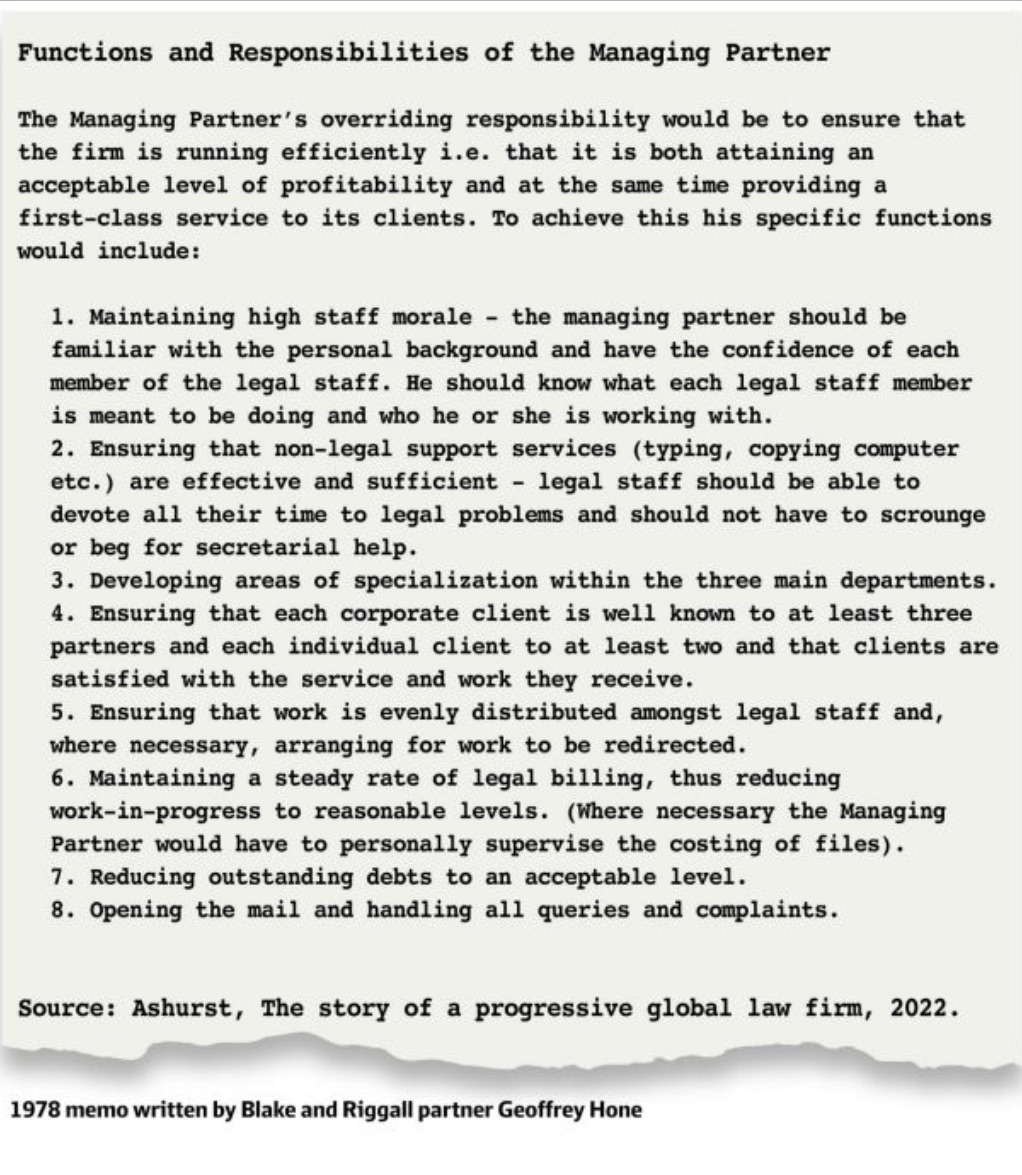
Because, included in Aaron’s story is a 1978 memo written by Geoffrey Hone -‘Functions and Responsibilities of the Managing Partner‘ – that’s an exert from a book Ashurst have published to celebrate their 200 years – ‘Ashurst, the story of a progressive global law firm‘ (2022) which I think is light years ahead if its time (the memo that is, not the book):

So, aside from the use of “he”, which given who the MP of Blake and Riggall was at time could be forgiven, can you see any fault at all in this manifesto?

I’d go so far to say – not only is this a brilliant piece of work, if you want to set up a law firm in this day and age, follow it!

As usual, comments are my own and I welcome feedback from anyone who can think of a manifesto for your law firm managing partner that would include items outside this – because we should always remember, our MPs work for us!

rws_01

What’s hot and what’s not in #Auslaw

My article on ‘What’s hot and what’s not in #Auslaw’ was published in PM magazine this month.

My thanks to Matt Baldwin and the team at PM magazine for giving me this opportunity!

You can read the article here:

As usual, comments are my own and I welcome feedback.

rws_01

Report: The top 5 measures of ‘Value’ – in your client’s eyes

If you missed it, the recently published ‘The Legal Spend Landscape for 2022‘ by Apperio sets out the ‘Top 5 Measures Of Value‘ in the eyes of the survey respondents – aka, your clients!

In order, these included:

  • Outcome of legal matters – 66%
  • Hourly cost per lawyer – 60%
  • Spend forecast vs Actual spend – 46%
  • Risk exposure – 43%
  • Overall spend by law firm, matter type or business unit – 40%

Interestingly, in the same Report, the Top 3 answers to what the ‘Most Effective Techniques For Controlling Legal Costs‘ were:

  • Structuring more legal work under AFAs – 74%
  • Utilising specialist software for monitoring and maintaining cost – 63%
  • Centralising all legal spend through the legal department – 49%

And I very much suspect that the last of these – “Centralising all legal spend through the legal department” – is going to be a post in the near future, either here or on my other blog.

As usual, comments are my own and I welcome feedback.

Have a great week all.

rws_01

Why you need a client Engagement Letter and, importantly, why you need to keep it updated: Two recent cases

First off, for those who don’t know differently: in the world of professional services firms an ‘Engagement Letter’ isn’t an expression of love to another. Indeed, for us an ‘Engagement Letter’ might better be phrased as a ‘Pre-nup agreement’!

What is an Engagement Letter and why are they so important?
In the world of professional services firms, an ‘Engagement Letter‘ can generally defined as being:

“A document that sets out the business relationship between a client and their law firm. This letter serves as an agreement between the parties on the terms of their engagement. This includes details on the services being offered, client responsibilities, deadlines and compensation.”

Engagement Letters can include more, but in short they set out:

  • Exactly what the Scope of Services being provided are
  • Who is assigned to do what, and
  • How much the law firm will be paid by the client for doing said Scope of Services.

They are important for two main reasons: (1) on the part of the law firm they set out what the client’s expectations are – thus limiting the potential professional indemnity risk on the part of the firm; and (2) on the part of the client they set out the service standards, the expectations – they hold the law firm to account.

So, for both parties: a properly agreed to Engagement Letter sets out the expectations and assigns the risk – “win/win” as they say.

Two recent case studies
So let’s take a look at two recent cases that evidence just how important Engagement Letters are.

In the first case (a US-based medical case), a [medical] patient was billed US$230K for surgery having previously been advised – in their Engagement Letter – that the cost of the said surgery was estimated at US$1,300.

The Supreme Court in that case held that the estimate was protected by contract law, as no formal extension of scope letter had been issued and so the patient was only required to pay the US$1,300 original estimate.

Lesson Learnt: Send your out of scope (or extension of scope or variation of scope) letter out as soon as you are asked to do something that is not in your Engagement Letter.

In the second case (UK-based legal matter), a properly executed retainer agreement allowed a law firm to keep its agreed £300K fee, even though the bond issue that it related to was aborted.

Interestingly, the judge in the second case, His Honour Judge Paul Matthews, previously (as in a week earlier) made a comment – in reducing costs sought by a receiving party because all of the work was handled by a solicitor claiming grade A rates, that:

“it was not for the paying party to identify which work could have been delegated.”

See here

Lesson Learnt: Engagement Letters need to be properly drafted; but, importantly – get yourself a Project Manager to manage the case so that they can constantly review the work and ensure that any Out of Scope work is immediately communicated.

My 5 hints on how to manage Engagement Letters
If you follow these 5 hints, I think you’ll find you have far fewer issues with getting your fees paid:

  1. The most important thing to remember is to have an Engagement Letter with your client!
  2. Once you have the Engagement Letter, remember that it is not a ‘set and forget’ document. Don’t sign it, then put it in the file and forget it. Keep a copy close to hand and review it daily.
  3. If, at any time, you see Scope Creep happening, send an immediate notification to your client that you are being asked to do tasks outside of the originally agreed Scope of Works.
  4. And by ‘client’ here, I don’t mean the person asking you to do the work, but the person who will be paying the bill (accepting they may be the same).
  5. Finally, if your project is big enough, put a Project Manager in charge of reviewing and managing all of this.

As usual, comments are my own and I welcome feedback.

Have a great week all.

rws_01

Image credit goes to Scott Graham on Unslpash

2021 Annual Profile Of Solicitors In NSW – the Good, the Bad, and the Ugly

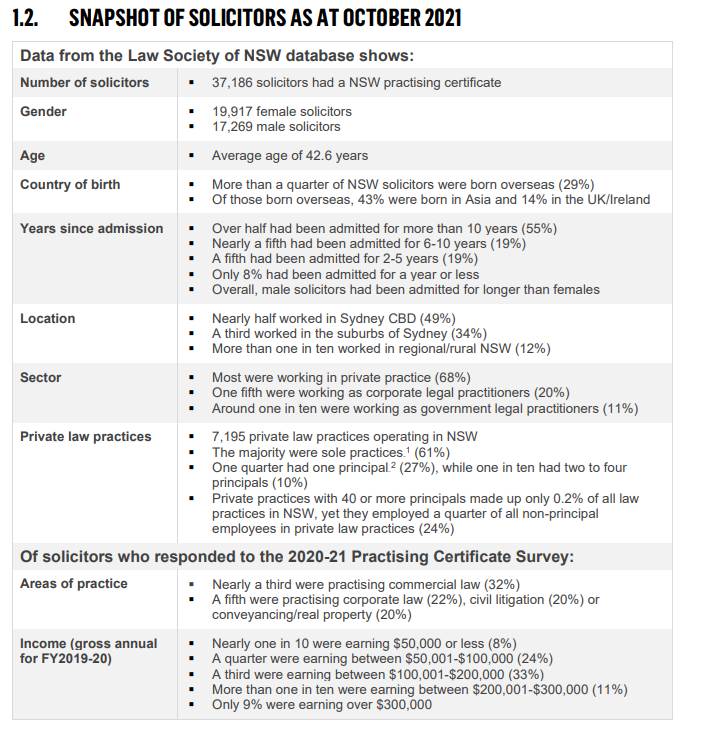
In conjunction with Urbis, the New South Wales law Society recently published its 2021 Annual Profile of Solicitors in NSW Report. This latest snapshot of the legal profession in NSW has some interesting take-outs, so I thought I would highlight them in the first blog I have done in several months…

A Snapshot of the Industry

Overall the industry is healthy. There are close to 40,000 solicitors in NSW with current practising certificates (I would be interested to see what that number would be if the cost of maintaining a practising certificate wasn’t so high!).

Lady Justice would be happy to see that for the 5th year in a row there were more female solicitors with practising certificates than males, BUT there is still a LONG WAY to go for female parity here.

So where do we all work?

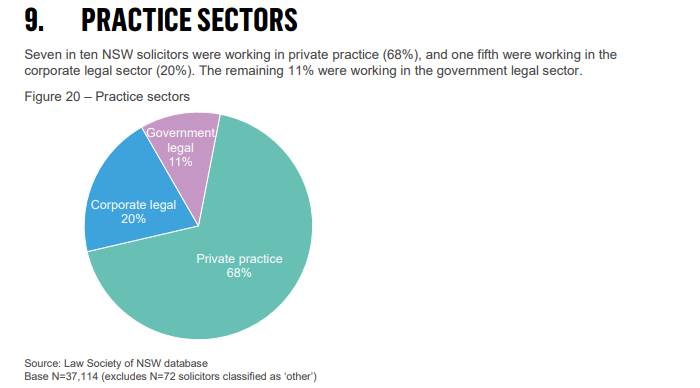
7 out of 10 solicitors in NSW work in private practice

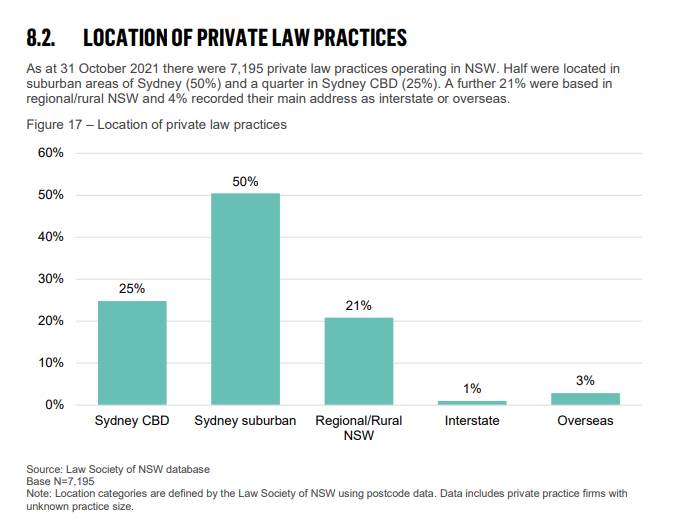
And most of those private practitioners don’t work in the CBD…

The surprising figure for me there was only 3% have overseas addresses – which, given how popular Australian lawyers are overseas, indicates a data/price issue.

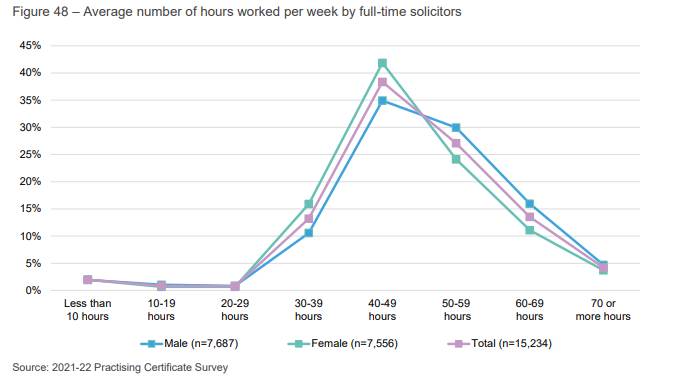
But how hard are we working?

Bloody hard….

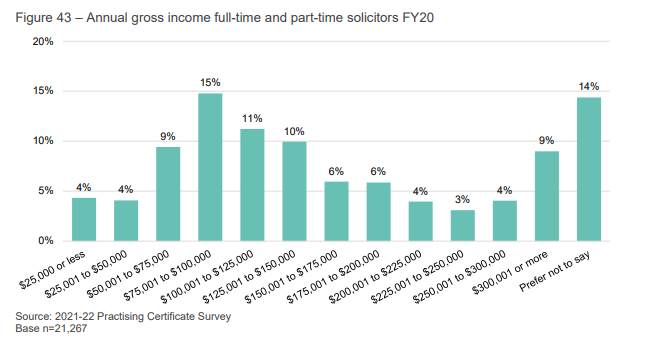
Okay, so how much are we earning?

Well, not a lot really – more than half earn less than $150,000 per year (think ‘student debt’, think 50 to 60 hours a week)…

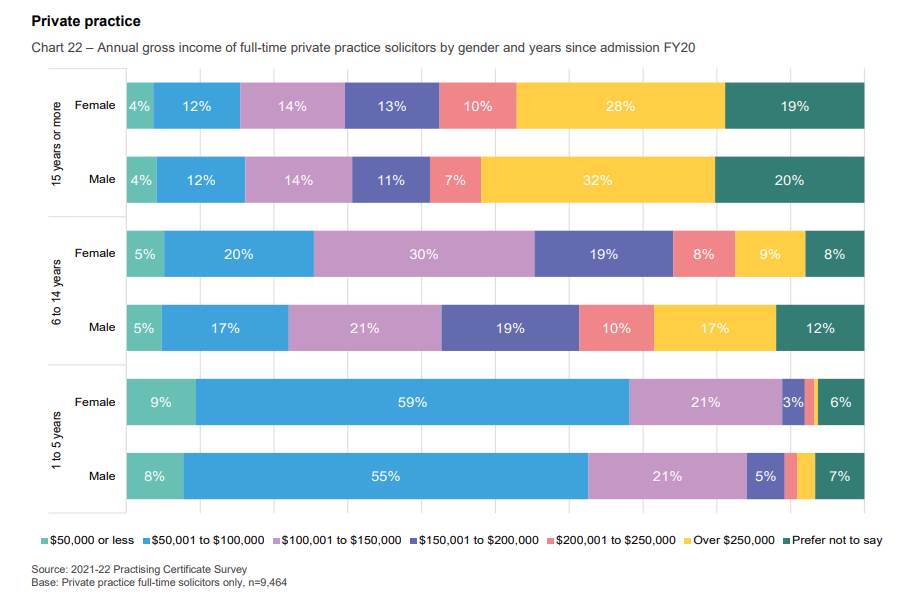
But men and women get paid the same – right?

Not exactly. While you might start out the same – the longer you work, the more likely men will get better paid than women in private practice in NSW…

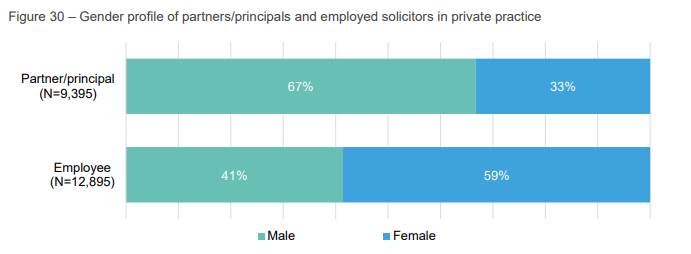
But I thought Lady Justice had our backs…

Yeah, not exactly. Headline stats can read well, but scratch the surface and you might find a problem…

and if that is not a graph of gender in-balance, I don’t know what is…

As usual, comments are my own and I welcome feedback.

Have a great week all.

rws_01