business development

#BigLaw is far from dead

Business Development image

Has the death knell of #BigLaw been rung too early?

Despite all rhetoric to the contrary, three reports published within the past week would suggest that the business model of #BigLaw is far from dead.

  1.  Citi Private Bank’s Law Firm Group report*

The first, published in the American Lawyer, was Citi Private Bank’s Law Firm Group‘s quarterly report on financial performance in the legal industry.

While this report headlined as ‘Despite Growth, Law Firm Forecast Dims for 2015‘, it is worth noting the following three paragraphs from the report:

“Looking at the results by firm size, the Am Law 100 firms saw demand and revenue momentum build. For the Am Law 1-50, part of the positive momentum is due to some moderation in 2014 results from the first quarter to the first half. The Am Law 100 firms are also better poised than smaller firms for near-term revenue growth, given that they had comparably larger inventory increases (especially in accounts receivable) at the end of the second quarter.

The Second Hundred was the only segment that saw a drop in demand. It also had the lowest increase in inventory (2.3 percent), so the third quarter will likely be particularly challenging for these firms.

Despite the momentum generated by the largest firms, it was the niche/boutique firms that had the strongest first half overall. Revenue was up 7.0 percent on the strength of a shortened collection cycle (compared with a lengthening for the Am Law 100 and Second Hundred segments), as well as modest increases in demand and rates. The niche/boutique firms also posted the smallest increase in expenses, 1.9 percent, creating a substantial widening of the profit margin. Because of the accelerated inventory turnover and only modest improvement in demand, however, inventory for these firms was up only 2.8 percent. These smaller firms may therefore find the second half of the year more challenging than the first half.”

So, while mid-tier firms appear to see revenue in decline, the top-end of town was actually seeing demand and revenue momentum build.

[* The results of this report are based on a sample of 177 firms (83 Am Law 100 firms, 45 Second Hundred firms and 49 niche/boutique firms)]

2.  BTI Consulting report**

The second report is a snippet from BTI’s Annual Survey of General Counsel and goes under the bye-line: ‘Large Law Edges Out Mid-Sized Firms for New Work, with Higher Rates‘.

Here, BTI Consulting’s research found that:

“60% of law firm hires went to larger law firms (650 lawyers or more) in the last year. Clients report hiring large law as a result of increased and more pointed attention—think industry knowledge and more specific discussion of company issues. Think less about your firm statistics and more about the people to whom you are talking.”

Possibly more damning, however, was the observation that:

“The onus is on mid-sized firms to do better. Clients expect mid-sized firms to bring more client focus and more business understanding than large law—but are not always getting what they expect. And, mid‑sized firms have to demonstrate vastly better understanding of their potential clients’ targeted objectives than large law.”

[** Research is based on 280 in-depth interviews with corporate counsel at companies larger than $750 million in revenue as part of BTI’s ongoing Annual Survey of General Counsel.]

3. CommBank Legal Market Pulse Conducted by Beaton Research + Consulting

The last report is a little closer to home, Q4 2014 results from CommBank’s Legal Market Pulse conducted by Beaton Research + Consulting.

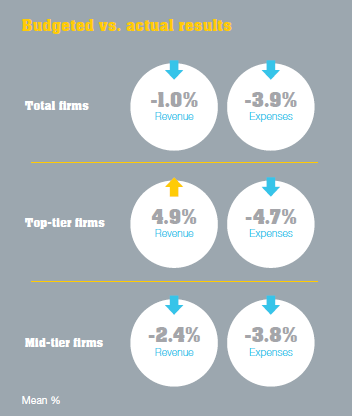
I’ll most likely review the findings of this report more closely in a post later this week – and it may even be interesting to compare them against previous Q2  & Q3 reports – but for the purposes of this post I believe we don’t really need to go past the following infographic from the report:
CBA Q42014 Graph

which would certainly seem to indicate that “top-tier” firms are far happier with overall FY2014 results than their “mid-tier” cousins.

Bringing it all together

So, what does this mean?

To my mind what these three reports cumulatively evidence is this:- while #NewLaw may have arrived, and while it may be here to stay, what is increasingly clear is that #BigLaw is not the market segment that needs to be concerned with this development.

Nope, dig a little deeper and I think you’ll find that it is actually Managing Partners in firms with revenue in the A$20-A$70 million range who will be having a lot more restless nights sleep…

“… we are being asked to do less with less”, Ann Klee of GE

Business Development image

Work in the legal profession for more than 5 minutes and you’ll hear someone say that clients today are asking the law firm to do “more for less“. It is probably one of the fastest terms to become a cliché in the English language.

So imagine my delight, when watching a video of a presentation given by Ann Klee, VP of Global Operations — Environment, Health & Safety, at General Electric Company at the recent Big Law Business Summit, in describing how (in part) GE managed to reduce its outside legal spend by $60 million in a year, she says that the bottom line is that the role of a lawyer today is about managing more risk, it’s not about just being asked to do more for less, it’s being asked to do less with less (see 16 minutes and 15 seconds into video).

This absolutely spot on.

Law firms today need to:

  • partner with the business to empower their clients,
  • always be looking to deliver on outcomes, not to be following procedure for procedure’s sake (or, worse, following procedure to blow out legal fees),
  • through the use of legal project management, agile or some other mechanism that works for you: identify and eliminate any workflows that are adding no value to the deal/advice.

In short: we need to be doing ‘less for less‘, but we need to be doing it in such a way that is “faster, better, and smarter” for our clients.

At the end of the day, clients like GE are already doing this – so law firms today can either get on board with solving their clients’ problems from their clients’ perspective, at a standard of accountability that their clients are being held to; or they face the very real prospect of becoming irrelevant.

Fannie Mae’s GC says “Call Me When I’m Not Sending You Work”

Business Development image

Part 1 of an outstanding interview with Fannie Mae’s General Counsel Brian Brooks was published to Bloomberg’s Big Law Business website on Friday.

Although full of insightful comments and suggestions for private practitioners, my favourite is this:

“[Then] there are lawyers who are really sources of market information and intelligence, who are always letting you know what’s going on in your industry, even when you yourself may not have a need for them that day. Those are the people who really become the trusted advisors.

I know that phrase “trusted advisor” gets overused. Maybe it becomes trite, but it really means something. What it means is that, even when I’m not in a position to send any work your way, you’re still going to pick up the phone and let me know what’s going on in my industry.”

Brian puts the dynamics of the client-lawyer relationship pretty simply really.

He also has something to say on ‘depth versus breadth’ that’s well worth a read, so wonder on over and take a read.  In the meantime, I’ll look forward to Part 2.

Loyalty programs revisited

Business Development image

Back in March of this year I blogged that loyalty programs were likely an under-utilised means by which Australian law firms could differentiate themselves in a highly competitive legal market. I was, then, particularly happy to see that recently Australian Government Business (www.business.gov.au) blogged  on a similar issue – ‘Customer loyalty or reward programs‘ – which looked at, among other things:

  • What customer loyalty programs are.
  • The benefits and risks of a customer loyalty program.
  • Tips when implementing a customer loyalty program.
  • Legal and compliance issues for customer loyalty programs.

A lot of which is directly relevant to law firms looking to implement a customer loyalty program.

Why you should think of implementing a customer loyalty program in your firm

As far as law firms are concerned, the perennial question has been:

How do we make sure that our customers [clients] understand the benefits of being exclusive to our brand?

Here, while we have known for a long time now that the ‘customer experience‘ has been the bedrock of customer loyalty, it has only been in recent times that we have been able to show that loyalty programs can, and do, add to this overall customer experience.

But customer experience isn’t the only reason why law firms need to think carefully about implementing a loyalty program. Other benefits include:

  • gaining a better understanding of the customer buying behaviour – which practice groups are they using, when, how often, why? Are they using more than one partner in a practice group or the same partner?
  • increase you brand recognition within your existing customer base – putting in place a formal loyalty program should go some way to helping you promote you law firm internally within your client’s business; if for no other reason than water-cooler chat.
  • increase your word of mouth referrals.
  • provides an added incentive for clients to give you work rather than a like skilled and experienced firm (i.e., all things being equal).
  • can be used to help recognise referrers to the firm – if you include referrers in the program, all things being equal they will more likely refer clients to your firm than a competitor.
  • it can help you implement formal and informal customer listening and feedback programs (as part of the program offering).
  • it will help members of your firm get to know who your key customers are and what they do.
  • it should provide your firm with a platform to cross pollenate into other service areas without looking like a hard sell.

You could also find that putting a customer loyalty program in place leads to greater use of your much underutilised CRM systems!

All that said, a word of caution for those who are intending to implement a customer loyalty program in their firm:

  • customer loyalty marketing must start with the law firm demonstrating loyalty to the client. Much like the trust it is built on, you cannot expect loyalty from your client if you are unwilling to offer the same type of loyalty to your client,
  • the foundation of a customer loyalty program is a promise. If for any reason whatsoever you are unable to fulfil on that promise, then you shouldn’t implement the program, and
  • always keep in mind that while the lawyer inevitably gets the credit when things go well, it is the brand that gets the blame when things go wrong – so make sure that at the heart of you customer loyalty program is always a dialogue between you and your client.

Get it right though and a well implemented and executed customer loyalty program could be just he thing your firm need in order to differentiate itself from the market.

China, #Auslaw firms, and the $400 billion lost opportunity

Business Development image

Last week I blogged that Australian law firms were missing out on a massive opportunity by not being better at selling Australian law, and Australia more broadly, as an alternative venue to London and New York. One of the things that I commented on in the post was how Australian law firms were falling short on their ability to sell venues such as the National Stock Exchange (NSX) and Australian Stock Exchange (ASX) as alternative venues on which Asian, and Chinese in particular, companies could look to to raise capital.

It could not have been more timely then that later in the same week Reserve Bank of Australia (RBA) Governor Glenn Stevens added a monetary value to the opportunity being missed here – $400 billion.

Yeap, Stevens is quoted in this article as saying:

“…capital markets should prepare for a world where China invests $400 billion a year offshore.”

So, the question I asked in my blog last week remains:

“What is your law firm doing to capitalize on this opportunity?”

Because there is absolutely no doubt in my mind that while we ponder this question others in the region are touting the benefits of Singapore, Hong Kong or a whole raft of other suitable offshore venues.

Is a law firm in your pocket the next big thing?

Business Development image

A 54-page report out last month [July 2015] by UBS analysts in London, New York, Hong Kong and Japan, working with consultants at KPMG, titled “Is a bank in your pocket the next big thing?” (extracts of which have been published in today’s Sydney Morning Herald), that surveyed 67 bank management teams in 18 countries, predicts that as much as 11 per cent of Australia’s bank branches are threatened by closure over the next three years as a result of the proliferation of mobile banking.

According to numbers cited in the article, on the latest data available from the Australian Prudential Regulatory Authority (the relevant governing body), an 11 per cent closure of local bank branches would amount to circa 603 branches closing.

Thinking “this is banks, what have they got to do with law?“; or “law is different“?

If so, take a second to process this: we are no longer talking disruption of an industry here, we are now talking about transformational, fundamental technological change in society.

As the UBS report says:

“Going forward, emerging technology and innovation will further enhance mobile banking functionalities that aim to develop deep customer relationships and superior mobile banking experiences, such as communication enrichment, a comprehensive ‘mobile wallet’, and content monetisation, (for example) revenues related to music and e-book downloads.”

… not seeing it?

How about this quote from Commonwealth Bank of Australia (CBA) chief executive Ian Narev at a lunchtime function in July:

“These days, you have to understand in real time what your customers are doing and react in real time,” Mr Narev said. “And that aspect in the use of technology to drive customer engagement will be our number one priority.”

For any doubters out there, the final nail in the coffin for me was this:

“The report also showed how the mobile channel is catching up to the internet channel, with mobile expected to be used by more customers than internet web pages in three years.”

So, how are your customers buying your legal services? And how confident are you that they will still be doing the same in three years from now?

Because you never know, your law firm could very well be the next app in your client’s pocket…

Australian-based law firms are failing to sell Australia as a forum to Asian clients

Business Development image

Today [29 July] the Australasian Lawyer has a post detailing a recent report by Baker & McKenzie that:

“cross border IPOs in the Asia Pacific region have increased by 75 per cent in the first half of this year.”

 Wow, Capital Markets and Corporate teams across the Region have really struggled since the GFC and seen a lot of layoffs in their teams so this must be music to their ears!

But what about Australia?

Well, it appears the news here is not so good. According to David Holland, head of Baker & McKenzie Corporate Practice in Australia:

“Australia didn’t see much activity and the regional boom is unlikely to have any significant effect on the Australian market specifically”.

Sorry but this is not acceptable.

Australia not only has a robust principal stock exchange in the ASX, but we can also offer traditionally family run Asian companies access to a very friendly IPO forum in form of the National Stock Exchange (NSX) of Australia, pitched as being:

the market of choice for SME and growth style Australian and International companies.”

Listing and reporting rules for both are pitched as being much less onerous than is the case with other stock exchanges across the region.

So, why are we missing the boat here?

To my mind the answer to this question is this:-

Australian law firms and government bodies are failing in their duty to sell Australian law as a viable forum for international business.

Yes we missed the boat on selling Australian law as the governing law for international agreements – the English and Americans (New York) beat us at to that. But in this case we have a very distinct advantage that we are simply not pursuing or pushing.

To be clear, we’ve known for some time that Asian governments (particularly China) have been advocating for their domestic companies to list overseas in order to show transparency. We’ve known for a long time that control remains a massive issue for Asian companies (particularly family run businesses) and IPOs are, as their name suggests, capital raising exercises.

And what have we done about it?

Pretty much nothing. Few, if any roadshows. The occasional newsletter. Maybe the odd seminar.

In short, nothing.

Looking for a silver lining?

Luckily for us there is one in an ABC article from February of this year “China-based companies to list on ASX to avoid Asian stock market costs and free float requirements“, which points out that:

“Smaller Chinese companies are looking to list on Australian stock market operator the ASX to avoid the cost and free float requirements of larger Asian exchanges.”

All we need to do now is get out there and spread the message!

The battle for Asia’s inbound investment

Business Development image

I was interested to see that The Lawyer has an article today [27 July] by David Rennick, the head of Pinsent Masons’ relatively new Australian outlet, on the competition between English and Australian law firms for prize Chinese’s infrastructure investment work (‘Never mind the Ashes: England and Australia are battling for the Chinese investment prize‘).

When I first arrived in Asia back in the early 1990s, most of the conversations we had with governments and businesses around “investment” in the region nearly always took the path of inbound [into Asia] investment: in that investments largely moved in one direction, from West to East, and appropriately attractive and protective legislatively schemes around those investments were always being sought.

Possibly due to the GFC, although I would be more inclined to say as the likely result of a progression in time and a growth in Asian economies post the Asian Financial Crisis troubles, a shift has taken place: today when we are in conversations around “investment”, this conversation has taken on a new life and we are just as likely to be discussing outbound [from Asian] investments into the West or into other developing nations/areas (such as Africa) as we are about inbound [into Asia] foreign direct investment.

I love infographics and clear evidence (if it was ever needed) of the shift taking place in the conversation taking place here can clearly be seen in two amazing recently published infographics: one by the South China Morning Herald (‘Chinese outbound investment to rise to another record‘) and the New York Times (‘The World According to China‘).

And while both of these show a massive increase in outbound direct investment by China and Chinese companies (and people) over the past decade, decade and half, what they don’t necessarily show is the different reasons/discussions that are taking place for/around these investments.

To be clear, while Asian (including Chinese) companies and governments are investing overseas for a multitude of reasons, they largely centre around two principal reasons:

On the one hand, the governments – including State Owned Corporations – need better returns on their investments than they would otherwise be getting at home or else they need to diversify this investment. We typically see this type of investment with Singapore’s Temasek and GIC (Government of Singapore Investment Corporation). More recently we have seen foreign pension funds investing in Australian infrastructure in this way.

On the other hand, we see investments in western businesses by Asian companies and organisations looking to purchase technical knowhow in order to up-skill themselves. An example of this can be seen with today’s announcement that: “A major Chinese venture firm has launched a US$5 billion fund devoted to buying up Western technology, internet and biotech firms that are looking to enter the Chinese market.

And it is for this reason that unlike David Rennick I don’t believe English or Australian law firms should be strategically looking at the Chinese for inbound infrastructure investment work (with the caveat that this doesn’t include strategies around the Chinese-led Asian Infrastructure Investment Bank (AIIB)), because I believe that type of inbound infrastructure investment work (once Australia can work out a suitably attractive investment vehicle for foreigners to invest in infrastructure) from Asia will more likely come from Korea, Japan and Singapore (under relevant FTA provisions with these countries).

For Chinese related inbound investment work, English and Australian law firms would do far better to be courting M&A and R&D work, and in this field they will find a much hungrier and more sophisticated competitor – the US law firm.

“You actually need to be in Asia to understand Asia.”

Business Development image

“You actually need to be in Asia to understand Asia. You cannot look at it from a distance, or certainly run a business in Asia from a distance. So, unless you are actually in Asia and focused on Asia and the different markets in Asia, it’s very difficult to understand the different markets, their stages of development, and how you need to run your business in those markets. And certainly you can’t do that from London or New York. That’s a fundamental point.” – Stuart Fuller, King & Wood Mallesons

The above quote, which I couldn’t have put better myself, is from an interesting interview between columnist David Parnell and Stuart Fuller, Global Managing Partner of King & Wood Mallesons (‘Stuart Fuller Of King & Wood Mallesons, On Vereins and Succeeding in China’s Legal Market‘) posted to the Forbes website on 20 July 2015.

A lot can be said about the ‘Mallesons’ strategic approach to Asia (or, probably more to the point, the lack of it) in its days as ‘Mallesons Stephen Jaques’ – when the firm was rumoured to be heavily courted by the likes of Clifford Chance and Linklaters in the UK – but since the tie-up with King & Wood (and the subsequent merger with SJ Berwin), the firm that is KWM, as it is now affectionately known, has certainly turned a corner, got its strategy ducks lined up and come a long way.

To my mind evidence of this is clear in the following two paragraphs by Fuller:

“Secondly, it’s a business model issue. If you come into Asia and run a Western business model, then you are likely to lose money. That’s quite difficult for many of the international firms because they have such powerful and strong business models in their home markets, and they export them to the rest of the world.

Thirdly, some markets are more developed than others, so if you come into Asia and think that because the law firms are younger, that they are less developed, or frankly, in some ways less professional, then you’ll be surprised. There are firms here — us for instance — who have 1200 lawyers and 2000 people across 12 cities in China alone. We have an impressive international business in China operating at an international standard. There are a number of firms across the market like us, and I think that is a surprise to Westerners.”

Absolutely spot on!

Indeed, probably the only thing missing from Fuller is the strength that relationships play in the overall marketplace throughout Asia – both at government level and in many of the region’s family run businesses.

Then again, possibly that’s what Fuller is eluding to when he says:

“And for Western business coming into Asia, the big thing you need to know is how to get things done. The system is different. It’s the lore as much as the law.”

In any event, it is clear that KWM has moved forward a long way since 2012, and I’m not sure the rest of the pack are giving this firm the appropriate credit they deserve.