And how many law firms out there don’t have events teams who are experts in project managing and holding events that they could monetarize the expertise of while leveraging and cross selling other ‘allied services’ – such as their lawyers?
Value Added Services
Bet I can guess on one hand how many law firms will go for a tender like this because this is a ‘free’ value added service.
Big mistake.
Get in touch if you want to chat about the “allied services” your firm is offering.
Earlier today (8/4/2024), The University of Sydney Business School and KPMG published their ‘Demystifying Chinese Investment in Australia (April 2024) report‘ (Report) into Chinese investment into Australian businesses. If you are a lawyer with a practice focus on inbound Chinese investment, the Report makes for very sobering reading:
Chinese investment in Australia fell 36 percent to AU$1.34 billion in 2023
This represents the second lowest year in investment value since 2006
Only 11 corporate transactions between the two countries were recorded in this period
The Report covers the period January to December 2023, only relates to corporate (not individuals) and excludes Hong Kong and Macau investment in Australia (i.e. Mainland China only).
Nonetheless, the Report reads bleak – particularly given how many law firm practices here in Australia rely on this type of work to survive.
Any positives?
So, are there any positives in the Report to write home about?
Healthcare was a big winner – accounting 42 percent of the total Chinese investment into Australia – although it should also be said, their accounted for two transactions totaling AU$562 million.
Agribusiness had a big bounce – representing a 21 percent increase in value through to A$283 million. Again though, this was through two deals!
Mining was the big loser with a significant decrease from A$1.8 billion in 2022 to A$34 million in 2023!
Anything else?
With a whopping 82 percent of total investment into Australia, NSW is the home of the largest share of Chinese investment – A$1.01 billion. Victoria accounted for 16 percent followed by WA with a mere 2 percent. Have to wonder what that means for Queensland
As I said at the start, all in all not a great read if you are an Australian lawyer looking for new business out of China. One ray of hope is that investment from privately owned enterprise saw a slight uptick in 2023 – up from A$641 million in 2022 to A$878 million. I suspect a large part of this would have been in property related transactions, because if it wasn’t the Australian-based property lawyers out there with Chinese clients seriously need to think about pivoting their practice!
As always, get in touch if you want to talk through any of the above.
For someone like me, who was at the forefront of the early development of international firms expanding into Southeast Asia from 1996 (remember when Dewey & LeBoeuf had a Bangkok office, or DLA Piper Bangkok was a shipping insurance firm?), some of the top level take-outs – that apply as much today as they did then – were:
🎯 “The problem we have in this part of the world is that our brand isn’t as known,” 🎯 firm brands simply do not supersede interpersonal relationships, 🎯 American law firm brands have not penetrated the Southeast Asian market in the same way that American consumerism has. 🎯 The stark truth is that no homegrown Southeast Asian company is more likely to approach any of the elite American firms over British firms such as Clifford Chance, Allen & Overy, and Linklaters, all of which have been entrenched in Southeast Asia for decades [my comment: although CC has closed its Bangkok office] 🎯 While in the U.S. and even in the U.K., it may be obvious which firms are competing for which types of clients, the target clientele in Southeast Asia is ambiguous and unclear.
But the Big 2 take-aways for me were: 🎯 Every jurisdiction within Southeast Asia is different [My comment: So, so true!]. 🎯 Clients want firms that can show what they can bring to the table, how they can add value, and can tell them clearly how much their services cost.
It’s a great article and well worth a read if you are looking to expand into Southeast Asia in the near future.
And if you are, feel free to contact the team at GSJ Consulting , we know what many of the pitfalls are…
Having spent more than a decade of my working life in South East Asia as a lawyer (at least for the most part), and with lots and lots of good friends still there, I found this article in the AFR today interesting.
It is my sincere hope that Australian law firms give it a real go, but track record suggests (see this blog post of mine from 2014!) the journey will not be an easy one.
And if you are a law firm looking to move into South East Asia, feel free to give me a call – after all, I was there pre Linklaters, Clifford Chance (both of whom I worked with), A&O, NRF, DLA and all the others (apart from Bakers who were there, oddly under an Australian Managing Partner 😂).
As always, get in touch if you want to talk through any of the above.
A recent article in the Global Legal Post by Ben Edwards: ‘Law firm marketing and business development teams spend more time firefighting than on strategy‘ threw up some very interesting – if not predictable – stats:
Two thirds (65%) of marketing and business development teams [in law firms] are spending more time firefighting then developing strategy
80% of that 65% spend at least 2/3rds of their working year extinguishing fires, over providing strategic thinking
Just over half (57%) have a seat at the head table [when it comes to strategy input]
69% of respondents said they spent most of their time on addressing short-term issues rather than focusing on long-term initiatives.
And the number #1 reason given for why law firm marketing and business development teams were running from one fire to another – a lack of investment in resources.
All of which leads me to ask this question:
Do law firm partners value the service they get from their business development and marketing teams?
Another way of putting that question is this:
Do law firm partners understand the strategic value that their business development and marketing teams can provide?
Because the evidence would suggest that they don’t.
By putting – let’s be frank – high paid personnel on firefighting tasks, your firm will not be getting good value for money.
So here are my 5 reasons why your business development team should be working with you on your firm’s strategy and not just putting fires out:
1. Industry focused
Most business development professionals are laser-focused on industry expertise. They understand a particular industry sector – such as energy, resources, financial services, FMCG, property – and by and large stay in their lanes. As such, many have a deeper understanding of what is happening in that industry sector than the partners they work with.
2. Market knowledge
Really good business developers are on top of market trends and competitor intelligence. They should be able to tell you what your competitors are up to, how your competitors are ranked in the market, which clients your competitors are acting for and the relevant lateral movement in your sector.
3. Relationship Building
A critical skill of good business development professionals is building relationships. They should be able to not only tell you who the General Counsel at client and target clients are, but also who the lead procurement team will be on a pursuit or tender opportunity.
4. Data analysts
A good business developer should be able to look at a set of data and provide you insights. For example: should you be worried if the number of instructions you are receiving is on the decrease, but the value per file is significantly increasing?
5. Results driven
Every good business development professional will tell you they are only as good as their last result! By nature, they are very results driven and don’t rest on their laurels.
So there you go, my 5 reasons why you need your business development team working with you on your next strategy day rather than just putting out fires!
Also, get in touch if you need help with any of the above.
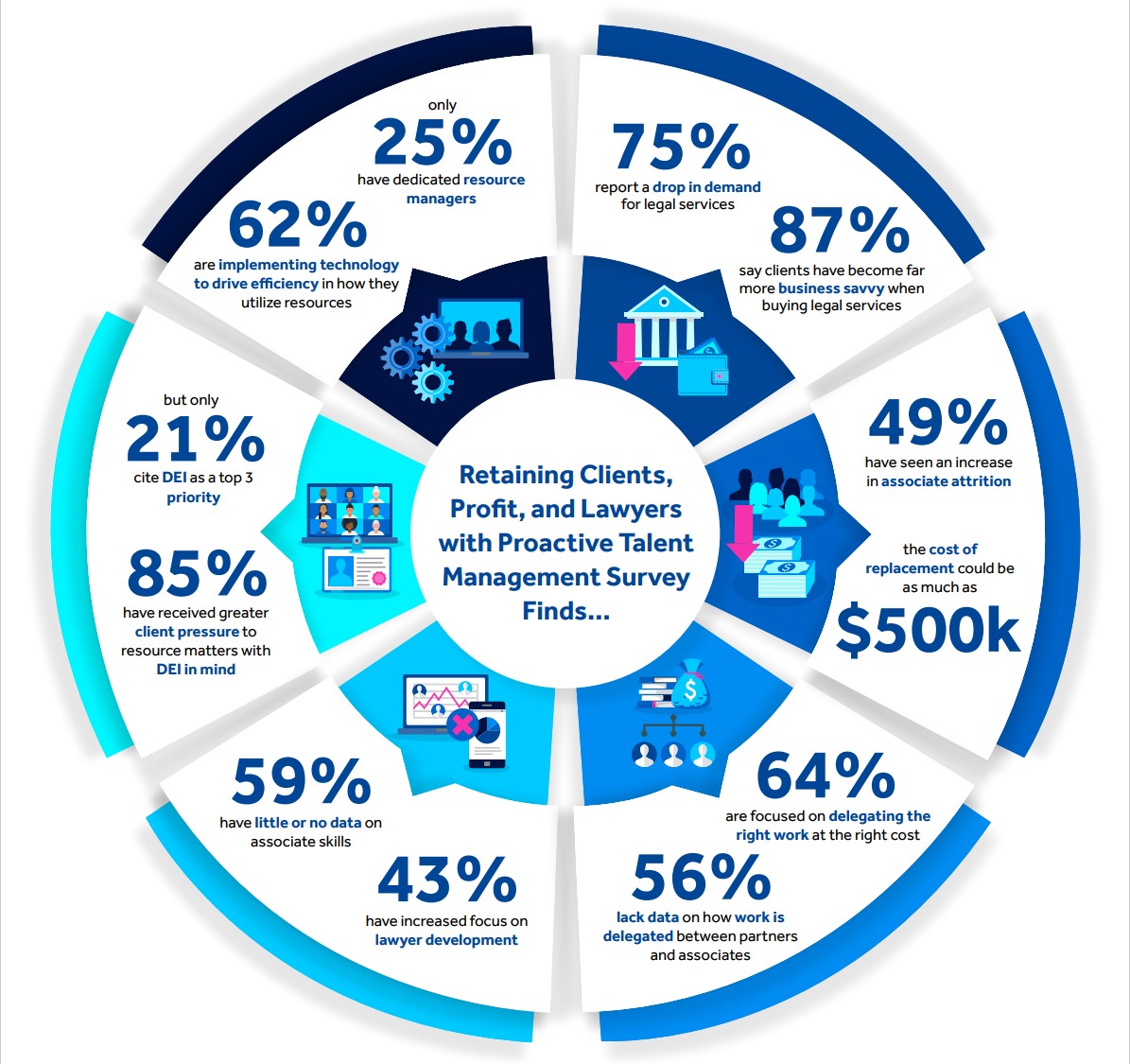
If you’ve wondered how much replacing that associate or senior associate who just left you is going to cost, then a recent report from Big Hand provides the answer: circa $500k.
That’s right, a cool half a million dollars!
Those costs won’t always be upfront and apparent, they will include:
a possible increase in salary for your replacement associate over your previous associate’s salary (due to market pressure) – which is somewhat ironic as salary may well be the reason the old associate left you!
commissions to talent agents to find you said new associate
increasingly – signing on bonuses
training costs over the first 12 – 18 months to bring the new associate up to scratch on your firm’s systems and business development strategy.
The list of actual and hidden costs here is almost limitless, and so the overall cost to your firm of replacing that departing associate/senior associate could actually be a lot more than $500k. Which begs the question:
with 49% of surveyed firms having said they had experienced an increase in associate attrition, you have to wonder why this isn’t an area where more firms are focusing their attention?
And with 75% of surveyed firms having said they have seen a drop in demand for legal services, is this a cost you really want to be incurring right now?
If you need help looking at your firm’s strategy, how to retain associates and differentiating your practice from the crowd, get in touch!
Yesterday (13/11) was World Kindness Day, and while I think that’s a great idea/concept – with the level of mental health issues that we have in the legal profession, you have to ask yourself:
Why doesn’t every law firm office have one of these benches?
I put a post up last week on LinkedIn, off the back of a very interesting blog by Jordan Furlong on his Substack feed: ‘The legal world in 10 years (if we’re really lucky)‘, that got some social media traction so I thought I would re-share here.
At the heart of my LinkedIn post was a comment Jordan makes on – what he calls – High-Value Retainers and the effect Gen AI will have on these fee arrangements. To quote:
High-Value Retainers Thanks to Gen AI’s consumption of many traditional tasks, lawyers have moved up the value ladder, going beyond “bet-the-company” and “run-the-company” work to start offering “grow-the-company” work (or “advance-the-individual”). These are engagements in which lawyers ask: “How can I improve your situation? What are your near-term and long-term goals? How can I help you anticipate problems and prevent them before they happen? How can I bring you more stability and peace of mind? How can I be your advocate and counsellor in whatever you need?”
While I think Jordan’s point is an excellent one, mine was this: “Do you think this could work in 10 years time?“
Because if you think it could: Why are you waiting 10 years for AI to develop in order to have this conversation – have this conversation with your clients now!
In that, it’s not a 10+ years from now discussion. It’s not a 10+ years from now problem. It’s a HERE AND NOW problem and a here and now discussion.









 RWS_01's B[D]log