Law firms that conduct formal client feedback programs can earn nearly twice the share of a client’s external legal spend than a firm not engaging in feedback;
in 2023, only 27% of clients were asked to participate in a client feedback program by their outside law firms.
Let’s get a realty check on that: Law firms that have a client experience (CX) feedback program can earn nearly twice the share of a client’s wallet, but less than one in three clients have been asked to participate in a client feedback program.
In business development we often talk about “low hanging fruit” and this seems like a ‘no brainer’ to me!
Get in touch if this is something that interests you. And, frankly, why should it not!
If you don’t have time to read Andrew Malocussions article, and I suggest you do because it’s actually very interesting, the long and short of it is that the reason why big (read global) law firms are losing millions in revenue (opportunity) is because…
… their pricing teams are too small.
All I have to say is, “seriously”!
Do yourself a favour, go back in time 5 years and work out for yourself whether or not the fact that law firm pricing teams are too small is the real reason they may or may not be losing millions of dollars in revenue.
For my part, this type of thinking doesn’t pass the pub test!
Feel free to reach out to me if you want to talk through any pricing strategy related issues/questions.
The numbers have been crunched and the results are in: ‘Dynamic Law Firms’ invest considerably more in their business development and marketing activities/departments than static firms are willing to do.
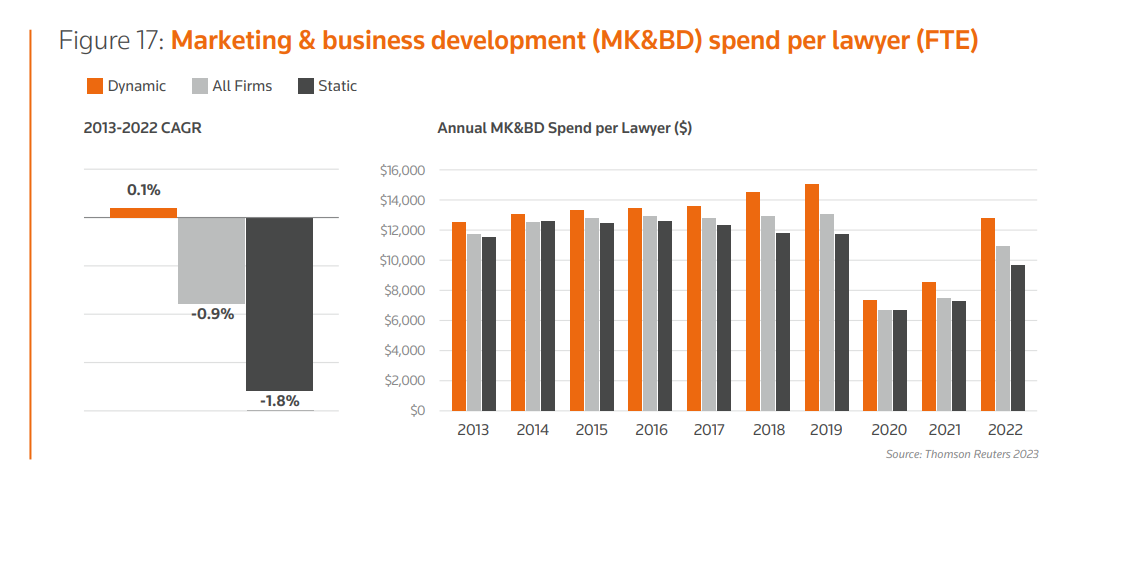
According to the latest (8th) iteration of Thomson Reuters Institute’s 2023 Dynamic Law Firms Report, Dynamic Law Firms consistently invest greater sums in their business development and marketing teams than Static Law Firms:
As you can see from the over graph, in 2022, on average, this investment by Dynamic Law Firms in their business development and marketing teams accounted to over $12,000 per lawyer. Roughly $2,500 more per lawyer than Static Law Firms.
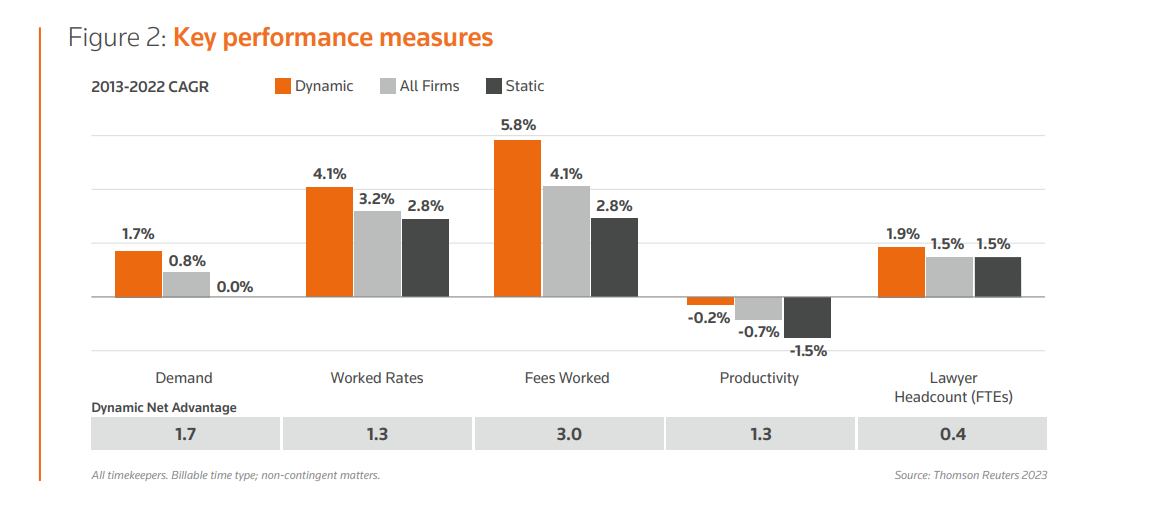
Importantly, this investment in business development pays off:
With Dynamic Law Firms consistently outpacing Static Firms in all growth Key Performance Measures; but, most notably from a business development perspective, in both ‘worked rates’ and ‘fees worked’.
So why is this? After all, business development and marketing is a ‘cost-center’.
Well, as the Report itself states:
“The first goal of MK&BD investment is to raise top-of-mind awareness of the law firm.
Research conducted over the course of many years by the Thomson Reuters Institute has shown that top-of-mind awareness is a vital first step toward winning work – a process that will see a firm move along a continuum from awareness to being viewed favourably, to being considered for and ultimately winning work, and hopefully, to a point where the firm has gained enough experience with the client that they garner credibility in the board room and can begin to box out competitors.”
A fact backed-up by the authors of Simple Heuristics who, in their principle of “recognition” [firm brand or lawyer], state that recognition is number one in any client’s decision process around whether or not to buy something.
And so it goes without saying that this ‘awareness‘ factor is critical in the ‘buying cycle’. If we don’t have this advantage, then we need to hope to hell the other providers aren’t a known commodity so we can proceed to the next level in the buyer’s decision process (typically experience – have they done this before?; then can I trust them not to mess this up and make me look stupid! – SIDE NOTE: price isn’t in the top 3 decision making selection criteria.).
Which is why, if you want to make sure your firm stays one step ahead of its competition, you actually need to be investing more, not less, in your business development team right now.
Yep, the evidence is in. It’s undisputed. Business Development and Marketing is not a ‘cost center’ (not that I ever thought it was). They not only pay for themselves, but they ensure your firms stays ahead of its competitors and earns more $$$s.
So the next time you think to yourself: “I need to cut costs, I’ll cut my business development and marketing budget” – I’m here to tell you that’s dumb – think again, because not only will it hurt you but it will take you on a journey to blandness.
As always, feel free to reach out to me for a chat if you want to talk through how I can help with this.
Ever wondered if there is a difference between ‘customer service’ and ‘customer experience’?
I was fortunate enough to come across this quote by Paul Roberts, CEO at My Customer Lens that, frankly, sums it up better than anyone else I have seen lately:
“It’s important to define the difference between customer service and customer experience. I like to define customer service as what you do, and customer experience is how you make people feel.”
Too often in professional services firms we concentrate on the ‘customer service’ at the expense of the ‘customer experience’; when the reality is that we should be much more focused on the customer experience than we are on the customer service.
As the article states:
“Improving the client experience is about looking at the entire client journey, from initial enquiry through to case completion, and beyond. It’s a rethink and review of every customer touchpoint throughout your organisation; from the way the phone is answered, to your hold music, reception waiting room and website home page.”
Spot on advice.
If you or your firm is struggling to get a grip with this, feel free to reach out to me for a chat.
Woke up this morning – Australia time – to news that had broken overnight that Eversheds Sutherland (ES) and King Wood Mallesons (KWM) had entered into an exclusive alliance, along with a whole lot of DMs (Direct Messages) in my LinkedIn box asked me what my initial thoughts were.
So here I go with some initial, off the cuff, thoughts about this:
With the closure of the 6 KWM offices across the UK, Europe and Middle East, the deal likely brings to a happy end KWM’s sad foray into those markets and puts final closure on the SJ Berwin story.
Both KWM Australia and KWM Hong Kong are not part of the deal. While this is good news for ES’s Hong Kong team – who I hold in very high regard – it seems very odd and shows possible cracks in the Swiss Verin model that is KWM (with KWM China being party to this arrangement). I’ll be very interested to see what this means for KWM Australia in particular.
The arrangement requires – subject to “client preference and conflict clearance” – KWM China to refer all outbound UK, Europe, Middle East, Africa and South America instructions to ES. I understand the “UK, Europe and Middle East”, but why include “Africa and South America” (noting that ES has offices in Africa but not South America that I can tell)? I think this could be particularly telling given both Africa and South America will be geographies in which KWM Australia plays and so there is the potential to see KWM Australia pitching for work against work that ES has been referred from KWM China.
Noting the deal is with “Eversheds International”, there is no mention of whether the consultancy arm of Eversheds is included in the arrangement. If it is, then KWM China has boosted it offering in this space significantly overnight (although there may well be some regulatory restrictions around that [consultancy] in China).
To me though, what will likely make or break this “formal cooperation agreement” however will be:
How are inbound/outbound referrals being tracked?
How are the referring partners being rewarded for the referrals?
And, what will the KWM Australia partners make of all this given access to a network of lawyers in one of their biggest overseas geographic locations, the UK, will be gone? Do they refer work to ES, even though they are not part of the deal? Or do they refer work to lawyers/mates in other law firms who compete with ES in the UK – including, interestingly US firms with news earlier this week that: “Nearly half of the UK’s largest law firms are US-headquartered”.
I guess we will have to wait and watch this space, but my three big observations are:
(1) Not sure what Eversheds is getting out of this deal – do KWM China refer that much work into UK, EMEA and South America?
(2) Looks to be a great deal for KWM China.
(3) Are KWM Australia being left in the wilderness?
It’s that strange time of the year when we start all over again as if the previous 12 months didn’t happen. Only it is not quite as simple as that. From today:
most lawyers will be charging clients 10% or more extra for their services, with little or no explanation about where the extra value is being delivered and with the new fee rate being completely and totally justified by the date in the calendar and CPI rate increases.
judging by the LinkedIn notifications I have been receiving, a fair number of lawyers will be promoted to new roles – “congrats all”. Along with those promotions comes increased fees charged to clients!
So while we are all enjoying the various EOFY parties over the next few weeks, or simply enjoying some downtime over the school holidays: keep in mind that you need to have a carefully crafted value message to explain to your clients why you justify that higher fee rate; and if you want to ensure that your realisation rate stays healthy I suggest it be better crafted than “we are in a new financial year”.
And if you are struggling with any of that, feel free to reach out to me for a chat.
Came across the term “Burden partners” in this article in the Australian Financial Review today. “Burden partners” is a term denoting those partners within a partnership whose cost to the partnership is greater than their contribution.
In simple terms, partners who withdraw more from the kitty than they have deposited.
The reality is that by its very nature (due to economic cycles), there will – from time-to-time – be partners who have years in which they withdraw more than they have deposited that year; but in most cases these partners will have previously made significantly higher deposits than withdrawals and are effectively withdrawing savings (having said that, retained earnings is not a given with law firm partnerships so this is more a reputational issue than financial one).
It is circumstances in which this is a prolonged (and often unfixable) trend where this becomes a problem.
You can also often see this with new partners who have probably been made-up too soon and don’t really have the book of business yet to justify their promotion to partnership ranks.
Either way, if the term “burden partners” sounds familiar and you want to discuss ways of how this can be fixed, feel free to reach out to me for a chat.
As usual, the Report is a very interesting read; but by far the two standouts for me were:
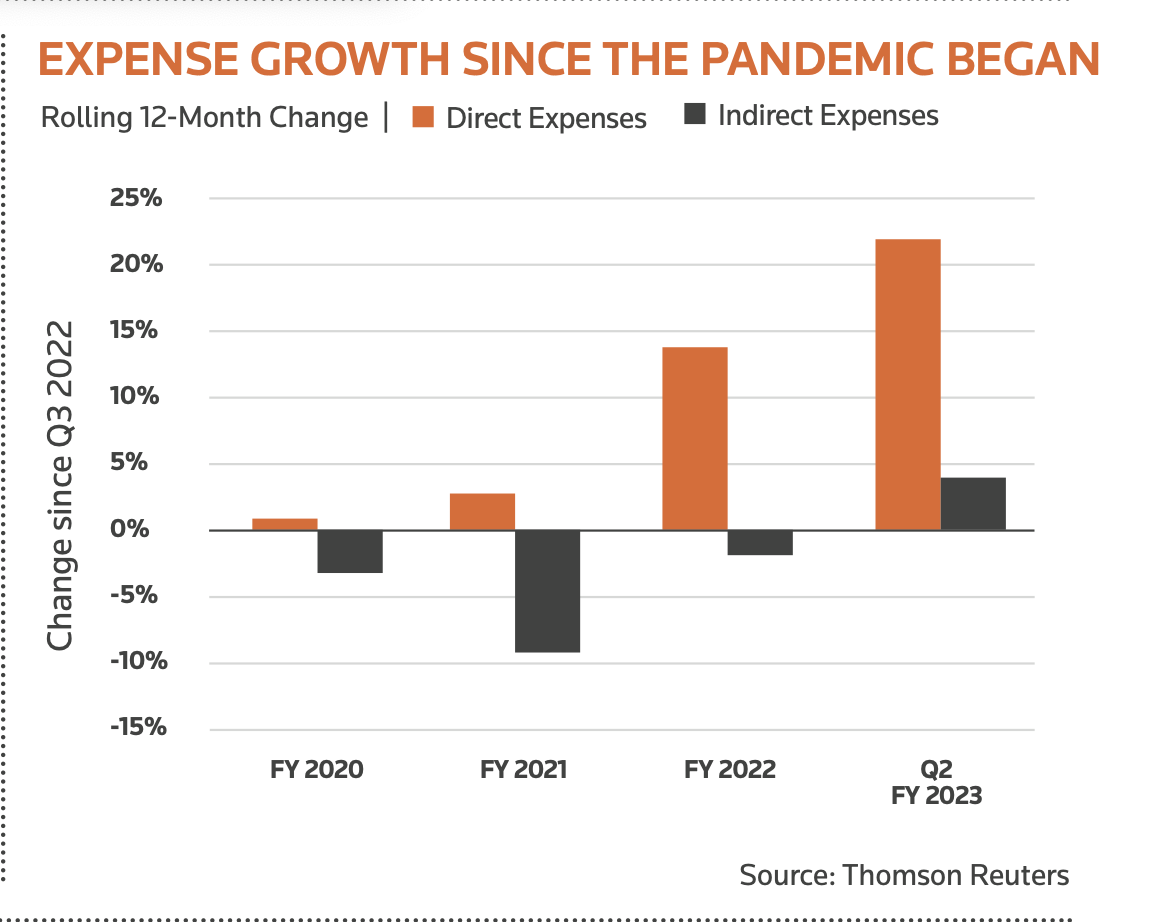
Expense Growth
Notice that rise in Direct Expenses?
That’s down to the pay rises you just gave to your 2 to 6 year PQE lawyers who are now sitting around very under utilised!
Where will clients need help?
The other chart in the Report that caught my attention was where clients anticipate their spend over the next 6 months.
Given the hangover from COVID, Workplace doesn’t surprise me too much.
Dispute Resolution, in difficult economic times, will always be a winner.
But, why Regulatory? We have moved past most of our Royal Commissions…
…and unless I’m missing something there is no growth mentioned for either Privacy or Cyber.
Given the ongoing changes in privacy regulation in Australia just announced, and global concerns around cyber (with IPH Ltd going into a trading halt following a potential cyberattack on two of its member firms this week), this must be an oversight.
If this all sounds too close to home to be true, feel free to drop me a line to talk through how we can fix this up.
Back on deck this week after close to 6 weeks off work (not too uncommon for us here in Australia where January is like July in France!).
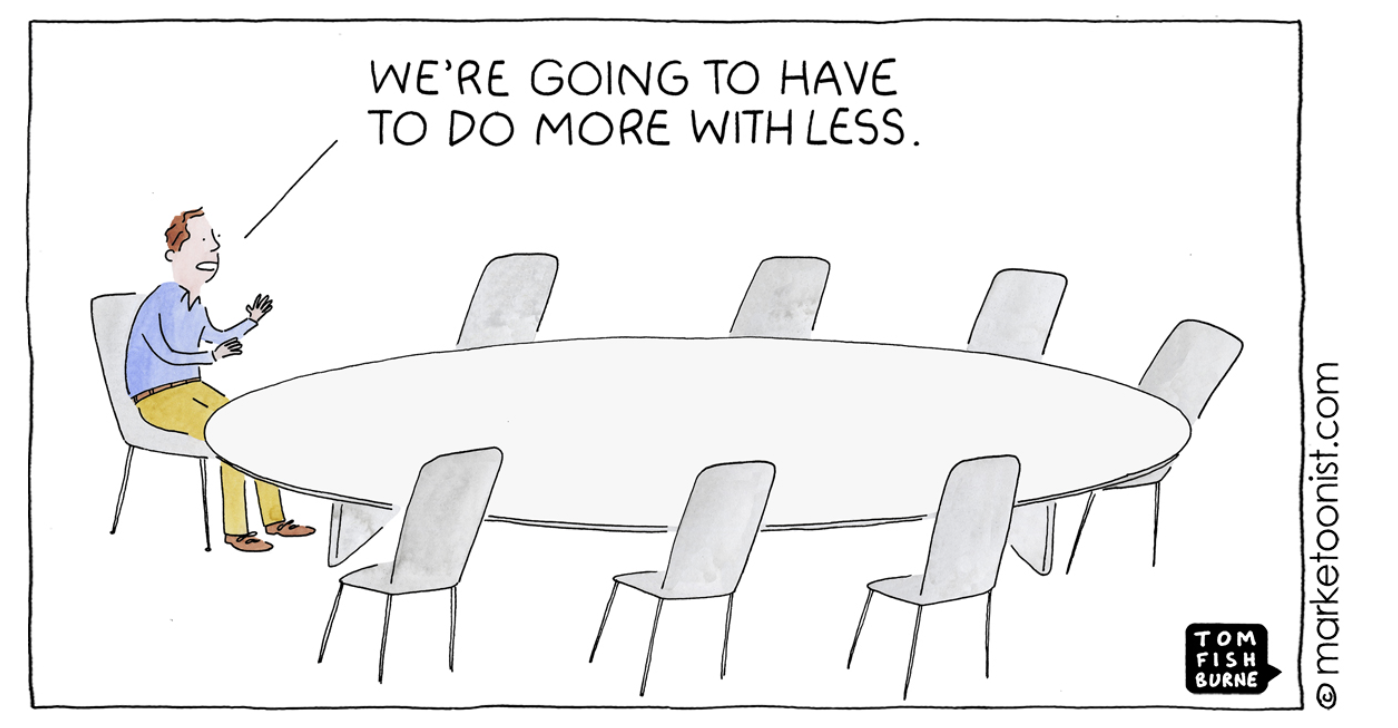
While catching up on my emails I came across this classic by Tom Fishburne. Yet again Tom hits a home run and I suspect many of us will be feeling this pressure over the next 11 to 12 months!
As usual comments are my own. And I hope everyone has a great 2023!
I have only tried to predict what might happen in the next 12 months in the world of AusLaw once. It was exactly 10 years ago – 2013 – and I got it so horribly wrong that many would argue I should never, ever, touch this subject again!
Of course, countering that I would argue that getting numbers #2 and #3 close to right, at that time, showed major insight – and surely you can gift me #6.
But there has to be a reason why I have not done a prediction post since and that reason is: Because I’m rubbish at it!
Instead, these days, I review the predictions of others and opine on whether – from my lofty hight of ‘know it all‘ – they can call it better than I can – which, they usually can!
And so that is why this year I would like to draw your attention to the 2023 Citibank-Hildebrant Consulting LLC ‘Client Advisory Report‘.
In its 15th Year, this Report has done a whole lot better at guessing what the future holds for law firms than I have ever done; and Part II: ‘Looking ahead to 2023 and beyond‘, Section B: ‘Key trends to watch in 2023‘, sets out 16(ish) trends to watch-out for in the next 12 months.
So let’s take a look at what these suggested trends are, and I will then add some comments I might have on them.
THE REPORT’S FORECASTED 2023 TRENDS
The evolution of the hybrid work model to a “more flexible” work model
The growth and reshaping of lawyer leverage
Equity partner growth at more firms
Greater focus on both revenues and expense-related operation efficiencies, including: I. Rethinking space II. Redesigning the professional staff leverage model III. More outsourcing IV. Increased use of project management V. Thinking twice about business travel VI. More investment in technology VII. Improving realization
AFAs
Pre-negotiated discounts
Continued focus on improving the billing and collections process VIII. Greater focus on cross-selling opportunities IX. Financing growth
MY COMMENTS
And here I go with my 2c.
The jury is out with this one – on the part of both the employee and the employer. I read a report the other day that stated employees wanted back in the office with rising cost of living expenses (read gas and electricity, but also inflation more generally). If that is true. get a couple of 30+ degree days in a row running the aircon all day, employees may well want to be working back in the office pronto (anyone else remember going to there cinema to cool-down?). On the other hand, employers are looking to reduce their footprint – after all, rent is up there with salaries winning the Biggest Overhead cost award. Some compromise is inevitable but it would not surprise me if we see a hybrid of a model introduced into Auslaw about a decade ago by Herbert Smith Freehills where you see most lawyers in the office 3 or 4 days a week, but back-office support staff (or Allied Professionals) working mostly from home.
There’s a recession on the way. It has already arrived in many parts of the world. And with a recession comes something called ‘stickiness’ – where lawyers, especially at Special Counsel level, keeping work they could otherwise be passing down to more junior lawyers makes sure they (a) make bonus, and (b) keep their jobs [after all, Special Counsel is the biggest loss leading level in most law firms]!
Unlikely – 5 generations in the workforce and a recession. I’d think you need to be very special to be looking at equity partner entry level at the moment. Now if we are talking salary partner, I would agree. And keep in mind that roles like ‘Managing Associate’ and ‘Special Counsel’ were born out of the 2008 GFC, so we may see more of these job descriptions appearing in job adverts in the near-ish future.
Absolutely, but let’s look at this a little closer: I.’Rethinking space’ – yes, see my response in 1 above II. ‘Redesigning the professional staff leverage model’ – no, see my answer in 2 above III. ‘More outsourcing’ – I wish, see number 8 from my 2013 prediction list! IV. ‘Increased use of project management’ – we have been talking about this for over a decade and if we still haven’t got this right then we don’t deserve to keep putting this on our ‘wish list’ V. ‘Thinking twice about business travel’ – absolute no brainer! Partners’ use of their airmails for upgrades will be a growing trend in the next 12 months! VI. ‘More investment in technology’ – yes and no. Yes if it is for cyber-security (especially client-driven cyber-security requirements), and yes if it is for time-based billing. But no if it is for anything else. VII. Improving realization – AFAs – Pre-negotiated discounts – Continued focus on improving the billing and collections process So much to say here, but all I will say is – rubbish. And what on earth is a ‘pre-negotiated discount’, is that a contractually agreed volume discount? If so, it is not an AFA! VIII. Greater focus on cross-selling opportunities – as I’m currently reading Heidi Gardner and Ivan A. Matviak’s ‘Smarter Collaboration: A New Approach to Breaking Down Barriers and Transforming Work‘ (didn’t realise they were married before I read this) I would hope so. But experience has shown me that partnership deeds drive cross-selling opportunities and not altruistic behaviour a lot better than HBR top-selling books! IX. Financing growth – ahh, maybe we wait and see how the other predictions go! And keep in mind that financial growth does not necessarily mean ‘profit growth’, which should be the main game for any law firm!
Anyhow, as usual comments are my own. And I hope everyone has a great 2023!






 RWS_01's B[D]log