Private equity has scored a partial victory in its push to expand in the US legal market, after lobbyists softened legislation in California that threatened to disrupt liberalisation of law firm ownership rules. Attorneys in the country’s largest state will be allowed to partner on some legal work with investor-owned law firms under the terms of a law signed by Governor Gavin Newsom.
What Does This Means for the US Legal Market?
By far the largest legal market in the world, what does this development mean for the future of the US – indeed Global – legal market? While this compromise isn’t a full liberalisation of the Californian (let alone US) legal market, along with the recent liberalisation of neighbouring Arizona’s legal market, which now allows non-lawyers to own law firms under an “alternative business structure” (ABS) model, it’s certainly a crack in the door. For private equity, it’ll be a sign that resistance to change from within the profession can be negotiated down. For California’s legal establishment, it’s a signal that – finally – the status quo is no longer politically or economically inevitable. For the Global legal market, it’s further evidence, if it were needed, that despite all of the challenges that come with owning a law firm, private equity very much remains interested in this asset class.
While it may feel like we are doing directory and award submissions all year round, the formal season for directory submissions is upon us. Over the next six or so months, you can expect your partners to get you working on submissions to:
IP Stars (September – October)
Chambers (December – January)
IFLR (January – February)
WTR1000 (February – March)
Legal 500 (May – June)
So I thought it might be helpful if we take a deep dive in to the joys of whether or not to submit for that directory listing!
Should we even bother submitting?
Great question!
To be honest, if you’re just starting out and have not submitted to a directory before, then the answer is probably “no”.
The Return On Investment (ROI) – particularly now that private equity has an investment in directories such as Chambers and Best Lawyers, is low at best.
On the other hand, done right (see below for some helpful hints) you can get some useful material for your marketing collateral – such as client feedback quotes to use in capability statements and tenders.
At the end of the day though, directories have nailed the ego trips (aka endorphins) of lawyers and so the decision of whether or not to submit might be out of your control, so…
If you are going to submit, do it right: Some helpful hints
Be selective: First off, don’t go for every directory/award submission possible. Best selective and go for those where you know the research is done properly.
Don’t pay-to-play: Some directories/awards require you to pay a fee to boost your ranking or use client feedback in your marketing collateral. Resist the urge to pay for a better ranking or award!
It’s a long game: Most people [read: partners] think that by submitting a response the world will change over night and they will go from Rank 3 to Rank 1. Unless you have had a dramatic change at your firm, like a big hitting lateral hire – that is not going to happen! Shifting the dial on your directory ranking is glacial, and goes some way to explaining the comments on the ROI above. So if you are looking to invest time in directories and this is tied to your ranking rather than the brilliant client feedback you might get, then look to a 3 to 5 year timeline and make sure you cover off the partners to be profiled comment below.
Referee feedback is vital: Referee feedback is vital to the success of your submission. Get good referee feedback that can be published in the directory and you’ll reap the benefits. What does this mean? Well you’ll be tempted to put the most senior people forward as your referees (such as General Counsel or Chief Financial Officer), but that’s not always the best strategy as they are either too busy to respond to the researcher’s queries, or else have too many firms asking them to be a referee so don’t provide feedback on any. Much better to use a more junior referee who will be delighted to have been asked to provide feedback and give [hopefully] gushing feedback that can then be used by the publication and subsequently by your Marketing and Business Development team!
Case studies: Typically you can submit up to 20 case studies. If you mark all of your case studies as being “confidential”, then you won’t be listed – no matter how impressive those case studies are! Why? – again, the directory publisher will have nothing to publish. So make sure you give the directory publisher material to work with.
Referee-2-case study: Try and link the referees you provide to the case studies you are submitting. You’d be surprised by how may submissions I have seen where there are 20 referees and 20 case studies and absolutely no link between the two. You need to ask yourself what message you are sending the researcher if you are not willing to provide a referee that is linked to the case study you are submitting?
Partners to profile: You are probably thinking this is a no brainer – profile your most senior partners! But, that would be a mistake. Why? Well, in all likelihood they would have been profiled in any event. Much better for you would be to select a mix of partners from senior to junior to profile that shows your firm has in place a good succession and continuity plan – that you will be in business for the next 100 years, not just the last 100 years!
Submit on time: Yes you can get extensions, but they are not looked upon favorably so make sure you submit both your submission and referees on time.
Evaluation criteria
The evaluation criteria for most directory/award submissions are:
So what/Who cares? – Why is your case study important? What sets it apart from other deals that year? Was it the biggest deal that year? Was it the first time something like this had been done? Try and work-up a case study that answers: “So what, Who cares?”.
Validation – This is the client feedback section, so make it count. TIP: Don’t use the same referees every year, kind of looks like your practice might be a little stale!
Peer review – Most people walk past the section where you are asked to nominated peers from other firms you worked with. Again, that’s a mistake. Peer review is a really important part of the evaluation criteria. And why would it not be? – Nothing better than having a lawyer at another firm say how good a lawyer you are and how they wished you worked with them!
Should AI be writing your directory submission for you?
Now, if you have read this far, and want to know whether there are any benefits in AI helping you draft (at least in the first instance) your directory submission, then take a look at an article I contributed to earlier this year on: ‘Why AI should be writing your directory and award submissions‘ [Note: you’ll need to provide an email to get this. If you don’t want to do that, DM me].
And finally
As always, get in touch if you need help with your directory submissions or if you just need them peer reviewed.
Super happy to say that I passed the Association of Proposal Management Professionals (APMP) Foundation Course test and so the team at GSJ Consulting are now accredited tender specialists – a rare feat for a tender provider focused on the professional services sector!
APMP is the peak industry body for proposal managers more broadly than professional services – like those tender writers doing submissions for multi-billion dollar construction tenders, so it really is a great honor to be in this esteem company.
Get in touch if you need help resourcing your next tender.
The Association of Corporate Council (ACC) – the worldwide association that promotes the interests of in-house counsel – recently published its ‘10 Key Findings from the ACC CLO Survey 2024‘.
While I have not read the full report, there are some very interesting take-outs from the Executive Summary, including:
58 percent of [in-house] departments have been impacted by law firm rate hikes
42 percent of CLOs say their legal department received a cost cutting mandate over the past year
23 percent of in-house say that rate increases have been difficult to manage
only 9 percent are “very confident” in their organization’s ability to mitigate emerging data risks
The top 3 issues that keep CLOs up at night are not what you would think [well, maybe one of them!]
The importance of ESG would appear to be a little over cooked – but…
…I’ll leave you with this one: 63 percent of CLOs say they are seeking to develop greater business acumen among the lawyers in their department – Good luck with that one!
Check out the link above to read more and as always if need any help feel free to get in touch.
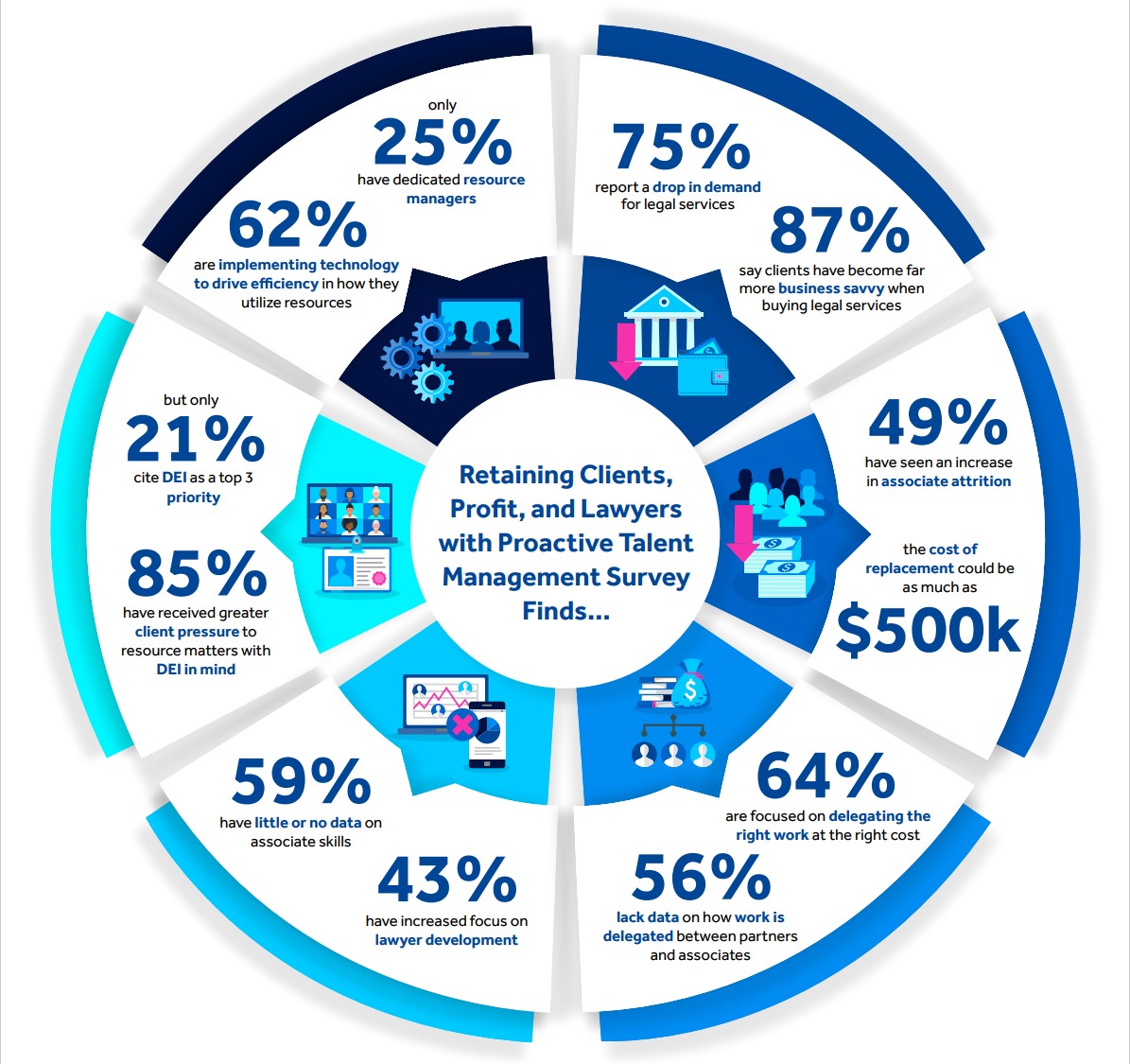
If you’ve wondered how much replacing that associate or senior associate who just left you is going to cost, then a recent report from Big Hand provides the answer: circa $500k.
That’s right, a cool half a million dollars!
Those costs won’t always be upfront and apparent, they will include:
a possible increase in salary for your replacement associate over your previous associate’s salary (due to market pressure) – which is somewhat ironic as salary may well be the reason the old associate left you!
commissions to talent agents to find you said new associate
increasingly – signing on bonuses
training costs over the first 12 – 18 months to bring the new associate up to scratch on your firm’s systems and business development strategy.
The list of actual and hidden costs here is almost limitless, and so the overall cost to your firm of replacing that departing associate/senior associate could actually be a lot more than $500k. Which begs the question:
with 49% of surveyed firms having said they had experienced an increase in associate attrition, you have to wonder why this isn’t an area where more firms are focusing their attention?
And with 75% of surveyed firms having said they have seen a drop in demand for legal services, is this a cost you really want to be incurring right now?
If you need help looking at your firm’s strategy, how to retain associates and differentiating your practice from the crowd, get in touch!
Happy Thanksgiving to all those who celebrate. So much to be thankful for this year with the crew GSJ Consulting – so a big shout out to all those who are helping us out on our journey of a thousand steps!
As readers of this blog will hopefully have observed, I’m a very keen observer of up-and-coming developments in the legal industry. Frankly it’s my job to follow and understand emerging market developments and, particularly, how they may affect the way we serve our clients.
And so it was, with such a mindset, that almost two decades ago I came across a concept being touted as the next BIG thing: ‘unbundled legal services‘.
Along with ‘covenant lite loans‘ (this was pre-2008 after all), ‘unbundled legal services’ were going to transform and change the way we serviced our clients; particularly those sophisticated purchasers of legal services.
Then, just like that, ‘unbundled legal services’ went exactly…
…nowhere – never to be heard of again in polite conversation!
Return of the Jedi!
I’m here to tell you that, following a recent report by the Solicitors Regulation Authority (SRA) [England and Wales] – published on 15 June 2023, ‘unbundled legal services’ are back from the dead!
Before I go into what the SRA’s report says, and why it might be important, let’s take a helicopter look at what ‘unbundled legal services’ meant back in the early 2000s and what ‘unbundled legal services v2.0’ means today.
Unbundled legal services v1.0
From the outset ‘unbundled legal services’ were also known as ‘limited scope representation’, I think in part because this was the term more commonly used in the USA – although I’m happy to stand correct on that. Anyhow, at the name suggests, ‘limited scope representation’ means exactly that: your lawyer won’t do everything for you on your matter and it is up to you and your lawyer to divvy-up what they do and what you do.
For this reason ‘unbundled legal services’ were seen as being extremely sexy because you – the client – got to choose what your law firm did [and charged you for] and what you kept in-house. Even better, you – the client – now had the option to appoint subject matter experts for the “grey haired work” (as Maister would call it), but for more menial work you could appoint an LPO (anyone remember “Legal Process Outsourcing”?).
Such radically thinking could even lead to such a thing as ‘coopetition’ (as I have blogged on previously!).
But, despite the obvious benefits of growing headline revenue with ‘unbundled legal services’, I would hazard a guess that 20 years later less than 1% of most law firms’ revenue is derived from this product. Evidence of my thinking here is, I believe, substantiated by a recent article in the Law Society Gazette: ‘Unbundling? Never heard of it, say 40% of firms’ by John Hyde.
Unbundled legal services v2.0
So back to the SRA report and why unbundled legal services appears to be back in vogue.
While limited to “family law” issues, the SRA report includes two important comments:
The first, more a definition, is: “Unbundling describes the process of dividing tasks in a service between the consumer and provider. This can, among other things, make them more affordable and accessible.” and
the second, going to the crux of the issue: “Solicitors providing ‘unbundled’ services could make legal help affordable for those whom it is currently too expensive“.
QED, a possible solution to the Access to Justice (A2J) issue?
While I think both of those comments are correct, I want to quickly pause and cover a few of the other comments made in the Report. These include:
We found that unbundling does have the potential to increase access to justice as it makes some legal services more affordable.
Law firms could attract more clients as those clients knew they could in fact afford an unbundled deal.
There are low levels of awareness of what unbundling is and how widely available it is, even though a number of providers already offer this.
All of which, in my experience, are true in the broader aspects of unbundling.
To finish up..
To finish up I’m going to use the SRA’s own wording in the Report; which is that the unbundling of legal services comes with complications that include:
We found no significant difference in the level of satisfaction between consumers who used unbundled legal services and those who used an end-to-end service.
Some consumers also wanted to have more control over their case.
Some [law firm] providers would like to expand what they do but there are concerns around the impact on firms’ insurance premiums and the possibility of legal action if things go wrong which they were not responsible for.
Let’s not beat about the bush: Points 1 and 2 are relatively damning; but it is that last point where, in my opinion, unbundled legal services have died the death of a million cuts: while most firms and lawyers would consider offering this service, most insurers of professional indemnity [PI] insurance have no ideal of what it is or how to price the risk.
The last point is especially the case given the fact that most law firms have no real understanding of how to provide a letter of engagement to their clients with clearly defined scopes of services that don’t include a million assumptions and caveats or: “it depends” clauses.
Anyhow, setting aside all of the above, I continue to hope we will see a growth in ‘unbundled legal services’ while remaining sceptical it’ll happen.
If you need some help with how you can use unbundled legal services to successfully differentiate your firm’s offering, feel free to reach out to me for a chat.
Back on deck this week after close to 6 weeks off work (not too uncommon for us here in Australia where January is like July in France!).
While catching up on my emails I came across this classic by Tom Fishburne. Yet again Tom hits a home run and I suspect many of us will be feeling this pressure over the next 11 to 12 months!
As usual comments are my own. And I hope everyone has a great 2023!
At this time of the year you will likely receive a whole bunch of emails in your inbox coaching you on what success should look like for the year ahead, and how you can make sure you achieve your goals. The reality is though that by week 2 of the new calendar year most of us have moved on from any big picture goal setting ambitions we stupidly set on New Year’s Eve and are, by now, heavily invested in the minuter of day-to-day life of making sure we meet our billable targets!
So, with this background in mind, I wanted to say whenever I think about what success might look like, I go back and read one of the best articles ever written on this topic – a post by Mark A Cohen in Bloomberg Law way back in August 2015!
Straight off the bat, it’s notable that the title of Mark’s post is ‘What are the Right Metrics for Law Firm Success?‘ and not ‘What are the Right Financial Metrics for Law Firm Success?’ – and therein lies one of the primary reasons why I love Mark’s post so much.
Anyhow, in his post Mark sets out the following 14 metrics under the sub-title ‘How should a law firm be measured?‘:
Excellence in areas that relate to client business
Client retention
Lawyer retention
Innovation
Effective use of technology
Alignment of financial interest with clients
Flexible billing model
Collaboration with clients and others in legal supply chain
Efficiency
Mentorship and training
Diversity
Performance metrics — client surveys and internal
Job satisfaction
Pro BonoProgram and Community Involvement
If you take “getting paid for what you do” and “being profitable” as a given, then I think Mark’s list is about as close to perfect as you can get.
So, if you are still on the “What will success look like in 2023?” or even, “What will success look like in FY24?” (heaven forbid you are that forward thinking!), bandwagon; then take a look Mark’s Bloomberg post – it’s a cracker even 7+ years after it was published!
As usual comments are my own. And I hope everyone has a great 2023!









 RWS_01's B[D]log