General business development issues

Does your firm need a Head of Growth?

Business Development image

I was away in the delightful Nelson Bay last week and so missed the opportunity to join the webinar co-presented by  John Grimley (@JohnGrimley) and Ivan Rasic (@Ivan_Rasic) on the issue of ‘Supercharge Your Law Firm Revenue With NewLaw And Big4 Sales Methods‘. Fortunately a recording of the webinar was made and you can now listen to this on YouTube (approximately one hour long, including the no-holds-barred Q+A session).

Anyhow, listening to John and Ivan’s webinar reminded me of a post on the Harvard Business Review website last month (February 19) titled ‘Every Company Needs a Growth Manager‘. In the post, the authors Jeff Bussgang and Nadav Benbarak set out very compelling reasons why every company (and not just Silicon Valley Tech companies) should have a growth manager or Head of Growth, many of which apply equally to professional services firms and so prompted this post.

Borrowing from Bussgang and Benbarak, the job description (JD) for the Head of Growth role at a law firm would likely say:

Oversight of client acquisition, activation, retention and cross-selling; working cross-functionally across the firm with Marketing & Business Development, IT, HR, Finance and Knowledge/Precedents to design, implement and execute on profitable growth initiatives within the business.

Although a number – if not all – of these functions are already happening with initiatives such as Key Account Management, Business Development, etc. I believe it is fair to say that it would be rare for these to be centralised under any one person’s control.

More to the point, many firms would benefit from giving an individual or team (depending on size) oversight to monitoring the right data and behaviours to ensure these key initiatives move forward without roadblocks. In turn, this should hopefully install a profitable growth mentality (aka, “profit principal”) within the firm as a whole (rather than the more traditional approach of having “star” teams).

It goes without saying that underlying all of this needs to be a well defined firm-wide strategic plan, which includes clearly defined growth objectives/targets. In addition, any firm looking to implement such a role/scheme would need to have a robust and honest client feedback program in place, as client insight needs to underpin any growth program.

Finally, the Head of Growth would need to work very closely with the Knowledge / Library team to implement a state of the art competitor intelligence analysis program – after all, it helps to know what’s going on in the market if you want to grow!

Ultimately, your Head of Growth would have the creative, analytical and strategic skills to work closely with the firm’s partners and leadership to get a clear understanding of your clients’ and target clients’ needs with the direct authority to implement a program or set of initiatives to target these needs and profitably grow your firm.

To sum up, although it would be a little unfair to say that, historically, professional services firms have not seen a need to grow their book of business – regardless of whether that was profitably or otherwise –  today’s highly competitive market certainly warrants your firm employing a Head of Growth position who is charged with oversight on growing the revenue and top-line profit of your firm.

RWS_01

Report: Do high growth firms share common traits?

Business Development image

This month saw publication of the 2016 High Growth Study by Hinge Research Institute. Although not limited to law firms, law firms (along with “Healthcare & Other”) made up 12.9% of the 968 respondents who answered Hinge’s survey and, therefore, the Study’s findings help provide some insight into whether or not “High-Growth” firms share common traits.

First, “High-Growth” was defined as being a firm with:

“Over $1 million in revenue and had an average yearly growth rate of at least 20%”.

Not exceptional. Having said that, of the firms surveyed:-

  • 30% generated over 88% of new revenue growth and were 45% more profitable than their No-Growth counterparts

so most definitely desirable.

So, did these High-Growth firms share any traits? In short, “yes”; and these included:

  • Target Clients: High-Growth firms are 75% more likely to have a highly specialized practice – i.e., not all things to all people or full services firms
  • Client base: High-Growth firms are more likely to target the larger clients (over $10 million in revenue)
  • Research: High-Growth firms are 2X more likely to conduct research on their target client
  • Differentiation: differentiators favoured by High-Growth firms are twice as likely to be easier to prove and are more relevant to clients. Importantly, these don’t include “reputation” and “awards won” (favour of No-Growth firms) and do include “culture” and “people”
  • Marketing investment: High-Growth firms invest 23% less in traditional marketing than No-Growth firms. This is because what marketing High-Growth firms do is targeted and measured

While some of these may surprise, they reinforce that in order to grow in today’s market firms need to have a clear understanding of who they are, who they work for, who they would like to work for, and the value/benefits they provide. In short, they’re focused.

RWS_01

The Client Cost Conundrum: Legal Service Pricing in a Post-Recession Market – A White Paper by the ALA

Business Development image

A post yesterday by Patrick Johansen, CLM, CPP, National Practice Manager at Seyfarth Shaw (on his ‘Patrick on Pricing‘ blog) alerted me to a newly published White Paper by the Association of Legal Administrators (ALA) titled “The Client Cost Conundrum: Legal Service Pricing in a Post-Recession Market“.

To start with, if you are going to publish a White Paper titled “The Client Cost Conundrum: Legal Service Pricing in a Post-Recession Market“, then, in my book, you have licence to write an absolute cracker.

Add to that your intent that:

“This white paper will identify economic factors that influenced relationship changes between clients and law firms after the Great Recession; pinpoint current legal service pricing best practices; highlight pricing strategies that can attract and retain clients; and help law firms learn to address efficiency and other factors that may affect many pricing scenarios.”

and throw in quotes from some of the industry’s leading pricing consultants – including Patrick himself, Colin Jasper of Jasper Consulting, Toby Brown of Akin Gump and Timothy Corcoran of Corcoran Consulting Group, and you’ve grabbed my attention.

So what did I find?

A very disappointing read, that had me both wondering what decade I had woken up in and really questioning whether the industry could survive for much longer.

What do I mean by this?

Well, judge for yourself: here are just some of the quotes from this paper:-

  • “Sixty-eight percent of law departments say they received discounts from firms in 2015. The number of law departments that received a discount of more than 10 percent has increased 4 percent in the past two years; the amount of firms receiving a 6 to 10 percent discount grew by nearly 9 percent”

–  Discounts are not a pricing strategy, period.

  • “In an effort to strengthen client relationships, some law firms are working to better understand their clients’ needs. Approximately 29 percent of firms say they’re working to identify each client’s unique pricing preferences to support the firm’s overall pricing strategy.”

–  29% of firms are working to identify each client’s unique pricing preference. Seriously, what are the other 71% doing: throwing darts in a dart board and hoping for the best?

  • “To better comprehend what clients want, 85 percent are initiating direct conversations about pricing and budgets.”

–  “initiating direct conversation”: as opposed to what exactly, being told?

  • “Twenty-two percent of firm leaders say they thoroughly understand their top 20 clients’ business models, earnings and growth strategy”

–  I have no idea what the other 78% are thinking of, but I’m suddenly very glad I cannot invest [financially] in a law firm.

  • “29 percent of firms say their knowledge of their clients’ business and client relationships give them a key competitive advantage”

–  what is the key competitive advantage for the other 71% I wonder?

  • “Sixty-one percent of firms say overcapacity is diluting their firm’s profitability.”

–  that’s too laughable to even be laughable. I mean seriously, are the other 39% saying it’s the Friday Night Drinks that’s the issue…?

And on that note, I shall end this post with this: read the White Paper, it is really well researched and a look at the Index itself is worth the download; just don’t expect to be blown away with how progressive the industry has become towards pricing.

RWS_01


Do you know your ABR?

Business Development image

There has been a fair amount written in recent days following an article published in the Wall Street Journal that ‘Legal Fees Cross New Mark: $1,500 an Hour‘. Most of the published articles I’ve read talk to the outrage of commanding such a high hourly charge-out rate, but this article by Stephen Harper caught my attention.

In the article, citing data from ‘The 2016 Report on the State of the Legal Market‘ by Georgetown University Law Center and Thomson Reuters Peer Monitor, Harper states that:-

“In 2005, collections totaled 93 percent of standard rates, the report found. By the end of 2015, the realization rate was down to 83 percent.”

Although US-based, this sad statistic very much reflects on an issue I touched on in my post on fixed fees in the Australian market yesterday; namely that 25% of Australian law firm revenue is now derived from “discounted” hourly rates.

If we say then that roughly 1/4 of a law firm’s revenue comes from discounted hourly rates, and that the firm is being paid approximately 83c in the $1, [compounded] we have a very serious profitability problem.

On these numbers alone, any law firm looking at its profit margin should be rushing into fixed fees – while admittedly upskilling themselves (including tracking data) on how to do this better.

And part of this process should also include an understanding of, as well as tracking, what each individual lawyer’s Average Billing Rate (ABR) is.

In the many hundreds of tenders I have done and the numerous conversations I have had with lawyers over the years, I have never once come across either a request for what the particular lawyer’s ABR is, nor heard the lawyer freely admit this rate. I have, on the other hand, heard daily the hourly rates that particular lawyers charge as if this were the reason why they were hired (there being an assumption that the higher your charge-out rate, the better value you provide!).

And therein lies the problem, as Harper says:-

“How much a firm bills doesn’t matter; what it actually brings in the door does.”

Too right. So the next time you hear a lawyer talk up their hourly rate, you might want to ask them what their ABR is – because that’s going to be a far better indicator of the value their clients see them providing. And if you get an answer, you might then want to talk to them about the benefits of fixed fee pricing.

When will a law firm have its Enron moment?

Business Development image

I’ve just read an interesting article about how disruptive Dyson has been. More specifically, the subject of the article was whether #NewLaw (as it is being called) will be as disruptive on the legal industry as Dyson was to vacuums?

But my outtake on reading the article was this: law isn’t ready for positive disruption (innovation), as we’re yet to have a really shockingly bad, client related, negative shock-wave (failure in client service).

What am I talking about?

Simply this, to my knowledge law has yet to have its Enron/Worldcom moment in the same way Arthur Andersen did for the accountants (anyone remember ‘Big 5’?).

More specifically, in our haste to be the “extension of your in-house legal team“, or “your trusted adviser“, or any one of about a million other fad terms out there today, I believe we may be forgetting one of the biggest (if I remember rightly it made #3 on the list) recommendations in the US Securities and Exchange Commission’s “Report of Investigation” into the collapse of Worldcom to [in the future] “… cure the principal failing that gave rise to the fraud: a lack of effective checks and balances on the power of senior management …“:

A corporate culture in which the advice of lawyers is sought and respected; and

So while, as a business developer, I whole support and encourage “getting to know your client better”, in doing so I would ask that you keep at the back of your mind this question:

Are we trying to “pillow talk” our clients?

Because almost two decades after the collapse of Worldcom, my takeout is that we need to have an Enron/Worldcom moment before we have a Dyson moment in order for the profession to move forward.

rws_01

Are the days of being an “extensions of your in-house team” over?

Business Development image

A recurring theme of tendering to in-counsel over the past several years has been the pronounced ability to “act as an extension of your in-house team” – or some variation thereof.

So what can we make of Craig Silliman, executive vice president for public policy and general counsel at Verizon, comments in Bloomberg yesterday that: “We Don’t Need Law Firms At Our Business Meetings”?

Truth is, I’m not sure.

That said,

“One pitch that you sometimes hear from law firms is, ‘We want to be your strategic partner, we want to sit inside your meetings, we want to get to know the business, etc.,’” he said. “That is what our in-house legal team does. We don’t need outside counsel to do that.”

If you’re a private firm or consult – no beating about the bush: that’s scary as sh1t!

But Craig doesn’t stop there, he goes on to say:

  1. “We have a lot of people in-house who are deeply embedded with the business, people who have a good general sense of the business, an ability to issue spot, an ability to support the business on what I’ll call a horizontal basis. By definition, when we’re bringing in outside counsel, we’re bringing them in as a vertical staff, as a highly specialized resource on one particular issue.”
  2. “The best outside counsel understand they are the client of the in-house legal team, and should make that team look good.”
  3. Outside counsel who are best at what they do understand that their one vertical issue fits within a larger strategic framework of legal policy, regulatory, and business issues that our in-house team is supporting the company on. Understanding how their role fits within a larger framework, and therefore the types of decisions we make about how to handle a case, how to move forward on something, have to be viewed through that larger lens.
  4. Related to that, I think outside counsel always serve their clients best when they understand that they are the client of the in-house legal team, and should make that team look good, understanding that the legal team in-house has a set of clients they’re interacting with on a larger basis.

If that weren’t enough , and if you’re like me and work in Marketing, then the following should send splinters up your spine:

“Sometimes part of the marketing pitch from law firms is, “We’re a big global firm. We can be your one-stop shop for all legal services.

That may be useful for some companies, but for us, I don’t think that’s a particularly compelling value proposition, because we have enough feet on the ground. We have enough people in-house that we can actually go out and pick and choose who the specialized resource is in a given firm, in a given country, to provide the needs that we have on that specific issue.

Sometimes part of the marketing pitch from law firms is, “We’re a big global firm. We can be your one-stop shop for all legal services.” For us, I don’t think that’s a particularly compelling value proposition.
Finally, the model of law firms has changed somewhat, as you’ve seen a lot of the work that traditionally was done by first and second year associates — all those document reviews and things like that, which formed the profitability base for law firms — has been automated, or it has been moved to lower-cost legal solutions outside the US or elsewhere.

Take out – every law firm is different: but in a world that is globalizing my view is that local knowledge still trumps.

RWS_01


Who is this for?

Business Development image

Anyone who has followed me on social media (twitter and LinkedIn being my big social media platforms outside of this blog) for any length of time will know that I’m a fan of Seth Godin. I believe any business developer can learn a lot from Seth’s blog and so recommended it often.

Fortuitously for me, Seth’s post overnight (Australian time) was titled: ‘Who is this for?‘ I say “fortuitously for me” because this represents my 100th post, and as with any milestone it’s only natural that you take some time to consider what the purpose is behind the activity?

So I asked myself this morning: who is this blog for?

It’s true that I have struggled with regular post scheduling – something we are all told needs to be done in order to get a following. At the same time, I have more followers than I ever expected and have interacted with people I consider my peers as a result of some of the posts that I have put up on this blog.

Can it be said then that this blog serves a self interest purpose? I think the answer to that is most certainly a “yes”. But I hope that only tells part of the story. I hope the followers and readers of this blog also gain something from it.

Importantly for me though, I have really come to enjoy blogging. I believe it make me a better writer and more learned about what is going on in the world of business development and legal services.

As it gives me a lot more than it takes, I have made the decision to continue on with this blog into 2016. I can only hope you come along for the ride.

‘Drive for show, Putt for dough’

Business Development image

According to a post earlier this week on the LexisNexis Business of Law Blog:

“A new legal spending trends report finds big law billing rates grew notably – pushing a 6% increase in the gap between the top two tiers of law firms, by attorney headcount, from 38% to 44%.”

Indeed:

“Median partner rates at the “Largest 50” law firms – those with more than 750 lawyers – rose to $711 per hour, based on 12 months of data ending June 30, 2015. That number is up from the last report where median partner rates came in at $675 per hour for the 12 months ending December 31, 2014.”

As I have posted before, however, this [rising headline hourly rates] is absolutely meaningless if your realization rates are in decline – an issue this particular report appears to remain silent on.

I have never understood, beyond ego, why a partner would be more interested in their hourly rate than their average realized billable rate (ARBR). After all, the ARBR amount is the amount that clients are willing to pay you – money in the bank – and is a more accurate reflection of your true worth/value.

Eventually you have to ask yourself which you would prefer: a headline charge-out rate of $1,000- with an ARBR of $700-, or a charge-out rate of $800- with an ARBR of $800-?

And that’s without going into how much easier it is to have the conversation with your clients around rising your realization rather than informing them on 1 July each year that you will be raising your rates by 10% again this year!

Alternatively, you can keep on driving for show and not worry too much about the dough you’re making.

A ‘Failure To Deselect’?

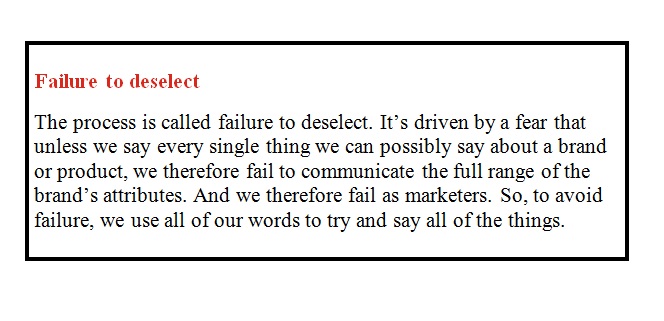
A Failure To Deselect

Read a fantastic rant by Barrie Seppings – Director of Creative Strategy at wordsearch, the world’s leading marketing network for architecture, property and real estate – on the Firebrand Ideas Ignition Blog yesterday titled “Copywriters: What the %$@#* are you saying?“.

Barrie’s post get my approval merely for quoting Don Watson, Paul Keating’s former speechwriter, brilliant book Death Sentence – and if you have ever written a tender and not read Don’s book, please do!

Anyhow in his post Barrie makes mention to something I had not heard of before and which he terms a ‘Failure to deselect‘, being:

“… a fear that unless we say every single thing we can possibly say about a brand or product, we therefore fail to communicate the full range of the brand’s attributes. And we therefore fail as marketers. So, to avoid failure, we use all of our words to try and say all of the things.”

Now, swap out ‘brand or product‘ and ‘marketer‘ and replace it with ‘law or regulation‘ and ‘lawyer‘ and does this sound familiar to you?

It certainly did to me. And in this time of ‘doing more for less‘ in law, it got me to thinking: are we actually suffering from a ‘failure to deselect’?

3 ways you can grow your book of business today

Business Development image

It’s very much been a story of doom and gloom in the Australian legal marketplace of late. Demand is down. The Aussie Dollar has fallen through the floor and seems to keep going. It’s nightmare and has been for some time.

As someone who advises law firms on business growth strategies, all this doom and gloom can be down right depressing. If, that is, you let it.

As for me, I prefer to talk things up and I enjoy looking around for the opportunities rather than dwelling too long on the negative. With that in mind, here are three ways and places you could be growing your book of business today:

  1.  Thailand

tweet 1

Rohini Kappasath (handle @TalkingAsia on twitter) recently tweeted that there are 180 Australian companies – large and small SMEs – operating in Thailand who are looking for growth and guidance.

When I questioned Rohini where these numbers came from, he told me (vid DM) they were provided by DFAT (Department of Foreign Affairs and Trade).

Think about that for a second: 180 Australian companies operating in Thailand who are looking for growth and guidance. I wonder how many of these companies are currently represented by Australian law firms? Having lived in Thailand for 12 years myself, I’d hazard a guess not too many.

Massive opportunity going begging here.

  2.  Malaysia

Headline in yesterday’s The Star Online:

“Domestic F&B players strive to expand into Australia”

with a lead paragraph that reads:

“The domestic food  and  beverage (F&B) sector is striving to expand into the high-value Australian market as reflected from the participation of 18 Malaysian exhibitors at the Fine Food Australia 2015.”

18 Malaysian exhibitors at the Fine Food Australia 2015 with,

“Ninety-five business meetings with over 80 potential business partners were arranged by Matrade for the Malaysian companies during the event”

and not a single law firm in sight (from what I can see).

Massive opportunity going begging here.

3. Inbound M&A

Headline from yesterday’s Australian:

“Foreign takeovers tipped to surge”

with the following graph:

inbound M&A

Other than, “massive opportunity going begging here”, not really sure I need to add anything to that!

So if you practice law in Australia and you are wondering what you can do about your ever dwindling revenue stream, all I can say is the work is out there: you just need to go looking for it.

* did you notice how I didn’t need to mention China once in this post… …quite clever that really.