Author: RWS_01

Over 20 years’ experience developing and implementing effective business development strategies in law firms across Australia and Asia.

What do clients value most when dealing with their lawyers?

Last week I posted on the recent publication of the 2016 LexisNexis Bellwether Report (this year titled ‘The Riddle of Perception’) – with specific reference to the disconnect within the Report between opportunities lawyers identify and approaches they plan to take.

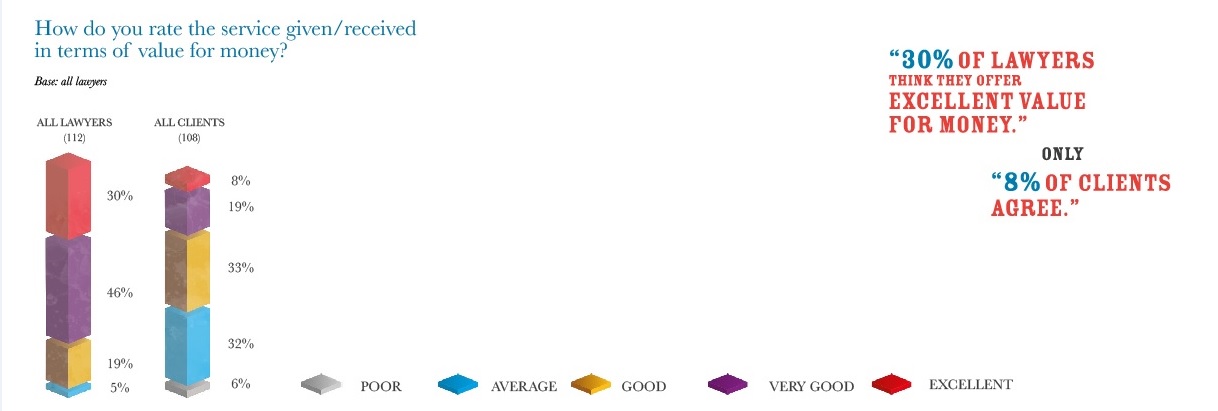
Looking at the Report further, when asked: “How do you rate the service given/received in terms of value for money?” – 30 % of lawyers thought they offered “excellent” value for money, whereas only 8% of clients agreed.

Probably more worryingly, 46% (almost half!) of law firms believed they provided a “very good” service, and only 19% of clients agreed.

And of extreme concern to law firms? – 32% (or almost a third!) of clients thought the service provide by law firms was “average“, whereas [not too surprisingly] only 5% of law firms agreed.


Image a

[click on image to enlarge]

Clearly a disparity remains between the service that lawyers believe they are providing and those that clients feel they are receiving.

And herein lies the problem: as we all know, “value” is subjective, in the eye of the recipient. In other words, it really doesn’t matter what “value” law firms believe they are delivering, but what the client believes they are receiving trumps all.

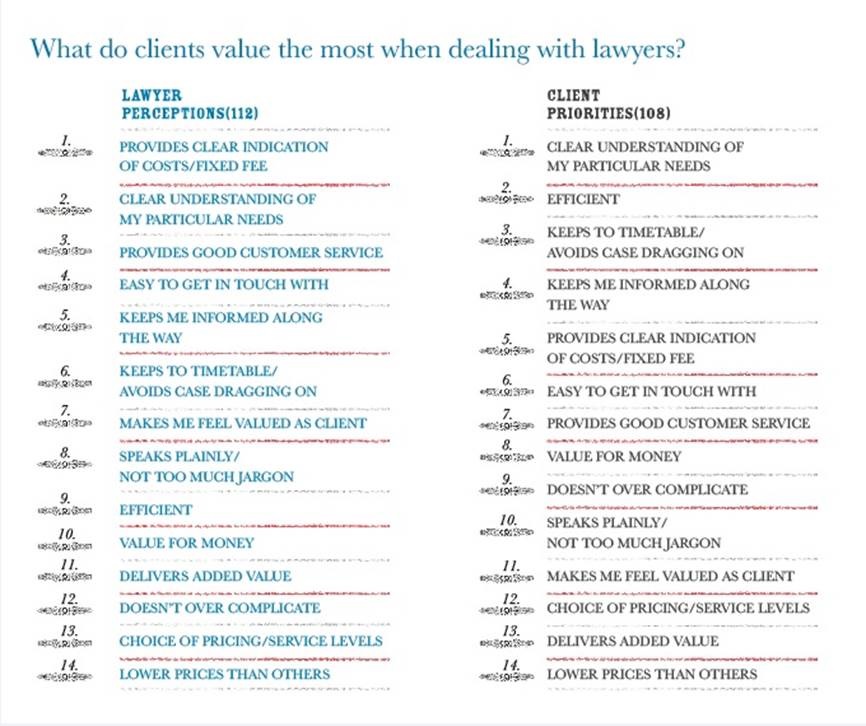
So, “What do clients value most when dealing with lawyers?“:-

image b

[click on image to enlarge]

Well, fortunately that question is answered in the Report too.

Takeout from this?

Just because a lawyer agrees to provide a discount doesn’t mean they’re providing greater value!

RWS_01

The law firm disconnect in two images

This week saw the publication of LexisNexis’s Bellwether Report 2016. titled:- ‘The Riddle of Perception‘.

Based on structured interviews with 122 independent lawyers and 108 clients (all UK-based I believe), this year’s Report provides valuable insight into the thinking of lawyers and law firms and, incredibly, how far removed that thinking still appears to be from the views of their clients.

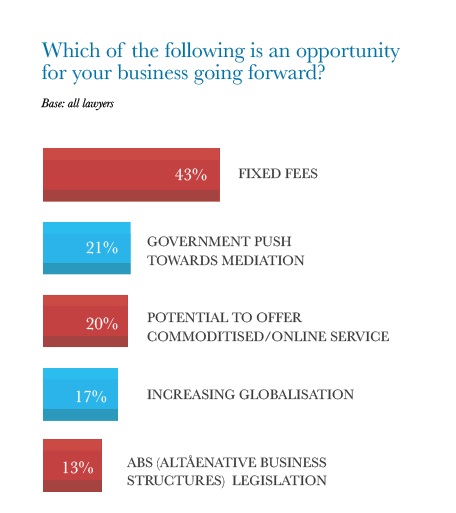
None so is this more starkly brought home to me than in two separate images in the Report in response to questions put forward around the issue of fixed fees.

The first (which is actually the second in the Report) can be found on page 22:-

Image 1

[click on image to enlarge]

where, in response to “Which of the following is an opportunity for your business going forward?” – 43% answered: fixed fees.

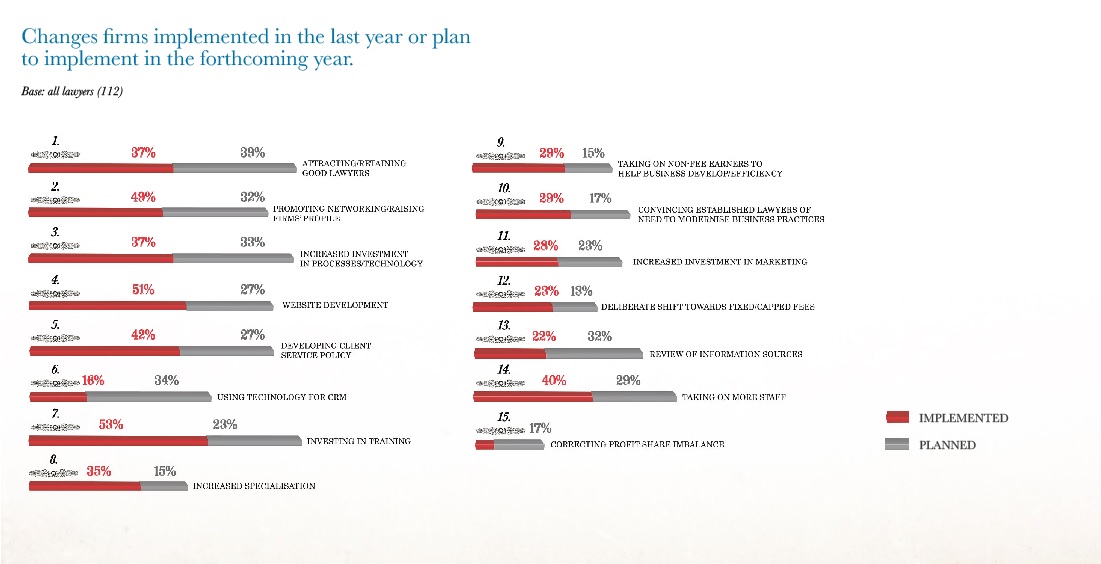
The second is found earlier in the Report on page 18, where when asked what “Changes forms implemented in the last year or plan to implement in the forthcoming year?” – a “deliberate shift towards fixed/capped fees” raked 12th. with only 13% saying there was anything planned around this for the forthcoming year.

Image 2

[click on image to enlarge]

Now call me crazy, but that seems to be as close as you can get to madness.

Read the Report though, it really is very good.

RWS_01

Exiting the ‘Valley of Despair’: Tips on rebuilding a book of business

Valley of despair

source: Emily Carr:- ‘Practical Change Management for IT Projects

The ‘Valley of Despair‘ is a term used in IT process improvement projects to describe the period of time where productivity decreases immediately after the implementation of a new process. In essence it describes that period of time during which you shift away from what you know and are comfortable with to what is new and unknown (but which will ultimately, hopefully, results in better processes).

Although a term commonly associated with process improvement, to me this has also become a good way to best describe a growing trend in the modern lawyer’s life; namely that particularly difficult period during which a disruptive element impacts on their book of business. Examples would include:

  • economic: with the GFC most securitization lawyers lost their practices overnight.
  • panel: when your firm loses a panel appointment with your practice’s biggest client as a result of the client rationalizing the number of its panel firms.
  • relationship: the key contact at your biggest client moves to a company your firm has no relationship with; or, worse, is promoted to a role where they no longer have influence over who gets the legal instructions.

There are many others, but you get the gist: your performance hits a wall called ‘change‘.

In my experience, partners who face this scenario come face-to-face with Elizabeth Kuber-Ross’ “Five Stages of Grief“:-

Denial —> Anger —> Bargaining —> Depression —> Acceptance

To overcome the Valley of Despair you need a sixth element: a desire to move forward.

  • Step 1: Accept your fate

The first step in any recovery program is accepting you have an issue. Too often law firm partners stick their heads in the sand and refuse to accept that anything is wrong until the Managing Partner is knocking on their door asking them what their plans are for the future (wink, wink: it’s not with us!). By then, you are well and truly in to the ‘bargaining’ and ‘depression’ phases. If you want to rebuild your book of business you need to be much further ahead of the game than that.

  • Step 2: Do an audit

Here’s the thing: things in life are rarely as bad as they first seem. So, as soon as you become aware of a change agent – such as those above – get out your pen and a piece of paper and write down a list of who you know, when was the last time you contacted them, what type of work could you be doing for them, are you already doing that type of work, etc.

In short, take stock of what you have and who you could be doing it for.

  • Step 3: Make a plan

Alan Lakein is reported to have said: “Failing to plan is planning to fail“. I’m not sure if he actually did, but it’s pretty accurate and if you want to rejuvenate your book of business then you will need a plan of how to go about this.

This plan should include the obvious, like:

  1. what type of work do I want to be doing?
  2. who do I want to do this work for?
  3. what do I know [commercially] about these businesses [tip: if the answer is “not a lot”, get a research assistant on to it ASAP]?
  4. who are the decision makers at these companies?
  5. how likely are they to give you / your firm the work [tip: rank the likelihood from 1 – 5 (very – unlikely)]?

Your plan also needs to include things you may not think of, such as:

  1. will my partners give me relief while I try and rebuild my book of business? If so, how long?
  2. what level of fees do I need to generate (cost +, times 3, times 5)?
  3. what rates will I need to charge to generate that level of fees? will the target client accept these rates? if I need to discount, will my partners accept me discounting to win work when their clients are paying full freight?
  4. who is currently doing the work for the target and what am I bringing to the table that would make the target move the work to me?
  5. how will my competition react to me invading their turf?
  • Step 4: Execute on the plan

I’ve heard it said that: “a plan without an action is a wish“. In the world of professional services, we see a lot of wishing!

So, as soon as you have your plan in place you need to get out from behind your desk and start to execute on it. Look at what

  • inbound and outbound related activities you need to do;
  • networking events are taking place and when;

then set yourself a 30-60-90 day action plan to work towards.

Most importantly, always be responsive and never, ever quit.  Building a book of business takes patience and repetition, you cannot adopt a “lottery mentality” as one shot actions nearly always lead to failure.

So if at first you don’t succeed, try again. That way, you’ll give yourself the very best chance of rebuilding your book of business and moving forward.

RWS_01
“Bill clients, get money”

Business Development image

In my spare time, I’m a keen amateur photographer (note, I didn’t say “good” 🙂 ). Anyhow, because of this interest I follow a number of photography related blogs which, every now and then, include posts that crossover into my professional life.

A post I read this morning from the DIYphotography website (I say “from” because I use feedly as my rss feeder and read all my morning updates on the Ziner app) is just such a post. Titled, ‘3 Vital Tips To Help You Set Your Photography Pricing‘ by Gannon Burgett, the post takes up a call by Sue Bryce that:

“You can’t price yourself when you have no self worth.”

and goes onto suggest that photographers follow the approach of photographers Sue Bryce and Tiffany Angeles and, I quote,:

  1. Charge what you’re worth – be confident in your abilities and know what it is you offer, both in terms of products and aesthetics
  2. Never set yourself at market value – part of knowing what it is you offer helps you better understand what it is you can charge. Don’t base your price purely off of competition. Don’t be afraid to charge more.
  3. Value yourself and your work – this is more all-encompassing than a specific tip, but without the confidence and self-value, it’s going to be a much tougher job to set your pricing.

Amazingly simple and straightforward advice that many lawyers could benefit from – a fact brought home to me in the very next post in my Ziner app, ‘The deep discount attorney and other cautionary tales‘ by Carala Del Bove on the LexisNexis Business of Law blog.

In this post, Del Bove quotes from real life case studies Ms Ann Guinn cites of lawyers willing to offer discounts to clients because, to quote:

“it just felt greedy to me [not to].”

In the post Ms Guinn offers the following two pieces of advice I wanted to share:

“Don’t try to get into your clients’ heads, cautions Ms. Guinn. In other words, don’t let your clients determine the value of your work.”

rather, discuss this with them upfront when you are first asked to quote on the instruction; and

“Instead of worrying about what discounting legal fees will mean for your client, think about what it will mean to you as a small business owner.”

All in all, two excellent posts on understanding the value of the service you provide clients and the dangers you face if you don’t price, bill and collect revenue on your work appropriately.

RWS_01

ps – I’d also like to credit Ms Guinn with the title of this post.

Why 1.9% revenue growth is not going to be enough, and what you can do about it

Business Development image

A fair amount was made in response to last week’s news item in Lawyers Weekly that [legal] industry revenue would grow by 1.9 per cent a year between 2016 and 2021 (‘Revenue growth on the cards despite challenging conditions‘ by Stefanie Garber on 6 April) to reach a total of $24.8 billion  (the Lawyers Weekly article draws on, and quotes, information contained in the latest IBISWorld Industry Report: Legal Services in Australia – March 2016).

Leaving aside the IBIS quote in the Lawyers Weekly article that:

“Wages were also set to increase, from a total pool of $10.5 billion in 2015-2016 to $11.4 billion in 2020-2021.”

or a “dire lawyer pay increase of just 1%” as another industry publication put it, banking 1.9 per cent revenue growth year-on-year over the next 5 years will simply won’t be enough if you have any ambition of your law firm staying afloat.

Why do I say this? Simple, The Australian Bureau of Statistics (ABS) Consumer Price Index (CPI) rose 1.7 per cent through the year to December 2015. This was a slight upward movement from 1.5 per cent for the year through September 2015. And with record low interest rates in Australia, it is highly unlikely (although not impossible) this will go down.

That means, by banking just 1.9 per cent annual revenue growth through to 2021, at best your firm will be standing still and more likely it will be going backwards.

If we agree then that 1.9 per cent annual revenue growth through to 2021 is not going to cut it if you want your firm to stay in business, what measure can you adopt to buck this?

In ‘Grow from Your Strengths: The only sustainable way to capture new opportunities is to remain true to what your company does best‘ a post by Gerald Adolph + Kim David Greenwood published on 18 August 2015 in strategy + business, Adolph and Greenwood contend that there are essentially four (4) ways a business (in our case, a law firm) can grow, which are:

  1. In-market leverage‘: which is where you seek out new growth opportunities from your existing customer-base. For law firms this could either be (a) grow the amount of current work you do (i.e, doing loan work for ABC Bank?, well do more loan work ABC Bank); or (b) cross-sell services to your current client-base (i.e, currently doing patent protection work for Pharma A?, well do corporate M&A work for Pharma A too).
  2. Near-market expansion‘: this is where you pursue opportunities in unfamiliar sectors with a product that has been tried and tested in a core sector of your business (in technical speak, ‘expansion through adjacencies‘). In laymen’s terms, if you currently do compliance work for banking clients but have never done any compliance work for insurance clients, then examine how easy it might be to transfer that existing [compliance] skill to the new [insurance] sector.
  3. Disruptive growth‘: where you respond to the current tight market conditions with a dramatic change in strategy by offering entirely new service lines. To a degree we can see this in last week’s announcement by Minter Ellison that it was launching Flex – but Minters are by no means the first to do this, nor will they be the last!
  4. Capability development‘: get better at what you are currently doing!

I wanted to expand briefly on ‘capability development‘. In Adolph and Greenwood’s post this has a number of meanings but one of those is ‘operational improvements‘ (legal project management anyone?).

For law firms operational improvements can be achieved really, really easily:- get better at billing; and, specifically, collecting what you bill.

realise

This is a 10 year outlook on ‘Billed and Collected Realization against Standard’ taken from the most recent [2016] Report on the State of the Legal Market by Georgetown University Law Center and Thomson Reuters Peer Monitor. It shows fairly graphically the fall off in realized rates over the last decade. Now can you imagine what it would do to your firm’s revenue and bottom line profitability if you could get that figure back closer to the 93% of a decade ago by 2025? My guess would be, significant.

RWS_01

ps – if you would like to see a little more on this, you can purchase this video I did for CPD for Me a few years (2014) ago.

Does your firm need a Head of Growth?

Business Development image

I was away in the delightful Nelson Bay last week and so missed the opportunity to join the webinar co-presented by  John Grimley (@JohnGrimley) and Ivan Rasic (@Ivan_Rasic) on the issue of ‘Supercharge Your Law Firm Revenue With NewLaw And Big4 Sales Methods‘. Fortunately a recording of the webinar was made and you can now listen to this on YouTube (approximately one hour long, including the no-holds-barred Q+A session).

Anyhow, listening to John and Ivan’s webinar reminded me of a post on the Harvard Business Review website last month (February 19) titled ‘Every Company Needs a Growth Manager‘. In the post, the authors Jeff Bussgang and Nadav Benbarak set out very compelling reasons why every company (and not just Silicon Valley Tech companies) should have a growth manager or Head of Growth, many of which apply equally to professional services firms and so prompted this post.

Borrowing from Bussgang and Benbarak, the job description (JD) for the Head of Growth role at a law firm would likely say:

Oversight of client acquisition, activation, retention and cross-selling; working cross-functionally across the firm with Marketing & Business Development, IT, HR, Finance and Knowledge/Precedents to design, implement and execute on profitable growth initiatives within the business.

Although a number – if not all – of these functions are already happening with initiatives such as Key Account Management, Business Development, etc. I believe it is fair to say that it would be rare for these to be centralised under any one person’s control.

More to the point, many firms would benefit from giving an individual or team (depending on size) oversight to monitoring the right data and behaviours to ensure these key initiatives move forward without roadblocks. In turn, this should hopefully install a profitable growth mentality (aka, “profit principal”) within the firm as a whole (rather than the more traditional approach of having “star” teams).

It goes without saying that underlying all of this needs to be a well defined firm-wide strategic plan, which includes clearly defined growth objectives/targets. In addition, any firm looking to implement such a role/scheme would need to have a robust and honest client feedback program in place, as client insight needs to underpin any growth program.

Finally, the Head of Growth would need to work very closely with the Knowledge / Library team to implement a state of the art competitor intelligence analysis program – after all, it helps to know what’s going on in the market if you want to grow!

Ultimately, your Head of Growth would have the creative, analytical and strategic skills to work closely with the firm’s partners and leadership to get a clear understanding of your clients’ and target clients’ needs with the direct authority to implement a program or set of initiatives to target these needs and profitably grow your firm.

To sum up, although it would be a little unfair to say that, historically, professional services firms have not seen a need to grow their book of business – regardless of whether that was profitably or otherwise –  today’s highly competitive market certainly warrants your firm employing a Head of Growth position who is charged with oversight on growing the revenue and top-line profit of your firm.

RWS_01

Report: Do high growth firms share common traits?

Business Development image

This month saw publication of the 2016 High Growth Study by Hinge Research Institute. Although not limited to law firms, law firms (along with “Healthcare & Other”) made up 12.9% of the 968 respondents who answered Hinge’s survey and, therefore, the Study’s findings help provide some insight into whether or not “High-Growth” firms share common traits.

First, “High-Growth” was defined as being a firm with:

“Over $1 million in revenue and had an average yearly growth rate of at least 20%”.

Not exceptional. Having said that, of the firms surveyed:-

  • 30% generated over 88% of new revenue growth and were 45% more profitable than their No-Growth counterparts

so most definitely desirable.

So, did these High-Growth firms share any traits? In short, “yes”; and these included:

  • Target Clients: High-Growth firms are 75% more likely to have a highly specialized practice – i.e., not all things to all people or full services firms
  • Client base: High-Growth firms are more likely to target the larger clients (over $10 million in revenue)
  • Research: High-Growth firms are 2X more likely to conduct research on their target client
  • Differentiation: differentiators favoured by High-Growth firms are twice as likely to be easier to prove and are more relevant to clients. Importantly, these don’t include “reputation” and “awards won” (favour of No-Growth firms) and do include “culture” and “people”
  • Marketing investment: High-Growth firms invest 23% less in traditional marketing than No-Growth firms. This is because what marketing High-Growth firms do is targeted and measured

While some of these may surprise, they reinforce that in order to grow in today’s market firms need to have a clear understanding of who they are, who they work for, who they would like to work for, and the value/benefits they provide. In short, they’re focused.

RWS_01

Medibank Idea Exchange

Business Development image

For my sins I am a member of Medibank Private Health Insurance. I understand it has something to do with having a young family and the Medicare rebate. Anyhow, regardless the reason I get a lot of emails from Medibank that have always gone to straight to my trash folder. That is, until this morning.

What makes this morning any different? Well, I received an email inviting me to join the Medibank Idea Exchange community. In part wondering why they were suggesting the singular rather than the plural, I thought I would take a look.

What did I find?

Well, while I have no intention of joining, what I found was an offer to join an ‘invite only’ community where I will be able to share my thoughts and ideas on a variety of different topics and issues and:

  • Contribute to discussions and surveys – so you can tell Medibank what you think and help shape future business decisions,
  • Talk with other members – so you can share experiences and handy tips,
  • Earn rewards for participating – that you can redeem on a great range of products and services.

and I thought to myself: “there might be something in this for law firms to learn from“.

RWS_01

‘Best’ or ‘Preferred’?

Business Development image

Trish Carroll, of GALT Advisory, had an article of hers published recently (February 26, but I didn’t get the email notification till today) in the Australasian Law Management Journal‘s Law Management Hub titled: ‘Get up close and personal to improve your business development‘.

While Trish’s article contains a number of really useful tips, I found it notable because of the following very thought provoking line:

“It is not about being the best; it is about being the preferred.”

99 times out of 100, I totally agree with Trish. And it is a really important lesson for high achieving lawyers to learn: being the best at what you do is no longer a guaranteed successful business model. In today’s legal market there are a lot of average lawyers making very serious amounts of money because they are the preferred ‘go to’ lawyer.

The one exception I would make would be for top-end, bet the bank, niche advisory work where being the best still trumps.

So the question you need to be asking yourself everyday is:

“What will I do today that will make me my clients preferred lawyer?”

RWS_01

The Client Cost Conundrum: Legal Service Pricing in a Post-Recession Market – A White Paper by the ALA

Business Development image

A post yesterday by Patrick Johansen, CLM, CPP, National Practice Manager at Seyfarth Shaw (on his ‘Patrick on Pricing‘ blog) alerted me to a newly published White Paper by the Association of Legal Administrators (ALA) titled “The Client Cost Conundrum: Legal Service Pricing in a Post-Recession Market“.

To start with, if you are going to publish a White Paper titled “The Client Cost Conundrum: Legal Service Pricing in a Post-Recession Market“, then, in my book, you have licence to write an absolute cracker.

Add to that your intent that:

“This white paper will identify economic factors that influenced relationship changes between clients and law firms after the Great Recession; pinpoint current legal service pricing best practices; highlight pricing strategies that can attract and retain clients; and help law firms learn to address efficiency and other factors that may affect many pricing scenarios.”

and throw in quotes from some of the industry’s leading pricing consultants – including Patrick himself, Colin Jasper of Jasper Consulting, Toby Brown of Akin Gump and Timothy Corcoran of Corcoran Consulting Group, and you’ve grabbed my attention.

So what did I find?

A very disappointing read, that had me both wondering what decade I had woken up in and really questioning whether the industry could survive for much longer.

What do I mean by this?

Well, judge for yourself: here are just some of the quotes from this paper:-

  • “Sixty-eight percent of law departments say they received discounts from firms in 2015. The number of law departments that received a discount of more than 10 percent has increased 4 percent in the past two years; the amount of firms receiving a 6 to 10 percent discount grew by nearly 9 percent”

–  Discounts are not a pricing strategy, period.

  • “In an effort to strengthen client relationships, some law firms are working to better understand their clients’ needs. Approximately 29 percent of firms say they’re working to identify each client’s unique pricing preferences to support the firm’s overall pricing strategy.”

–  29% of firms are working to identify each client’s unique pricing preference. Seriously, what are the other 71% doing: throwing darts in a dart board and hoping for the best?

  • “To better comprehend what clients want, 85 percent are initiating direct conversations about pricing and budgets.”

–  “initiating direct conversation”: as opposed to what exactly, being told?

  • “Twenty-two percent of firm leaders say they thoroughly understand their top 20 clients’ business models, earnings and growth strategy”

–  I have no idea what the other 78% are thinking of, but I’m suddenly very glad I cannot invest [financially] in a law firm.

  • “29 percent of firms say their knowledge of their clients’ business and client relationships give them a key competitive advantage”

–  what is the key competitive advantage for the other 71% I wonder?

  • “Sixty-one percent of firms say overcapacity is diluting their firm’s profitability.”

–  that’s too laughable to even be laughable. I mean seriously, are the other 39% saying it’s the Friday Night Drinks that’s the issue…?

And on that note, I shall end this post with this: read the White Paper, it is really well researched and a look at the Index itself is worth the download; just don’t expect to be blown away with how progressive the industry has become towards pricing.

RWS_01