Author: RWS_01

Over 20 years’ experience developing and implementing effective business development strategies in law firms across Australia and Asia.

Move over LPM, 2017 will be the year of LPM

Business Development image

For some time now the bigger law firms have positioned and prompted their use of legal project management (LPM) in the carriage of their client matters. Initially a little sceptical of the benefits of the application of LPM, most clients now demand some sort of project plan prior to the commencement of matters. Like other developments however, it’s use varies according to the type of matter, its complexity and the practice group doing the work.

Some may say that the use of LPM has come leaps and bounds in the past decade. My own view is far more sceptical.

Why? – well, in part, because I trained as a major projects/PFI lawyer in the mid-1990s and almost every office (in the days before open plan offices) had either a white board or chalk board with the deal plan set out on it (with critical project dates). Almost all the lawyers I knew in those days practised LPM, we just didn’t call it that.

That said and out the way, I want to introduce you to the LPM that will probably have a massive impact on how we resource legal matters going forward.

Legal Portfolio Management.

The ‘portfolio’ here relates to numerous rising trends.

It can mean ‘unbundling’ – where their is a split between what in-house lawyers and their private practice lawyers agree to do.

It can mean how private practice firms resource their matters – moving away from utilisation rates as a performance indicator – where one person doing 200% and another 50%  is a matric of success – to one where ‘team’ means meeting the lows and highs of resourcing around the firm (although I will add this will likely need the use of practice or client managers taking charge of the issue rather than client relationship managers).

Importantly, and increasingly, it will mean ‘agile’ working. By ‘agile’ here I refer to the use of freelancers/contractors/locum (see Lawyers On Demand and Crowd and Co) to met capacity needs, to the use of in-house shared services (see Westpac and Telstra), to the use of teams comprising lawyers from different law firms.

Whatever else, it is my view that Legal Portfolio Management will have significantly more impact on the long term resourcing of legal matters than LPM has.

And, probably for the first time, the opening two lines of the most recent (January – March 2017) Hays Trends Report for Legal In-house validates my thinking:
“Temporary and contract opportunities continue to arise as a result of new projects that existing teams do not have the capacity to undertake”.
Mark those words, for they foretell a movement coming your way!

What the year 2081 will mean for law firm discounts

Business Development image

Over the holiday’s I finally got time to read D. Casey Flaherty’s ‘Unless You Ask: A Guide For Law Departments To Get More From External Relationships‘ published by the Association of Corporate Counsel (ACC).

Casey’s publication is excellent and very insightful. Although written for in-house legal departments, it contains information that every private practice lawyer should be across. If for no other reason than it has an array of sample questions they may be asked.

But, it is a brief piece in the publication on asking for discounts on hourly rates/bills that I wanted to share with you all. Because Casey has managed to put into words, both succinctly and comprehensively, my own feelings on discounts.

So here it is (see pages 64 & 65):

Without some grounding in value, discounts just become a game.

First, you can only push the discount lever so many times. A recession hits or you run a convergence initiative. You get your firms to take a big haircut. What’s next? It will probably be a few years before you can return to that well in any meaningful way. Continuous improvement, on the other hand, should be a constant. There is always some process to refine, some assumption to question, or some technology to take better advantage of. Discounts can be part of a strategy. But a strategy that relies entirely on discounts is hollow.

Second, there is a huge volume of data that suggests that while most clients see themselves as negotiating progressively deeper discounts, what they are really doing is negotiating down the size of the rate increase. Last year, the client got a 10% discount off a $500 rate. This year, the client gets an 11% discount off a $520 rate. What really happened is that that firm increased the rate from $450 to $463. You can perform this trick—4% rate increase, additional 1% discount—for a quite long time before the rate flattens out. How long? 66 years. In 2081, the paid rate ($1,600/hr) would finally stop increasing as the discount (75% off a published rate of $6,399/hr) caught up to the rate increase.

Third, while almost every law department will proudly refer to the deep discounts they’ve negotiated, only about half even get one. That’s because a true discount is not calculated versus a lawyer’s published rate—of which there may be several—but is calculated by reference to something called a standard rate, an internal firm number used to determine realizations, profitability, etc. With a few exceptions, almost no one pays published rate and therefore everyone thinks they are getting a discount. But only about half of clients actually pay below standard rate. And even they are not getting as deep a discount as they think.

Fourth, if you count discounts as savings, please stop. If you’ve reduced rates below what you were paying previously, that’s one thing, especially if you also have a mechanism to monitor and hold the line on hours. But if you are just counting the delta between the published rate and your paid rate, it introduces some bizarre incentives. It encourages firms to jack up published rates so they can offer you the optical illusion of a bigger discount. It encourages you to select higher priced firm so you can report greater ‘savings’—i.e., you show double the savings by paying $700/hr to a lawyer with a published rate of $900/hr than you do paying $350/hr to a lawyer with a published rate of $450/hr. And your savings accumulate with every extra hour of work the firm bills. There is something inherently perverse about a savings metric that makes you look better the more you spend.

Fifth, finally, and most importantly, undue emphasis on discounts tends to confuse unit price with total cost. Rate differences are linear. Hours can differ by orders of magnitude. The $350/hr associate might look relatively cheap until it takes them ten hours to deliver work half as good as what the $800/hr partner delivered in one. Attention to the unit price ($350 v. $800) will obscure both quality and total cost ($3,500 v. $800). We intuitively understand the difference experience can make. Systems—the proper integration of process and technology to augment expertise in delivering legal services—are experience institutionalized. Systems merit attention in trying to understand the relationship among quality, unit price, and total cost. Discounts are only a small fraction of one piece of that puzzle.

There you have it: why discounts should not be anywhere near the front of your pricing arsenal.

RWS_01


R.I.P. AFAs in 2017?

I thought I would start my calendar year of blogging off with a slightly controversial post:

Will 2017 be the year that we finally sees the demise of so-called Alternative Fee Arrangements (AFAs)?

For those unfamiliar with the various types of AFAs currently in use – and there cannot be many of you out there, then Patrick on Pricing’s Continuum of Fee Arrangements is a good starting point.

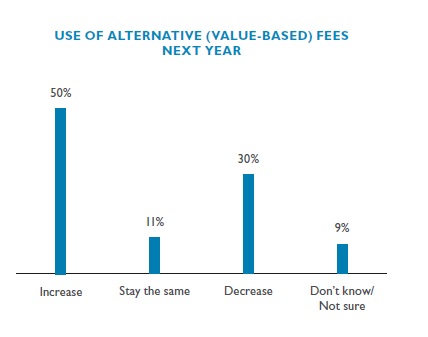
Okay, so a fair amount was made of a chart in a ‘ACC Report – Law Department Management: Establishing Value In An Evolving Business World’ published late last year which predicted a 50% increase in the use of Alternative Fees this year. Given the ACC is the leading voice for in-house counsel globally, including, now, Australia, pretty clear evidence of the future direction of AFAs you’d think.

But, to my knowledge, little has been made of the fact that the same chart foresaw a 30% decrease in the use of Alternative Fees this year by those same in-house counsel.

use-of-afas-image

And so I asked myself: Given their popularity, what could possibly be driving in-house to contemplate a reduction in their use of AFAs? This is especially so given that the ACC has very much been at the forefront of championing their use? And, potentially, in such large numbers?

The truth is, I don’t know the answer to this question. It could be as simple as the fact that in-house counsel expect to instruct out less work that fits the AFA model. But I also hazard a guess that with some in-house counsel it will have something to do with one or all of the following three possible reasons:

  1. AFAs are not transparent – no one, apart from the person who sets them, knows how they got to tat price. As such, it’s really difficult to compare them.
  2. AFAs don’t represent value. Despite a belief that they represent value over hourly billing, in the view of many in-house counsel they simply don’t. Therefore, much easier to use the foe you know (hourly billing with discounts).
  3. AFAs are not alternatives. Simply put, the core to most AFAs proposed by law firms remains: Units of Labour (manpower) x Time x Rate = Price. QED, they are not “alterative”. Indeed, their very names even suggest it with “blended”, “phase”, “task”, “volume”, “flat”.

To be clear, I don’t want to see the demise of value pricing. Indeed, quite the opposite. Nor am I particularly an advocate of hourly billing. I am however, wholly against the use of the term “alternative” when they clearly aren’t. And so I’m not overly surprised that 30% of in-house counsel are saying they will see a decline in their use this year.

Given the glacial speed of change in the the industry, I’ll wait to see if there is any change here this year. My gut tells me though not to hold my breath and that we are likely to be in the same place next year as we are now.

RWS_01

What strategies are being used to manage outside legal costs? – not AFAs!

“The growth of AFAs has been much slower than many predicted, remaining at roughly 16% of revenue in 2015…

… Most of the resistance has come from clients who are not comfortable with what law firms have proposed as AFAs, and would rather stay with hourly rates and discounting.”

[Both of the above are taken from the recently published 2017 Client Advisory, by Citi Private Bank and Hildebrandt Consulting Inc  (see page 9)]

I completely understanding why clients feel frustrated with the so-called Alternative Fee Arrangements (AFAs) that law firms often propose to them and are pushing back on these. Whenever you discuss AFAs with law firms, all you tend to hear is talk of ‘fixed fees’, ‘capped fees’, ‘success fees’, ‘risk collars’ and other such loft terms, more often than not being held as if they were innovative disruptors in the way we price legal services when the reality is 99.9% of them have the billable hour underpinning them and have been on the pricing menu for more than two decades. So why shouldn’t clients just go with a standard billable hour and get a 10% discount at the end of the matter – much simpler and proven route (and, as a side note, interesting to see the report continues to show realization rates on the slide!).

No, as a profession, the time has come to accept that if we want to be real about offering clients alternatives to the billable hour then we must get on the front foot and become more creative about what we are offering them. And the best, and possibly only, way we will achieve this is if we start to have conversations with our clients about this.

And herein lies both a solution and a way forward!

In another recently published report – the 2016 Legal Department In-Sourcing and Efficiency Report: The keys to a more effective legal department by Thomson Reuters (see page 16) – ‘Use of budgets for matters‘ smashes ‘Alternative fee arrangements‘ (59% to 31%) as the most popular answer to the question around what strategies are being used to manage outside legal costs.

strategies

Given this was a survey of 429 attorneys and operational professionals working in corporate legal departments by Thomson Reuters, you would think it would be a good indicator of in-house aptitude (side note: notice only 1% mention Reverse auctions? Definitely not reflective of the noise being made in the market around these!)?

Anyhow, here’s a Holidays thought for those law firms looking for alternatives to the billable hour that might actually (a) pay them some money, and (b) have the support of their clients:

go and speak to your client about use of budgets for matters.

After all, surely all those pricing directors, legal project managers, process improvement directors, innovation officers, etc talk with each other every now and then and come up with something helpful and original along these lines!

Happy holidays to all.

RWS_01


What percentage of legal spend is via alternative fee arrangements?

The Ninth Annual Law Department Operation Survey was published late last month (Nov 2016). A survey of – a record number of – 133 law department professional, one of the questions asked in this year’s survey was:

‘What percentage of legal spend is via alternative fee arrangement?’

Unlike other legal market surveys undertaken during the course of the year, the results here are telling in that they are from those running the legal department, as opposed to those practising, and therefore, arguably, are more reflective of the market’s aptitude to Alternative Fee Arrangements (AFAs).

Overwhelmingly – at 87 percent – US in-house law departments make some use of AFAs with their private practice suppliers. Tellingly though, only 14.1% of this is over 50% of spend and more than a third – 34.4% – is in the one to 10 percent space (making me wonder if this is just discounts disguised as AFAs).


afas-9th-ldo-survey-2016

RWS_01

The perfect storm for #OldLaw?

In my last post I mentioned that I may post some further thought I had on this year’s Altman Weil Chief Legal Officer Survey.

One further comment on the Survey findings I did want to make relates to what I consider to be ‘the perfect storm’ brewing for the so-called #OldLaw or Traditional Law firm model.

And the best thing about this post is that my point can be made by showing you the following three easy to read charts from the Survey:

Chart 1

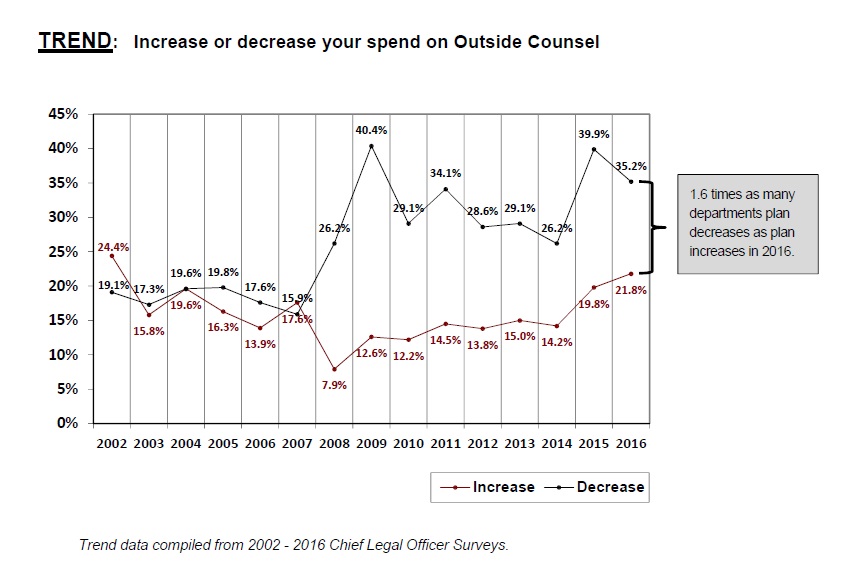
QUESTION: What are the chances you’ll be spending more money with me – your outside counsel – in the medium to long-term?

aw-1

[click on chart to expand]

ANSWER: Not an awful lot!

Chart 2

QUESTION: If you are not giving me – your outside counsel – the work, then who are you giving it to (ie, who is my main competitor)?


aw2

[click on chart to expand]

ANSWER: Yourself!

Chart 3

QUESTION: When you do give me work, what are the chances that you are going to ask me for a discount?

aw3

[click on chart to expand]

ANSWER: Very likely indeed!

Have to say, reading these three charts I’m left with the feeling that outside counsel are in for a very rough ride unless they are 100% focussed on what they want to do, and who they want to do it for!

RWS_01

The BIG takeout from this year’s Altman Weil CLO Survey

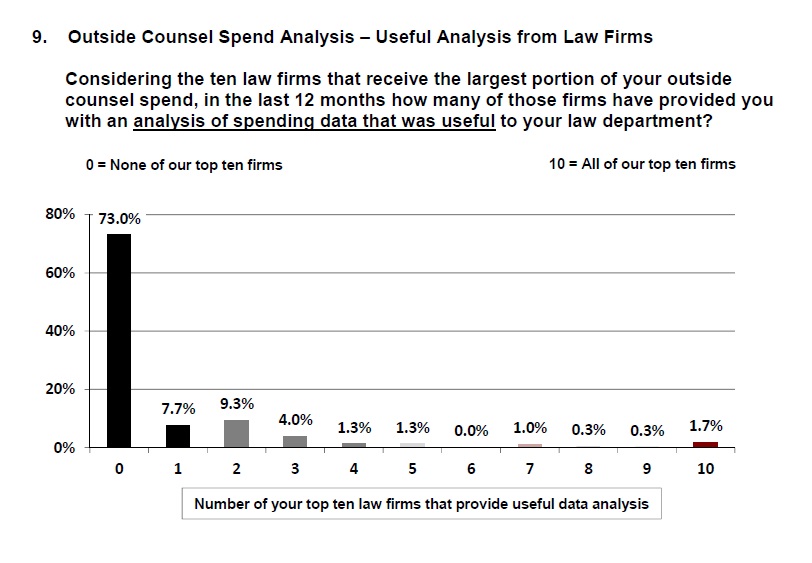
Altman Weil published the 2016 edition of its Chief Legal Officer Survey overnight Australian time. I may well post some more of my thoughts on this year’s content in the coming days, but what I wanted to share with you immediately is what I consider to be one of the most damning charts I have ever seen as it relates to business development, legal spend, and client relationship management:

altman-weil-clo-survey

That’s right, when asked the question:

Considering the ten law firms that receive the largest portion of your outside counsel spend, in the last 12 months how many of those firms have provided you with an analysis of spending data that was useful to your law department?

An overwhelming majority of CLOs (73%) responded “none”.

So, if you work for a law firm looking to differentiate your services; then the answer is it really isn’t that difficult.

RWS_01

The R.U.L.E.S revisited

In August 2013 I posted ‘Is it time for law firms to break with the RULES when looking at profitability?‘ on my old blog platform Australian law firm business development. It is without doubt the most read post I’ve ever written. And, as the recent publicity around DLA Piper’s decision to make equity partners clock 7.5 hours a day of time (not necessarily billed) shows, it remains one of the least followed and understood.

So what is the “R.U.L.E.S” system – and, three years after I last posted on this: do we, once again, need to promote its demise?

The R.U.L.E.S.

Taken from Robert J Arndt’s relatively short (at 31 pages) 1988 publication ‘Identifying profits (or losses) in the law firm‘, the acronym R.U.L.E.S stands for:

  • Realization – of billing rates
  • Utilization – of attorneys
  • Leverage – of lawyers
  • Expense – control of (both the fixed and variable kind), and
  • Speed – of the firm’s billings and collections.

For more than two decades the R.U.L.E.S have been the foundation for law firms looking to mine their financial information beyond the mere top level question of: ‘Did the firm made any money this year?’. Indeed, it could be argued that they were the precursor to the Balanced Scorecard in that they help determine:

  • which lawyers and partners are making a profit,
  • which practice areas are making a profit,
  • which matters are more profitable than others, and
  • which clients are more profitable than others.

But, in today’s world the R.U.L.E.S are not without fault. For example,

  • Realization is generally accepted as being the amount collected (ie, in the bank) against the effort to produce (ie productivity); or, as Altman Weil defines it: “realization is fees collected divided by the standard value of the time worked“.

On an individual fee earner basis, what this means is that if you set your fee earner a standard billable hourly rack-rate of [say] $100, and they charge the client $90 per hour (after write-offs etc) for work done, and for which the client pays $85 per hour (after asking for a discount etc) for the work, then the realization rate is 85% [I note that some firms adopt the practice of looking at realization as being the amount paid against the amount billed (94.44% in this example) but this is not the methodology used in RULES].

On the other hand, if the same fee earner does a fixed fee job for $1,000 and it only takes them 5 hours to do the job (cost of $500), then the realized rate is $200%.

While this may have been a good indicator of individual lawyers’ profitability in the past, increasingly it isn’t – not least because clients see through this BS and will not pay for their lawyers on a fully rack-rated hourly basis.

  • Utilization is the yardstick by which we determine how busy fee earners are. To determine this we look at the annual budget of hours the firm has set each relevant fee earner against the amount of billable time they have put on their time-sheets (daily, weekly, monthly or annually).

As I mentioned in 2013 – and nothing has changed – there are two principal flaws with this use of utilization:

  • the first, as shown by the likes of Crowell & Moring and others, is that the annual billable hour figure is a moving goal post.
  • the second, and more important, reason is that utilization sees an hour billed as “king” – it trumps all.

Today, where clients are looking for, among other things, an understanding of their business (non-billable hours spent attending industry events) and corporate social responsibility, utilization seems an outdated profit related performance metric.

  • Leverage is the number of fee earners you have to partners.

A reading of Maister’s Managing the Professional Service Firm will tell you, leverage is a key component of a law firm’s profitability. In order for a law firm to be more profitable, the maximum amount of work possible must be pushed down the chain to the more junior ranking lawyers.

Unfortunately, today this cannot be done so easily. Clients are simply not willing to pay for you to train your junior fee earners!

  • Expenses are both fixed (ie rent) and variable (ie salaries and bonuses) and are always going to be an important factor in determining a law firm’s profitability.
  • Speed of collection is generally determined as being the time from when you did the work to the time you are paid for that work.

Sometimes known as “lock-up” days, speed of collection will have a massive effect on the firm’s profitability.

Having bagged the R.U.L.E.S – again, the question remains: ‘What are the alternatives?’ The answer to that is that there are probably far more now than there were three years ago, but they are start from the same place:

(a) Do you have a satisfied client, and (b) Do you understand the value you bring to that relationship?

RWS_01

Is it better to focus on ‘Service Outcomes’ or ‘Labour Inputs’?

Business Development image

A lot has already been written about DLA Piper’s rumoured requirement that its equity partners document 7.5 hours of work a day. Referred to as the ‘Red Card‘ system, this latest initiative by DLA is reportedly being put in place by its COO Andrew Darwin in order to reduce/eliminate ‘delinquent behaviour‘ by withholding quarterly profit drawings and, if persistent, reduced monthly drawings of those partners who do not meet the 7.5 hours a day target.

Now, as has been noted elsewhere, this 7.5 hours a day doesn’t have to be billable work – it merely needs to be ‘documented’. As such, marketing, administration, mentoring, and knowledge management tasks can all count towards this daily target.

But I have two questions for those like legal recruiter Dan Binstock, co-chair of Garrison & Sisson’s Partner and Practice Group Division, who suggest that:

“[A] policy like this is usually brought on due to unproductive behavior that needs to be addressed. While this is unusual, if there are segments of partners who are not carrying their own weight and coasting, this policy is definitively a firm kick in the rear.”
Which are:
  1. Do labour inputs reflect service outcomes?
  2. Do labour inputs reflect productive time?

Now I will accept that if you are answering the above two questions in a modern law firm -ie, exceeding budget – then it is highly likely you are far exceeding the 7.5 hours a day requirement.

So here’s the thing: I’m sure Andrew Darwin’s latest initiative has an agenda. Like others have written, I’m sure it has more to do with forcing unproductive partners of the firm out than it has to do with rewarding partners who exceed the requirement. It’s only a shame that in a global partnership, behaviours among equity partners is such that if an equity partner (yes, “equity”) is unproductive, has been given every opportunity to rectify this and turn things around, and has not done so, they can no longer be tapped on the shoulder and asked to move on.

RWS_01

Hourly billing – A dialogue with John Chisholm

In the concluding paragraph to a LinkedIn post he made Friday, 2 September – title ’10 rules about hourly billing for law firms’, in which he sets out the rules of US-based blogger Matthew Homann as they apply to hourly billing – my good friend, and sometime mentor, John Chisholm asks:

“Are we changing the “we sell time” mindset and business model of the legal profession? Are we changing it quick enough?”

I believe John’s questions to be important and worthy of a response. So here’s mine.

Are we changing the “we sell time” mindset of the legal profession?

“If aren’t selling time, what are we selling?”

Many would say that lawyers sell their expertise, knowledge, skill, and experience.

While I would have held that to be true pre-2008, in the new world order I no longer believe that to be the case and would hold that today this type of thinking makes it incredibly difficult for you to differentiate yourself from the pack. I’d go so far as to say that in today’s world expertise, knowledge, skill and experience are a given: they merely get you an invitation to the dance.

No, short of a nuclear event or a commoditised issue, what lawyers (and business development people on their behalf) sell today is access to the right expertise, knowledge, skill and experience. And we do this by fulfilling on all of the modern day clichés: – understanding our clients’ businesses, being client-focussed, always being available, always adding value to the relationship.

The problem though is that even if we know what we are selling, how we charge for it is a very different beast.

Are we changing the “we sell time” business model of the legal profession?

In the 2016 edition of ‘Law Firms in Transition’ by Altman Weil the researches asked:

“If your firm uses any non-hourly based billing, is your use of alternative fee arrangements primarily reactive (in response to client requests) or primarily proactive (arising from your belief in the competitive advantage of alternative fees)?”

72.2% of law firm leaders responded – “reactive“.

In an era where “Sixty-four percent of large firms have added a Pricing Director or staff equivalent” (see page (v) of the report), that’s pretty staggering. But it also goes to the heart of the problem: there clearly isn’t significant enough incentive to move away from what is in place (hourly billing) and towards something new – and the reality is we are only offering non-hourly fee arrangements under the very real threat of not being given the work at all!

And, to my mind at least, herein lies the crux of the issue John raises:- the problem is not that we sell time per se, but rather our business model rewards people for charging by it.

Indeed, if we truly want to know if the industry is changing from the “we sell time” reward model, then the Altman Weil report identifies all we need to know. In there it stipulates that law firm leaders clearly see:

“Efficiency and pricing [as] areas that firms can control to meet the changing marketplace and manage challenges and opportunities.”

And yet despite clearly seeing this:

“The one pricing tactic that has been adopted by a majority of large and small firms is developing data on the cost of services sold. Sixty-seven percent of all firms and 91% of large firms are doing this fundamental analysis, which should enable them to structure more customized fee proposals.”

And while I do commend law firms for trying to establish what a particular type of work might cost, this evidence clearly shows that firms remain stuck in a cost-plus method of charging for services rather than trying to determine what the value is to the client in doing the work – which actually would enable them to structure more customized fee proposals.

To close out this segment, I believe that the Altman Weil report touches on a central problem, and with it a possible solution, to the “we sell time” business model that currently exists in many law firms:

“…in too many firms personal, political and cultural obstacles are hindering pragmatic economic decisions.”

Are we changing it quick enough?

It should be obvious by now that my response here is going to be “no”.

But I wanted to finish by quoting a paragraph in the Altman Weil report that I believe sums up the profession’s glacial attitude to change far better than I can:

“If the strategy is simply to keep up with the pack, it misses the point that most of the pack is itself lagging and just a small increase in pace can distance a firm from its undifferentiated competitors. A firm can never get ahead by merely aspiring to keep pace with sluggish competitors. Vigorous pursuit of opportunities has always paved the way for competitive success.”

RWS_01