Author: RWS_01

Over 20 years’ experience developing and implementing effective business development strategies in law firms across Australia and Asia.

Fixed or capped fees – as a client which would you go for?

Last week the American Arbitration Association (AAA) announced that it would introduce an alternative fee arrangement (AFA) option on “eligible cases” offering to help resolve B2B disputes through the arbitration process (source prnewswire.com).

The AAA’s claim is this is the “first of its kind to be offered by a national provider of alternative dispute resolution (ADR) services“.

So let’s check it out.

Setting aside the “eligible cases” issue, what are the AFAs being options being offered?

According to the AAA:

  • Fixed Fee Arrangement, whereby an AAA arbitration panel member proposes a fixed fee for the pre-hearing, hearing, and post-hearing phases of arbitration which must be approved by all parties.

  • Capped Fee Arrangement, whereby an AAA arbitration panel member proposes a fee cap for the entire arbitral process which must be approved by all parties.

Wait a second, as you’ll know from my last post, capped fee arrangements are not an AFA and any pricing expert advising you otherwise needs to be shown the door.

But…

Given the choice – as a client of a  law firm client – which would you choose?

My take: depending on how different the two quotes are – which I’m guessing would be done on an “hourly rate x number of hours x which way is the wind blowing calculation“, I’d go capped fee (the exception here, a really low ball fixed fee).

Why – given my objection to this?

Well, because a fixed fee is – fixed. While a capped fee is – capped.

So if your lawyer comes in under cap (using hourly rates), they can only bill you what they have charged. And if the lawyer breaches the cap (using hourly rates), then they cannot charge you any more than the cap – hence it’s name.

So, as a client, I win both ways.

While a fixed fee is fixed. So if the lawyer uses time-sheets (hourly rates) and comes in under the fix, back luck you client. On the flip side, if the lawyer uses time-sheets and comes in over the fix, back luck law firm.

QED: in this case, I’d go the capped fee option.

The sting in the tale here though is these 7 little words:

“which must be approved by all parties.”

which despite India Johnson, President and CEO of the AAA-ICDR, comment that:

“Alternative fee arrangements align with our mission to add cost savings and fee transparency and predictability to the arbitral process; the AAA and its Roster of Arbitrators are proud to be the first arbitral institution to offer an AFA option to parties and counsel seeking to resolve their disputes through arbitration,”

means the reality is it will never happen.
rws_01

Why most law firms don’t need to hire a Head of Pricing

Following a conversation I had recently with John Chisholm, I had reason to revisit Patrick Johansen’s website patrickonpricing.com and re-read both his Continuum of Fee Arrangements™ and his Roll Call of pricing professionals.

Let’s get controversial. Re-reading Patrick’s stuff it occurred to me that there are an awful lot of law firms have hired pricing experts (Patrick has over 300, but it wouldn’t surprise me if that number were closer to 500) on -most likely- really good money who, get this: don’t really need them.

Why do I say that?

Looking again at Patrick’s Continuum of Fee Arrangements, Patrick has sixteen different pricing options available for law firms to offer clients:

  1. Hourly – the ‘go to’ pricing option for law firms. But are hourly rates pricing or billing?
  2. Volume – nope, not a pricing mechanism. It’s a discount. Not even an alternative fee arrangement (AFA).
  3. Blended – isn’t that an hourly rate?
  4. Retainer (Periodic) – okay, now we are talking. Law firms may need some help from a pricing expert on this one. But wait up, how much of a law firm’s revenue is done on a retainer mechanism? Less than 5% would be my guess. Justify the cost of pricing expert on the books (as opposed to freelancing), unlikely.
  5. Capped – OMG don’t get me started on capped fees. Known as the “heads I lose, tails I lose” pricing mechanism for law firms. I understand why clients love capped fees, they cannot lose. But any pricing expert on a law firm’s books who recommends capped fees as an option deserves to be sacked immediately.
  6. Task – okay, but isn’t this really just a fixed fee?
  7. Flat (Transaction) – okay, but again: isn’t this really just a fixed fee?
  8. Phase – sounds like a fancy name for task to me!
  9. Fixed – Nirvana. Now we need a pricing expert.
  10. Contingency – implies it needs to be contingent on something.
  11. Portfolio – my view is that this is one of the most misunderstood and under-used of the various pricing options. I’m not sure there are many pricing experts in commercial law firms who do this well.
  12. Hybrid – yeah right. Are we talking cars now?
  13. Holdback – this isn’t pricing. This is a reward mechanism. I could do all the pricing calculations in the world, but if the legal team provide a rubbish service then the client will withhold a part of the fee.
  14. Risk Collar – is hourly billing with an up and downside calculation mechanism.
  15. Success/Bonus – again, performance related.
  16. Value – right, and how many law firms are really doing this? Few and far between. Hell, most law firms don’t even understand the ‘value’ they provide (see ‘discounts’ and google number one AFA offered by law firms). No, nice to say; but a very long way from getting it.

So looking at this list I ask myself: “How much science is involved in pricing legal services?”. And the answer I come up with is: “Not a lot”.

Taking all this on board, I get why law firms hire ‘pricing experts’ out of accounting teams. And maybe that’s where the real opportunity is being missed.

But trust me, for all but two or three of the above pricing options, you don’t need a pricing expert – you need an accountant. So don’t waste your money hiring one.

rws_01

How many working hours a week is too many? Where do we stop?

Without travelling east to west, 169.

One of the more read posts on this blog was something I wrote back in August 2016 – ‘Why asking someone to work 2,000 billable hours a year will kill their spirt‘ . I had reason to re-read this post early this week following the publication of a post on the asialawportal.com website by Matthew Kelly – ‘Work life balance across Asia – and how things are changing‘.

Matthew’s post follows on the back of an article published in Business Insider earlier this month that ‘South Korea is trying to stop overwork by limiting the maximum workweek to 52 hours‘. The gist of the BI article was that President Moon Jae had recently legislated that the maximum working hour week in South Korea had been reduced from 68 hours a week to 40 hour per week, but with the option to do any additional 12 hours per week ‘overtime’. All sorts of reason for why South Koreans work so hard were also mentioned, including that South Koreans need to work overtime to supplement their salaries (which, if true, is a rather sad reflection on the society).

Leveraging off of this, Matthew’s post argues that attitudes to long hours and presenteeism are generally shifting at law firms in Asia.

My View

On the one hand, I would agree with Matthew. Attitudes towards presenteeism are changes in Asia. Partners and senior managers at law firms are more tolerant of the agile approach to work-life balance. The days of sitting in the office as a junior lawyer and waiting till your partner had left do seem to be on the way out.

That said, with the reduction in the number of junior lawyers (relative to previously) working in private practice and the increased use of technology to be able to draft advices and contracts on the go has, in my view, led to an increased expectation around the number of billable hours lawyers are expected to work in the Region.

For some time now the number of billable hours required in order to qualify for law firm bonus pools has been on a slow upward trajectory. A little over a decade ago this sat – as an industry average – around the 1,400 hours a year mark and now it is probably closer to 1,800 (with US law firms being north of 2,000 hour per year).

While this increase in the overall number of hours required to be billed per annum may not seem massive, in day terms it really isn’t uncommon now to see junior lawyers today with billable target hours of around 7 to 8 hours per day.  And as Yale University has pointed out for a number of years now, asking someone to do 1 billable hour is a lot different to asking them to do 1 working hour (‘The Truth about the Billable Hour‘).

Once again though, you may ask why all this matters?

Well in the first instance, and probably most importantly, in a time when ‘wellbeing’, ‘mindfulness’, ‘flexibility’ and ‘agile’ are vogue in law firms, it would seem counter-intuitive to ask someone to work to a set number of billable hours per annum.

But in addition to this, asking someone to work to any set number of billable hours, even if that is one, assumes that ever dollar of revenue is equal. And we all know that’s not true. So it is actually a pointless target. But it is a pointless target that also causes serious mental health issues for lawyers. So it is actually cruel.

And for all those reasons it is time we moved on from billable hour targets and utilisation as reward/budget metrics and came to some consensus on a different metric by which we could reward private practice lawyers that actually inspired them to develop their skills, their practice and remain engaged in the profession,

rws_01

“Who still pays sticker price”

…is a quote from the 2018 Buying LegalProcurement Survey‘ that I took the time to read over the weekend.

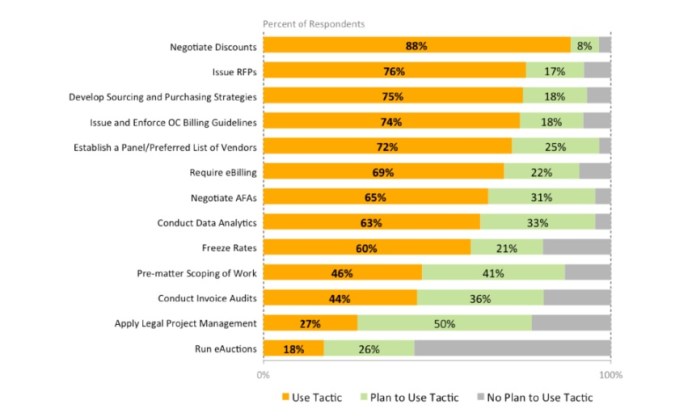
This report makes for a fascinating read, not least the fact that ’72 percent of organizations are currently using panels/preferred provider lists’ and that ’25 percent are planning to use them in the future’ [Takeout tip:- best to invest in a really good tender team. Something that we in #Auslaw have always under invested in].

Anyhow, one of the quotes of the report is “Who still pays sticker price?

my take, for what it’s worth, is that nobody does.

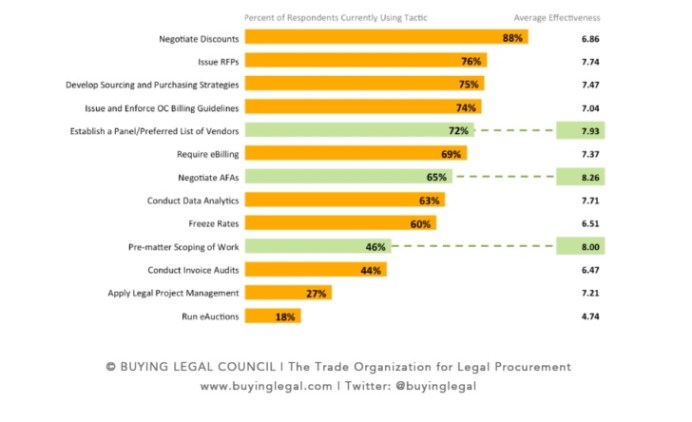
Leaving aside the fall in realization rates we see continue to see every year in reports such as the one published by Altman Weil (what are we at this year – 83%?), the rise of so-called AFAs currently used by “65 percent of survey respondents and another 31 percent are planning to use it” means that even if the ‘billable hour’ isn’t dead yet, the hourly rack-rate certainly is.

But the point of this post – as is a common theme here on my blog posts – goes to the use and, importantly, effectiveness of ‘discounts’.

One of the graphs in the report shows that a massive 88% of respondents negotiate discounts with their legal service providers and that a further 8% plan to use this tactic in the future.

Picture One - 23072018

While totally believe, this is also an unreal stat (think about that for a second: 88% of clients are saying you are not worth what you think you are worth!).

But – and here’s the crux, when asked the “average effectiveness” of the various fee negotiation options available to them, the client preferred option of negotiating discounts did not come top.

Not even close.

The most effective was negotiating AFAS.

And the second most effective way of ensuring that your law firm delivers on time and on price?

–  ‘pre-matter Scoping of Work’

Picture Two - 23072018

Well there’s a surprise – properly scope a matter and implement legal project management and, odds on, you’ll have a satisfied and happy client that isn’t asking you for a discount – is probably happy to pay you hourly rates – and is giving you repeat work.

What more could you want!

rws_01


Because it’s 1 July…

…my health insurance premium has significantly increased,
…my home contents insurance premium has significantly increased,
… my car insurance premium has significantly increased,
…the daily daycare cost (of both) my children has significantly increased,
…my coffee shop has increased the rate of a large, and
… my lawyer has increased his rate.

Such is life in Australia.

Fine by me, but in every single one of the increase fee notifications above (all by letter and none via an actual conversation with me) the underlying reason for the increase was cited as being an increase in ‘costs’.

My two take-outs: (1) if we all stopped increasing our rates in July maybe increased costs would be less of an issue, and, importantly, (2) if you can hold a conversation around “value delivered” rather then cost, you’ll be streets ahead of the competition.

rws_01

Is there a ‘Customer Value Gap’ in legal services?

Earlier today I read a wonderful post by Tom Spencer: “Is AI the Solution for the Banking Sector? (Part I: Problems)“.

In his post, completely unrelated to legal – and yet oh so legal sector related, Tom states that in response to changing client buying-cycles/decisions, banks worldwide are making large investments in digital technology and analytics in order to:

  • deliver a better experience,
  • reduce costs,
  • deepen and broaden existing client relationships,
  • extend their distribution reach, and
  • protect relationships against traditional and new competitors.

[kind of sound like the perfect CRM software!]

Two additional questions Tom then asks (with undertone inference added by me) are:

  • How much value are solutions delivering to customers?
  • How could new value be created?

rws_01

‘Trusted advisor’ status… …the Holy Grail?

Ever since David Maister published ‘The Trusted Advisor‘ in 2001, it has been the daily pursuit of private practice lawyers to demonstrate that they have attained and retain ‘trusted advisor‘ status with their key clients. As is the case with many cliche phrases used or suggested by law firm marketing teams (like, “what keeps you up at night?”) however, I have often wondered – and vocalised – what being a trusted advisor actually means?

Sure there are many consultants who can (suggest) road-map your way to trusted advisor status. There may even be one or two lawyers out there who can articulate what that actually means. But as I have often been heard to say: “how often do you instruct a personal advisor – such as a lawyer, accountant, financial advisor – that you don’t (at least a little), trust?

My guess is that would happen in very few occasions (in my case I needed a plumber at 11pm and didn’t take too long doing reference checks 🙂 ).

But the interesting take is how in-house lawyers view this phenomenon.

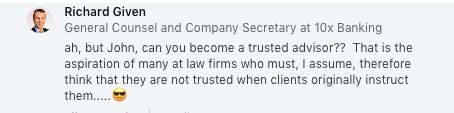
And on the note, I was quietly pleased to see the following post by Richard Given – General Counsel and Company Secretary at 10x Banking – on a LinkedIn thread I was involved in last week:

Screen Shot 2018-06-03 at 7.00.07 pm

because Richard sums up my exact concerns/thoughts over the past decade and a half whenever the term “trusted advisor” has been thrown about.

Food for thought at least.

rws_01

The difference between value and money

Last week (18.5.2018) Seth Godin published a post on ‘The difference between time and money’. In the post, Seth states:

You can’t save up time. You can’t refuse to spend it. You can’t set it aside.

Either you’re spending your time.

Or your time is spending you.

Very profound. Especially if you work in the legal industry.

At roughly the same time (15.5.2018), the Association of Corporate Counsel (ACC) named its 2018 Value Champions.

One of the quotes – in the accompanying news reports to the announcement – states that, when considering value, the committee/clients give(s) consideration to: “cutting costs, improving predictability of spend, and improving legal and processing outcomes.

For a long time now our industry has used time as a metric of success and tried to equate value with the cost of that time.

What I hope we can take out of these two completely unrelated posts is this:- cost of service may have something to do with how we value something, but more often than not it has nothing to do with it at all.

So if you are looking to be a client-centric value champion ask yourself everyday:-

‘What am I doing to add value to my clients’ businesses?’

Because that’s surely how you will survive moving forward.

rws_01

Is the end of the ‘full service’ law firm nigh?

Quoting from a recently published ‘UK Business Legal Services Market’ report, last week (10 April) the Law Society Gazette (England and Wales) published an interesting article re ‘Demand for business law rising but top-200 go niche as competition intensifies’.

The article reports that:

IRN surveyed the websites of the top 200 law firms to guage how many have created vertical sector teams to advise different industries. Thirteen vertical sectors are listed by over 50 firms, led by real estate (101), financial services and insurance (97), and hospitality, leisure and sport (91). Another 10 sectors reach double figures.

Interestingly going on to state that:

Some vertical sectors are already becoming crowded, the report warns, with the next emergent trend a move to more niche expertise. In health, for example, niche specialties include GPs, independent hospitals and social care.

With the likes of Tim Williams having advocated for a number of years that ‘niche expertise’ is one of the principal ways law firms can survive the future, with the publication and public discussion of this report maybe the time has one again come to ask:

  • what do we mean by the term ‘full service’ law firm?, and
  • is there any negativity moving away from this term.

In response to the first point, personally I have never truly understood what law firms were trying to achieve by claiming to be ‘full service’. Indeed, I’m not sure I can cite a single honest example of a big law firm being ‘full service’ (in Australia, most don’t do Wills & Estates and syndicated bank lending under the same roof).

On the support services side, ‘full service’ always seemed to be something Marketing had come up with in the early 2000s to ensure we had ‘cross selling’ collaboration and were not missing out on any opportunity with the rise of Globalisation.

On the lawyer-side, the term ‘full service’ law firm over the last 20 years seems to have meant that the lawyer could put their hand up to do bankruptcy as well as your latest employment contract (especially when there is little incentive within the firm to refer the work to the ‘true’ expert) – i.e., Jack of all trades, Master of none.

In response to the second point, I believe the article itself clearly answers this question – clients would prefer to deal with subject matter experts.

And therein lies the most interesting twist to this issue today:- it has been the case since I first started out in this business over 20 years ago that if you were considered a ’subject matter expert’, you would do well.

So, taking this all on board my take-out from this post is this:-

moving forward, if you want to be taken seriously, stop promotion your firm as ‘full service’ and start promoting both the firm and its lawyers as the subject matter experts.

Because that’s how we survived the future in the past.

rws_01


The Three Noble Horsemen of private practice: ‘Finders, Minders and Grinders’

When I first started working in private practice there what were then commonly known as the Three Noble Horsemen of private practice law firms:- The Finders, The Minders and The Grinders.

The Finders‘ were what we today call ‘rainmakers‘. They went to all the conferences. They were members of the most exclusive golf clubs. They spent hours at some of the finest gyms and clubs. Indeed, there isn’t anywhere they wouldn’t go – often at short notice – if they thought their next big deal was there. On the flip-side, they had also forgotten most of the law they studied at university and hadn’t spent a day on the tools in years.

The Minders‘ were charged with looking after the client once the Finders had brought the client in. They were good lawyers and they had some good/great networking skills, but they weren’t very good at sourcing greenfield opportunities. To that end, they went to conferences and played golf so long as their prized client was at the conference or playing golf that day. Today this group are more commonly known as ‘Client Relationship Partners‘.

The Grinders‘ were academically brilliant lawyers who gave spot on advice. They were the product that the Finders could sell and the bedrock that the Minders could rely on. Mostly introverted and shy however, they neither liked the idea of ‘selling’ themselves nor the thought that they would have to network with clients. The just wanted to be on the tools – lawyers as a profession, not a business.

And, in those days, most firms knew, accepted, and encouraged, that if the firm was going to succeed it needed all of these partner skill-sets. To have Finders without Minders and Grinders was a quick route to failure. As was having Grinders, without Minders and Finders.

They were all interwoven.

Introducing the balance scorecard

And then we introduced the ‘balance scorecard’.

Under the balanced scorecard, in order to maximise your revenue (100 point partner), you needed to be a little of everything – but expert at nothing.

Finders needed to do some minding and, heaven forbid, grinding.

Minders now needed to do some finding and grinding.

And, worst of all, those introverted Grinders now needed to do some finding and minding.

Unsurprisingly, after a short period of time, the Grinders were on their way out. It was just too hard for them to find work and even if they did fluke a new matter, they simply couldn’t keep the client past one or two deals. So, on the basis that “if you cannot beat them, join them” many of the Grinders decided to join the growing ranks of in-house counsel.

More surprisingly, the Finders found themselves in a spot of trouble. They were a heavy cost, and under the new performance structure, they weren’t making any money/profit. Sure they may get the odd referral credit, but they weren’t really doing any of the work and so – in truth – anyone could do what they were doing.

Out of all of them, the Minders were doing the best. But without the Finders to help them find the work and the Grinders to actually do the work, the Minders soon become what we like to call ‘entrepreneurial‘ partners.

And so that is where we are today.

But I do miss the days of the Three Noble Horsemen of private practice:- The Finders, The Minders and The Grinders, and I think any firm looking at its 2025 strategy could do a  lot worse than get a hell of a lot better at its finding and grinding, even if that comes at the cost of some minding.

rws_01