
legal panels

‘Is Australia the world’s most competitive legal market?’ – So what if it is!

Way back in 2014, my good friend John Grimley, off the back of some comments I made in his book ‘A Comprehensive Guide to the Asia-Pacific Legal Markets‘ asked the question: ‘Is Australia the world’s most competitive legal market?‘.

Many of us in Business Development who work in this market day-in, day-out believe that it is.

Evidence we often provide to back this claim up includes:

  • The sheer number of panel appointments: both at Government (Commonwealth, State and Local Council) and private sector (nearly every ASX100 company is now panelled), means we are tendering year round.
  • If we are not tendering for panels, then we are tendering for projects and sub-panels. Most major law firms in Australia will be doing 250+ tenders a year!
  • Client fluidity. Tenders are one part of this, but client movement among firms is increasing. The stickiness we used to see is no longer there and, frankly, it is getting harder and harder to keep clients in this market. We need to be on top of our game, ALL THE TIME!
  • Law firm consolidation: we have seen a fair amount of this in the past 10 years. Anyone remember HDY, Herbert Geer, Dibbs Barker, Kemp Strang? These days, when it rains, I can play a game of “spot the law firm umbrella that has outlasted the law firm“!
  • But perhaps one of the biggest signs of how competitive the market is here is the sheer number of partner lateral movement we see each year. I’m sure other markets, such as the US, have higher numbers of actual lateral partner movement; but, I suspect pro rata number of partners, Australia would be in the top 2 or 3 in this field.

So those of us who live and work in Business Development in Oz can put our hands up and say: “We live and work in one of the world’s most competitive markets”, where brand differentiation is difficult, and almost everyone relies on innovation and technology to set themselves apart from the pack.

If all above is true: What can we do about it?

Well, not a lot actually.

But, and here is the good news, over the weekend I read a blog post by Seth Godin which gave me hope that, actually, it doesn’t really matter.

In ‘Too much competition‘ Seth states something so profoundly obvious I have to wonder why I have cared about how competitive our market is for so long.

So what is that Seth said?

Focus on the customer

Here you go:

Focus on the customers who care enough about your idiosyncratic and particular offerings that they’ll not only happily walk away from the lesser alternatives, but they’ll tell the others.

Simple really!

Only it’s not. So if you need some help with how to successfully differentiate your firm in tenders, feel free to reach out to me for a chat.

rws_01

Is It Fair To Charge Different Clients Different Rates?

Leaving aside the whole issue of whether or nor the billable hour is the best way to charge clients, do you think it is fair to charge different client different rates for the same work?

This article by Jordan Rothman on abovethelaw.com would suggest the answer to that question is – ‘yes’.

And I actually don’t disagree with Jordan’s outcome, but do disagree with his thinking of why.

After all, at least here in Australia, we very rarely have the same panel rate for all legal panels we are appointed to so; despite, or rather, the fact that we will be doing similar work under the various panel appointments.

QED – IMO – it’s fair to charge different clients different rates for the same work we do (and, HINT, it all comes out in the wash when you look at the Average Realised Rate – but I will leave that for another post).

But, and here is the critical difference I have with Jordan’s post, different clients will equate a different value to the work being done by you – and so it is more than fair to charge one client more or less than another client perceived on the value of the service they are getting.

For example, and I accept this is somewhat crude, somebody who has never been divorced before and whom your firm ‘looks after’ in a very emotional period of their life is way more likely to value the service your firm provides than someone going through their fifth divorce – so charge them more!

If you want to have a chat about how you can maximise your value opportunities, feel free to reach out.

rws_01

Report: 45% of Australian GCs are forecasting a decrease in their 2019 legal spend – How is this going to be achieved?

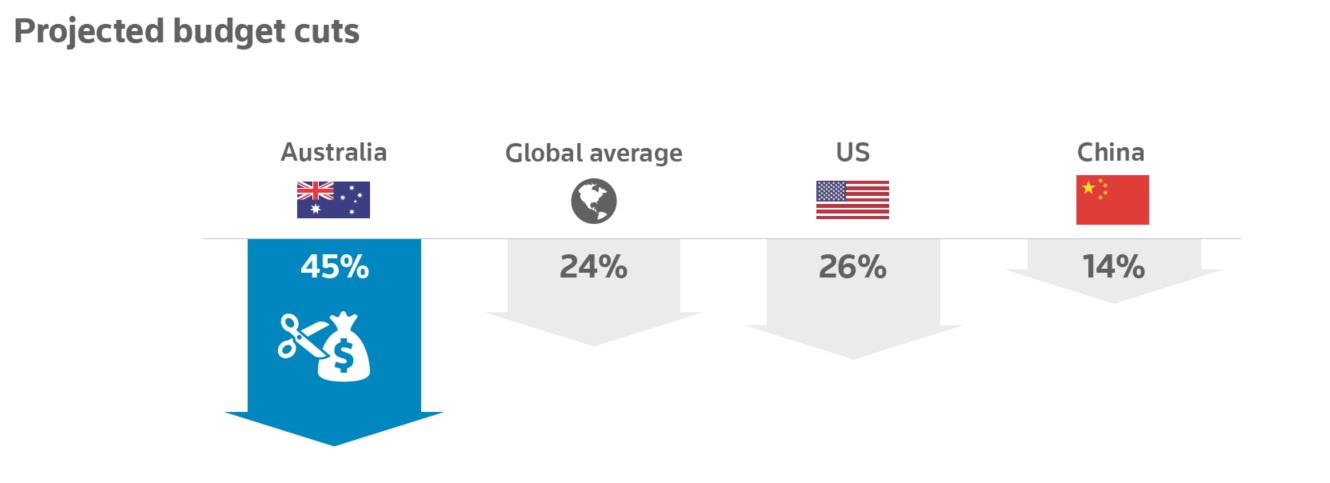
The State of Australian Corporate Law Departments Report 2019 – a joint publication between Thomson Reuters and Acritas – was published earlier this month. With more than 2,000 telephone interviews conducted and 73 interviews with Senior Legal Counsel based in Australia taking place, the sample for this report is robust. And while the usual rhetoric around “more for less” is reflected throughout the Report, one of the standouts is that Australian GCs are forecasting 45% projected budget cuts (over 2018 we have to assume):-

budget cuts

To put that into context, that almost twice the global average.

In a time when we have Royal Commissions being announced almost weekly, and compliance issues are on the front pages of the papers daily, you have to wonder where and how these savings are going to be achieved.

As to the ‘where’, given how much ‘top-end’ reputational compliance work that’s happening in Australia at the moment, and how little cost savings can be made from the margins in low-end commoditised work, you’d have to assume the most likely area will be in the mid-level contract drafting/negotiation/management space [the space in which about 30 out of the top 40 firms in Australia play].

As to the ‘how’, having read the Report my take is that Australian GCs will look to achieve this through:

  • innovation
  • panels, and
  • the elephant in the room

Innovation

‘Innovation’ has been a buzzword in the Australian legal world for over a decade. And, as one of the first jurisdictions to legislation the incorporation of law firms, to many outside Australia our system has been one of envy.

But when you ask Australian GCs to rate the innovation of Australian law firms, only 35% feel they’re working with service providers they find modern and innovative.

innovation

From where I sit this means that 65% of Australian GCs don’t think you’re really doing all that much in the innovation space!

Legal Panels

Led by procurement, the dreaded ‘legal panel’s’ stated aim is to achieve:

  • cost efficiencies and predictability
  • relationship building (de facto another way of cost savings)
  • less administrative burden
  • quality [of work]
  • responsiveness
  • access to experts, and
  • value adds on offer

All great and noble aims if you are looking for a 45% cost saving year-on-year – until you take a closer look at the reality:-

panels

This chart is from the ‘GC Thought Leaders Experiment‘ and it clearly indicates that having a panel in place isn’t saving you anything! Add to that lateral hire movement over the past 5 years, and I very much doubt any of the metrics of having a panel are being met.

It’s worth noting here that swimming against the tide of rationalising panels to fragment legal spend is A Verona Dorch – Peabody’s Energy’s Chief Legal Officer who stated (on the issue of appointing panels) that:

Expanding the pool allowed me to insert a few more midsize and non-money center firms than I otherwise could have. And that’s been incredibly helpful—just a few months in, I’m noticing that those firms are extra eager to impress and put forth their top talent.

So maybe, just maybe, if you get it right there is something to be said for legal panels – only not in the form we currently have them.

The elephant in the room

And so we come to the elephant in the room, where a lot of these savings are likely to be found:

40% of Australian in-house buyers of legal services have used alternative legal service providers (“ALSP”) for support on legal matters, and over half of those who used an ALSP did so as they felt it was a more affordable option.

Private practice we are on notice.

As always though, interested in your thoughts/views/feedback.

rws_01