law firm clients

Pinsent Masons joins the #Auslaw party!

Business Development image

Some 15 months (December 2013) after Pinsent Masons initially appointed Maddocks ex-chief executive David Rennick to lead the firm’s review of growth opportunities in Australia, and three months after the vote to appoint John Cleland as new global managing partner that appears to have confirmed the firm’s stated international growth strategy , Pinsent Masons has, today, announced that it will launch a 5 partner led local Australian practice in May of this year with offices in Sydney and Melbourne that will initially focus on infrastructure related work.

Given the firm’s overall strength in infrastructure related work in Asia – partner-in-charge of Asia Ian Laing has significant PPP and PFI experience – a strategic focus in this area would appear to be sensible.

That said, Pinsent Masons decision to open here (with an as yet undeclared number of lawyers and support staff) does nothing to deter from the fact that the legal market in Australia is a very competitive and crowded one, a trend that is likely only going to increase with the growing interest of international brands – so the very best of luck to this firm going forward and welcome to the Auslaw party!
Q2 2014/15 CommBank Legal Market Pulse report

Business Development image

The CommBank Legal Market Pulse report for Quarter 2 2014/15, conducted by Beaton Research + Consulting,  has been published.  Providing useful insights into the latest trends and developments impacting on the Australian legal industry, this report has rapidly cemented itself as a staple among serious legal business developers in Australia.

Interesting outtakes from the latest report include:

  • unsurprisingly, given the continuing political uncertainty and falling commodity prices, many law firm leader believe there may well be a downturn in the broader economy over the next 12 months.
  • one in three firms are looking to expand geographically by opening new offices, with an emphasis on Perth, Brisbane and Canberra being the locations of choice. This is an interesting development as it had been the stated strategy of many firms in Australia for a long time not to expand outside of their geographic stronghold base. For example, for a long time HDY were only ever going to be a Sydney firm serving national clients. Now they have an office in Brisbane. Likewise for G&T (new offices in Melbourne and Perth). What I would be interested to find out though is how much of this expansion is self-driven and how much of it is been driven by major clients looking to rationalise the number of law firms they use? If that question was asked, I suspect we may find that this trend is more client-driven than firm-driven.
  • Asia at 89%, UK/EU at 67% and Brisbane at 52% are seen as being the geographic areas with the highest revenue growth expectations. Sorry but I find this nothing short of astonishing. Have any of these respondent law firms looked at how crowded the Brisbane and Asian legal markets are? And wasn’t it only a few months ago that PwC were reporting that return on equity for Asian law practices was the lowest globally (at somewhere in the 20% range). [that said, Clifford Chance did recently announce a desire to increase revenue in Asia by 25%]
  • expected changes in realised rates is a 1% (+) increase. Pathetic! Might I suggest the firms concerned consider not increasing their rates by 5-10% this year and instead concentrate on trying to get more than 80c in the $ in realised billing rates.
  • negotiating price with clients, at 81%, is seen as the biggest business challenge facing law firms. Here, I would hazard a guess that negotiating the price we want from our clients is probably the real business challenge as it would seem that price negotiations in law firms is a one way conversation at the moment.
  • the practice area with the highest revenue growth expectations is Government (at 55%). With the announced forthcoming closure of the Australian Government Solicitor potentially putting up for grabs around $111.3 million in revenue for private practice law firms, perceived growth in this sector shouldn’t be too surprising. What does remain to be seen is how much of this pie firms other than Clayton Utz (at 11% for 2013-14)  can get their hands on.
  • 54% of law firms surveyed believe revenue from “non-legal services” will increase over the next 2 years. While I was unable to find a definition of “non-legal services”, the relatively low (at 54%) number of law firm leaders who saw growth in revenue in this area does surprise me. This is especially so if services such as the recently launched Orbit by Corrs Chambers Westgarth is seeing as constituting “non legal services” (in that it is not core legal advisory work).
  • and finally, 70% of law firms see “recruiting partners and staff from competitors in the new location” as being the most likely method of geographic expansion, while only 30% saw this geographic expansion occurring as a result of a “merger with an existing firm” – so be on the lookout for 2015 being a very business year for lateral hires!

If you haven’t already done so, can I suggest you download a copy of the report. It really is an interest read.

Are the legal press letting the importance of revenue get in the way of a good story?

Business Development image

An interesting news item appeared on the Global Legal Post website overnight (Australian time). Citing a recently published (January 2015)  Legal Services Market Research Report by IBIS World, the Global Legal Post item, which is titled “Australian firms on the hunt for increased revenues” states that:

Pressure on revenues is forcing Australian firms to look overseas in a bid to increase turnover.

First of all, if I’m allowed to say, this is irony in action!

Given the number of international (mostly British) law firms that have entered the Australian legal market in the past five or so years as a result of perceived or real limitations on growth in their own domestic markets, to now be informed that one of the consequence of this action is that Australian firms now need to look overseas to grow their own revenue is, well, ironic.

More importantly – aside from being wrong as the IBIS Report clearly states that the market in Australia is growing (if admittedly at a snail’s pace) – is that it misses a crucial point; namely, increasing turnover for turnover’s sake is nothing short of a wasted effort!

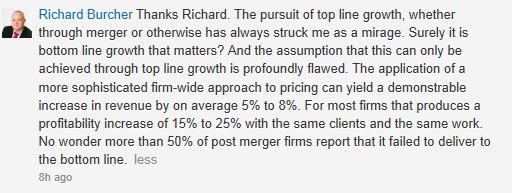
But don’t take my word for it, as the prominent industry strategist and pricing expert Richard Burcher rightly points out in his comment to the link I posted to this on LinkedIn last night:

Surely it is bottom line growth that matters? And the assumption that this can only be achieved through top line growth is profoundly flawed. The application of a more sophisticated firm-wide approach to pricing can yield a demonstrable increase in revenue by on average 5% to 8%. For most firms that produces a profitability increase of 15% to 25% with the same clients and the same work. No wonder more than 50% of post merger firms report that it failed to deliver to the bottom line.

RB image

Precisely Richard.

Unfortunately, however, this is not the only example of this type of legal press reporting/thinking.

Only the same day (Monday) The Australasian Lawyer reported – citing (wrongly in my opinion) another UK website – that the Australian arm of DLA had been “fingered for [the] law firm’s drop in revenue” as if huge levels of shame needs to be attached to this [revenue drop] given that it

follow[ed] a transition period where underperforming partners in the region [Asia] departed.

Well I happen to know a number of the partners who left DLA last year and one thing I can say with absolutely certainty is that they were anything but underperforming. More accurately, what they were was in practices that were no longer strategically aligned to where DLA sees the future of its business (something I think is made clearer in the UK version of this news). And, in a partnership sense, there is nothing wrong with having conversations like that. Indeed, they are to be encouraged.

So as with the discussion around revenue and profit, the discussions around revenue and strategy, while related are two different issues.

And all of this before we even get into the very real discussion of whether or not one law firm’s growth has to come at the cost of another law firm.

Shouldn’t a law firm talk to its clients before agreeing to merge with another firm?


Business Development image

The results of an interesting survey (looking at UK law firm merger activity) of 102 of the UK’s top 200 law firms by legal communications specialists Byfield Consultancy and partnership law experts at Fox Williams is being reported in the UK press overnight.

The headlines that appear to be grabbing the most attention from the survey results are that:

“Almost half of all non-merged UK firms would consider a tie-up over the next two years”

and that:

“As many as 95 per cent of managing partners expect their firms to merge within the next decade”.

Interesting as these numbers are, what grabbed my attention was the surprising – to me at least – fact that only 43 per cent of all merged firms revealed that they “investigated feedback from clients” prior to merging with the other law firm.

When you then take on board that “81 per cent of merged firms cited growth as a reason for joining forces” with their merger partner, doesn’t it seem a little odd that less than half would then discuss whether or not there was any real growth prospect in the merger with their clients and their merger partner’s clients (including any joint clients) prior to merging?

Little wonder, maybe, then that only:

“43 per cent of firms that have merged since 2010 believe that the move was a success”.

Acritas’ Sharplegal Survey: Vive La Différence – or you’ll lose work!

Business Development image

The days of the male dominated culture in law firms are numbered if said firms want to have any chance of continuing to win work from the growing number, as well as importance, of female in-house general counsel according to the latest research undertaken by Acritas’ Sharplegal (an annual global legal market survey of over 2,000 general counsel) revealing how differently male and female buyers approach the purchase of legal services.

Bottom-line take out from the covering article – on the Acritas website – announcing the survey result that should get every male law firm partner and their business development team’s thinking caps on is this:

Firms that are able to demonstrate in-depth knowledge of their female client’s business and her needs also stand to gain higher levels of favorability from her – an all-important step on the path to winning work.

This statement is also directly reflective of Lucy Siebert’s (international counsel at Australia’s Telstra) comments at the recent Legal Week Asia regional ‘Corporate Counsel Forum’, held at the end of November 2014, where she stated that:

We [Telstra] specifically look to see that they’re ensuring the best possible talent pool for us – not just white Anglo-Saxon males. We’ve got a very strong diversity policy and so we expect that to be something that is also important to our panel firms.

Crucially, law firms who are looking to win a greater share of work from female in-house counsel should note:

When asked what drove the likelihood to recommend a firm, a much higher proportion of women than men spoke about responsiveness as a deciding factor.

And specifically that:

Not only was it the quality of communication that mattered to female in-house counsel, but also the speed and level of interaction they experienced.

Interestingly, the survey also reports that:

43% of women working in senior in house legal roles said they used LinkedIn on a daily or weekly basis, compared with just a third of men. Furthermore, only a quarter of women said they never used the social network, compared to two fifths of men, suggesting that new business approaches to women may be better made online than ‘on the golf course’.

A final ‘thought for the day’ is the following by Lisa Hart Shepherd, CEO of Acritas [commenting on the survey findings]:

“A change in thinking and culture is needed if men want to impress an increasingly influential group of female in-house counsel who value business understanding and efficient communication over reputation, personal relationships and trust when choosing their preferred legal partner.”

Ambitious or just blind hopeful? – Clifford Chance look to grow Asia revenue by £50 million

Business Development image

On the train ride to work today I read a briefing update on the Australasian Lawyer website that the newly elected Managing Partner of Clifford Chance, Matthew Layton, had announced that the firm aims to raise revenue in Asia by 25 per cent.

Now the first thing I should say about this is that I haven’t been able to verify the source for this briefing update. The second thing I should say is that I know a number of key people – both on the management and fee earning sides – at Clifford Chance in Asia.

Putting that aside however, and on the back of the news that Fried, Frank, Harris, Shriver & Jacobson is to effectively close its Hong Kong and Shanghai offices and pull out of Asia (there remains some debate whether the firm will retain a representative office in Hong Kong and there is also a suggestion that the firm will not relinquish its Shanghai licence), and bearing in mind that Clifford Chance LLP’s announced earnings for its Asia Pacific operations in 2014 were £195 million (significantly up from 2013 announced earnings of £179 million but only marginally up from announced 2012 earnings of £181 million), I’m left wondering:

where do Clifford Chance see themselves earning an additional circa £50 million in Asia in 2015-16?

Because, while I wish  Matthew Layton, Caroline Firstbrook, Bas Borris Visser and everyone else at Clifford Chance the very best of luck, I’m not sure that:

“embrac[ing] technology and flexible working and service models as key elements for [the] expansion”

will cut it. And I somehow think the management teams of a number of other firms in the region (including those at Fried, Frank, Harris, Shriver & Jacobson) would agree.

Does your law firm have a ‘Big Ideas Project’

Business Development image

Last week I read about ‘The Big Ideas Project‘, a product of the Progressive Change Institute. I have to admit to being an admirer of projects like The Big Idea Project; but news today that Clifford Chance had appointed Amsterdam managing partner Bas Boris Visser as its first ‘global head of innovation and business change’ got me to thinking:

I wonder how many law firms have adopted a Big Ideas Project to help them decide what innovation and business change they need to be adopting and implementing if they’re to be more client-facing?

And, more specifically,:

If law firms aren’t adopting something like this internally – why not?

In 2015 the challenge we face is ourselves

Business Development image

Happy New Year to you all.

At this time of year you’ll likely read your fair share of articles predicting what the year ahead will bring. You may even read the odd article or two on the trends that are likely to impact on our business during the course of this year.

I should state for the record that I enjoy reading these articles and in many cases the predictions are not too far off the mark.

Indeed,  in previous years I would have been one of the first to gaze into my crystal ball and give you my prediction on the 10 or so issues that we are most likely going to face in 2015.

But not so this year.

To my mind the biggest challenge we, as business developers, face in 2015 is the fact that our business development efforts have been missing their mark in recent years.

To be clear, this is not a message I’m sending out there as a business developer.

I wish.

No, this is something our clients are telling us loud and clear.

In short, we, as business developers, have not been listening to what our pay masters are telling us.

Crucially, in 2015 we are also likely to see our marketing and business development messages lost in the noise surrounding chatter around AEC, ASEAN (as the region decides whether 2015 really is the year) and other such regional and global initiatives (Free Trade Zones being one).

While each of these will undoubtably be important factors for our business over the next 12 months, it is my belief that none is likely to lead to our down fall.

For the answer to that question, again we only need look at the resounding message being sent to us by our clients (yes, our clients), over a prolonged period now:

business development activities by law firm [in Asia] in 2014 missed their mark.

In 2015 then, we business developers need to be lifting our game and constantly asking:

what can we, as a law firm, be doing differently that will help our clients win more work, generate more revenue, and earn them higher rates of profitable return?

Alternatively, carry on as normal in 2015 and don’t be surprised if, at year-end, this is the result:

“If you always do what you’ve always done, you’ll always get what you’ve always got.”

-Henry Ford

Law firms are failing to support clients in South East Asia – really?

Business Development image

Yesterday I read an article on the lawyersweekly.com.au website by Felicity Nelson titled Law firms are failing to support clients in South East Asia‘. This article cites recent research done by Acitas, including:

  • 45 per cent of multinationals require legal advice in South East Asia;
  • 34 per cent of Australian multinationals’ legal spend now goes outside their home jurisdiction; and
  • 60 per cent of Australian in-house counsel surveyed said they needed legal advice in South East Asia

There is no doubt in my mind that Acitas research is both good and thorough. I have high regard for them.

But there is one niggling issue I have with the title of this article and that is this: while it would be fair to ‘Australian’ law firms (such as Minter Ellison or Clayton Utz) are not particularly active on the ground in South East Asia – and we can debate the merits of that strategy till the sun comes up – it’s a far cry to then extend that argument to say:

 Law firms are failing to support clients in South East Asia.

And why do I say this?

Well, some firms with a presence is South East Asia and Australia – and who therefore must have a strategic plan around meeting their multinational clients needs in both jurisdictions – include:

  • Allen & Overy
  • Baker & McKenzie
  • Clifford Chance
  • DLA Piper
  • Linklates – Allens
  • Norton Rose Fulbright

Keep in mind that these are international law firms with an actual presence in South East Asia and Australia with a declared strategy of having multiple offices in order to meet the needs of their multinational clients. They’re not ‘fly-in, fly-out‘ operators; so they don’t have to worry about some of the very real strategic and cost issues that Lisa Hart Shepherd, CEO of Acritas, points out in the article and which I made only yesterday around organic growth and local knowledge acquisition!

My only question having read Nelson’s article is this then:

What the Hell are these firms doing if, as is alluded to in the article title, a large proportion of Australian and multinationals in-house counsels’ needs in South East Asia are going unmet?

and having read the results of Acritas’ survey in the article,

What do these firms plan to do to meet these very real needs now?


* I would recommend you read the Lawyers Weekly article, it raises w hole host of additional issues not covered in this post

Does my law firm need an Asian strategy?

Business Development image

I go to a lot of meetings at which the state of the Asian* legal market is discussed during the course of a year. At a lot of these meetings, it is taken as a given that the relevant/respective law firm “needs” to either be in Asia, have an Asian strategy, or both. But, as is the case with a lot of prospect mining in this industry, short consideration seems to be given to the pitfalls of getting involved, and the most important strategic question of the lot:

Why?

as in:

Why do we (as a firm) even want to be involved in the cutthroat market of Asia?

is all but glossed over.

Keep in mind that most law firms won’t make money in their first few years of involvement in the region (and I should know, I have first-hand experience helping with the success of a start-up law firm that later became part of Clifford Chance). Indeed, some firms have been active in Asia for over a decade and still haven’t made any real money (and now exist on the principal that they have “a lot invested in the region”). And with a number of firms saying they want to grow revenue by 30 or so per cent year-on-year, if you do decide to get involved in the region then your firm’s commitment can easily and quickly translate into millions of dollars.

With all of this in mind then, it is important that your strategic reasons for being involved are more than simply a partner’s desire to live somewhere a little more exotic than cold, windy [insert name of city] or because you heard on your train ride to work this morning that XYZ company may give you a job in Rangoon at some unspecified time in the future.

More specific questions your firm needs to be asking include:

  • does the firm have short-term, medium-term and long-term strategic goals in place that will help measure whether your foray into the market has been a success?
  • has the firm identified which of your existing client base is active in the region?
  • do any of your firm’s clients have strategic growth plans for the Asian market?
  • are your firm’s potential clients in the region growth prospects, or are they mature players whose account you need to keep?
  • is your firm pursuing an aggressive acquisition policy or more conservative rear-guard protectionist policy?
  • how are looking to grow in Asia – lateral hires in the markets we want to be in (preferred method for South East Asia)? Or are we relocating partners from elsewhere into the jurisdiction (favoured method in Korea for example)?
  • what performance related metrics has the firm put in place to encourage its partners to be actively involved in the strategy (for example, is there cross-referral profit points?)?
  • what local issues will the firm need to include? – For example, how many law firms send lawyers to Asia without sending them on a cultural awareness or language program (in the same way as government departments do)? Why is that I wonder?
  • what are your competition currently doing/likely to do in the near future in the region? Importantly, do they have a chequebook that is likely to cause me considerable pain?

These are just some of the issues your firm should be thinking through if it wants to get involved in the potentially lucrative Asian market.

And the pot of gold at the end of the rainbow?

  • The Asia-Pacific legal services market had total revenues of $80.4bn in 2013
  • The Asia-Pacific legal services market enjoyed compound annual growth rate (CAGR) of 5.9% between 2009 and 2013
  • The Asia-Pacific legal services market is forecast to enjoy an compound annual growth rate (CAGR) of 7% for the five-year period 2013 – 2018
  • The monetary value of the Asia-Pacific legal services market is forecast to be $112.9bn by the end of 2018

Unsurprisingly then, you won’t be alone. There were approximately half a million active lawyers in the Asia-Pacific legal services market 2013.

—–

* It is critical, when looking at your “Asian” strategy, that you think of the whole of Asia – Indonesia; Korea; Myanmar; Malaysia; Philippines; Singapore; Thailand; Taiwan; Vietnam; as well as China. In other words, Asia is more than just China. If China is your market strategy, that’s fine but don’t call it an “Asian” strategy, call it a “China” strategy. Likewise, if ASEAN is your target market, call it an ASEAN strategy, not Asian.