in-house counsel

‘Stupid is as stupid does’

Business Development image

In the 1994 movie of the same name, Forrest Gump is asked:

“are you stupid or something?”

to which Forest replies:

“stupid is as stupid does”.

Some 20 years later (yes, it really has been that long!), in general parlance this phrase has come to mean that:

‘an intelligent person who does stupid things is still stupid’ – (Urban dictionary)

and I have to say that this thought went through my mind earlier this week when I read that a third of [UK] commercial firms are likely to raise their rates in a bid to boost their profits (Solicitors Journal 6 May 2015 – “Number of law firms planning to raise charge out rates increases“).

Leaving aside the issue of whether a direct raise in your rates will equate to increased profits (for example, the psychological impact of rising rates/budgets on fee earners with no increased salary (cost)) –  what in the world would make 26 (1/3rd) of so-called intelligent finance directors of the UK’s Top 100 law firms say “it is likely their firms will increase their charge out rates in order to improve profitability in the year ahead“?

As I have blogged countless times before (the most popular being: ‘Is it time for law firms to break with the RULES when looking at profitability?‘), hourly rates are but one of the metrics in calculating profitability. And it’s probably not even the biggest metric driving your firm’s partner profit levels, which almost certainly would be better achieved via an increase in your realised rate.

Putting this mathematically (admittedly not my strongest area), say my hourly rate is $100 and my realization rate is 90%, then I’m being paid $90-. Taking this forward I’ve decided to increase my hourly charge-out rate to $110-, but find that my realization rate has now fallen to 80%. If my maths is correct, I’m now being paid $88-.

In other words, in real terms, I’m losing money!

Don’t think this could happen? Then take a look at Charts 4 & 5 from the ‘2015 Report on the State of the Legal Market‘ published by The Center for the Study of the Legal Profession at the Georgetown University Law Center and Thomson Reuters Peer Monitor (at page 5)
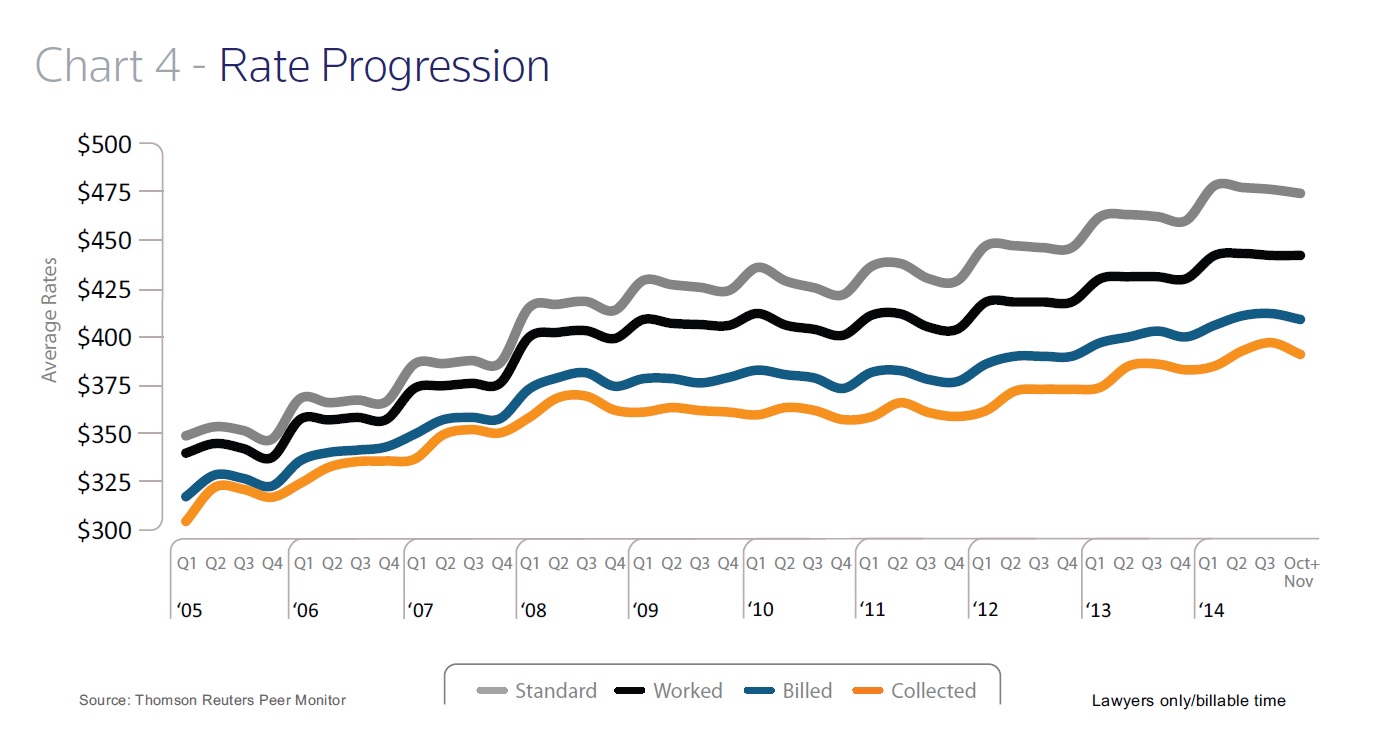
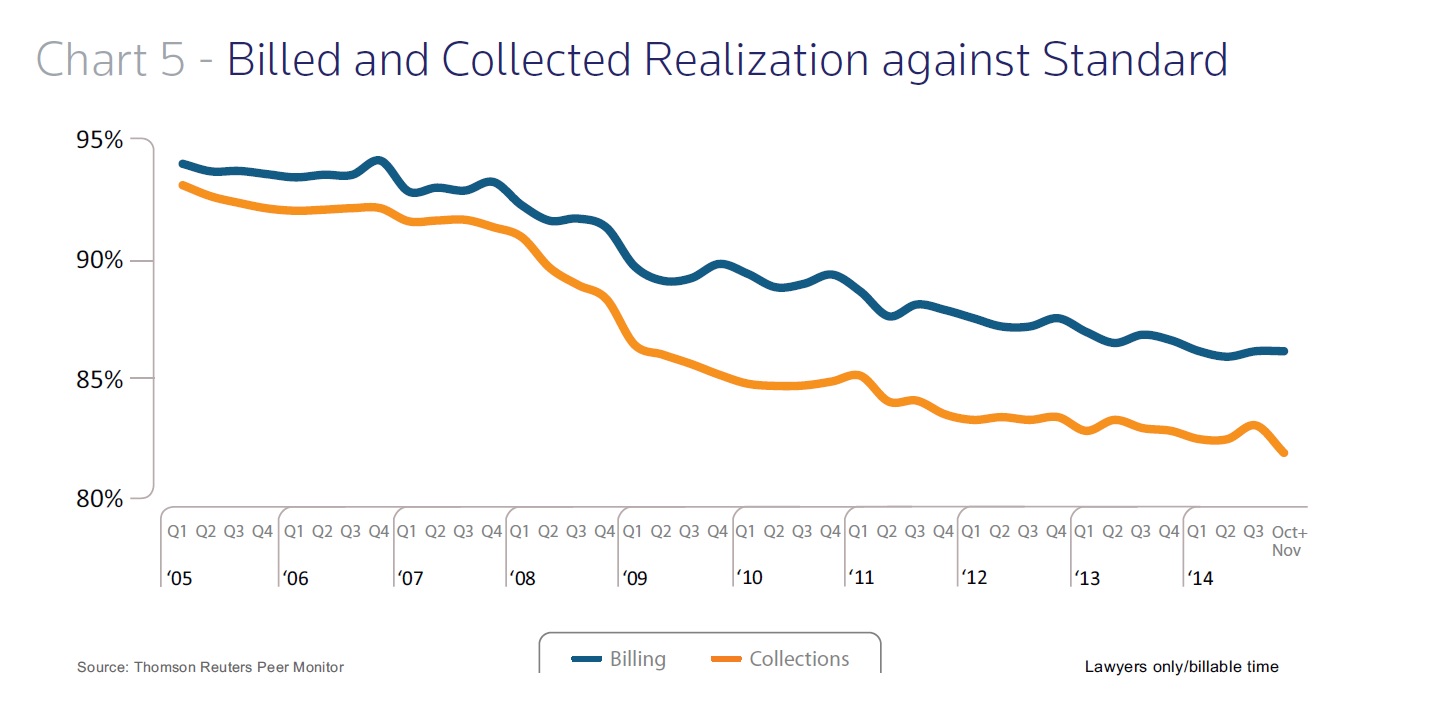
chart 4


chart 5

Those charts don’t make for pretty reading.

So when, as the article reports:

“…firms realise this is not going to be an easy sell to clients who are likely to negotiate hard to keep fees down, so their approach to increasing charge out rates is likely to be softly softly, rather than gung-ho”

my response would be: “why bother?”.

Instead,

  • try keeping your charge-out rate the same over the next 12 months;
  • try not to give discounts;
  • try to increase your realisation rate (by 3 to 5 cents in the dollar);
  • try to reduce your lock-up days;

and see where you end up.

You may just find that has a better impact on your partner profitability numbers than the likely impact that is going to come your way when you go annoying and off-siding your clients with the almost obligatory 1 July 10% rate increase letter.

But I could be wrong…

Your law firm’s brand recognition: How much does it really matter?

Business Development image

Earlier today Dr George Beaton (@grbeaton_law), Partner in Beaton Capital and an associate professor at the University of Melbourne, posted the following question to Twitter:

“Which firm is the ‘world’s strongest’? Skadden or Baker & McKenzie or Jones Day. Confusing”

George I

With a twitter pic link to an article on the Global Legal Post website that contains links to the following “Related stories”:

George II

Leaving aside the issue of financial strength, as George’s tweet clearly infers brand strength, the question I always ask when I see news items and survey responses of this nature is this:

Does it really matter?

And the answer to that really depends on what my firm’s overall strategy is.

Taking a step back, whenever I’m asked in my role as a business development consultant by law firm partners of the importance of such survey findings I will often respond by asking them the following question in return:

Imagine we are on a long distance flight on an important business route – say Sydney to London or Tokyo to New York. Now, say I give out a questionnaire to all 300 plus passengers on that plane asking them the simple question of whether or not they have heard of your firm. Would you prefer:

A. a greater percentage of passengers in first class to have heard of you?

B. a greater percentage of passengers in business class to have heard of you? 0r

C. a greater percentage of passengers in economy class to have heard of you?

Now if your firm’s business plan is to be doing “premium work for premium clients”, then my guess is you’d want a greater percentage of first class passengers to have heard of you. Similarly, if your business plan is to be working with the top ASX 200 companies, then I would hazard a guess you would want to be known by both first class and business class passengers, with the edge being on the greater brand recognition among the business class passengers. Finally, if your firm’s business plan is to be a leading B2C law firm, that I’m guessing you wouldn’t mind if your brand is widely recognised by the economy class passengers.

A very simplistic way of looking at this issue? Very much so.

But, at the end of the day, despite headlines that read ‘Top legal brands grow 45pc faster than others over last four years‘, I’m very much of the view that surveys of this nature fail to ask a more critical question, namely:

Do you regularly, or have you ever, instructed one or more of these firms you have heard of in the last three years?

Because, does it really matter if you have heard of me but never given me any work (ie, fed me)?

And all of this is before we get into the even more interesting discussion of whether or not you instruct individual lawyers (lawyer name [brand] recognition) – either at my firm or elsewhere – regardless of which firm they work for (lateral hire movements)?

After all, we have a long flight ahead of us…

From the client’s perspective

Business Development image

Overnight (Australian time) Bruce MacEwen, President of Adam Smith, Esq and a leading commentator on professional services, wrote an outstanding blog post – ‘The Client Seat‘.

The post outlines some of the personal experiences Bruce has recently encountered as part of his role as Chair of the Finance Committee of his local church, St. Michael’s Episcopal Church at West 99th Street and Amsterdam Avenue, who own a vacant corner lot abutting the rear of the sanctuary and are looking for ways to realize some value from the asset; and, specifically, as it relates to the process of interviews the church is going through to select and engage a law firm to assist them in this process.

I anticipate there being a lot of commentary written about Bruce’s post  – if there isn’t already. It raises a number of thought provoking issues of what it feels like to be sitting in the client’s seat as part of this process and some of the gems that lawyers and law firms come out with to try and impress a prospective client into appointing them to do the work – even where they may not be qualified to do the task at hand.

But what really grabbed my attention in the post was the following observation Bruce makes:

The other asymmetry is one of disclosure and, to be pointed about it, candor: The client needs to tell the firm as much as honestly possible about the engagement and what the client knows, while the lawyers’ instinct and practice is to guard information, hedge predictions, and avoid definitive statements. This is true even when the firm is posed direct questions about simple business arrangements and not ultimate outcomes, such as “Who will be working on my matter?”

This is such an on the money observation of the profession, but think about it for a second:

In an age where open candour and transparency around both your personal and your firm’s credentials will most likely win you and the firm the trust of clients and prospective clients, and thus a lot more work in the long run, why do lawyers still feel the need to be guarded and reluctant to give straight answers to straight questions?

How often do you let your clients know the value you provide to them?

Business Development image

Based on interviews with 188 independent lawyers and more than 500 clients, the LexisNexis Bellwether Report 2015: the Age of the Client (published earlier this week) found that:

“80% of lawyers think they’re delivering above average service…

… but only …

…40% of clients say they’re receiving it.”

What does this mean?

Well, either:

  1. You’re not as good as you think you are; or
  2. You’re not communicating well enough to your clients the value you bring to the transaction/relationship.

I’ll leave it for you to decide which you think applies to you.

A conversation with Lucy Fato, General Counsel at McGraw Hill Financial

Business Development image

Last week Bloomberg’s new Big Law Business website published a two-part extract [It’s All About Relationships and ‘Gut Checks’ Are Better than AFAs] from a recent interview Bloomberg had with Lucy Fato, General Counsel of McGraw Hill Financial (among others, parent company of Standard & Poor’s).

Transcripts from the interview make for interesting reading. While not agreeing with all Ms Fato has to say, her take on the following issues run close to how a number of in-house counsel feel here in Australia:

On the role of in-house counsel:

But my view is that the role of in house counsel is, in many ways, to be the face of the company in these situations. Outside counsel can never really have perfect information about what a board or a CEO is thinking. They can never really step into the shoes of in-house counsel.

That’s how in-house lawyers really add value. They can connect all the dots. I think, historically, general counsel deferred more to outside counsel than what you see today. It’s a process that has evolved.

On the role secondments can play in developing personal relationships with in-house counsel:

Secondments are a great way for a firm to build a relationships. The associate is actually here, in our building, getting to know our people, getting to learn our business, and when they go back to the firm, they bring all of that knowledge with them. It’s especially effective when a firm is new to the company.

On the developments going on in in-house departments:

In-house departments have become much smarter about how we manage our departments and how we manage our legal expenses. In-house departments are becoming bigger, more global, and many companies, including ours, spend a lot of money on outside counsel. Getting a handle on that is extremely important.”

On the role data plays on the modern relationship between in-house and external legal:

I’m very big on data and having a lot of information to work with…

E-billing gives you enormous visibility into how law firms make money.

On alternative fee arrangements:

Getting better control over who we’re spending money with, how they are staffing deals, how much time is being spent on matters — taking a hard look at those types of questions is more effective over the longer term than trying to do alternative fee arrangements.

On hourly rates:

But I will say it’s gotten a little out of control. It’s eye popping even for me, and I’ve been doing this a long time, when I see an hourly rate that’s over $1,000 an hour. I look at that and think, “Really?”

Ms Fato makes a number of other good observations and comments, both about the evolving role of in-house counsel and the relationship between in-house departments and their external legal advisers, but I wanted to finish this post with probably my favourite:

Firms have to be mindful that their client is not just the lawyer. It’s also the business person.

Absolutely.

The two types of efficiencies law firm associates need to become familiar with…

Business Development image

Really interesting article [‘What Associates Should Know About In-House Rates and Efficiencies‘] by Gina F. Rubel was published overnight (7 April 2015) on The Legal Intelligencer website – discussing the two types of efficiencies that law firm associates should become familiar with – contains a gem of a quote from an in-house general counsel that I wanted to share/pass on.

First, to put some context around the quote below by Gino Benedetti, as Rubel states:

“There are two types of efficiencies with which lawyers need to be familiar. The first is general efficiency, which is the state or quality of being efficient and the actions designed to achieve optimal results. The second is economic efficiency, which requires optimal production and distribution of a firm’s resources.”

And while both are extremely important to in-house counsel, the following quote in the article by Gino Benedetti, General Counsel of SEPTA, should give some indication to private practice law firm associates which of the two bears more commercial importance to their in-house clients:

“Associates should understand that every case does not require a full-court press,” said Gino Benedetti, general counsel of SEPTA. “Associates add value when they think creatively by identifying the core issue in dispute and focus their case work on things that impact that issue. Often, associates work on an aspect of the case that does not have any meaningful impact on the ultimate outcome. So, associates should appreciate that their time may be less expensive, but that does not justify inefficiency. Associates should communicate often with the partner or the client directly so that the client’s objective is understood and the work is driven by that objective.”

If you haven’t already, I’d like to suggest you go over and read the entire article. It’s full of sage advice from several in-house GCs.

In the meantime, if you are a private practice law firm associate, the next time your supervising partner asks you to undertake a task on behalf of your client why not ask yourself which type of the two types of efficiency you are going to bring to the task…?

Network ASEAN: Are you plugged in?

Business Development image

I read with interest a commentary post yesterday (although the post itself was made on 7 February) by Reid Kirchenbauer (on the www.investasian.com website) that outlines some of the economic developments that had occurred in the forty years since The Association of Southeast Nations (ASEAN) and Australia had developed diplomatic relations – ‘Understanding Australia-ASEAN Trade’.

Some of the more notable aspects of Reid’s post include:

  • Southeast Asia (SEA) is currently Australia’s second largest trading partner after China
  • Bilateral trade between SEA and Australia was valued at US$67.9 billion in 2013

And yet, somewhat troubling, notwithstanding the multi-billion dollar level of trade between ASEAN and Australia, and even though a free trade agreement (FTA) exists between ASEAN-Australia-New Zealand (the AANZFTA signed in 2010), a 2013 survey by the Australian Trade Commission (ATC) found that the majority of companies in Australia were not aware of the ASEAN Economic Community.

I say “somewhat troubling”, but the reality is that the ATC 2013 survey mirrors a recent Acitas survey, whose major findings were that:

  • 45 per cent of multinationals require legal advice in South East Asia;
  • 34 per cent of Australian multinationals’ legal spend now goes outside their home jurisdiction; and
  • 60 per cent of Australian in-house counsel surveyed said they needed legal advice in South East Asia

but that these needs were largely going unmet – “Law firms are failing to support clients in South East Asia” an article by Felicity Nelson posted to the Lawyers Weekly website on the 19 December 2014.

If we leave aside for the moment the comprehensive recent report by  The Lawyer Magazine on Southeast Asia Legal Elite (the Executive Summary of which can be read here), it seems indisputable to me that ASEAN represents a massive opportunity for Australian law firms in 2015 and that, sadly, a large part of this opportunity is going to be unmet.

Turning back to Reid’s post though, what realistic opportunities exist for Australian law firms in all this?

Well,

  • no doubt assisted by the Thailand-Australia FTA (TAFTA), coming into effect in 2010, Thai foreign direct investment (FDI) into Australia has increased by over 20 times since 2007;
  • with the Australia-Malaysia FTA (MAFTA) coming into effect in 2013, Australia is ranked the third biggest investment destination for Malaysian investors and two-way investment between the nations has doubled since 2010 and now accounts for more than $20 billion; and
  • in addition to being the oldest FTA between an ASEAN nation and Australia (signed in 2003), according to the most recently published data Singapore is currently the largest foreign investor in Australian real estate, making up 28% of all foreign property investments in Australia.

and that’s just inbound work from ASEAN into Australia, let alone any of outbound work the 60 per cent of surveyed Australian in-house counsel said they needed help with in SEA.

All of which leads me to ask:

  • is your law firm plugged into a formal or informal network in ASEAN?
  • if so, do you know what level of inbound referral work you are getting from your ASEAN network partners?
  • and, do you know what level of outbound referral work you are sending out to the partners in your ASEAN network?

Shouldn’t a law firm talk to its clients before agreeing to merge with another firm?


Business Development image

The results of an interesting survey (looking at UK law firm merger activity) of 102 of the UK’s top 200 law firms by legal communications specialists Byfield Consultancy and partnership law experts at Fox Williams is being reported in the UK press overnight.

The headlines that appear to be grabbing the most attention from the survey results are that:

“Almost half of all non-merged UK firms would consider a tie-up over the next two years”

and that:

“As many as 95 per cent of managing partners expect their firms to merge within the next decade”.

Interesting as these numbers are, what grabbed my attention was the surprising – to me at least – fact that only 43 per cent of all merged firms revealed that they “investigated feedback from clients” prior to merging with the other law firm.

When you then take on board that “81 per cent of merged firms cited growth as a reason for joining forces” with their merger partner, doesn’t it seem a little odd that less than half would then discuss whether or not there was any real growth prospect in the merger with their clients and their merger partner’s clients (including any joint clients) prior to merging?

Little wonder, maybe, then that only:

“43 per cent of firms that have merged since 2010 believe that the move was a success”.

Indonesia – the next frontier?

Business Development image

To those wondering what the next marketing and business development frontier in the Asia-Pacific will be for law firms now that China and India have started to go off the boil, I can say “the hunt is over” – Indonesia will be the ‘hot’ new buzzword of 2015.

An article published in Singapore’s Straits Times today [26 January 2015] – “Foreign law firms eye Indonesia market – Global players drawn in by opportunities as Jakarta pursues investment deals” by Wahyudi Soeriaatmadja in Jakarta, sets out a number of compelling reasons (as well as limitations) as to why more global law firms are looking to try an get active in this rapidly expanding and increasingly attractive market.

Of note:

  • Indonesia is South-East Asia’s largest economy
  • The country has an extremely ambitious 5-year infrastructure (roads and railways) development plan
  • The government of newly elected President Joko Widodo is looking to boost gross domestic product (GDP) growth by 7 per cent over the term of its government

Add to this list that Indonesia has one of the fastest growing middle classes in the world, and setting aside some of the practical limitations in place on foreigners practising in Indonesia, given the close proximity of Australia to Indonesia it is somewhat surprising that Australian firms don’t appear to be having the same tactical strategic business development approach to this market (as outlined in the article) that firms in places such as Malaysia do.

Of course, this very likely will change during the course of the year as ‘Indonesia‘ becomes the buzzword of 2015.

Acritas’ Sharplegal Survey: Vive La Différence – or you’ll lose work!

Business Development image

The days of the male dominated culture in law firms are numbered if said firms want to have any chance of continuing to win work from the growing number, as well as importance, of female in-house general counsel according to the latest research undertaken by Acritas’ Sharplegal (an annual global legal market survey of over 2,000 general counsel) revealing how differently male and female buyers approach the purchase of legal services.

Bottom-line take out from the covering article – on the Acritas website – announcing the survey result that should get every male law firm partner and their business development team’s thinking caps on is this:

Firms that are able to demonstrate in-depth knowledge of their female client’s business and her needs also stand to gain higher levels of favorability from her – an all-important step on the path to winning work.

This statement is also directly reflective of Lucy Siebert’s (international counsel at Australia’s Telstra) comments at the recent Legal Week Asia regional ‘Corporate Counsel Forum’, held at the end of November 2014, where she stated that:

We [Telstra] specifically look to see that they’re ensuring the best possible talent pool for us – not just white Anglo-Saxon males. We’ve got a very strong diversity policy and so we expect that to be something that is also important to our panel firms.

Crucially, law firms who are looking to win a greater share of work from female in-house counsel should note:

When asked what drove the likelihood to recommend a firm, a much higher proportion of women than men spoke about responsiveness as a deciding factor.

And specifically that:

Not only was it the quality of communication that mattered to female in-house counsel, but also the speed and level of interaction they experienced.

Interestingly, the survey also reports that:

43% of women working in senior in house legal roles said they used LinkedIn on a daily or weekly basis, compared with just a third of men. Furthermore, only a quarter of women said they never used the social network, compared to two fifths of men, suggesting that new business approaches to women may be better made online than ‘on the golf course’.

A final ‘thought for the day’ is the following by Lisa Hart Shepherd, CEO of Acritas [commenting on the survey findings]:

“A change in thinking and culture is needed if men want to impress an increasingly influential group of female in-house counsel who value business understanding and efficient communication over reputation, personal relationships and trust when choosing their preferred legal partner.”