Came across the term “Burden partners” in this article in the Australian Financial Review today. “Burden partners” is a term denoting those partners within a partnership whose cost to the partnership is greater than their contribution.
In simple terms, partners who withdraw more from the kitty than they have deposited.
The reality is that by its very nature (due to economic cycles), there will – from time-to-time – be partners who have years in which they withdraw more than they have deposited that year; but in most cases these partners will have previously made significantly higher deposits than withdrawals and are effectively withdrawing savings (having said that, retained earnings is not a given with law firm partnerships so this is more a reputational issue than financial one).
It is circumstances in which this is a prolonged (and often unfixable) trend where this becomes a problem.
You can also often see this with new partners who have probably been made-up too soon and don’t really have the book of business yet to justify their promotion to partnership ranks.
Either way, if the term “burden partners” sounds familiar and you want to discuss ways of how this can be fixed, feel free to reach out to me for a chat.
As readers of this blog will hopefully have observed, I’m a very keen observer of up-and-coming developments in the legal industry. Frankly it’s my job to follow and understand emerging market developments and, particularly, how they may affect the way we serve our clients.
And so it was, with such a mindset, that almost two decades ago I came across a concept being touted as the next BIG thing: ‘unbundled legal services‘.
Along with ‘covenant lite loans‘ (this was pre-2008 after all), ‘unbundled legal services’ were going to transform and change the way we serviced our clients; particularly those sophisticated purchasers of legal services.
Then, just like that, ‘unbundled legal services’ went exactly…
…nowhere – never to be heard of again in polite conversation!
Return of the Jedi!
I’m here to tell you that, following a recent report by the Solicitors Regulation Authority (SRA) [England and Wales] – published on 15 June 2023, ‘unbundled legal services’ are back from the dead!
Before I go into what the SRA’s report says, and why it might be important, let’s take a helicopter look at what ‘unbundled legal services’ meant back in the early 2000s and what ‘unbundled legal services v2.0’ means today.
Unbundled legal services v1.0
From the outset ‘unbundled legal services’ were also known as ‘limited scope representation’, I think in part because this was the term more commonly used in the USA – although I’m happy to stand correct on that. Anyhow, at the name suggests, ‘limited scope representation’ means exactly that: your lawyer won’t do everything for you on your matter and it is up to you and your lawyer to divvy-up what they do and what you do.
For this reason ‘unbundled legal services’ were seen as being extremely sexy because you – the client – got to choose what your law firm did [and charged you for] and what you kept in-house. Even better, you – the client – now had the option to appoint subject matter experts for the “grey haired work” (as Maister would call it), but for more menial work you could appoint an LPO (anyone remember “Legal Process Outsourcing”?).
Such radically thinking could even lead to such a thing as ‘coopetition’ (as I have blogged on previously!).
But, despite the obvious benefits of growing headline revenue with ‘unbundled legal services’, I would hazard a guess that 20 years later less than 1% of most law firms’ revenue is derived from this product. Evidence of my thinking here is, I believe, substantiated by a recent article in the Law Society Gazette: ‘Unbundling? Never heard of it, say 40% of firms’ by John Hyde.
Unbundled legal services v2.0
So back to the SRA report and why unbundled legal services appears to be back in vogue.
While limited to “family law” issues, the SRA report includes two important comments:
The first, more a definition, is: “Unbundling describes the process of dividing tasks in a service between the consumer and provider. This can, among other things, make them more affordable and accessible.” and
the second, going to the crux of the issue: “Solicitors providing ‘unbundled’ services could make legal help affordable for those whom it is currently too expensive“.
QED, a possible solution to the Access to Justice (A2J) issue?
While I think both of those comments are correct, I want to quickly pause and cover a few of the other comments made in the Report. These include:
We found that unbundling does have the potential to increase access to justice as it makes some legal services more affordable.
Law firms could attract more clients as those clients knew they could in fact afford an unbundled deal.
There are low levels of awareness of what unbundling is and how widely available it is, even though a number of providers already offer this.
All of which, in my experience, are true in the broader aspects of unbundling.
To finish up..
To finish up I’m going to use the SRA’s own wording in the Report; which is that the unbundling of legal services comes with complications that include:
We found no significant difference in the level of satisfaction between consumers who used unbundled legal services and those who used an end-to-end service.
Some consumers also wanted to have more control over their case.
Some [law firm] providers would like to expand what they do but there are concerns around the impact on firms’ insurance premiums and the possibility of legal action if things go wrong which they were not responsible for.
Let’s not beat about the bush: Points 1 and 2 are relatively damning; but it is that last point where, in my opinion, unbundled legal services have died the death of a million cuts: while most firms and lawyers would consider offering this service, most insurers of professional indemnity [PI] insurance have no ideal of what it is or how to price the risk.
The last point is especially the case given the fact that most law firms have no real understanding of how to provide a letter of engagement to their clients with clearly defined scopes of services that don’t include a million assumptions and caveats or: “it depends” clauses.
Anyhow, setting aside all of the above, I continue to hope we will see a growth in ‘unbundled legal services’ while remaining sceptical it’ll happen.
If you need some help with how you can use unbundled legal services to successfully differentiate your firm’s offering, feel free to reach out to me for a chat.
An article by Neil Rose on Legal Futures website today (15.5.2023) has a statistics that should have every law firm business development expert shaking in their boots.
To quote:
45% of clients changing which practices they allocate work to in the past year
Taken from the latest ‘State of the UK Legal Market 2023‘ by Thomson Reuters, Rose’s report contains even more damning news for those marketers and business developers who thought law firms outranked lawyers in client choice selection:
Reputation has also dropped “dramatically” in importance for keeping a firm top-of-mind
On the positive front,
In the UK, more than in many other regions of the world, clients are focusing on the quality of the whole relationship with their advisers.
But, backing up the reputation comment above, the big takeaway for me has to be,
In a major shift over the past 10 years, the historical reputation of a law firm is no longer enough to keep it top-of-mind in the market. The message is clear: firms need to re-consider how they present and deliver value to clients…
I have deliberately bolded that part of the quote because if this is something that is likely to be concerning you, or if you feel this provides your law firm with a great opportunity, then feel free to reach out to me and let’s have a chat about how you can to work on this!
As usual, the Report is a very interesting read; but by far the two standouts for me were:
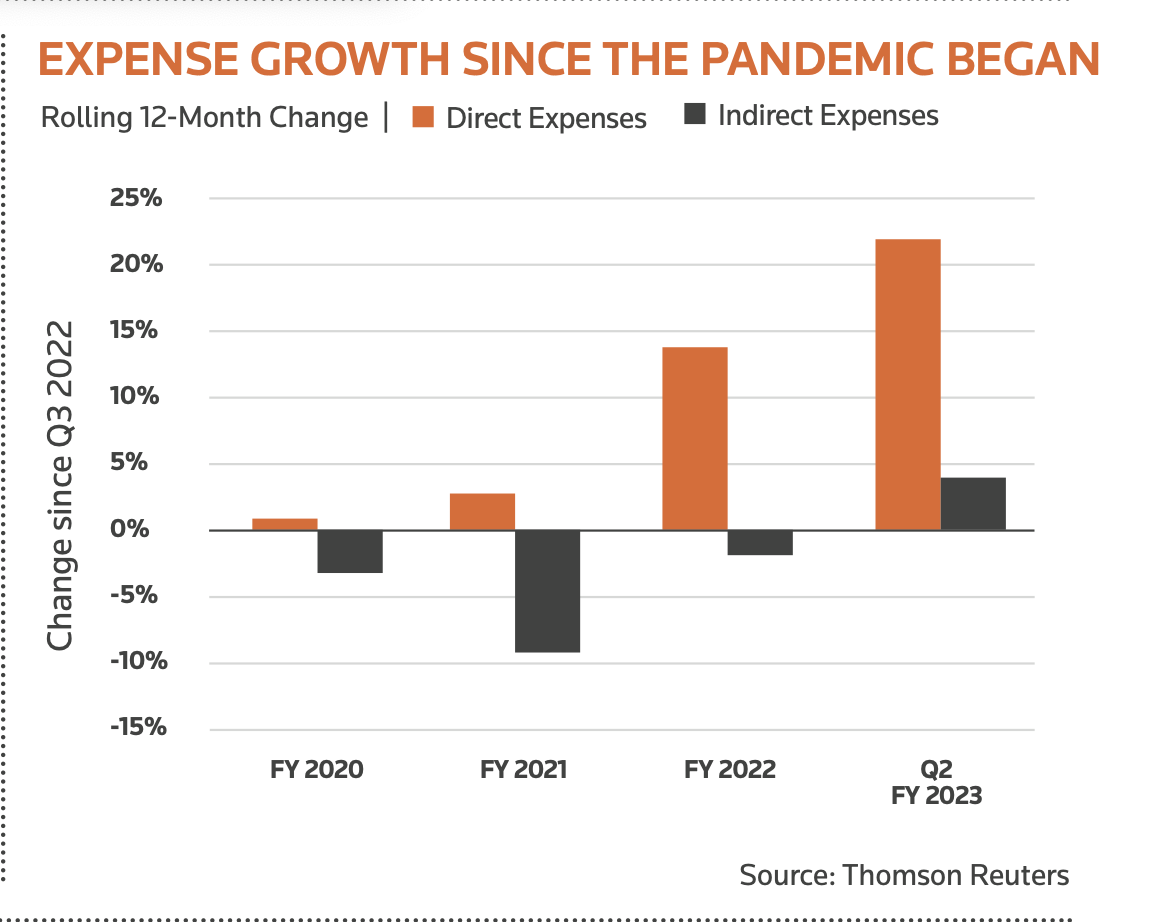
Expense Growth
Notice that rise in Direct Expenses?
That’s down to the pay rises you just gave to your 2 to 6 year PQE lawyers who are now sitting around very under utilised!
Where will clients need help?
The other chart in the Report that caught my attention was where clients anticipate their spend over the next 6 months.
Given the hangover from COVID, Workplace doesn’t surprise me too much.
Dispute Resolution, in difficult economic times, will always be a winner.
But, why Regulatory? We have moved past most of our Royal Commissions…
…and unless I’m missing something there is no growth mentioned for either Privacy or Cyber.
Given the ongoing changes in privacy regulation in Australia just announced, and global concerns around cyber (with IPH Ltd going into a trading halt following a potential cyberattack on two of its member firms this week), this must be an oversight.
If this all sounds too close to home to be true, feel free to drop me a line to talk through how we can fix this up.
As I have written on this blog on numerous occasions since March 2013, big international law firms need to consider – and account for – foreign exchange (FX) currency fluctuations – especially if their P&L is based in one currency – whether that be GB Pounds or US Dollars.
So it was with some amusement that I saw the following article headline in The American Lawyer today:
‘As Currencies Fluctuate, Law Firms Adjust Lawyer Pay and Billing Across the Globe’
But, before we all get ahead of ourselves and start to think law firms have finally figured out that as they approach $2BN+ in global revenue with business operations – in many cases – in over 20 countries, they might want to think about currency fluctuation issues, the real reason this has all of a sudden now become an issue comes out in the article:
‘Firms are taking steps to minimize the impact exchange rates could have on partner compensation, associate salaries and other expenses’
Which itself raises another issue I have mentioned so many times previously on this blog, if currency exchanges do fluctuate over the course of a financial year, what does that do to your multiplier?
Do you go from a 3x multiplier to a 5x? Do you go from a 5x multiplier to a 7x?
And what happens if the FX fluctuation is as a result of a stronger local currency, do you go from a 5x multiplier to a 3x?
The legal process outsourcing market, valued at $8 billion in 2020, is projected to grow at a compound annual rate of 22% from now until 2027, when it is expected to have swelled to $30 billion
Knockless’s article is not, however – in my opinion – without some elements of controversy.
On the one hand,
Jason Winmill, managing partner of the legal consulting firm Argopoint, said the move to outsource legal work to India is motivated by the relentless ongoing pressure to reduce in-house legal spending.
Which, I have no doubt, is true.
On the other hand, however:
India is favored for its low labor costs and high availability of skilled lawyers who are proficient in English.
And, to be clear, when we’re talking about ‘low labour costs’ here, what we are talking about is:
…legal workers earn about $12,000 to $30,000 a year reviewing contracts, handling legal research, subpoena responses and document reviews and completing other tasks…
Which, when you consider
N.Y. law firms raise starting salaries to $215,000 as lawyer pay race continues
But then, having said that “India is favored for its low labor costs and high availability of skilled lawyers who are proficient in English”, this is then qualified with:
Most of the work companies move to India involves record-keeping, compliance and document review—mainly nondisclosure and confidentiality agreements, low-level purchasing contracts and routine aspects of Intellectual property.
But hang on a second, isn’t that exactly what $215K a year first-year is doing?
Nope, looks like I might have got that totally wrong
The move reduces legal spending and frees up U.S.-lawyers for higher-value matters.
To be clear, I have no issue with new lawyers in the US/UK etc making as much money as they can – many have what must feel like life time debts. And I have no issue with businesses – whether that be in-house legal or private practice – making money out of outsourcing work to India.
But, are we doing right by those in the Indian middle?
Happy New Year to you all, and welcome to the new calendar year that is 2022.
During the holiday period here in Australia (published 13 December 2021) I was fortunate enough to read a really insightful article in MIT Sloan Management Review by Andreas B. Eisingerich, Deborah J. MacInnis, and Martin Fleischmann titled ‘Moving Beyond Trust: Making Customers Trust, Love, and Respect a Brand’
which set-out how service providers, like law firms, could provide real value to their customers using the 3Es:
enable
entice,
enrich
Where:
Enable = help your customers solve problems in ways that are economically feasible, reliable, efficient and convenient
Entice = making your customers feel good
Enrich = build self-affirming identities.
And the benefits of using this method?
Evidencing the research outcomes of this methodology, the article sets out 6 benefits you should see:
Higher Revenue
Lower Costs
Higher Barriers to Entry
More Paths to Grow[th]
Stronger Talent Pool (within your firm as lawyers want to do this type of work for this type of client), and
Greater Retention Rates in your firm.
All of which – should – result in higher profit.
Well worth a look, take a read – and certainly food for thought!
As always, the above represent my own thoughts and would love to hear yours in the comments below.
You’d have to have been hiding under a rock for past two years not to have seen an article or two on the benefits/pitfalls of remote working. But, as we move into the next phase of this pandemic/endemic, one in which we must start to learn to live with COVID, law firm management now need to be asking:
‘What does the future of the office look like for our firm?’
Truth is, there’s no simple answer to this question. On the one hand, we have those who advocate that “distance breeds distrust” and “out of sight, out of mind”. On the other hand, we have a lot of people saying we’re not going back to the old ways – and if you make us, we will part of the Great Resignation.
One answer to this issue might be in what the Australian Financial Review recently termed ‘Anchor Days’.
As per the AFR article, ‘Anchor Days’ are days on which a group of employees (in the same team) agree to go into the office on the same day each week with the aim of enhancing collaboration and ensuring a more lively office culture.
While I like the concept of Anchor Days, I think I should also point out that, from my reading, it comes with a couple of major misconceptions:
we all work in the same physical location (geographically in the same State/Cities, but also on the same floor of a building!).
that collaboration is more likely to happen in physical presence, when what we actually find is that collaboration more likely occurs with inclusion, and inclusion is more aligned with trust. QED, if you want more collaboration within your team, then trusting that your team can get it’s shit done here remotely/agile and not dictating collaboration top down, is a big step in the right direction.
My final comment: if Anchor Days become a thing, what day(s) would you chose?
A fairly evenly distributed demographic of large (defined as being 600+ lawyers), mid-sized (defined as being 100-600 lawyers) and small (up to 100 lawyers, for the U.S. only) law firm respondents, insights from the survey include time spent responding to RFPs, persons within firms charged with project managing responses, as well as tools and expertise made available to responding teams, in both the U.S. and the U.K.
As with most surveys of this nature however, it is the role that pricing plays that typically grabs my attention and given this survey’s combined U.S. and U.K. perspective even more so in this case.
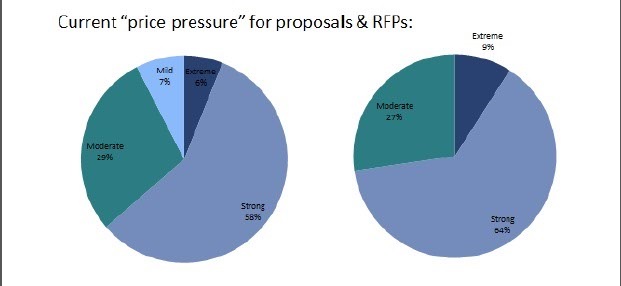
Given ongoing market pressures, it should surprise no one that responses of “strong” from the U.S. (58%) and the U.K. (64%) to the question of what current “price pressure” for proposal & RFPs were fairly similar.
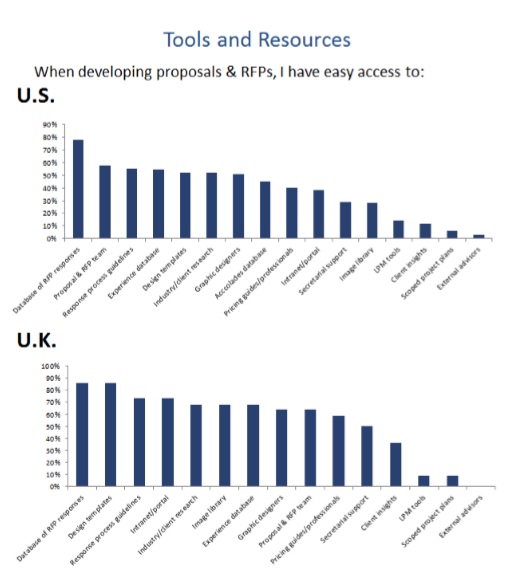
A little more surprising to me was the difference in responses between the U.S. (40%) and the U.K. (60%) to the question “when developing proposals and RFPs, I have easy access to” the answer was “pricing guides/professionals“.
Now don’t get me wrong, even these days I think it is particularly progressive and somewhat comforting to know that 60% of my colleagues in the U.K. have access to some sort of “pricing guide/professional”.
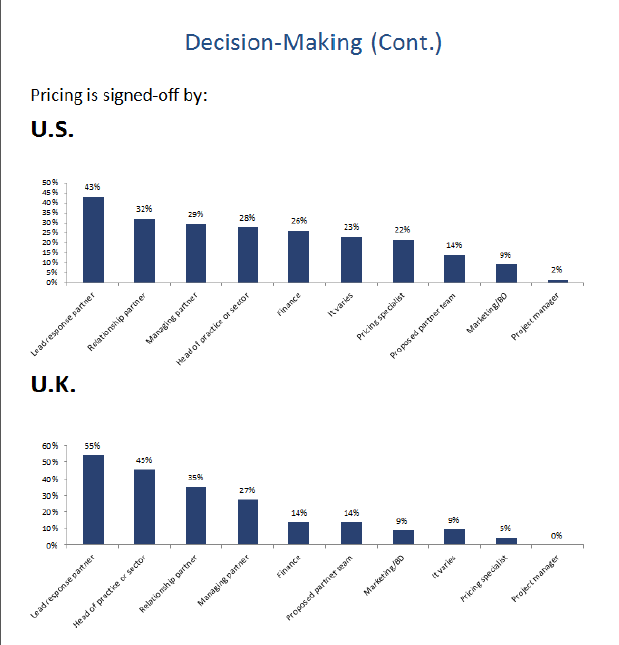
Until, that is, you get to see who actually gets to sign-off (i.e., the “decision maker”) on the all important issue of pricing in RFPs in the U.K.. Here, and I kid you not, the response in the U.K. of “pricing specialist” (that same person who 60% claim to have some form of access to – either via guides or in person) was 5%.
I think that is worth repeating – 5%.
Put into context, that means in the U.K. pricing in your RFP is more likely to be signed off by Marketing & BD (9%) or Finance (14%). Indeed, in the U.K., “It varies” is likely to have more of a say on final pricing in the RFP response than the so-called pricing specialist.
I’m not so sure why the results of this particular survey so surprise me. After all, time and time again survey results show that we typically say one thing about pricing, but do quite another.
What I will say though is this: if you have access to a pricing specialist, and pricing by your pricing specialist is being determined in 5% or less of your RFP responses, my guess is going to be one of two things: (a) you have no idea if you are making money from your RFP “wins”, or (b) more likely, you are leaving money on the table big time!
Of note overnight (OZ time) was news that Bernero & Press (Wendy Bernero and Aric Press) have launched a service called: ‘The Red Team’. Described as being “A Lifeline for Marketing and Business Development Departments” the aim of The Red Team is to provide:
“…high-quality, experienced marketing, communications, and business development professionals to law firms on a project basis or to fill temporary needs.”
Sounds very similar to the sort of lawyer placement service we are seeing from the likes of Crowd & Co here in Australia, only in this case the target market is specifically support services.
I have to say that outsourcing back office services such as marketing and business development was something I saw becoming popular in Asia during the Asian Financial Crisis in late 1998 and I have often wondered when we would see such a move take hold in the West.