business development

Using Microsoft’s Outlook and To Do to supercharge your Business Development efforts!

Success is the product of daily habits – not once-in-a-lifetime transformations.

– James Clear, Atomic Habits

Just as James Clear wrote in his best selling book Atomic Habits, success in business development is the sum of your daily habits and not a once-in-a-career pitch win!

To this end, while most professional services firms employ sophisticated Client Relationship Management (CRM) platforms, my experience has been that the greatest success in building daily business development rituals and habits comes from utlising the existing tools you have and are already familiar with – namely your Microsoft ‘Outlook’ and ‘To Do’ apps.

So for this week’s BD Tips Wednesday post I thought I would take a very high-level look at how you can be using Microsoft’s Outlook and To Do apps to advance your business development efforts:

Tips with using Outlook for your Business Development

  • Block-out 15 minutes each morning in your Outlook diary to post and comment on social media platforms, such as LinkedIn.
  • Block-out 15 minutes each lunchtime to call or email 1 client, prospect or referrer to catch-up and see how they are doing and whether there is anything you can be doing for them.
  • Use your Outlook email scheduling function to write marketing emails at a time more convenient for you (in my case 11pm!), but to be sent when they are more likely to be read by your target audience (say, 8am the next day!).
  • Use the email ‘categories’ function to organize your business development and marketing emails by campaign, client or project. This should make searching for emails in the future much easier [trust me, Future You will love Present You if all you do is do this!].
  • If you are working as part of a team, sync your Outlook calendar with the other members of your team so you can easily see when team members are free.
  • Schedule time each month in your Outlook diary to review and assess how your business development activities are fairing and determine if you need to make adjustments to your strategy/methodology.

Tips with using To Do for your Business Development

  • Schedule To Do reminders for re-occurring tasks, like writing and scheduling your social media posts.
  • Set To Do reminders ahead of time for important dates and events. An example here might be to schedule a reminder in your To Do app that the birthday of a client is coming up next week and you need to send them a handwritten card!
  • Use your To Do app to schedule follow-up reminders for people you meet at events, emails you have sent that have not been responded to, or actions you have promised to complete.

Used properly, your Microsoft Outlook and To Do apps can be very powerful business development tools. Ones which are typically very much under utilised by most professionals.

As always, get in touch if you need help with your business development strategy and activities.

Richard & GSJ

[Note: This post was first published on my LinkedIn BD Tips Wednesday page]

Directory season is coming!

While it may feel like we are doing directory and award submissions all year round, the formal season for directory submissions is upon us. Over the next six or so months, you can expect your partners to get you working on submissions to:

  • IP Stars (September – October)
  • Chambers (December – January)
  • IFLR (January – February)
  • WTR1000 (February – March)
  • Legal 500 (May – June)

So I thought it might be helpful if we take a deep dive in to the joys of whether or not to submit for that directory listing!

Should we even bother submitting?

Great question!

To be honest, if you’re just starting out and have not submitted to a directory before, then the answer is probably “no”.

The Return On Investment (ROI) – particularly now that private equity has an investment in directories such as Chambers and Best Lawyers, is low at best.

On the other hand, done right (see below for some helpful hints) you can get some useful material for your marketing collateral – such as client feedback quotes to use in capability statements and tenders.

At the end of the day though, directories have nailed the ego trips (aka endorphins) of lawyers and so the decision of whether or not to submit might be out of your control, so…

If you are going to submit, do it right: Some helpful hints

  • Be selective: First off, don’t go for every directory/award submission possible. Best selective and go for those where you know the research is done properly.
  • Don’t pay-to-play: Some directories/awards require you to pay a fee to boost your ranking or use client feedback in your marketing collateral. Resist the urge to pay for a better ranking or award!
  • It’s a long game: Most people [read: partners] think that by submitting a response the world will change over night and they will go from Rank 3 to Rank 1. Unless you have had a dramatic change at your firm, like a big hitting lateral hire – that is not going to happen! Shifting the dial on your directory ranking is glacial, and goes some way to explaining the comments on the ROI above. So if you are looking to invest time in directories and this is tied to your ranking rather than the brilliant client feedback you might get, then look to a 3 to 5 year timeline and make sure you cover off the partners to be profiled comment below.
  • Referee feedback is vital: Referee feedback is vital to the success of your submission. Get good referee feedback that can be published in the directory and you’ll reap the benefits. What does this mean? Well you’ll be tempted to put the most senior people forward as your referees (such as General Counsel or Chief Financial Officer), but that’s not always the best strategy as they are either too busy to respond to the researcher’s queries, or else have too many firms asking them to be a referee so don’t provide feedback on any. Much better to use a more junior referee who will be delighted to have been asked to provide feedback and give [hopefully] gushing feedback that can then be used by the publication and subsequently by your Marketing and Business Development team!
  • Case studies: Typically you can submit up to 20 case studies. If you mark all of your case studies as being “confidential”, then you won’t be listed – no matter how impressive those case studies are! Why? – again, the directory publisher will have nothing to publish. So make sure you give the directory publisher material to work with.
  • Referee-2-case study: Try and link the referees you provide to the case studies you are submitting. You’d be surprised by how may submissions I have seen where there are 20 referees and 20 case studies and absolutely no link between the two. You need to ask yourself what message you are sending the researcher if you are not willing to provide a referee that is linked to the case study you are submitting?
  • Partners to profile: You are probably thinking this is a no brainer – profile your most senior partners! But, that would be a mistake. Why? Well, in all likelihood they would have been profiled in any event. Much better for you would be to select a mix of partners from senior to junior to profile that shows your firm has in place a good succession and continuity plan – that you will be in business for the next 100 years, not just the last 100 years!
  • Submit on time: Yes you can get extensions, but they are not looked upon favorably so make sure you submit both your submission and referees on time.

Evaluation criteria

The evaluation criteria for most directory/award submissions are:

  1. So what/Who cares? – Why is your case study important? What sets it apart from other deals that year? Was it the biggest deal that year? Was it the first time something like this had been done? Try and work-up a case study that answers: “So what, Who cares?”.
  2. Validation – This is the client feedback section, so make it count. TIP: Don’t use the same referees every year, kind of looks like your practice might be a little stale!
  3. Peer review – Most people walk past the section where you are asked to nominated peers from other firms you worked with. Again, that’s a mistake. Peer review is a really important part of the evaluation criteria. And why would it not be? – Nothing better than having a lawyer at another firm say how good a lawyer you are and how they wished you worked with them!

Should AI be writing your directory submission for you?

Now, if you have read this far, and want to know whether there are any benefits in AI helping you draft (at least in the first instance) your directory submission, then take a look at an article I contributed to earlier this year on: ‘Why AI should be writing your directory and award submissions‘ [Note: you’ll need to provide an email to get this. If you don’t want to do that, DM me].

And finally

As always, get in touch if you need help with your directory submissions or if you just need them peer reviewed.

And if you are submitting – best of luck!

Richard & GSJ

*this post was first published to my LinkedIn account as a BD Tips Wednesday post

Allied Services

One of, it not THE BIGGEST problems with the billable hour💲is this: you don’t make any money 💰 when you and your team is sleeping 🛌.

So how can you ‘fix’ 🔨 this?

One way is to have a team that doesn’t sleep 💤 – go global!

Another way is to write a book 📖 and hope you’ll make your millions on the royalties 🤑 (and that can work, ask John Grisham).

ALLIED SERVICES

But, a more recent trend, is for law firms to offer clients what are known as “allied services” – or “adjacent services“.

Only, in most cases, there is absolutely no aligned or adjacent service being offered.

So, what is the point of this post?

Well here is a tender✍ for an allied/adjacent service lots of law firms really could be offering their clients:

Provision of Annual Member Meeting Services (AMM)‘.

It’s not legal work, but boy does it have adjacent opportunities.

https://lnkd.in/gq8ubVF2

And how many law firms out there don’t have events teams who are experts in project managing and holding events that they could monetarize the expertise of while leveraging and cross selling other ‘allied services’ – such as their lawyers?

Value Added Services

Bet I can guess on one hand how many law firms will go for a tender like this because this is a ‘free’ value added service.

Big mistake.

Get in touch if you want to chat about the “allied services” your firm is offering.

rws_01

Survey: Chinese investment in Australia falls to second lowest level since 2006

Earlier today (8/4/2024), The University of Sydney Business School and KPMG published their ‘Demystifying Chinese Investment in Australia (April 2024) report‘ (Report) into Chinese investment into Australian businesses. If you are a lawyer with a practice focus on inbound Chinese investment, the Report makes for very sobering reading:

  • Chinese investment in Australia fell 36 percent to AU$1.34 billion in 2023
  • This represents the second lowest year in investment value since 2006
  • Only 11 corporate transactions between the two countries were recorded in this period

The Report covers the period January to December 2023, only relates to corporate (not individuals) and excludes Hong Kong and Macau investment in Australia (i.e. Mainland China only).

Nonetheless, the Report reads bleak – particularly given how many law firm practices here in Australia rely on this type of work to survive.

Any positives?

So, are there any positives in the Report to write home about?

  • Healthcare was a big winner – accounting 42 percent of the total Chinese investment into Australia – although it should also be said, their accounted for two transactions totaling AU$562 million.
  • Agribusiness had a big bounce – representing a 21 percent increase in value through to A$283 million. Again though, this was through two deals!
  • Mining was the big loser with a significant decrease from A$1.8 billion in 2022 to A$34 million in 2023!

Anything else?

  • With a whopping 82 percent of total investment into Australia, NSW is the home of the largest share of Chinese investment – A$1.01 billion. Victoria accounted for 16 percent followed by WA with a mere 2 percent. Have to wonder what that means for Queensland

As I said at the start, all in all not a great read if you are an Australian lawyer looking for new business out of China. One ray of hope is that investment from privately owned enterprise saw a slight uptick in 2023 – up from A$641 million in 2022 to A$878 million. I suspect a large part of this would have been in property related transactions, because if it wasn’t the Australian-based property lawyers out there with Chinese clients seriously need to think about pivoting their practice!

As always, get in touch if you want to talk through any of the above.

rws_01

Do American law firms in Southeast Asia have a brand problem?

If you missed it, Jessica Seah published an article on law.com this past weekend (Letter from Asia: In Singapore, The Americans Have a Brand Issue) that contains lots of thought provoking – and relevant – points for law firms looking to set up in Southeast Asia to consider.

For someone like me, who was at the forefront of the early development of international firms expanding into Southeast Asia from 1996 (remember when Dewey & LeBoeuf had a Bangkok office, or DLA Piper Bangkok was a shipping insurance firm?), some of the top level take-outs – that apply as much today as they did then – were:

🎯 “The problem we have in this part of the world is that our brand isn’t as known,”
🎯 firm brands simply do not supersede interpersonal relationships,
🎯 American law firm brands have not penetrated the Southeast Asian market in the same way that American consumerism has.
🎯 The stark truth is that no homegrown Southeast Asian company is more likely to approach any of the elite American firms over British firms such as Clifford Chance, Allen & Overy, and Linklaters, all of which have been entrenched in Southeast Asia for decades [my comment: although CC has closed its Bangkok office]
🎯 While in the U.S. and even in the U.K., it may be obvious which firms are competing for which types of clients, the target clientele in Southeast Asia is ambiguous and unclear.

But the Big 2 take-aways for me were:
🎯 Every jurisdiction within Southeast Asia is different [My comment: So, so true!].
🎯 Clients want firms that can show what they can bring to the table, how they can add value, and can tell them clearly how much their services cost.

It’s a great article and well worth a read if you are looking to expand into Southeast Asia in the near future.

And if you are, feel free to contact the team at GSJ Consulting , we know what many of the pitfalls are…

AFR: Top law firms eye big growth in South-East Asia strategy

Having spent more than a decade of my working life in South East Asia as a lawyer (at least for the most part), and with lots and lots of good friends still there, I found this article in the AFR today interesting.

It is my sincere hope that Australian law firms give it a real go, but track record suggests (see this blog post of mine from 2014!) the journey will not be an easy one.

And if you are a law firm looking to move into South East Asia, feel free to give me a call – after all, I was there pre Linklaters, Clifford Chance (both of whom I worked with), A&O, NRF, DLA and all the others (apart from Bakers who were there, oddly under an Australian Managing Partner 😂).

As always, get in touch if you want to talk through any of the above.

rws_01

Thomson Reuters Institute: Australian Law Firm Midyear Market Update

Last week (22 February 2024) Thomson Reuters Institute published its midyear market update on Australian law firm’s financial performance. Overall the sector remains robust, posting year-on-year “growth” of 7.2%. “Growth” here being defined as:

A measure of total billable hours worked by the average law firm

Leaving aside the flaws in that definition, if we are to use it as a yardstick for year-on-year growth and a like-for-like comparison globally, then the Australian legal sector looks positively healthy – particularly so for those practising Dispute Resolution (9.5% growth year-on-year, although I question the low starting bar here as DR has suffered a number of negative years as a result of COVID) and “General” Commercial (7.5% growth year-on-year; and while no definition of “general” is provided it clearly doesn’t include M&A, which sits in a different bucket).

Black clouds?
If there is a black cloud around the numbers it’s leverage and expenses.

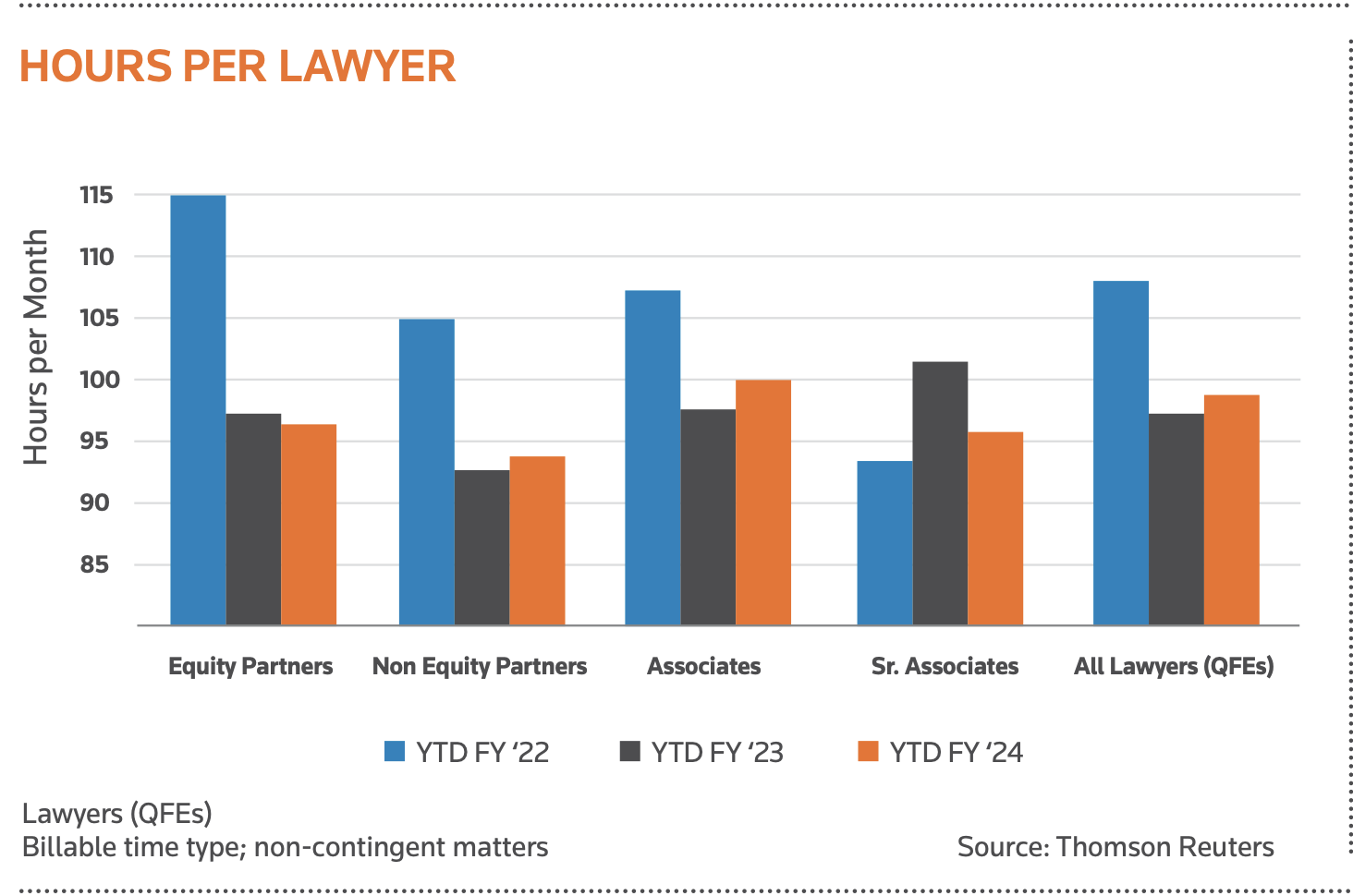
As the chart above indicates, leverage between partners, senior associates, associates and lawyers still looks out of shape when compared against firms in other jurisdictions.

What this chart indicates to me is that partners (in particular, equity partners) are still doing way too much of the billable work and not pushing the work down to more junior lawyers (which might be understandable if it was salary partners looking to make equity; but kind of suggests it is equity partners looking to retain equity points – maybe a post for another day!).

Having said this, it might also be a trait of the Australian legal market. We often don’t follow the 10-20-30-40 leverage model here in Australia.

A potential second black cloud is on the expense-side: lawyer renumeration.

While this appears to have cooled – down from 13% growth in 2023 to 7.3% growth in the first half of 2024, for those of us who work in this market day-in, day-out, there is an acknowledgement and acceptance that mid-level lawyers (those between 4 and 8 years PQE) are rare as hen’s teeth.

And the reason for that is simple – most see Australia as a small fish bowl and want to spread their wings in Asia, London or New York.

Who could blame them!

Some come back, many don’t.

But what it does mean is this: we pay a premium for mid-level [good] lawyers here in Australia!

The last black cloud has to be lateral partner movement.

The Thomson Reuters midyear market update doesn’t include a section on lateral partner movement, but it should. Not only because it would make for interesting reading, but also because it’s a good indicator figure.

As always, get in touch if you want to talk through any of the above.

rws_01

5 Reasons why your business development team should be working on your business strategy and not just putting out fires!

A recent article in the Global Legal Post by Ben Edwards: ‘Law firm marketing and business development teams spend more time firefighting than on strategy‘ threw up some very interesting – if not predictable – stats:

  • Two thirds (65%) of marketing and business development teams [in law firms] are spending more time firefighting then developing strategy
  • 80% of that 65% spend at least 2/3rds of their working year extinguishing fires, over providing strategic thinking
  • Just over half (57%) have a seat at the head table [when it comes to strategy input]
  • 69% of respondents said they spent most of their time on addressing short-term issues rather than focusing on long-term initiatives.

And the number #1 reason given for why law firm marketing and business development teams were running from one fire to another – a lack of investment in resources.

All of which leads me to ask this question:

Do law firm partners value the service they get from their business development and marketing teams?

Another way of putting that question is this:

Do law firm partners understand the strategic value that their business development and marketing teams can provide?

Because the evidence would suggest that they don’t.

By putting – let’s be frank – high paid personnel on firefighting tasks, your firm will not be getting good value for money.

So here are my 5 reasons why your business development team should be working with you on your firm’s strategy and not just putting fires out:

1. Industry focused

    Most business development professionals are laser-focused on industry expertise. They understand a particular industry sector – such as energy, resources, financial services, FMCG, property – and by and large stay in their lanes. As such, many have a deeper understanding of what is happening in that industry sector than the partners they work with.

    2. Market knowledge

    Really good business developers are on top of market trends and competitor intelligence. They should be able to tell you what your competitors are up to, how your competitors are ranked in the market, which clients your competitors are acting for and the relevant lateral movement in your sector.

    3. Relationship Building

    A critical skill of good business development professionals is building relationships. They should be able to not only tell you who the General Counsel at client and target clients are, but also who the lead procurement team will be on a pursuit or tender opportunity.

    4. Data analysts

    A good business developer should be able to look at a set of data and provide you insights. For example: should you be worried if the number of instructions you are receiving is on the decrease, but the value per file is significantly increasing?

    5. Results driven

    Every good business development professional will tell you they are only as good as their last result! By nature, they are very results driven and don’t rest on their laurels.

    So there you go, my 5 reasons why you need your business development team working with you on your next strategy day rather than just putting out fires!

    Also, get in touch if you need help with any of the above.

    rws_01

    Survey: The cost of replacing that departing associate…

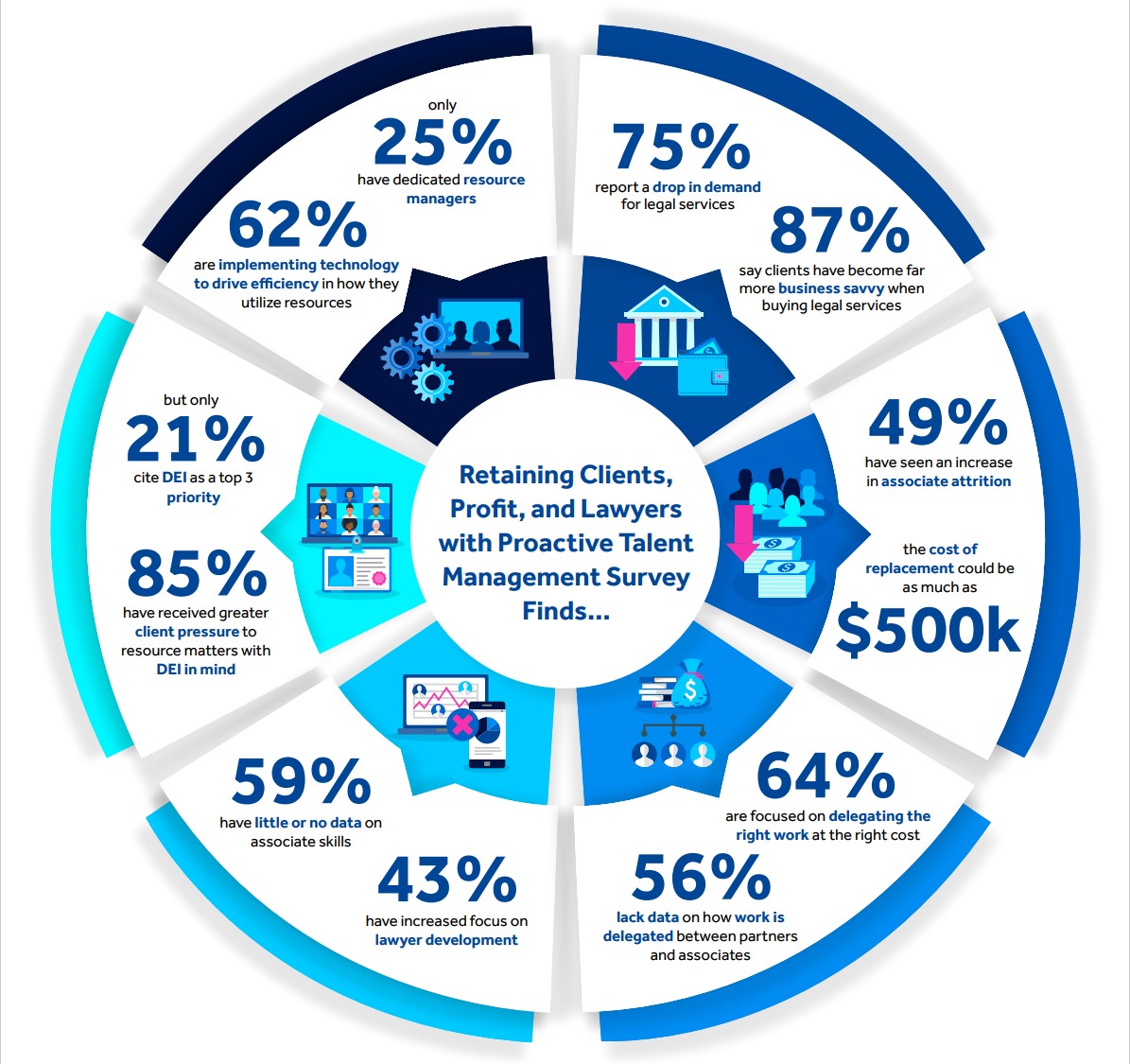
    If you’ve wondered how much replacing that associate or senior associate who just left you is going to cost, then a recent report from Big Hand provides the answer: circa $500k.

    That’s right, a cool half a million dollars!

    Those costs won’t always be upfront and apparent, they will include:

    • a possible increase in salary for your replacement associate over your previous associate’s salary (due to market pressure) – which is somewhat ironic as salary may well be the reason the old associate left you!
    • commissions to talent agents to find you said new associate
    • increasingly – signing on bonuses
    • training costs over the first 12 – 18 months to bring the new associate up to scratch on your firm’s systems and business development strategy.

    The list of actual and hidden costs here is almost limitless, and so the overall cost to your firm of replacing that departing associate/senior associate could actually be a lot more than $500k. Which begs the question:

    with 49% of surveyed firms having said they had experienced an increase in associate attrition, you have to wonder why this isn’t an area where more firms are focusing their attention?

    You also have to ask: Does asking someone to work 2,000 billable hours a year have something to do with these attrition rates among associates?

    And with 75% of surveyed firms having said they have seen a drop in demand for legal services, is this a cost you really want to be incurring right now?

    If you need help looking at your firm’s strategy, how to retain associates and differentiating your practice from the crowd, get in touch!

    rws_01