#BizDevTip

Are the legal press letting the importance of revenue get in the way of a good story?

Business Development image

An interesting news item appeared on the Global Legal Post website overnight (Australian time). Citing a recently published (January 2015)  Legal Services Market Research Report by IBIS World, the Global Legal Post item, which is titled “Australian firms on the hunt for increased revenues” states that:

Pressure on revenues is forcing Australian firms to look overseas in a bid to increase turnover.

First of all, if I’m allowed to say, this is irony in action!

Given the number of international (mostly British) law firms that have entered the Australian legal market in the past five or so years as a result of perceived or real limitations on growth in their own domestic markets, to now be informed that one of the consequence of this action is that Australian firms now need to look overseas to grow their own revenue is, well, ironic.

More importantly – aside from being wrong as the IBIS Report clearly states that the market in Australia is growing (if admittedly at a snail’s pace) – is that it misses a crucial point; namely, increasing turnover for turnover’s sake is nothing short of a wasted effort!

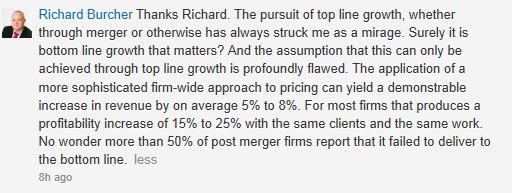
But don’t take my word for it, as the prominent industry strategist and pricing expert Richard Burcher rightly points out in his comment to the link I posted to this on LinkedIn last night:

Surely it is bottom line growth that matters? And the assumption that this can only be achieved through top line growth is profoundly flawed. The application of a more sophisticated firm-wide approach to pricing can yield a demonstrable increase in revenue by on average 5% to 8%. For most firms that produces a profitability increase of 15% to 25% with the same clients and the same work. No wonder more than 50% of post merger firms report that it failed to deliver to the bottom line.

RB image

Precisely Richard.

Unfortunately, however, this is not the only example of this type of legal press reporting/thinking.

Only the same day (Monday) The Australasian Lawyer reported – citing (wrongly in my opinion) another UK website – that the Australian arm of DLA had been “fingered for [the] law firm’s drop in revenue” as if huge levels of shame needs to be attached to this [revenue drop] given that it

follow[ed] a transition period where underperforming partners in the region [Asia] departed.

Well I happen to know a number of the partners who left DLA last year and one thing I can say with absolutely certainty is that they were anything but underperforming. More accurately, what they were was in practices that were no longer strategically aligned to where DLA sees the future of its business (something I think is made clearer in the UK version of this news). And, in a partnership sense, there is nothing wrong with having conversations like that. Indeed, they are to be encouraged.

So as with the discussion around revenue and profit, the discussions around revenue and strategy, while related are two different issues.

And all of this before we even get into the very real discussion of whether or not one law firm’s growth has to come at the cost of another law firm.

Indonesia – the next frontier?

Business Development image

To those wondering what the next marketing and business development frontier in the Asia-Pacific will be for law firms now that China and India have started to go off the boil, I can say “the hunt is over” – Indonesia will be the ‘hot’ new buzzword of 2015.

An article published in Singapore’s Straits Times today [26 January 2015] – “Foreign law firms eye Indonesia market – Global players drawn in by opportunities as Jakarta pursues investment deals” by Wahyudi Soeriaatmadja in Jakarta, sets out a number of compelling reasons (as well as limitations) as to why more global law firms are looking to try an get active in this rapidly expanding and increasingly attractive market.

Of note:

  • Indonesia is South-East Asia’s largest economy
  • The country has an extremely ambitious 5-year infrastructure (roads and railways) development plan
  • The government of newly elected President Joko Widodo is looking to boost gross domestic product (GDP) growth by 7 per cent over the term of its government

Add to this list that Indonesia has one of the fastest growing middle classes in the world, and setting aside some of the practical limitations in place on foreigners practising in Indonesia, given the close proximity of Australia to Indonesia it is somewhat surprising that Australian firms don’t appear to be having the same tactical strategic business development approach to this market (as outlined in the article) that firms in places such as Malaysia do.

Of course, this very likely will change during the course of the year as ‘Indonesia‘ becomes the buzzword of 2015.

What is the ultimate dead-end job?

Business Development image

On reading the title, how many of you thought:-  law?

The title of this post is actually taken from an article in today’s South China Morning Post by Peter Guy – ‘Banking – the ultimate dead-end job

The article is a great read and while I would ask you to read Peter’s article in full; if I can, I’d ask you to take in some of the following comments he makes:

  • Even as a traditional service industry, investment banking used to beckon candidates with a sense of excitement, like you were entering an elite and exclusive club.
  • Growing interference and lower pay are driving the smartest and most innovative people away from the once-superior banking industry
  • Today’s deadening layer of bureaucracy is discouraging many new hires from spending more than two or three years in a bank before leaving the industry entirely or seeking positions in hedge funds.
  • Older, more senior bankers whose careers straddle pre- and post-financial crisis have few career choices and must subjugate themselves to the compliance-led and rules-driven banking culture until retirement.

Alternatively,

 who wants to work and lead a dumbed-down organisation?

Acritas’ Sharplegal Survey: Vive La Différence – or you’ll lose work!

Business Development image

The days of the male dominated culture in law firms are numbered if said firms want to have any chance of continuing to win work from the growing number, as well as importance, of female in-house general counsel according to the latest research undertaken by Acritas’ Sharplegal (an annual global legal market survey of over 2,000 general counsel) revealing how differently male and female buyers approach the purchase of legal services.

Bottom-line take out from the covering article – on the Acritas website – announcing the survey result that should get every male law firm partner and their business development team’s thinking caps on is this:

Firms that are able to demonstrate in-depth knowledge of their female client’s business and her needs also stand to gain higher levels of favorability from her – an all-important step on the path to winning work.

This statement is also directly reflective of Lucy Siebert’s (international counsel at Australia’s Telstra) comments at the recent Legal Week Asia regional ‘Corporate Counsel Forum’, held at the end of November 2014, where she stated that:

We [Telstra] specifically look to see that they’re ensuring the best possible talent pool for us – not just white Anglo-Saxon males. We’ve got a very strong diversity policy and so we expect that to be something that is also important to our panel firms.

Crucially, law firms who are looking to win a greater share of work from female in-house counsel should note:

When asked what drove the likelihood to recommend a firm, a much higher proportion of women than men spoke about responsiveness as a deciding factor.

And specifically that:

Not only was it the quality of communication that mattered to female in-house counsel, but also the speed and level of interaction they experienced.

Interestingly, the survey also reports that:

43% of women working in senior in house legal roles said they used LinkedIn on a daily or weekly basis, compared with just a third of men. Furthermore, only a quarter of women said they never used the social network, compared to two fifths of men, suggesting that new business approaches to women may be better made online than ‘on the golf course’.

A final ‘thought for the day’ is the following by Lisa Hart Shepherd, CEO of Acritas [commenting on the survey findings]:

“A change in thinking and culture is needed if men want to impress an increasingly influential group of female in-house counsel who value business understanding and efficient communication over reputation, personal relationships and trust when choosing their preferred legal partner.”

Does your law firm have a ‘Big Ideas Project’

Business Development image

Last week I read about ‘The Big Ideas Project‘, a product of the Progressive Change Institute. I have to admit to being an admirer of projects like The Big Idea Project; but news today that Clifford Chance had appointed Amsterdam managing partner Bas Boris Visser as its first ‘global head of innovation and business change’ got me to thinking:

I wonder how many law firms have adopted a Big Ideas Project to help them decide what innovation and business change they need to be adopting and implementing if they’re to be more client-facing?

And, more specifically,:

If law firms aren’t adopting something like this internally – why not?

Singapore takes another step closer to being the regional centre for arbitration and mediation resolution work

Business Development image

Last Monday, 5 January 2015 marked the start of the legal year in Singapore and with it the opening of its latest court – the Singapore International Commercial Court (SICC).

With an initial make-up of 11 current and former judges, hailing from a combination of seven common and civil law jurisdictions (Australia, Austria, France, Hong Kong, Japan, the United Kingdom, and the United States), the SICC aims to become the World court for international commercial disputes and is the latest development in an ongoing concerted effort by the Singaporean government to make this island state the centre for arbitration and mediation in the region that first began way back in July 1991 with the establishment of the Singapore International Arbitration Centre (SIAC) and has, more recently, included the opening of the Singapore International Arbitration Academy in 2012 to help develop practitioners´ arbitration knowledge and skills and the Singapore International Mediation Court (SIMC) in March 2014.

As the epicentre of international trade increasingly moves from the more court litigious West to a more negotiated dispute resolution culture in the East, there is little doubt that this strong initiative by Singapore will pay dividends in the near term. Indeed, with already near to US$2 billion in annual revenue for Singapore-based legal services practitioners, it could be said that it already is.

While it can also undoubtedly be said that Singapore’s aggressive marketing of itself as a centre for mediation and arbitration work – which includes a very generous tax treatment on revenues generated locally for this type of work – is aimed at the slightly older, and previously more successful, Hong Kong International Arbitration Centre (HKIAC), it’s hard to see how these developments cannot have anything but a negtative impact on the ambitions of the Federal and NSW State governments to promote the Australian Centre for International Arbitration (ACIA) as the regional centre for arbitration and mediation resolution work. Indeed it will be interesting to see what, if any, response the Federal government, NSW government and ACIA have to these latest regional developments.

In the meantime, Singapore’s proximity to India, its long tradition of being a proponent of the rule of law, as well as the ongoing preparations for ASEAN integration later this year are all likely going to go a long way to helping ensure that the SICC achieve its ambition of becoming “Asia’s First Choice” for commercial dispute settlements.


In 2015 the challenge we face is ourselves

Business Development image

Happy New Year to you all.

At this time of year you’ll likely read your fair share of articles predicting what the year ahead will bring. You may even read the odd article or two on the trends that are likely to impact on our business during the course of this year.

I should state for the record that I enjoy reading these articles and in many cases the predictions are not too far off the mark.

Indeed,  in previous years I would have been one of the first to gaze into my crystal ball and give you my prediction on the 10 or so issues that we are most likely going to face in 2015.

But not so this year.

To my mind the biggest challenge we, as business developers, face in 2015 is the fact that our business development efforts have been missing their mark in recent years.

To be clear, this is not a message I’m sending out there as a business developer.

I wish.

No, this is something our clients are telling us loud and clear.

In short, we, as business developers, have not been listening to what our pay masters are telling us.

Crucially, in 2015 we are also likely to see our marketing and business development messages lost in the noise surrounding chatter around AEC, ASEAN (as the region decides whether 2015 really is the year) and other such regional and global initiatives (Free Trade Zones being one).

While each of these will undoubtably be important factors for our business over the next 12 months, it is my belief that none is likely to lead to our down fall.

For the answer to that question, again we only need look at the resounding message being sent to us by our clients (yes, our clients), over a prolonged period now:

business development activities by law firm [in Asia] in 2014 missed their mark.

In 2015 then, we business developers need to be lifting our game and constantly asking:

what can we, as a law firm, be doing differently that will help our clients win more work, generate more revenue, and earn them higher rates of profitable return?

Alternatively, carry on as normal in 2015 and don’t be surprised if, at year-end, this is the result:

“If you always do what you’ve always done, you’ll always get what you’ve always got.”

-Henry Ford

Law firms are failing to support clients in South East Asia – really?

Business Development image

Yesterday I read an article on the lawyersweekly.com.au website by Felicity Nelson titled Law firms are failing to support clients in South East Asia‘. This article cites recent research done by Acitas, including:

  • 45 per cent of multinationals require legal advice in South East Asia;
  • 34 per cent of Australian multinationals’ legal spend now goes outside their home jurisdiction; and
  • 60 per cent of Australian in-house counsel surveyed said they needed legal advice in South East Asia

There is no doubt in my mind that Acitas research is both good and thorough. I have high regard for them.

But there is one niggling issue I have with the title of this article and that is this: while it would be fair to ‘Australian’ law firms (such as Minter Ellison or Clayton Utz) are not particularly active on the ground in South East Asia – and we can debate the merits of that strategy till the sun comes up – it’s a far cry to then extend that argument to say:

 Law firms are failing to support clients in South East Asia.

And why do I say this?

Well, some firms with a presence is South East Asia and Australia – and who therefore must have a strategic plan around meeting their multinational clients needs in both jurisdictions – include:

  • Allen & Overy
  • Baker & McKenzie
  • Clifford Chance
  • DLA Piper
  • Linklates – Allens
  • Norton Rose Fulbright

Keep in mind that these are international law firms with an actual presence in South East Asia and Australia with a declared strategy of having multiple offices in order to meet the needs of their multinational clients. They’re not ‘fly-in, fly-out‘ operators; so they don’t have to worry about some of the very real strategic and cost issues that Lisa Hart Shepherd, CEO of Acritas, points out in the article and which I made only yesterday around organic growth and local knowledge acquisition!

My only question having read Nelson’s article is this then:

What the Hell are these firms doing if, as is alluded to in the article title, a large proportion of Australian and multinationals in-house counsels’ needs in South East Asia are going unmet?

and having read the results of Acritas’ survey in the article,

What do these firms plan to do to meet these very real needs now?


* I would recommend you read the Lawyers Weekly article, it raises w hole host of additional issues not covered in this post

What are Asia regional in-house lawyers looking for from their outside counsel?


Business Development image

The end of November saw Legal Week (legalweek.com) putting on the second of its Asia regional ‘Corporate Counsel Forum’ events in the Gallery Room of Singapore’s Grand Hyatt hotel.  Judging by the impressive collection of 220 regional in-house lawyers who attended, this event is likely now a firm fixture in the diaries of many in the industry. And rightly so. Events of this calibre are few and far between and should not only be welcomed, but encouraged.

Legal Week’s Elizabeth Broomhall wrote up a very succinct account of what took place at the Forum in a post on the Legal Week website on 5 December [2014].

In summarising the day’s events, and following subsequent discussions with Lucy Siebert, international counsel at Australia’s Telstra, and Julia Shtepa, managing director of legal for South Asia at Accenture, Elizabeth’s article highlights the following 5 issues (among more) as issues in-house team in the region have identified as being important to them when selecting outside counsel.

1.  Local or International?

It would appear that in-house counsel in Asia are not immune to a discussion that is taking place on a more global level; namely:- should we be hiring local or international law firms?

On the one hand, there are many benefits to hiring an international law firm to act on your matters. On the other, particularly in the mixed legal landscape of Asia (where common and civil law sit side-by-side), there really is no substitute for – as Siebert calls it – “on the ground knowledge”.

I would wholeheartedly agree that there are complex issues in play here, as it is indisputable that there are very clever lawyers working with leading country and regional law firms. That’s why I was particularly drawn to Shtepa’s comment that:

“Sometimes Accenture will engage an international firm to play a ‘deal coaching’ role, she said. “Depending on the regulatory environment and the language constraints, it may be that the deal is led by an international firm and supported by a local firm”.”

If you can afford it, then this seems to me to be a very clever approach to take.

Alternatively, a case could be made that in-house counsel in Asia, as is the case in other parts of the world, look to instruct the lawyer and not the law firm.

2.  Panel or no panel?

Client legal panel arrangements are the bane of many a private practice lawyer and their marketing team. Many an hour is spent responding to these and Australia, the home of Telstra, has undoubtedly played a major role in the development of this arrangement. Indeed, many of the ASX 200 have both Australia and Asia legal panels in place. So I was surprised to see Broomhall write that:

“many regional counsel believe these [panels] remain difficult in Asia given the limited capacity foreign law firms have compared with in their home markets, the different practice restrictions on foreign law firms across jurisdictions, the high turnover of partners in the region and the fluidity of the markets.”

While each of these is valid in their own right, none are unique to the region – and certainly would not seem to me to be an impediment to implementing a panel arrangement if the desire was there to do so. No, I would contend that there are two additional factors that mean panel arrangements are not, yet, as prevalent in Asia, which are: (1) relationships still trump all when assigning work; and (2) the rise of procurement is still to come.

That said, as Broomhall herself says: “An increasing number of companies, including Chinese state-owned organisations, have been moving in this direction in a bid to control costs” – and given the number of tender writing jobs that require local/regional language skills (notably Mandarin) that I have seen advertised in the last 3 months, my guess is that this [implementing panel arrangements] will be one of the major growth areas in 2015. Indeed, I will be interested to see what the position on this issue is at the Forum in 2015!

3. Where are all the Alternative Fee Arrangements (AFAs)?

Throughout my time in Asia, law firms have had to be very conscious of their cost-base as clients have always been value drivers. And with annual ROI profit margins of around 20% (which translates to probably the lowest ROI returns in the industry globally), many would say rightly so.

Leaving this aside however, I found myself in total agreement with the comment that when it comes to innovative fee arrangements, Asia lags behind the West.

Actually, with my interest having been spiked in this issue I went online to try and see how many firms had ‘on the ground’ regional Pricing Directors (a role that has seen phenomenal growth in both Europe and America, and less so here in Australia) and I couldn’t find one law firm that had an on the ground head of pricing present in the region.

All of which screams: law firms who can create opportunities to genuinely discuss the value exchange and AFAs with their clients have a massive opportunity to differentiate themselves in what is currently an extremely tight market.

4.  Secondments and other value adds

It was interesting to note that both Siebert and Shtepa agreed that “secondments are also an opportunity to add value”.

In my experience, the staffing structure of law firms in Asia – which need to necessarily be tight because of the control on costs – has, historically, not leant itself to law firms offering secondments to corporate clients (historically, as part of a global offering, financial institutions have tended to fair better here).

Clearly, going forward, one of two things will happen: either law firms will need to revisit this discussion, or New Law providers –such as Lawyers on Demand and Riverview Law – are going to find a very nice gap in the market – indeed, many may argue that Advent is already taking advantage of this exact situation.

And law firms who doubt this should note Siebert and Shtepa’s comment that:

“secondments help lawyers in private practice gain a better understanding of their businesses. Indeed, they believe this is the key overall message to get out to firms: get to know our business; understand our drivers.”

and one of the best ways to do that – a secondment.

5.  A more diverse profession

I wanted to finish this post on what I consider to be an important note of hope from Siebert’s comment that:

“We [Telstra] specifically look to see that they’re ensuring the best possible talent pool for us – not just white Anglo-Saxon males. We’ve got a very strong diversity policy and so we expect that to be something that is also important to our panel firms.”

If you haven’t already read Elizabeth’s article, I would like to strongly recommend that you wander on over there now…

Coming of Age in Asia

Business Development image

2014 is slowing to drawing to a close, and with it a notable milestone in my career:-

2014 constitutes 18 years since I started working in the Asia-Pacific region; hence, the year I consider myself as coming of age in Asia.

If I’m completely honest, the start of my career in Asia was more of an accident than a plan. Having backpacked my way through South East Asia (SEA) in 1991, I had returned for a “brief” visit to see friends before moving on to live in Australia for a while. While there, I met a group of young lawyers who were looking to set up their own firm. They were full of vigour and had a zest for life I found infectious and, as luck would have it, it would be another 12 years (and several coup d’états) before I made it to the shores of Australia!

And so, in a reflective mood of nostalgia, I have decided to write down 10 things that remind me of those times to see how far, as a profession, we have progressed.

1. There was a financial crisis

I had hardly got my feet under the table when the Asian Financial Crisis (AFC) would hit in 1997.

What’s more, I was squarely in the epicentre of this crisis – later to be called the Tom Yum Goong effect (following the forced float of the Thai Baht) – and a whole bunch of lawyers in the region would find themselves retraining from being project finance, M&A and capital markets lawyers to bankruptcy and restructuring lawyers tout de suite.

The “internet” (pre-Google) was our new best friend and Chapter 11 was the new buzzword!

Not that I knew it then, but the AFC would play a major role in my career for many years to come.

(NB: I was later to arrive in Australia in 2007, a few months prior to the Global Financial Crisis (GFC))

2. International law firms were in expansion mode

International law firms operating in SEA in 1996 largely consisted of Baker & McKenzie and Freshfields. A number of others did have “best friend” status with local firms, but they had not made the move to hanging their own shingle on the door just yet. The operating strategy of the day was still “fly-in, fly-out” from Singapore or Hong Kong.

The considerable upswing in workout work following the AFC would fundamentally change this approach and it would not be long before Allen & Overy, Clifford Chance and Linklaters would all have local operations. Norton Rose would follow later. Coudert Brothers and White & Case would also operate locally (Coudert Brothers on the back of Freshfields closing down its operations).

Unlike later expansions undertaken by these firms however, all flew-in international partners (a number, including Linklaters, would later reduce or eliminate their “international partners” from on the ground in SEA for a “local partner” strategic approach), and all cited “assisting global clients locally” as the rationale for opening locally.

(NB: It is worth noting that a number of international law firms would continue to offer services in Indonesia and the Philippines on a “fly-in, fly-out” basis).

3. India and China were the future

Everyone you ran into in those days talked about the future being India and/or China (it would be some time before I would hear of the acronym “BRIC”, but accept it may have been in use then). The only problem at the time was that (a) India’s market was regulated, and (b) China’s market was very embolic – in those days, not too long after Mao, it was extremely difficult to find a mainland Chinese qualified lawyer who spoke English. Add to that the restrictions in place on mainland qualified lawyers and foreign firms acting on the ground in mainland China, and it was rare to find an international firm who had such an offering.

As would transpire, our approach to India would arguably prove to be the blueprint to the “sector” approach that would become all the rage in years to come. In India’s case, practices were set up in Singapore and Dubai (for proximity purposes) with “India desks” in London, Hong Kong and New York (at that time, most capital raisings being undertaken by India companies were NY-based 144a deals and if I was to be paid a $1 for every time I heard a NY qualified lawyer complain about direct flights between HK and Mumbai I would never have to work again!). The notable thing about these Indian practices? – they included capital markets, corporate and commercial, and finance lawyers sitting together in the same space.

18 years later and India and China are still the future. Meanwhile, a generation of lawyers have passed through the system.

4. Fee pressure was immense

Fee pressure was immense following the AFC – period!

99 per cent of the work assigned to lawyers went out on a competitive tender basis and, in many cases, firms would tender to do the work on a loss leading basis. Often the reason cited for this was “to keep our lawyers busy”.

Needless to say, those firms who didn’t smarten up to the tendering process and how to price work profitably were pretty quickly destined not to hang around.

(NB: so prevalent was competitive bidding at the time, that I heard of one occasion – unverified – where a firm ended up bidding against itself.)

5. Alternative fee arrangement (AFAs) were the rage!

The first AFA I ever saw was an agreement to do the legal work on an IPO in exchange for shares in the listing company (a practice that would later be prohibited by the regulators). I would soon see a “success fee” arrangement for a competitive bid of bankrupt assets and more “fixed fees” for loan workouts and debt repayment applications than you can poke a stick at.

All of these pre-dated the GFC in 2008.

So when I say to people there is absolutely nothing new with AFAs, I mean I can actually cite examples dating back to 1997 where we used alternatives to the hourly rate on a daily, if not hourly (pun intended), basis.

(NB: a firm I worked with had an annual retainer for a client in place in 1998)

6. Technology

Anyone remember the Y2K bug?

Oh what fun we had with that one! I don’t think I ever did work out how much we must have spent making sure we didn’t lose all of our clients’ records overnight. In a day when most of our computers weren’t even networked, technology was something we thought about constantly.

7. Outsourcing

A debate was taking place in the business at the time as to whether or not support services should be outsourced and lawyers should “concentrate on lawyering”.

At least one firm I know went down this path and outsourced its accounting and secretarial services (and later, marketing would also be outsourced). That firm is still operating on that basis to this day.

Another firm I know spun off its support services function into a limited liability company and then charged back the support services to the firm on an “as needs basis”. Unlike the previous example, this practice became too contentious and, as far as I am aware, the support service was brought back into the mainfold of the firm (but it is worth noting that a number of in-house legal teams would operate on very similar structures down the road).

8. Support services became its own business

Prior to 2000, most lawyers I knew did their own marketing, wrote their own tenders and were in charge of their own knowledge management and client updates.

A significant increase in global panel tendering for financial institutions and corporates, together with project based pitching, changed this approach. Add into the equation the rise of corporate events and directory listings (at that time, Martindale Hubble was the only real regional directory listing but Chambers and APL500 were just about to take off) meant a business case could now be put forward for specific support services.

Likewise, the need for precedent documents to help keep costs down when pricing for work, as well corporate intelligence on clients (used in things such as client meetings and tenders), client legal updates, and more general information management saw the development of the “professional support lawyer” / knowledge management role.

In sum, between 1998 and 2005, in my part of the world, support services rapidly became a business in its own right. Which is probably just as well for me.

9. Relationships trumped all

The relationship between a lawyer and their client trumped all – and it was as simple as that.

There was no such thing as “commercial” and “legal” conflicts, because there was a complete understanding that you would never act against the interests of your client. This was ingrained culturally. In times that pre-dated key account management, global account management, etc. lawyers knew everything about their client. They spoke with the client frequently and often met informally.

There were, however, two prevailing problems with this approach: (1) many client relationships were not that profitable and (2) we hadn’t yet worked that out yet!

This would change with time, and while I would argue that relationships still trump all in Asia, the level of sophistication surrounding the profitability of a relationship has improved significantly since those days.

10. It was fun!

Last, but not least, we had a lot of fun!

Yes, we worked long hours. But, we were young. And, we grew up together. Many of us went to each other’s weddings. We celebrated each other’s children being born. And we went to significant other events in each other’s lives.

(p.s., in days before the Asian Financial Crisis there was a restaurant in the old Stock Exchange of Thailand (SET) building on Wireless Road that would set its lunchtime buffet price according to the [lunchtime] closing bell. It occurred to me when writing this post that it’s probably only now, 18 years later, that they would be able to get away with doing that again – if they still existed)